Felted Mittens: Seamless Wet Felted Mittens, Knitted Ones, and a Mitten Ornament
11 min read Intermediate
We may earn a commission from links on this page, at no extra cost to you. As an Amazon Associate I earn from qualifying purchases. Learn more.
How to wet felt a pair of seamless mittens over a resist: sizing the resist with the shrinkage formula, how much merino a pair takes, two ways to make the thumb, and fulling them to fit on your own hand. Plus knitted and felted mittens, and a small sewn mitten ornament.
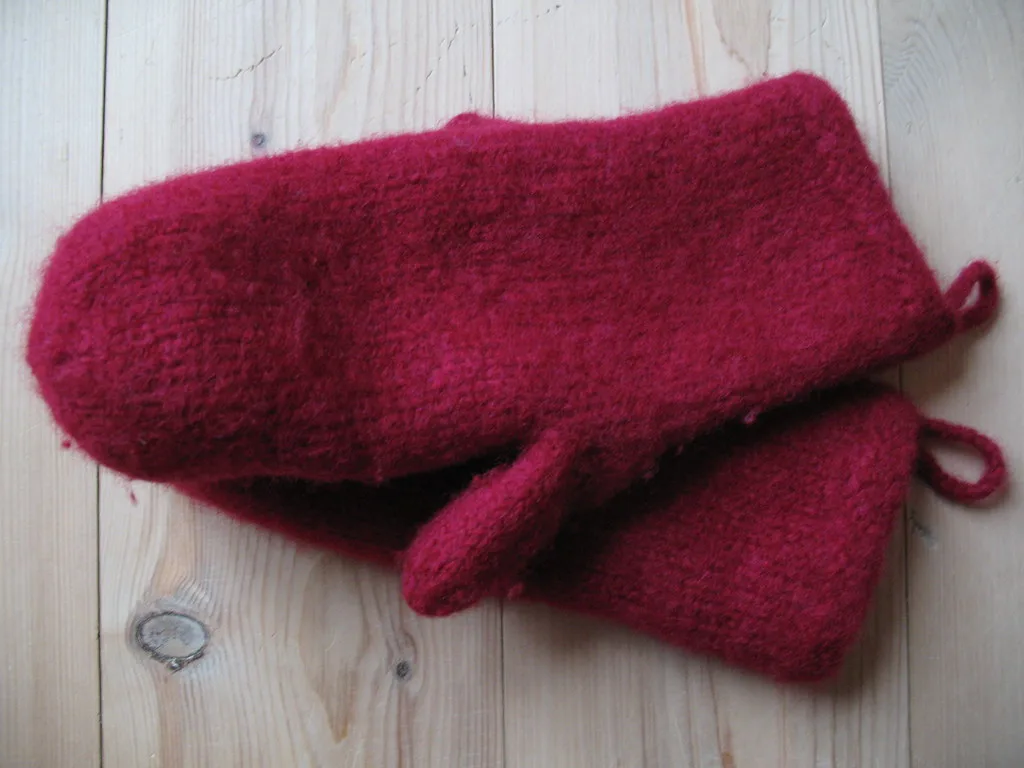
A wet felted mitten starts out about half as long again as the hand that will wear it. The resist for a women's mitten 10 in (25.5 cm) long is 15⅜ in (39 cm) long, and the wool wrapped around it looks like a mitten for a giant until the last twenty minutes of fulling, when it shrinks onto your hand and takes the shape of your knuckles.
A seamless felted mitten has no seam to wear through at the fingertips, and because the last stage of shrinking happens on the hand, it fits the way a bought mitten never does. The wet felted pair comes first and in full, followed by knitted mittens shrunk in the wash and a small sewn mitten ornament. If you have an old wool sweater instead of loose wool, the cut-and-sew method is on sweater mittens.
How do you size the resist for felted mittens?
Measure the finished mitten you want, then divide each measurement by one minus the shrinkage rate. For merino fulled firmly, as mittens must be, plan on 35%, so every measurement is divided by 0.65. This is the same rule used on resist felting and wool shrinkage when felting, and it matters more on a mitten than on a bag, because a bag that comes out an inch short is still a bag.
For the finished size, measure the hand:
- Length: from the wrist crease to the tip of the middle finger, plus the cuff you want (2–2½ in, 5–6 cm, for an adult) and about ½ in (1.3 cm) of ease at the fingertips.
- Width: half the circumference around the knuckles, plus about ½ in of ease. Laid flat, this is the width of the finished mitten.
| Size | Finished mitten (length × width) | Hand resist at 35% | Thumb resist at 35% | Merino per pair |
|---|---|---|---|---|
| Child, about 6–8 years | 7½ × 3½ in (19 × 9 cm) | 11½ × 5⅜ in (29 × 14 cm) | 2¾ × 1½ in (7 × 4 cm) | 1¾ oz (45–55 g) |
| Women's medium | 10 × 4¼ in (25.5 × 11 cm) | 15⅜ × 6½ in (39 × 17 cm) | 3⅞ × 2 in (10 × 5 cm) | 3 oz (80–90 g) |
| Men's large | 11 × 4¾ in (28 × 12 cm) | 17 × 7¼ in (43 × 18.5 cm) | 4¼ × 2⅛ in (11 × 5.5 cm) | 3¾ oz (100–110 g) |
Worked through for the women's size: 10 ÷ 0.65 = 15⅜ in, and 4¼ ÷ 0.65 = 6½ in. Adding 35% instead gives 13½ in, nearly 2 in short, and a mitten that stops at the second knuckle. The thumb measurements are the finished thumb (about 2½ × 1¼ in, 6.5 × 3.2 cm, for the women's size) divided the same way.
Thirty-five percent is a planning figure, not a promise. Coarser wool shrinks less and a lightly fulled piece shrinks less again; see the table on wool shrinkage when felting. If you have never felted this wool before, felt an 8 in (20 cm) square with the same number of layers first, measure it, and use your own number in the formula. Err large: a mitten that is too big can be fulled further on the hand, and one that is too small cannot be saved.
Drawing and cutting the resist
Draw the outline on paper first: a rectangle of the resist size, the top rounded into a dome, and the wrist edge left straight. Cut it from thin foam floor underlay, about ⅛ in (3 mm) thick, or from heavy plastic sheet. The thin material matters: a thick resist leaves a wide, flat edge where the two sides meet. Other resist materials are compared on resist felting.
One resist makes both mittens if you use it twice, flipping it for the second one. The two will match better if you lay them both out before you start rubbing either, so they get the same water, the same soap and the same number of rolls.
How much wool do you need for a pair of felted mittens?
About 3 oz (80–90 g) of merino wool top for a women's pair, as in the table. That works out to roughly 1 oz (28 g) for every 130 square inches (840 cm²) of resist, counting both faces, and gives a finished felt about ⅛ in (3 mm) thick: warm, flexible enough to grip with, and dense enough to stop the wind.
Merino in the 19–21 micron range felts fast and is soft against the wrist. If merino makes you itch, is merino wool itchy explains why some people react and what to try instead. A Corriedale or another medium wool wears harder at the fingertips but shrinks less, so measure a sample and adjust the resist. Avoid anything labeled superwash, which will not felt at all; best wool for felting covers the choice in more detail.
Weigh it out before you start. For one women's mitten (42 g of the pair's 84), make six equal piles of 6 g, one for each layer on each side, and set aside the last 6 g for the thumb and an extra layer over the fingertips. Weighing is what makes the two mittens come out the same thickness; laying by eye, the second one is almost always thinner.
How do you lay out the wool?
Three thin, even layers on each side, each at right angles to the one below. Lay the first layer along the length of the resist, the second across it and the third along the length again. Let each layer on the first face overhang the edges by about 1½ in (4 cm).
- Lay the first face. Three layers on the resist, overhanging the sides and dome but not the wrist edge, which stays bare so it becomes the opening.
- Add the fingertip layer. Put a thin extra wisp over the top 2 in (5 cm) of the dome. The fingertips and the tip of the thumb take most of the wear.
- Wet it out. Cover with netting, sprinkle with warm soapy water, and press flat until all the wool is wet. Rub lightly through the net for a minute or two so the fibers stay put.
- Turn it over. Fold the overhanging wool tightly over the edges of the resist, smoothing it flat so there is no ridge.
- Lay the second face the same way: three layers, each overhanging, then wet them and fold the overhang back over to the first face.
A gentle soap such as olive oil soap is kinder to your hands than dish soap through an hour of rubbing; best soap for felting compares the options. The full wetting and rubbing method, if this is your first resist piece, is on wet felting for beginners.
How do you make the thumb on felted mittens?
There are two ways, and they give different mittens.
A built-on thumb
Draw the thumb onto the resist as part of the outline, sticking out from the side at about 45 degrees, with its base starting about 2½ in (6 cm) above the wrist edge for an adult. The thumb is wrapped with the rest of the hand in one piece. Lay short wisps around it rather than long strips, because long fibers bridge the crotch between thumb and hand and leave a thin web there.
This is the easier method, and it is the one to use for your first pair. The thumb sits at the edge of the mitten, in line with the hand, which is less anatomical but perfectly comfortable once fulled on the hand. Because the thumb lies flat in line with the hand, each mitten fits either hand just by turning it over, so one resist makes both.
A separate thumb
Felt the thumb first, over its own small resist, and leave the bottom 1 in (2.5 cm) of wool dry and fluffy. Then, while laying out the palm side of the hand:
- Lay two of the three palm layers.
- Place the thumb where your own thumb sits on the palm, fan its fluffy base out over the palm wool, and slip a small scrap of resist under the thumb so it doesn't felt flat onto the palm.
- Cover the fanned base with the third palm layer, which locks it in.
- Once the hand is felted and the main resist is out, cut a small slit through the palm inside the thumb's base and work it open with your fingers.
This is one common method among several; some felters cut the thumb hole first and join a felted tube to it instead. The separate thumb sits on the palm like a real hand, and the mittens become a true left and right, so place the thumb on opposite sides for the two. It takes about an hour longer per pair.
How do you full mittens to fit on the hand?
Rub and roll first, with the resist in, until the felt passes the pinch test: pinch the surface and lift, and the fibers lift as one skin instead of pulling away in tufts. Roll it in a bamboo mat or one of the stand-ins on felting mat alternatives, turning it a quarter turn and flipping it every 50 to 100 rolls so it shrinks evenly. Mittens shrink most along the direction you roll, so if one is getting too short, roll it across the width for a while instead.
When it passes, cut the wrist open along the bare edge and pull out the resist. From here the mitten is fulled on the hand:
- Work it inside out first. Rub the inside seam line where the two faces met, so it doesn't stay as a ridge.
- Put it on. With the mitten hot and soapy, put your hand in and rub the outside with your other hand, squeezing around the knuckles and up into the thumb.
- Throw it. Take it off and throw it onto the table or into the sink 20 or 30 times, then put it back on. Throwing shrinks it faster than rubbing does.
- Check often. Stop when it is snug across the knuckles and there is about ½ in (1.3 cm) of room beyond the fingertips. The thumb should reach the end of your thumb without pressing on it.
- Shape the cuff. Leave it straight, fold it back, or stretch it into a gauntlet while it is wet. Rub the cut edge between soapy fingers until it is smooth and rounded.
Full both mittens together, a few minutes each in turn, and compare them often. If one gets ahead, set it aside. Rinse in warm then cool water with a splash of white vinegar in the last rinse to clear the soap.
How do you dry felted mittens?
Shape them while they are wet and let them dry on a form. Roll the water out in a towel, put each mitten on once more to set the shape, then stuff it with a hand-shaped wad of plastic bags or a folded towel, pushing a rolled washcloth into the thumb. Dry them flat or upright, away from a radiator or heater, for one to two days. A hot dryer will shrink them again.
To wash them later, use cool water, wool detergent and no rubbing, and dry them the same way. Felted wool is warm when damp but not waterproof, and fingertips wear through in time; a patch needled or stitched over the worn spot lasts well. Care is covered on can you wash felt.
Can you knit mittens and then felt them?
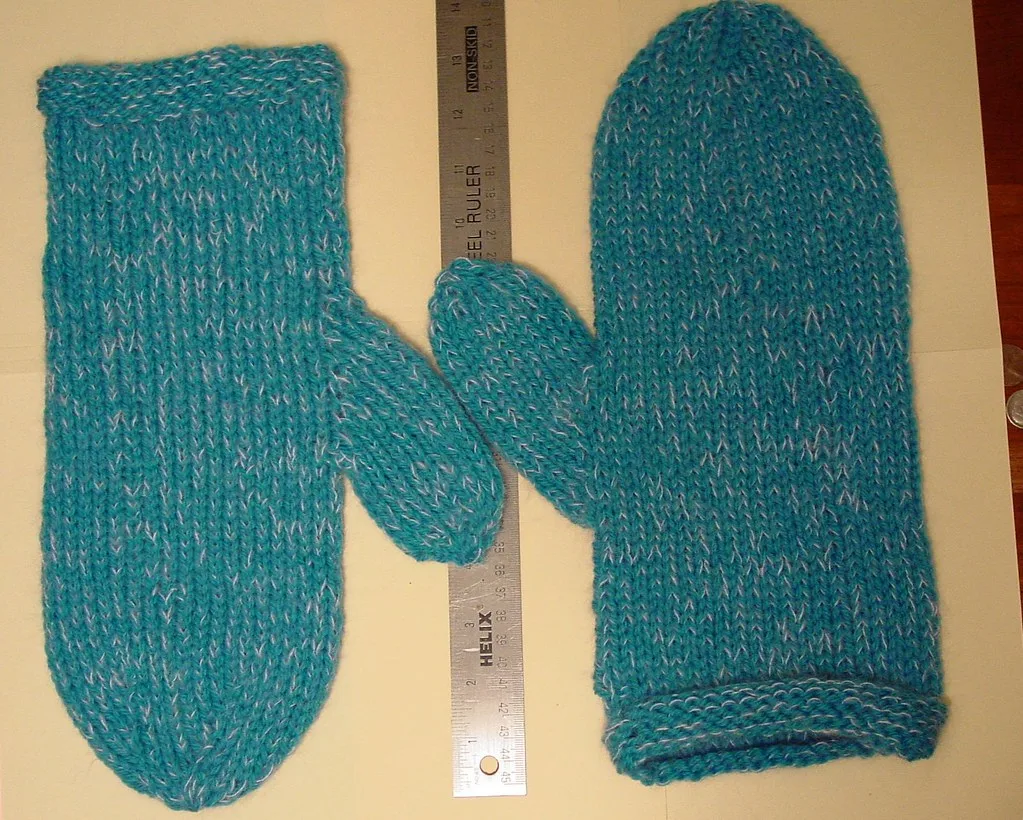
Yes, and it is the commoner route for knitters. Knit a large, loose mitten in a feltable, non-superwash worsted or chunky wool on needles two or three sizes larger than the yarn label suggests, then shrink it in a hot wash or by hand. The method, the swatch and the machine settings are on felting in knitting, and slippers made the same way are on knitted felted slippers.
The sizing rule is the same division, but knitting shrinks more in length than in width, often 30–40% along the length and 15–25% across. For the women's mitten above, that means knitting it about 15⅜ in (39 cm) long at 35%, but only about 5⅜ in (13.5 cm) wide at 20%. Swatch first, felt the swatch exactly as you will felt the mittens, and use your own percentages. Knitted mittens are fulled to fit on the hand at the end exactly as above.
How do you make a felt mitten ornament?
A pair of small mittens tied to each end of a cord hangs over a branch the way children's mittens hang on a string through a coat. It takes about 40 minutes and uses scraps.
- Template: a mitten 3 in (7.5 cm) tall and 2¼ in (5.7 cm) wide, thumb included. Draw around the outline of a real mitten shrunk on a copier, or draw it freehand.
- Felt: use wool blend felt in red, green or gray. Cut four pieces, two facing each way, so you get a left and a right. One 9 × 12 in sheet cuts twelve pieces, enough for three pairs.
- Cuff: a strip of white felt about 1¾ × ¾ in (4.5 × 2 cm), trimmed to the wrist width and stitched across the wrist of the front piece, or a band of white wool needled onto it.
- Decoration: a snowflake, a heart or an initial in backstitch on the front piece before joining; felt applique has more ideas.
Blanket stitch the front and back together around the edge with two strands of embroidery floss, leaving the wrist open. Stuff lightly with a pinch of fiberfill if you want them puffy. Knot each end of a 10 in (25 cm) red cord or baby yarn and stitch the knot inside a cuff, then hang the pair over a branch.

A wet felted version is a good way to practice before a full-size pair. A mitten 2½ in (6.5 cm) tall needs a resist about 3⅞ in (10 cm) tall and about ⅛ oz (3–4 g) of wool, laid in two layers per side. For other shapes made the same way, see felted Christmas ornaments; for flat shapes needled inside a kitchen cutter, see cookie cutter needle felting.
Buttons, beads and small pom-poms on ornaments are choking hazards for children under 3, so for a tree within a toddler's reach, embroider every detail and hang the pair high.
Matching hats, slippers and ornaments
A hat felted over a resist in the same wool makes a matching set; the method is on wet felting a hat. Wet felted slippers use the same resist technique with reinforced soles, described on felted slippers. The mitten ornament sits well with the other shapes on a felt Christmas tree and with the felt star ornaments and felt snowflake ornaments on a real one.
Frequently asked questions
How big should the resist be for felted mittens?
Divide each finished measurement by one minus the shrinkage. Merino fulled firmly shrinks about 35%, so a women's mitten 10 in (25.5 cm) long and 4¼ in (11 cm) wide needs a resist about 15⅜ × 6½ in (39 × 17 cm). Adding 35% instead of dividing leaves it nearly 2 in short.
How much wool do you need for a pair of felted mittens?
About 3 oz (80–90 g) of merino top for an adult women's pair, 3¾ oz (100–110 g) for a large men's pair and 1¾ oz (45–55 g) for a child of 6 to 8. That is three layers on each side plus a little extra for the thumbs and fingertips.
How do you make the thumb on wet felted mittens?
Either draw the thumb onto the resist so it is wrapped with the hand, which is simplest, or felt a thumb over its own small resist first, leaving the base loose, and lay that fluffy base into the palm layers. The separate thumb sits on the palm like a real hand; the built-on thumb sits at the edge.
How do you make felted mittens fit?
Make the resist from the shrinkage formula, take the resist out once the felt passes the pinch test, then put the mitten on and full it on your hand with hot soapy water, rubbing and squeezing until it is snug across the knuckles with about ½ in (1.3 cm) to spare at the fingertips.
How do you make a felt mitten ornament?
Cut four mitten shapes about 3 in (7.5 cm) tall from wool blend felt, add a white felt cuff, blanket stitch each pair of pieces together, and tie the two mittens to the ends of a 10 in (25 cm) cord so the pair hangs over a branch. One 9 × 12 in sheet cuts three pairs.
Topics
Image credits
- A pair of dark red felted wool mittens with small hanging loops at the cuffs, lying on pale wooden floorboards — Risager (BY SA)
- Two oversized teal knitted mittens laid flat beside a steel ruler, before felting — cakersandco (BY)
- A tiny pair of red and green knitted mittens with white zigzags hanging on a Christmas tree branch — HPUPhotogStudent (BY)