Needle Felted Nutcracker: A Standing Soldier Built From Cylinders, and a Sewn Felt Ornament
12 min read Intermediate
We may earn a commission from links on this page, at no extra cost to you. As an Amazon Associate I earn from qualifying purchases. Learn more.
How to needle felt a 5½ in nutcracker soldier: the cylinders it is built from, a wire or skewer core so it stands, wool weights per part, color blocking, beard, jaw and epaulettes, plus a flat sewn felt nutcracker ornament with measurements.
A traditional German nutcracker is turned on a lathe, so almost every part of it is a cylinder: two legs, a body, a head, and a tall hat sitting on top. A felted one follows the same plan: five or six firm cylinders of core wool, stacked on a core so they cannot nod, with the character added in color blocks, a beard and a square jaw. The standing figure below is about 5½ in (14 cm) tall, and after it come measurements for a flat felt nutcracker ornament you sew instead.
Where does the nutcracker figure come from?
The painted soldier or king with a lever jaw is a folk art from the Erzgebirge, the Ore Mountains on the border between Saxony and Bohemia. Seiffen is the village most associated with it. Most accounts credit Wilhelm Füchtner of Seiffen with turning the first of the lathe-made, painted nutcrackers around 1870, though sources give the date as anywhere from 1870 to 1872. Some say he based the design on a king in Heinrich Hoffmann's 1851 picture book König Nussknacker und der arme Reinhold. Carved nutcracker figures existed before then, so the claim is about this particular style, not the first nutcracker of any kind.
The ballet comes from another Hoffmann. Tchaikovsky's The Nutcracker premiered in St. Petersburg in December 1892. It was based on Alexandre Dumas's lighter retelling of E.T.A. Hoffmann's 1816 story. The ballet was not an immediate success, and its place as an American Christmas fixture is usually traced to George Balanchine's New York production of 1954. It is also often said that American soldiers stationed in Germany after the Second World War brought wooden nutcrackers home. That is widely repeated, but hard to pin to a source.
How much wool does a needle felted nutcracker take?
Wool goes with volume, so it helps to work it out per part. The table assumes firm felting at about 0.3 g per cubic centimeter, which is in the middle of the range for a hard needle felted piece. Firm enough to stand on a shelf, but you can still dent it with a fingernail.
| Part | Finished size | Wool, firm |
|---|---|---|
| Base disc | 1¾ in (4.5 cm) across, 5/16 in (8 mm) thick | about 4 g |
| Legs, two | each ⅝ in (1.6 cm) across, 1½ in (3.8 cm) long | about 5 g for the pair |
| Torso | 1⅛ in (3 cm) across, 1⅝ in (4.2 cm) long | about 9 g |
| Arms, two | each a scant ½ in (1.1 cm) across, 1½ in (3.8 cm) long | about 2 g for the pair |
| Head | a scant 1 in (2.4 cm) across, 1 in (2.5 cm) tall | about 3½ g |
| Hat | a scant 1 in (2.4 cm) across, 1¼ in (3.2 cm) tall | about 4 g |
| Beard, hair, epaulettes, trims | — | about 2 g |
| Total | 5½ in (14 cm) standing | about 30 g (1 oz) |
The parts add up to about 5¾ in (14.5 cm), and the joins swallow the extra centimeter or so. Build every cylinder from core wool and keep the colored merino for a thin top layer. That way about 20 g of the total is core wool and only around 10 g is color, most of it red and black. A figure made at two-thirds the size, about 3¾ in (9.5 cm), takes about a third of the wool (roughly 9 g), because each dimension shrinks by a third and the volume goes with the cube.
What goes inside: wire or a skewer?
A nutcracker is tall and narrow, with a heavy hat on top, so felt alone sags forward within a season. Pick one of two cores before you make any cylinders, because the cylinders get built around it.
Wire, for separate legs
Cut about 14 in (35 cm) of 1.5 mm armature wire, roughly 16 gauge, and bend it into a long hairpin. The closed end runs up through the torso and neck into the head. The two free ends spread at the hips and become the legs, with about ⅝ in (1.5 cm) left over at the bottom of each to bend flat and bury in the base. Twist the two strands together once at the waist so the legs keep their spacing. Soft aluminum armature wire is the easiest to bend at this size. Wrap the whole frame tightly in a thin layer of core wool before anything else, or the needles hit bare wire and snap.
A skewer, for legs felted as one block
Many wooden nutcrackers stand with their legs nearly touching. If yours does, felt the legs as a single oval block about 1⅛ in (2.9 cm) wide and ⅝ in (1.6 cm) deep, no wider than the torso and about the same wool as two separate legs, and press a groove up the front and back with the side of the needle to split them visually. Push a bamboo skewer, trimmed to about 4½ in (11.5 cm), up from the base through the legs, torso and head, with its top ending inside the hat. It is quicker than wire and just as stiff. The catch is that the legs cannot be posed.
How do you build the body?
- Base. Felt a firm disc of core wool flat on the mat with a 36 gauge needle, turning it often so it stays round. Leave the top slightly fluffy so the legs can bond to it.
- Legs. Wrap core wool tightly around each leg wire (or around the skewer), rolling it on the mat like a cigarette, and needle it firm. Keep turning it so it stays a cylinder and does not flatten into an oval.
- Torso. Wrap core wool around the wire above the hips, building it out to the full width. Needle the top flat where the shoulders will be. A flat top is what makes a nutcracker look square and military rather than round like a snowman.
- Head and hat. Build the head as a short cylinder on the top of the core, then the hat as a taller cylinder on top of that, joined with diagonal stabs right around the seam. Needle the crown of the hat flat against the mat so the edge stays crisp.
- Arms. Felt them separately as thin cylinders, each with loose fibers at the shoulder end, and attach them hanging straight down against the sides. A nutcracker's arms are stiff, so do not bend them at the elbow.
- Base join. Bend the leg wires flat into the base (or push the skewer into it) and felt over the join from every side. Stand the figure on the table and needle the underside of the base until it does not rock.
Use a 36 or 38 gauge needle for the cores and save the finer needles for the color. Felting needles explained covers which gauge does what.
How do you color block the uniform?
The wooden figures are painted in flat, hard-edged blocks, and the felt version looks right only if the edges are just as crisp. Lay each color as a thin layer and needle its boundary with a 40 gauge needle held almost flat to the surface, so the fibers lock along a line instead of drifting into the next color. Work from the biggest area to the smallest.
- Coat. Red over the whole torso and both arms, in two thin layers so no core wool shows through. Wrap it down over the top ⅜ in (1 cm) of the legs to make a coat skirt.
- Front panel and cuffs. A stripe of white or gold about ¼ in (6 mm) wide down the front of the coat, plus a white ring at each wrist.
- Trousers and boots. White on the upper legs, then black from about halfway down to the base. A tight black ring at the boot top looks better than a soft blend.
- Belt. A black band ⅛ to 3/16 in (3–5 mm) wide around the waist, with a tiny square of gold at the front for the buckle.
- Hat. Black all over, with a gold band about ⅛ in (3 mm) wide just above the brim line. Add a few red or green wisps on the front for a plume. For a king, make the hat gold instead and needle a row of small points around its top edge.
- Hands. White mittens, or peach to match the face. Many wooden nutcrackers hold a sword, scepter or rifle. A painted toothpick, glued in, works fine if no small child will handle the figure.
Green, blue and purple coats are all traditional too, and a shelf of three or four in different coats looks more planned than a single figure. Whatever the coat color, keep the black, white and gold the same.
How do you make the face, jaw, beard and hair?
The face is what makes it a nutcracker rather than a toy soldier. On the wooden ones the mouth is a lever that drops open, so the lower face is a square block, not a rounded chin.
- Skin. Cover the front half of the head in peach or pale pink. The back is going to be covered by hair.
- Jaw. Needle a small rectangle of extra peach wool on the lower front of the head so it stands out about 1/16 in (2 mm) from the cheeks. Then run a thin line of dark red or black across it, about a third of the way down, for the mouth opening. A row of tiny white dots above the line gives the wooden figure's bared teeth.
- Nose. A firm peach ball about 3/16 in (5 mm) across, attached by its loose fibers just above the mouth. Wooden nutcrackers have big noses, so err on the large side.
- Eyes and brows. Small black ovals of wool with a speck of white for the highlight, set high and close under the hat brim, with a thick black brow over each. Needle felting eyes compares wool, bead and glass eyes. Beads suit a figure only adults will handle.
- Cheeks. A wisp of pink rubbed into each cheek with the needle barely entering.
- Mustache. Two small twists of white or black wool, needled at the middle only, with the ends curled upward.
- Beard. White fiber laid in a horseshoe from ear to ear, around and under the jaw block. Do not cover the jaw: the open mouth should stay visible above the beard. Smooth carded white gives the neat, short beard of most modern nutcrackers. Curly locks give the shaggy older look.
- Hair. A fringe of the same white fiber needled in a line all around the bottom edge of the hat, longer at the back so it falls to the shoulders.
The needle felted Santa page covers laying curly locks in rows so the curl survives. The same method works for a nutcracker's beard, just shorter.
How do you add buttons and epaulettes?
Buttons. Five or six gold dots down the front panel, about 3/16 in (5 mm) apart. Tiny rolled balls of gold or yellow wool, needled in hard, are the child-safe version. For a display piece, small gold beads sewn on with a stitch that runs through the torso look more like the painted originals.
Epaulettes. Felt two flat gold ovals about ⅜ in (1 cm) long on the mat, firm at the center and loose at the edges. Attach one on top of each shoulder so it overlaps the top of the arm. For the fringe, sew a row of short loops of metallic gold thread along the outer edge, then cut the loops open and trim them to about ⅛ in (3 mm). A cross-belt of white wool from one shoulder to the opposite hip finishes the uniform.
To turn the smaller nutcracker into a hanging ornament, leave off the base and sew a cord loop through the crown of the hat. If you used a skewer core, the stitch can catch the felt just above the skewer tip. Check that the figure hangs straight before you knot it.
How do you make a flat felt nutcracker ornament?
The sewn version takes an evening, needs no needle felting, and is the one to make with children or to make a dozen of. It finishes about 4½ in (11.5 cm) tall and 1½ in (3.8 cm) wide. Use 1 mm wool-blend felt, which holds a crisp cut edge better than thin acrylic felt.
The template, in measurements
- Back and front: two rectangles 1½ × 4½ in (3.8 × 11.5 cm) in red, top corners slightly rounded. Cut a slit ¼ in (6 mm) wide and 1¼ in (3.2 cm) deep up the middle of the bottom edge to separate the legs.
- Hat: black, 1½ × 1¼ in (3.8 × 3.2 cm), laid over the top of the front.
- Face: peach, 1⅛ in wide × ¾ in tall (2.9 × 1.9 cm), directly under the hat.
- Beard: white, a U shape ⅜ in (1 cm) deep that wraps the sides and bottom of the face, with a small rectangle cut out of the middle so the mouth shows.
- Chest: the red backing shows for 1 in (2.5 cm) under the beard. Add a gold strip ¼ in (6 mm) wide down the middle.
- Belt: black, a strip ¼ × 1½ in (6 mm × 3.8 cm).
- Trousers: two white pieces ⅝ × ¾ in (1.6 × 1.9 cm), one on each leg.
- Boots: two black pieces ⅝ × ½ in (1.6 × 1.3 cm), at the bottom of each leg.
The stack adds up: 1¼ + ¾ + 1 + ¼ + ¾ + ½ = 4½ in. The beard overlaps the bottom of the face and the top of the chest.
Sewing it
- Stitch every appliqué piece to the front while it is flat, with a small running stitch or whip stitch in matching thread. Leave the hat band until last.
- Embroider the face: two black French knots for eyes, a short straight stitch in dark red across the mouth gap, and a pink stitch or a dab of blush on each cheek.
- Add the hat band, buttons and epaulettes in gold thread or yellow felt. A cluster of straight stitches fanned out at each shoulder reads as an epaulette.
- Fold a 6 in (15 cm) length of cord in half and lay its ends between the two layers at the top of the hat.
- Blanket stitch the front to the back all the way around, up into the leg slit and back down, catching the cord as you pass it. Push a little stuffing into the body before you close the last side, but keep the legs flat.
Felt appliqué covers the stitches. For a toddler's ornament, use embroidered eyes and buttons only, with nothing glued on. Remember that the wire and small parts of the needle felted figure make it unsuitable for anyone under 3.
What to pair it with
Nutcrackers suit a tall, formal arrangement: a pair standing either side of a felted wreath on a mantel, or a row at different heights next to a felted Santa. On the tree, flat felt nutcrackers sit well with felt star ornaments in the same gold thread, and with the red felted cardinal. For the rest of the set, see felted Christmas ornaments.
Frequently asked questions
How much wool do you need for a needle felted nutcracker?
About 30 g (1 oz) for a firm 5½ in (14 cm) standing nutcracker with a felted base, of which roughly two-thirds can be core wool. The torso is the biggest single part at about 9 g. An ornament at two-thirds that height takes about a third of the wool, around 9 g.
How do you make a needle felted nutcracker stand up?
Give it a core. Either bend about 1.5 mm armature wire into a hairpin whose two ends run down the legs into a felted base, or felt the legs as one block and push a bamboo skewer from the base up through the legs, torso and head. Then needle the underside of the base flat.
What colors is a traditional nutcracker?
The classic soldier has a red coat, white trousers, black boots, a black belt, a tall black hat with a gold band, gold buttons and epaulettes, a peach face with rosy cheeks and a white beard and hair. Kings swap the hat for a gold crown, and many makers use green, blue or purple coats.
How big should a felt nutcracker ornament be?
About 4½ in (11.5 cm) tall and 1½ in (3.8 cm) wide is a good size for a sewn felt nutcracker ornament. It is big enough to stitch a face on and small enough to hang on an ordinary branch without bending it.
Is a needle felted nutcracker safe for children?
Not for children under 3. It has a wire or skewer core and small parts such as beads, buttons and epaulettes. The sewn felt ornament with everything stitched down and no beads is the better choice for young children, and felting needles are sharp, so children who felt need supervision.
Topics
Image credits
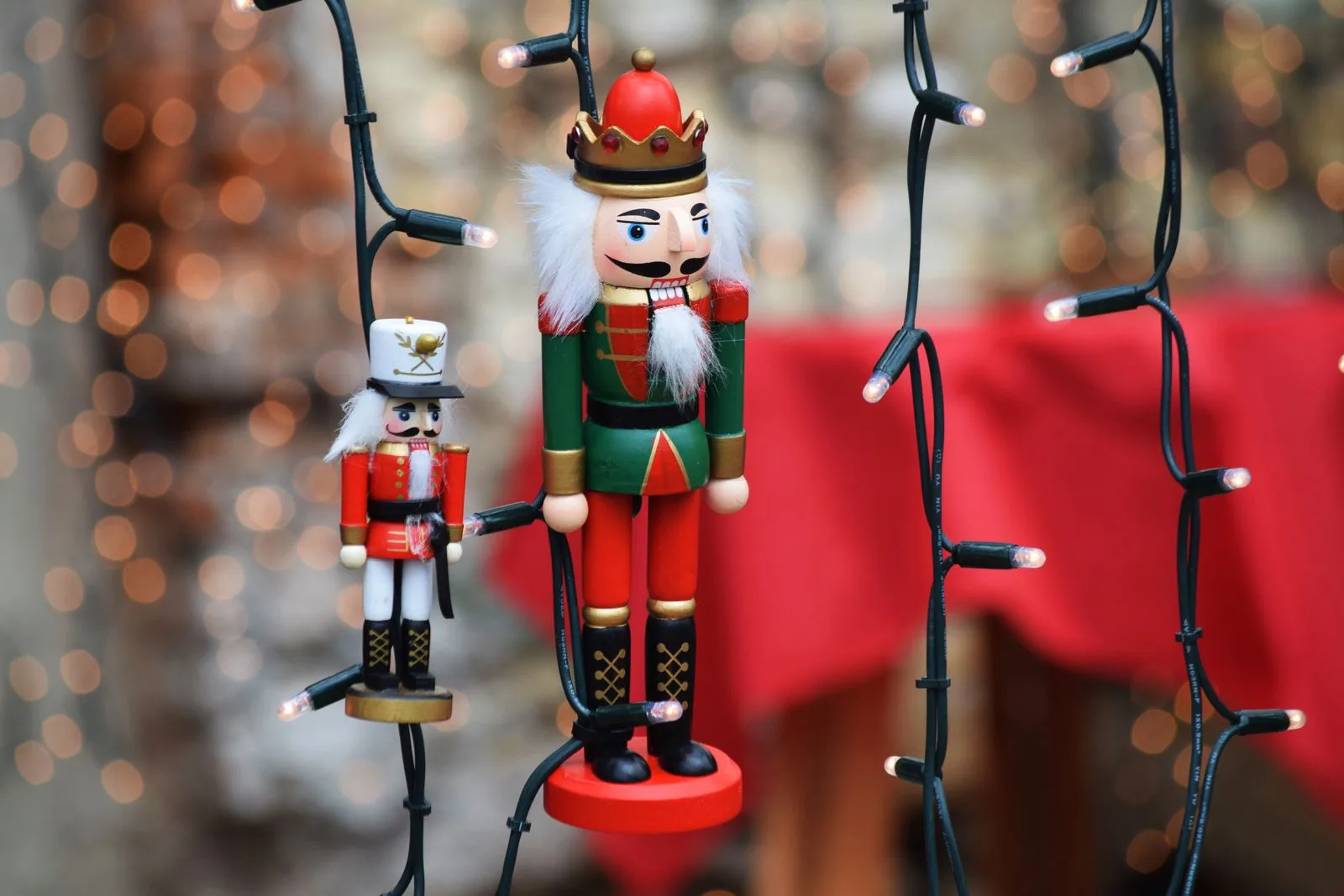
- Two painted wooden nutcracker ornaments, one in a red coat and one in a green coat with a red crown and white beard, hanging among strings of Christmas lights — Nikolina (Pexels License)
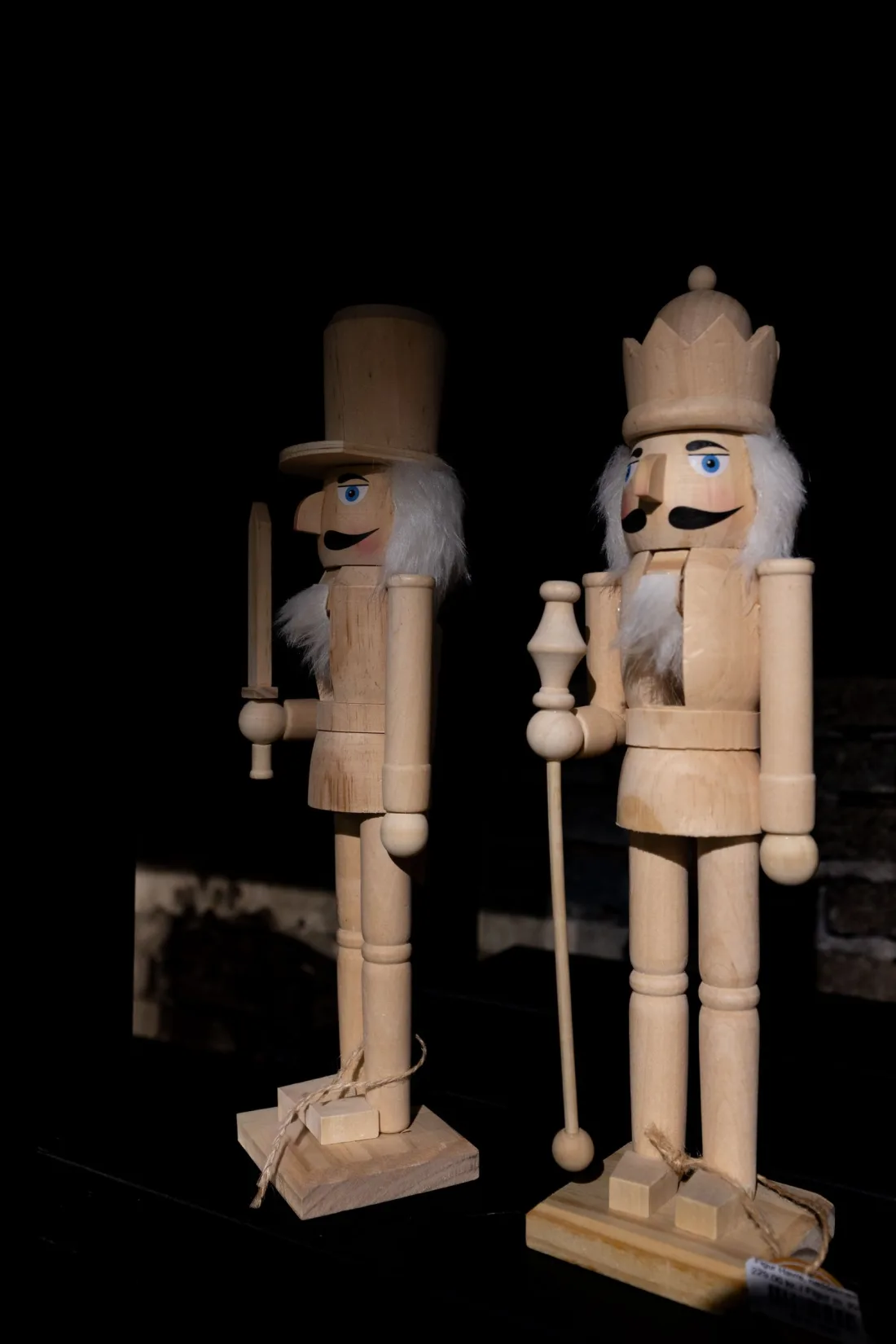
- Two unpainted wooden nutcrackers with white fiber beards, one in a tall hat holding a sword and one in a crown holding a scepter, against a black background — Joerg Mangelsen (Pexels License)
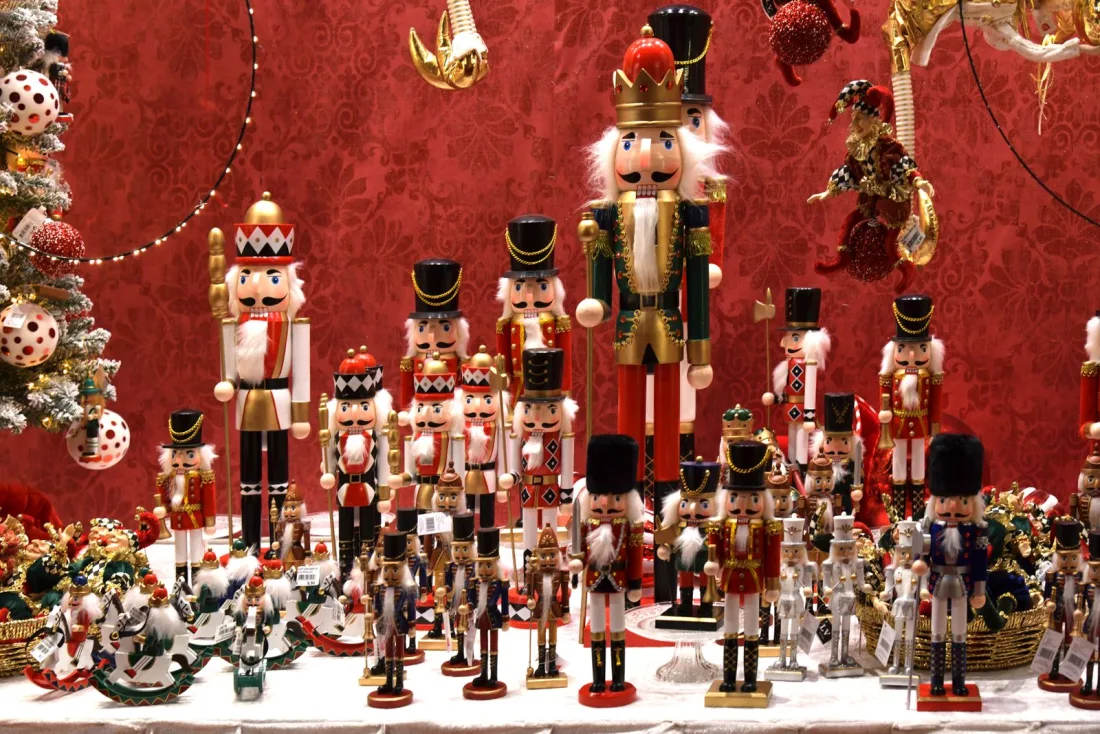
- A shop display of dozens of painted wooden nutcrackers in red, green, white and black uniforms against a red patterned wall — Serena Koi (Pexels License)