Knitted Felted Slippers: Knit Them Far Too Big, Then Shrink Them to Fit
10 min read Intermediate
We may earn a commission from links on this page, at no extra cost to you. As an Amazon Associate I earn from qualifying purchases. Learn more.
A slipper for a 25 cm foot leaves the needles 37 cm long. Choosing yarn that will actually felt, swatching for your own shrinkage figure, and judging a free pattern before you cast on.
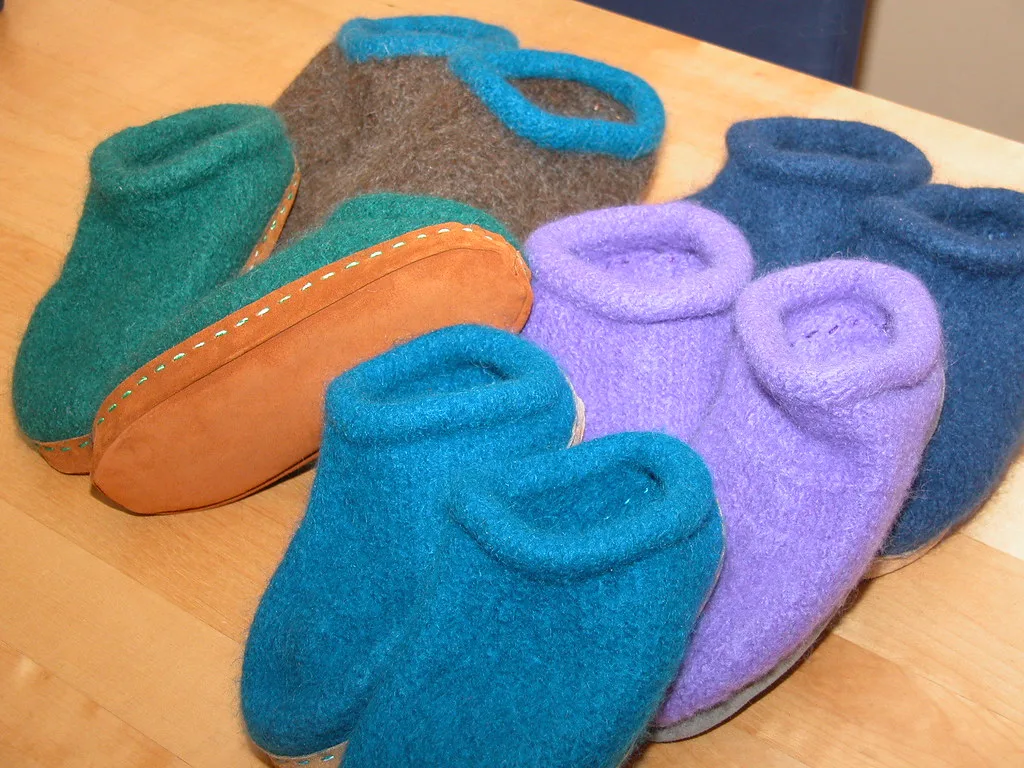
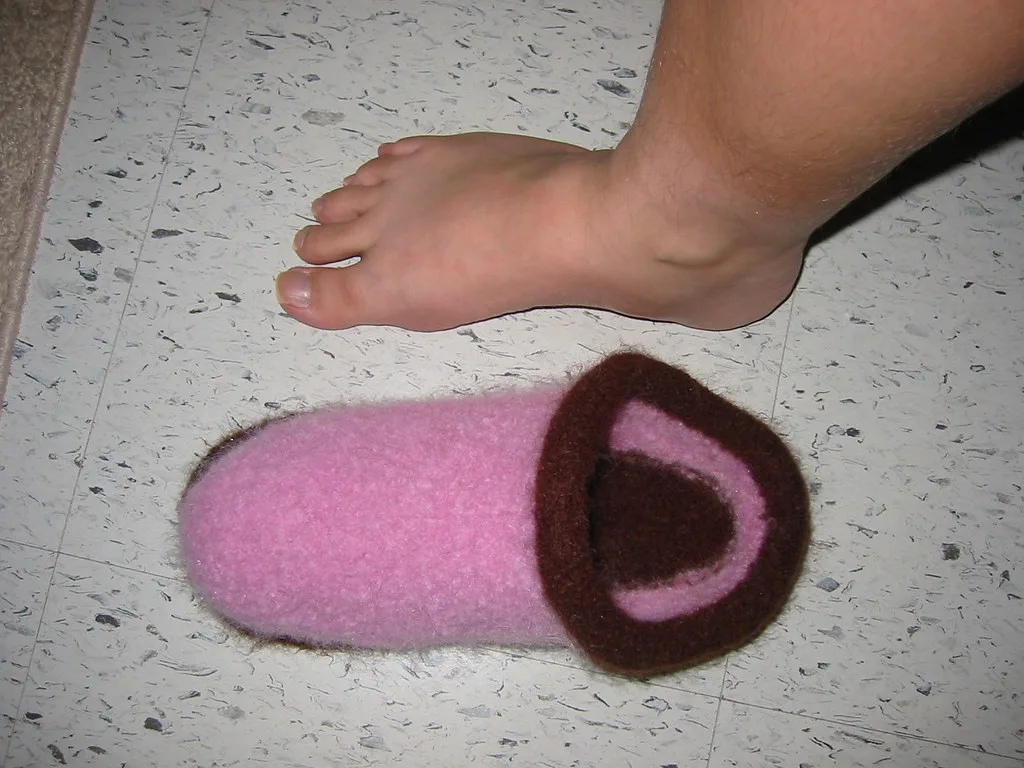
A slipper for a 25 cm foot comes off the needles about 37 cm long, with a cuff wide enough to pull over a calf. Held against the foot it is meant for, it looks like a mistake. That gap between the knitted object and the finished one is the entire technique, and the washing machine closes it.
Size is not decided when you knit but when you wash, and you can always wash again. The comparison with the other three routes is on the main felted slippers page.
Yarn: the one decision you cannot correct
Untreated wool. In a superwash yarn the scales have been stripped or coated away, which is precisely the property you are trying to exploit here — it will not felt, and extra cycles will not change that. This one point accounts for most of the pairs that come out of the machine the size they went in.
- Weight. Aran or chunky, held double. Doubling gives the thickness a slipper needs without a gauge so tight the fibres cannot move.
- Breed. Coarse breeds felt hardest and wear best — Icelandic and Lopi-style yarns, Shetland, Romney, generic "pure new wool" aran. Merino felts, but goes thin at the ball of the foot sooner.
- Blends. Above roughly 20% nylon, acrylic or plant fibre, felting is reluctant and uneven; the non-wool part does not shrink at all.
Testing an unlabelled yarn
Cut a 30 cm length, wet it with hot water and soap, and rub it hard between your palms for two minutes. Wool that will felt thickens and the plies disappear into one another until you cannot count them. Superwash and synthetic blends stay recognisable as a piece of string.
Needles two to three sizes up
Whatever the ball band says, hold aran double and work it on 8 to 9 mm — roughly two or three sizes up from what a single strand would want. The fabric should look wrong: loose, gappy, floppy, the sort of thing you would rip back on any other project.
Fibres have to migrate past each other and lock, and they need room to travel. A tight fabric felts slowly and unevenly and ends up stiff as board with the stitches still showing. If the knitting looks like a sensible slipper before it goes in the machine, it is already too dense. More in felting in knitting.
Which stitch patterns survive
Stocking stitch is very nearly the only answer. It shrinks predictably, and the stitch definition dissolves into an even fabric that looks like sheet felt rather than knitting.
- Ribbing pulls in first, then felts at a different rate from the flat fabric beside it, so cuffs come out puckered and tight.
- Cables blur into lumpy ridges — the crossings hold more air and felt less.
- Lace closes completely. Every hole fills.
The one useful exception is garter stitch for a sole panel. Garter felts thicker and denser than stocking stitch at the same gauge, so a panel under the foot gives a tougher sole that takes longer to go thin. It does not give a grippier one — felt is felt, and the ridges are gone by the time the wash has finished with them.
That looks like special pleading after the ruling on ribbing, so here is the difference. Garter does shrink unevenly along the row direction, exactly as ribbing does. But the sole is the one part of a slipper that is flat, fully supported and pressed under a standing foot for the rest of its life, so the mismatch is squashed flat and never shows. A cuff has nothing holding it out, which is why the same behaviour there reads as a puckered, tight edge. Work a whole slipper in garter and it distorts.
The swatch is not optional
Published shrinkage figures describe one designer's yarn in one machine. Yours will differ, sometimes by ten percentage points — a whole size on a slipper.
- Knit 20 × 20 cm in the actual yarn, held double, on the actual needles.
- Mark exactly 15 cm horizontally and 15 cm vertically with a running stitch in smooth contrast cotton, which will not felt into the wool.
- Felt it exactly as you will felt the slippers — same temperature, same cycle, same jeans in the drum. No hand-wash shortcut.
- Measure between the marks: width and length.
Expect 30 to 40%, and more in length than in width, because the row direction gives more. Then work backwards: pre-felting length = finished length ÷ (1 − shrinkage). Why the two directions differ is in wool shrinkage when felting.
How long to knit it
Two numbers, in this order. The finished slipper is the foot plus about 1 cm of ease — press it tight to the foot and you have knitted a sock. Then divide that finished length by (1 − shrinkage) to get the length to make it at. Worked through at 30%, which is the conservative assumption and the right one to start from, since a slipper that is still too long can go back in the drum and a short one cannot come back out of it:
- Child, 18 cm foot: finished 19 cm, knit it at 27 cm
- Child, 21 cm foot: finished 22 cm, knit it at 31 cm
- Adult, 24 cm foot: finished 25 cm, knit it at 36 cm
- Adult, 26 cm foot: finished 27 cm, knit it at 39 cm
- Adult, 28 cm foot: finished 29 cm, knit it at 41 cm
Those are a starting point, not a result. Swap in the figure your swatch gave the moment you have it: if the 15 cm marks came back at 10 cm, that is 33% and every entry above moves up — a 27 cm finished slipper then wants knitting at 40 cm rather than 39. The same arithmetic run at 40% shrinkage puts that slipper at 45 cm, which is the width of the whole range and the reason nobody else's percentage will do.
Three constructions
The clog or moccasin
A flat sole knitted first, stitches picked up all round it for the upper, then the toe shaped and a low heel added. Best fit, because the sole is a real shape rather than a fold, and the most to get wrong. Fiber Trends "Felt Clogs" by Bev Galeskas is the landmark pattern for this shape — a paid pattern from its designer, not ours, but the one most other felted clog patterns descend from.
The slipper boot
Worked like an enormous sock: cuff down, heel flap, toe decreases. Warmest of the three. Keep the leg under about 20 cm — a long tube felts unevenly, because the part riding on top of the drum load takes less abrasion.
The simple two-piece
A shaped rectangle folded and seamed at toe and heel. Worst fit, no shaping to get wrong, and the right first attempt: felting hides seams almost completely.
Where the free patterns actually are
Most people searching for these want a free pattern, and there genuinely are hundreds. Three places:
- Ravelry. Search the pattern database for felted slippers or felted clogs and switch on the free-pattern filter. The largest collection anywhere.
- Designers' own sites. Many put one free pattern up as a shop window for the paid ones.
- Yarn company sites. Spinners publish free patterns to sell yarn, so the pattern names a real, feltable yarn.
Printed collections — thirty-odd slipper patterns to one book — turn up in libraries too. Our round-up is at free felting patterns for beginners.
How to judge one before casting on
- Both measurements stated, before felting and after. Given only the finished size, a pattern cannot be adapted to your yarn.
- The exact yarn named, with fibre content, so you can tell whether it is superwash.
- The designer's felting method — temperature and cycle. Uncommon, and worth a lot.
- Finished projects attached, as Ravelry patterns have. Other knitters' notes hold the honest shrinkage figures.
- Warning signs: one gauge and no pre-felting dimensions, "felt until it fits" with no target, or a sample knitted in an acrylic blend.
Whatever a pattern claims, swatch anyway.
The felting run
- Slippers into a zipped pillowcase or laundry bag. Loose fibre clogs a pump.
- A pair of jeans or two tennis balls for abrasion, and a teaspoon of detergent — no more, or the suds cushion the load.
- 60 °C, the longest agitation the machine offers, and no spin on the first run. A spin sets creases into half-felted wool.
- Check part way through if the door will open, measuring against your target length rather than judging by eye.
- Still too big? Run a second short cycle. Two short cycles beat one long one, because every extra minute is permanent.
- Take them out damp. Do not let them dry before shaping.
Front loaders that lock shut are the awkward case: run the first cycle at 40 °C, which gets it started with little risk of overshooting, then finish at 60 °C. With no machine, a sink of very hot water, soap and a plunger does the same job more slowly — the principles of any wet felting.
Shaping and drying
Pull a plastic bag over each foot, put the damp slippers on and walk about for five to ten minutes, pushing the toe up and the heel back as you go. Nothing else fits as well. Then stuff them firmly with newspaper and dry for two days away from direct heat — a radiator dries them fast and hard.
Too big, and too small
Too big is a non-problem: another short cycle, checked every ten minutes. Felting further makes the fabric thicker and stiffer as well as smaller, so a slipper taken down two sizes feels more like a clog.
Too small has no fix. Felting is irreversible, and stretching a damp slipper over a form gains a few millimetres that spring back on drying. That asymmetry is why every instruction here says to err large: of the two ways to miss, only the generous one leaves you anything to work with.
Keeping the pair matched
Knit both before felting either, and felt them together in one load for the same time. Topping up one alone afterwards is how you end up with two different slippers: a single item in a drum takes far more abrasion than one of a pair. If they do come out mismatched, run the larger one alone very briefly and expect to overshoot.
Colour felts at its own rate
Dyeing changes how fast a fibre felts, by enough to see. Two colours from one yarn line, and sometimes two dye lots of one colour, shrink at measurably different rates — on a striped slipper that shows as puckering, a twisted seam, or one band standing proud.
- Swatch in stripes. If the slipper uses three colours, knit the swatch with a band of each and mark 15 cm across all of them. A colour that shrinks out of step then announces itself on a swatch.
- Never stripe with a superwash blend. Self-striping sock yarns usually are superwash. That stripe holds its length while everything round it contracts by a third, leaving a ruffled band and a slipper pulled out of true.
One colour and one dye lot for the pair sidesteps all of it.
Finish the soles
Wool on its own has no grip on a hard floor and no armour where you push off, so the underside is always the first part of a pair to fail. Puff fabric paint or liquid latex dotted across it is the cheap answer and wants redoing every year; a stitched-on leather sole is an evening's work and makes the slippers last three to five times as long. Materials, cutting, hole spacing, stitch spacing and the repairs are all on slipper soles. Shop-bought examples of a sole done properly, and the footbeds that genuinely hold an arch, are in best felt slippers.
None of this asks for special equipment: one pot of feltable wool, needles too big for it, and a machine that will run hot. The rest of the kit list is in felting supplies, the Nordic tradition these shapes come out of is in Scandinavian wool slippers, and what felting actually does explains why the surface behaves nothing like the knitting that made it.
Which is the point of the exercise, and the thing that takes a knitter longest to accept. You are not knitting a slipper. You are knitting the raw material for one, badly and far too loosely on purpose, and the drum turns it into the slipper. Cast on the second one before you wash the first.
Frequently asked questions
How much bigger should knitted slippers be before felting?
About 45 to 70% longer: divide your target length by (1 minus your swatch's shrinkage figure). A 25 cm foot wants a finished 26 cm slipper, which at 30% shrinkage means knitting it about 37 cm long.
Where can I find a free felted slipper knitting pattern?
Ravelry has hundreds — search for felted slippers and switch on the free-pattern filter — and many designers and yarn companies publish them on their own sites. Take any pattern that states both pre-felting and post-felting measurements and names the exact yarn; ignore the rest.
Can I use ribbing or cables on felted slippers?
No. Ribbing pulls in and then felts unevenly, cables blur into lumpy ridges and lace closes up completely. Stocking stitch is the only pattern that shrinks predictably, with one exception: a garter stitch panel under the sole felts thicker and tougher.
What if the slippers come out too small?
Nothing useful. Felting cannot be undone, and stretching a damp slipper over a form buys a few millimetres that mostly come back. Always aim large — a slipper that is still too big can simply be washed again.