Valenki: Felted Wool Boots, How They Are Made and How to Wear Them
6 min read Intermediate
We may earn a commission from links on this page, at no extra cost to you. As an Amazon Associate I earn from qualifying purchases. Learn more.
What valenki are, why a seamless felted boot is so warm in dry cold, how they are made by machine and by hand, choosing a pair, galoshes and soles, and how to dry them without ruining them.
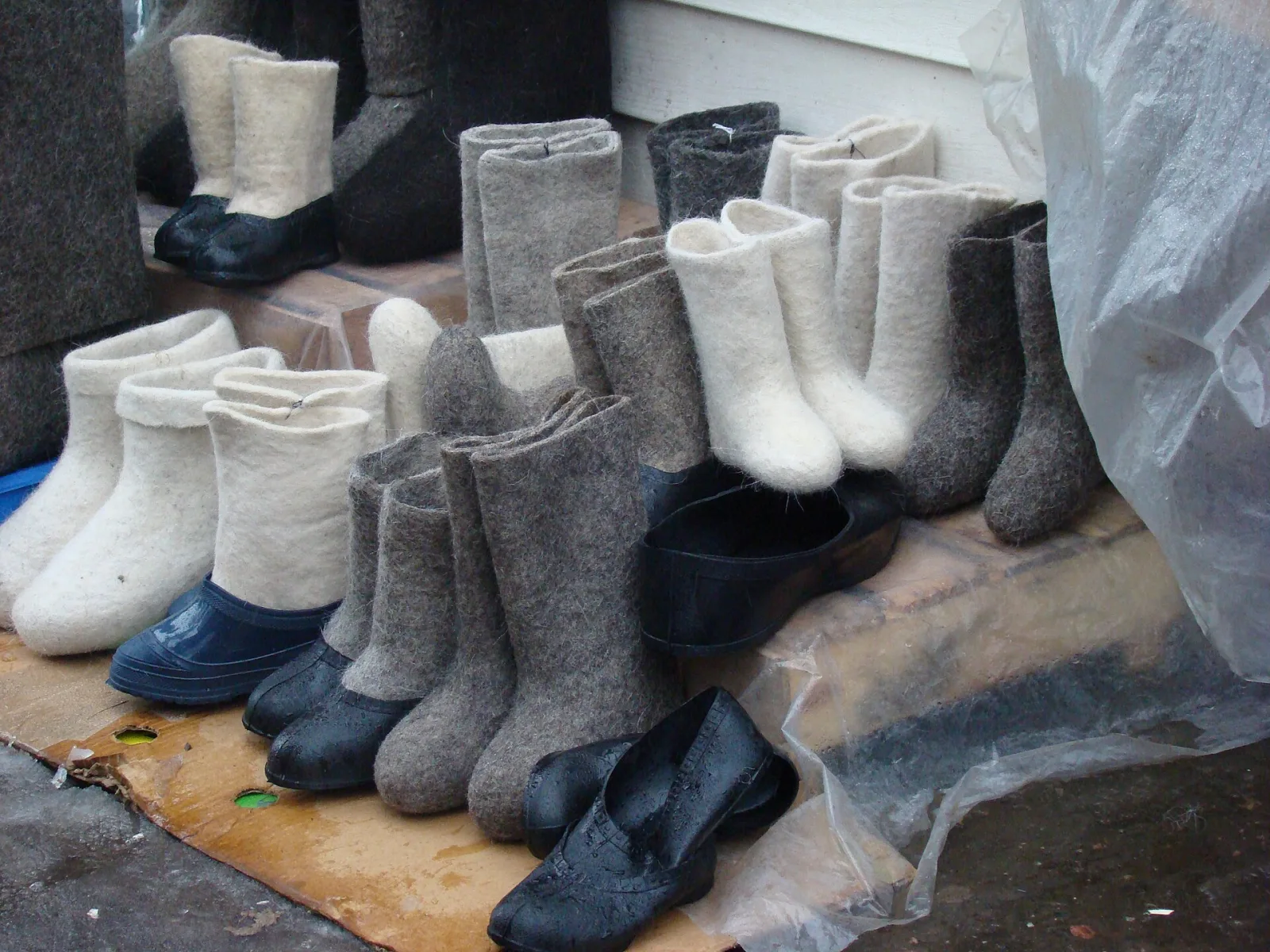
Valenki are felted wool boots made in one seamless piece, usually knee-high, thick, and so stiff when new that they stand up by themselves. They are the traditional winter boot across Russia and Ukraine, where they are called valianky. Similar felted boots are made across Central Asia and the Nordic countries. In dry cold they are among the warmest things anyone can wear on their feet. In slush they soak through in minutes. Both facts come from the same material, and understanding it is most of what you need to wear, buy or make a pair.
What makes them warm
A valenok is solid felt, several millimeters thick in the leg and thicker at the sole and heel, with no seams and no lining. Felted wool traps a great deal of still air between its fibers, and still air is what insulates. With no seams, there is nowhere for cold to come through and no stitching to wear. Wool also absorbs moisture from the foot without feeling clammy, which matters in a boot worn all day. In a dry, deep frost, where snow squeaks underfoot and never melts, nothing gets wet and the boot stays warm.
The weakness is the same material. Felt is fibers locked together, not a membrane, so water that sits against it soaks in. Snow that melts on a warm doorstep, slush on a city street, or a puddle under the snow will soak a pair through. Hence the galoshes.
How valenki are made
The name comes from the verb for felting or fulling wool, and the method has changed little in principle.
- Carding. Sheep's wool, traditionally a coarse, strong wool, is carded into thin, even batts.
- Laying around a form. The batts are laid in layers around a flat boot-shaped template that is far larger than the finished boot, often half again or more. That allows for the shrinkage to come.
- Felting. Hot water, soap and pressure lock the layers into a seamless cone that is the boot's shape.
- Fulling. The rough boot is worked with heat, water and pressure, by hand or in a fulling machine. It shrinks hard and thickens until the felt is dense and firm. This stage takes the most work.
- Shaping on a last. The fulled boot is stretched over a wooden last in the shape of a foot and leg, and dried on it, so it sets into a boot shape.
- Finishing. The surface is singed or sanded smooth and the top edge trimmed.
Factories do the felting and fulling by machine, but the sequence is the same. It is also the same sequence as a felted slipper made at home, only far thicker and on a larger scale.
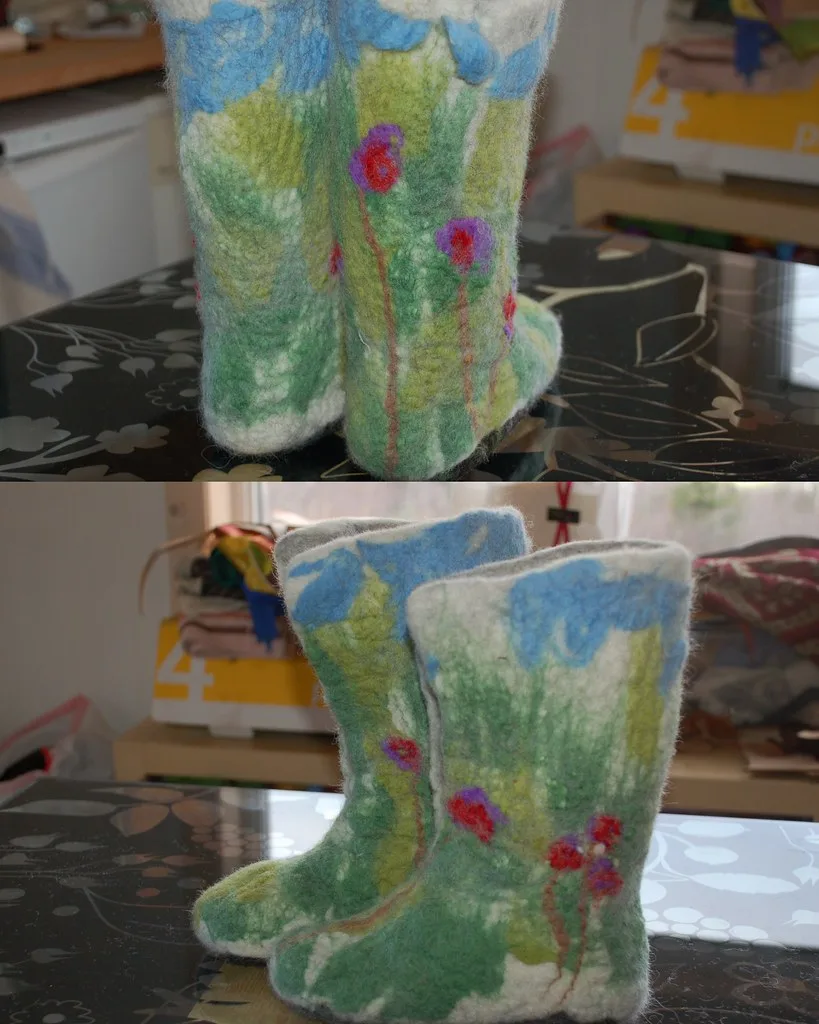
Wet felting your own pair
Handmade felted boots are made around a resist, the same technique as felted slippers and wet felted hats, and the result can be far more decorative than factory valenki. The pair in the photo above has a picture felted into its outer layer. Read resist felting first. Everything depends on sizing the resist correctly.
- Resist size. Divide every finished measurement by one minus the shrinkage. A coarse wool that shrinks 30% needs a resist about 1.4 times the finished size in every direction. Make both boots on one resist shaped as two boots joined at the top of the leg, felted as one piece and cut apart across the middle to make the two openings, or on two resists cut from the same pattern.
- Wool. Use a sturdy wool rather than fine merino: Corriedale, Gotland, Norwegian or Romney. Fine wool felts beautifully but wears through at the heel. Best wool for felting compares them, and Corriedale is a reliable choice.
- Thickness. Lay more layers at the sole and heel than at the leg, which wears less. A knee-high pair takes several hundred grams of wool, often 500 g (over a pound) or more, against roughly half that for slippers.
- Fulling. This is where handmade boots most often fail. A boot that is felted but not fully fulled is soft, stretches out of shape in a week, and wears through fast. Keep fulling until the felt is hard and you can no longer pinch up loose fibers. Then shape it on your own foot, or on a last or a boot form stuffed with towels, and dry it on that.
Wool shrinkage when felting gives the rates for different wools. For a smaller first project with the same method, make a felted stocking or the miniature boots below.
Choosing a pair
- Fiber. 100% wool. Blends with synthetic fiber felt less densely and are less warm.
- Even thickness. Press the felt at the heel, the toe and the ankle bend. It should be firm everywhere, with no thin or soft patches. The heel wears first.
- Fit. Roomy enough for a thick wool sock and a little toe space. New valenki are stiff and loosen with wear. They stretch slightly in width and almost not at all in length, so do not buy a pair that is short on the promise it will give.
- Height. Knee-high is traditional and warmest. Ankle and calf heights are easier to wear indoors and with modern clothes.
- Sole. Plain felt for indoors and dry snow. A molded rubber sole attached at the factory for city streets. Traditional pairs are bought plain and worn with separate galoshes.
Galoshes and soles
Rubber galoshes are low overshoes that cover the foot of the boot. They keep slush off the part of the boot that touches the ground, while the felt leg stays dry above it, and they can come off indoors. A sole can also be attached permanently: rubber glued and stitched on, or a thick leather or felt sole sewn over the original. Slipper soles covers the materials, and the same choices apply to a boot at a larger scale.
Drying and care
Wet valenki must dry slowly. Stuff them with newspaper, change it every few hours, and leave them at room temperature. Heat is the enemy here, as it is in all felting: a wet boot on a radiator or a stove, off its last, shrinks and stiffens as it dries and comes out smaller and board-hard. A boot dryer is fine on a cool, fan-only setting.
- Cleaning. Brush off dry dirt and snow with a stiff brush or a suede brush. Spot clean marks with cool water and a little wool wash. Never machine wash them.
- Pilling and fuzz. Normal with wear. Trim it with a fabric shaver or a razor held flat.
- Storage. Clean and completely dry, in a breathable bag, with cedar blocks or a lavender sachet. Moths love felted wool boots stored in a cupboard over summer; see protecting wool from moths.
Felt boots that are not valenki
Several things are sold as "felt boots" that work differently.
- Felt-lined boots. Rubber or leather winter boots with a removable wool felt liner inside. They are waterproof outside and warm inside, and the liner is the felted part. Replacement liners are sold separately and are worth having, so you can wear one pair while the other dries.
- Felt slipper boots. Soft, thin felted ankle boots for indoors. Best felt slippers covers them, along with the Finnish felt boot tradition.
- Decorative miniatures. Small felted valenki made as Christmas ornaments, often with woven ribbon cuffs.
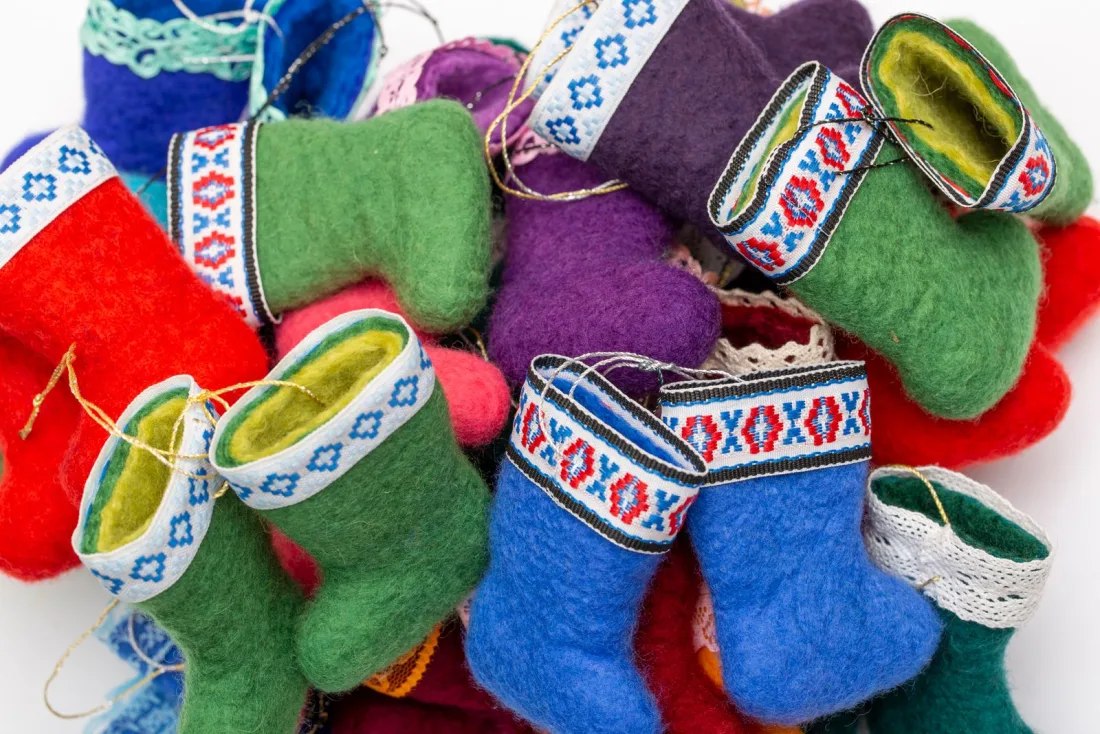
The miniatures are a good way to try the resist method in an hour, and a row of them in different colors looks good on a tree or along a mantel.
Frequently asked questions
What are valenki?
Valenki are traditional felted wool boots from Russia and Ukraine, usually knee-high, made in one seamless piece by felting wool around a boot-shaped form. The name comes from the verb for felting or fulling wool. They are worn in dry winter cold, often with rubber galoshes over the foot.
Are valenki waterproof?
No. Felted wool sheds dry snow and copes with brief damp, but standing water and slush soak straight in. That is why valenki are traditionally worn with rubber galoshes, or bought with a rubber sole already attached, anywhere the snow turns wet.
How should valenki fit?
Roomy enough for a thick wool sock, with a little space at the toe. They are stiff when new and soften and mold to the foot with wear. Avoid a tight pair on the promise that it will stretch: felt gives a little in width, almost nothing in length.
How do you dry wet valenki?
Slowly, at room temperature, stuffed with newspaper changed every few hours. Never on a radiator, a stove or a boot dryer set to hot. Fast heat shrinks and hardens wet felt, and a pair dried on a radiator can come out a size smaller and as stiff as cardboard.
Topics
Image credits
- Rows of white and gray valenki, traditional felted wool boots, some fitted with black rubber galoshes — akk_rus (BY 2.0)
- Two views of a pair of handmade wet felted boots in pale green with a felted-in meadow pattern of flowers and blue sky — ingermaaike2 (BY)
- A pile of miniature felted valenki ornaments in red, green, blue and purple with woven ribbon cuffs — Valentin Ivantsov (Pexels License)