Felt Purse and Pouch: Sewn from Thick Felt, Wet Felted Seamless, or Knitted and Felted
8 min read Intermediate
We may earn a commission from links on this page, at no extra cost to you. As an Amazon Associate I earn from qualifying purchases. Learn more.
Small felt purses three ways: a coin purse and zip pouch sewn from 3 mm wool felt with no hems, a seamless wet felted purse with the resist math worked out, and a knitted purse felted in the washer. Closures, straps, needle felted decoration and care.
A felt purse can be cut from one piece of 3 mm wool felt and sewn up in an evening, because thick felt has no grain and does not fray: the cut edge is the finished edge, with no hems, facings or lining required. The same purse can also be felted from loose wool in one seamless piece, or knitted oversized and shrunk. The three routes give different purses: sewn is quick and crisp-edged, wet felted is seamless and rounded, knitted is the thickest, and each suits its own closures.
The sizes here are for small purses and pouches: coin purses, zip pouches, clutches and a small crossbody. For a bag big enough to carry books, see wet felting a bag.
Felt purse sizes, methods and closures
| Purse | Finished size | Best method | Closure | Time |
|---|---|---|---|---|
| Envelope coin purse | 4 × 3½ in (10 × 9 cm) | Sewn from 3 mm felt | Sew-on snap or magnetic snap | 1 hour |
| Seamless coin purse | 4 × 3 in (10 × 7.5 cm) | Wet felted over a resist | Zipper or sew-in purse frame | 3–4 hours plus drying |
| Zip pouch | 8 × 5½ in (20 × 14 cm) | Sewn from 3 mm felt | 7 in zipper | 2 hours |
| Clutch | 9 × 5 in (23 × 13 cm) | Sewn or wet felted | Magnetic snap under a flap | 2–5 hours |
| Small crossbody | 7 × 8 in (18 × 20 cm) | Knitted and felted, or wet felted | Flap with a button loop | A weekend |
Sewing is the quickest and gives crisp edges. Wet felting gives a purse with no seams, which is softer and rounder and lasts very well. Knitting and felting is the slowest, but it uses only yarn and a washing machine, and the result is the thickest of the three.
How do you sew a purse from thick felt?
Use wool or wool-blend felt 3–5 mm (⅛–3/16 in) thick, often sold as industrial felt or thick wool felt by the square foot or yard. At that thickness the purse holds its shape without interfacing. Thin 1 mm craft felt in 9 × 12 in sheets is too floppy on its own; fuse two layers with a double-sided fusible web if that is all you have. The differences between felts are in wool felt fabric.
Envelope coin purse, from one piece
- Cut a strip 4 in (10 cm) wide and 9 in (23 cm) long. Round the two corners at one short end with a coin as a template; that end becomes the flap.
- Fold it up. Fold the square end up by 3½ in (9 cm). That leaves the pocket 3½ in deep and a 2 in (5 cm) flap.
- Fit the closure first. Mark where the flap lands on the front, and set the two halves of a magnetic snap or sew-on snap now, while you can reach the inside. Put a 1 in (2.5 cm) square of felt behind each half.
- Stitch the sides. Hold the two sides with sewing clips rather than pins, which leave holes and slip in thick felt. Join each side with a blanket stitch or a whip stitch in perle cotton, about ⅛ in (3 mm) from the edge and ⅛ in apart. On a machine, topstitch ⅛ in in with a long stitch and a size 16 needle.
- Finish the flap edge with the same stitch, or leave it bare. Thick wool felt looks clean unfinished.
Edge stitches, and how to keep them even around a curve, are in felt applique.
Zip pouch
Cut two panels 8 × 5½ in (20 × 14 cm). Felt needs no hem at the zipper, so lay each top edge on the zipper tape with the felt edge ⅛ in from the teeth and topstitch through both, with the zipper foot on a machine or a backstitch by hand. Use a 7 in zipper and cover each end with a ¾ in (2 cm) felt tab, so the ends sit inside the seam. Open the zipper halfway, stitch the other three sides with the panels wrong sides together, and you are done. For a flat base, cut a ½ in (1.3 cm) square out of each bottom corner and stitch the cut edges together; the pouch opens out to about 1 in (2.5 cm) deep.
Straps
Felt stretches along a long thin strip, so a strap cut from a single layer droops after a few weeks. Cut two strips 1 in (2.5 cm) wide and stitch them together, or stitch cotton webbing behind one strip, or use leather cord threaded through two punched holes and knotted inside. A crossbody strap is about 48–52 in (122–132 cm) long, a wrist strap about 12 in (30 cm) before folding.
How do you wet felt a seamless purse?
Lay wool around a flat template, called a resist, felt it until it shrinks around the shape, then cut the opening and take the resist out. The wool joins around the edges, so there is no seam. The full layering method, handles and fulling for a bag are on wet felting a bag; the general principles are in resist felting. Here is what changes at purse size.
Resist size
Divide the finished size by (1 − shrinkage). Merino shrinks about 35–45% in wet felting, so use 40% and divide by 0.6. Coarser wools shrink about 25–30%; divide by 0.72.
| Finished purse | Merino resist (÷ 0.6) | Wool to lay out |
|---|---|---|
| Coin purse, 4 × 3 in (10 × 7.5 cm) | 6¾ × 5 in (17 × 12.5 cm) | About ½ oz (15 g) |
| Glasses case, 7 × 3½ in (18 × 9 cm) | 11¾ × 5⅞ in (30 × 15 cm) | About 1 oz (25–30 g) |
| Clutch, 9 × 5 in (23 × 13 cm) | 15 × 8¼ in (38 × 21 cm) | About 2 oz (55 g) |
Those weights give a felt about ⅛ in (3 mm) thick, which is right for a purse that is handled every day. Cut the resist from foam floor underlay or several layers of bubble wrap taped together, and round every corner; a sharp corner felts thin.
Steps
- Lay four thin layers of merino on one side of the resist, each at right angles to the last, with the wool overhanging the edges by about ¾ in (2 cm). Leave the top edge, where the opening will be, flush with the resist.
- Wet it, flip it, fold the overhang around onto the back, and lay four layers on the second side in the same way.
- Rub both sides through a sheet of netting with warm soapy water for 15–20 minutes, paying attention to the edges, until a pinch of fiber lifts the whole surface rather than single hairs.
- Cut the opening along the top edge and take the resist out. Smooth the inside edges with soapy fingers.
- Full it hard. Roll it in a towel, knead it, throw it into the sink. Check the size against your target every few minutes and stop when it is reached. A small purse shrinks fast.
- Shape and dry it over something the right size: a block of wood, a small box wrapped in plastic.
For a closure, sew a zipper into the opening by hand with a backstitch, or sew the purse into a purse frame of the sew-in kind, which has holes along the frame for stitching. Glue-in frames work too, but the glue must go into the channel only.
Can you knit a purse and felt it?
Yes, and it gives the densest fabric of the three. Knit the purse much larger than you want, in a worsted wool that is not labeled superwash, with US 10½ (6.5 mm) needles so the stitches are loose. Then wash it hot in the machine with a pair of jeans for friction, checking every 10 minutes. Knitting shrinks more in height than in width, typically 30–40% across and 40–50% up, so a coin purse meant to finish 4 in (10 cm) wide and 3 in (7.5 cm) tall is knitted roughly 6 × 5½ in (15 × 14 cm) per side. A swatch, measured before and after felting, is the only reliable way to plan the size. The felted bag knitting pattern walks through the swatch, the arithmetic and a full pattern; a coin purse or crossbody is the same pattern with fewer stitches.
There is a shortcut: a wool sweater that has already been shrunk. The sleeves of an adult sweater are about the right size for a glasses case, and the body gives enough flat fabric for a clutch. Felted sweater projects shows how to cut one for the most fabric.

How do you decorate a felt purse?
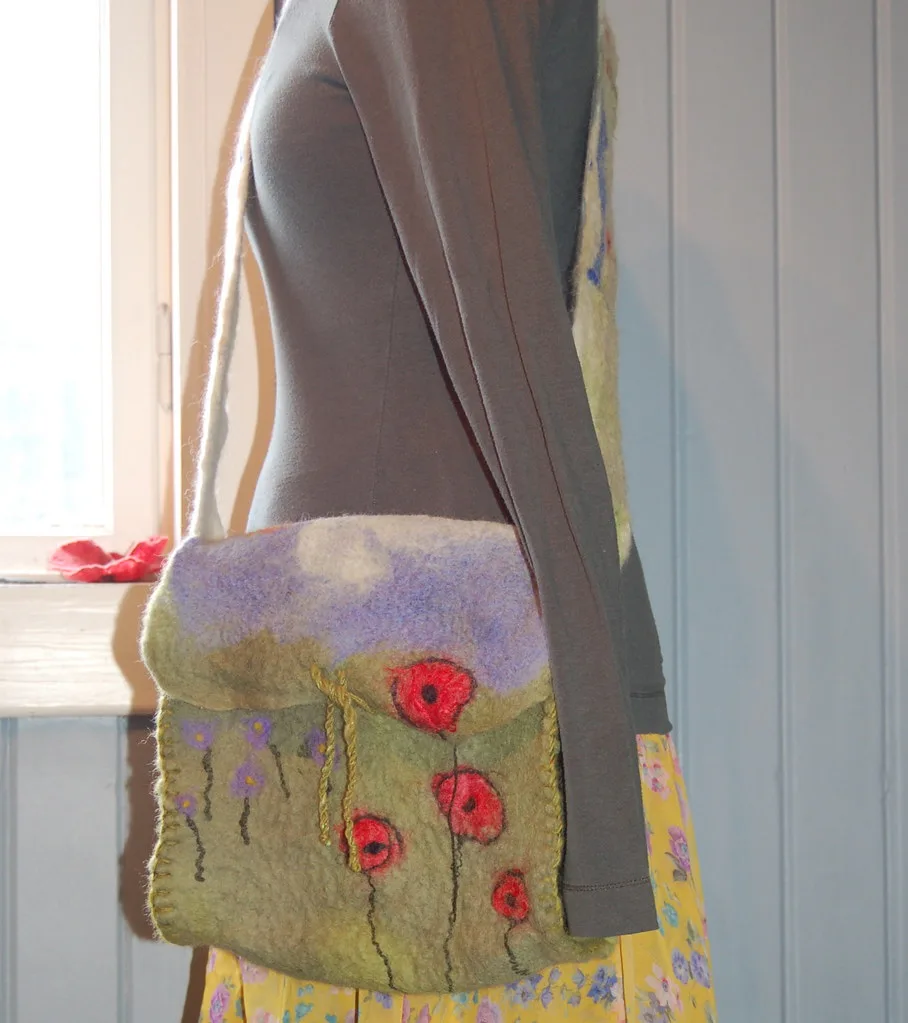
- Needle felting. Slide a foam pad or a firm sponge inside the purse so the needle only goes through the front. Lay wisps of colored wool on the felt, fix them with a 38 gauge needle, and finish with a 40 or 42 so the surface is tight and smooth. Dense wool felt grips needled fiber well; needle felting on fabric covers which bases hold best. Needles are very sharp and barbed, so read is needle felting dangerous before handing the job to a child.
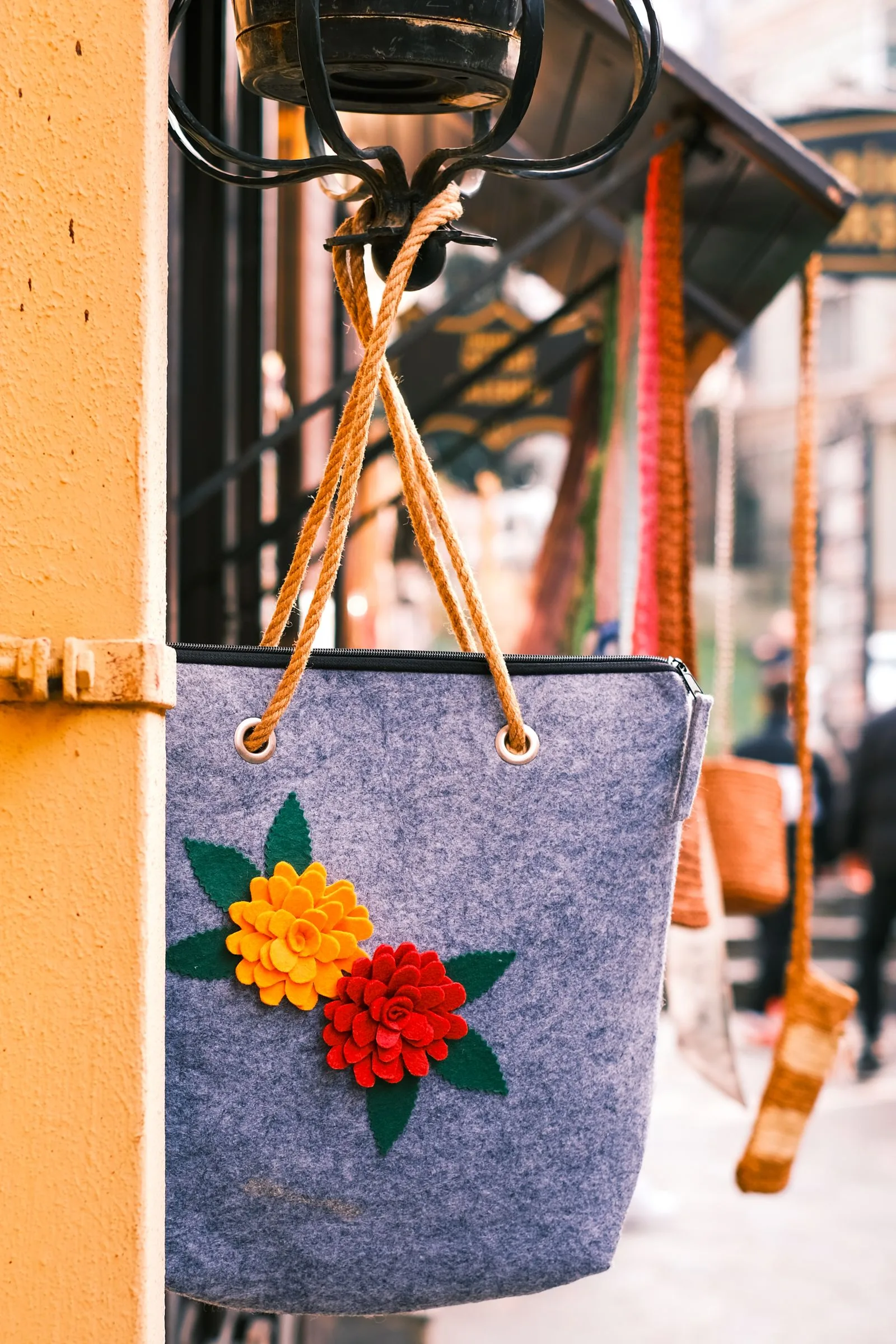
- Applique. Felt flowers like those on the tote at the top of this page are cut from thin felt and stitched on before the purse is assembled, while you can reach the back of the stitches.
- A charm. A small needle felted shape on a clip hangs from the zipper pull or strap ring; felt bag charms has designs at that size and a loop that won't pull out.
How do you clean a felt purse?
Brush off dust with a soft brush, and spot clean marks with a damp cloth and a drop of wool wash, pressing rather than rubbing. Never put a wool felt purse in the washer: it will shrink further, unevenly around the zipper or frame, and those will no longer fit. If a full wash is unavoidable, hand wash it cool without squeezing, press it in a towel, and let it dry stuffed into shape with paper. More on what each type of felt survives is in can you wash felt. Pills on the surface of a well-used purse come off with a fabric shaver on its lowest setting.
For a structured tote and a felt insert that keeps a handbag in shape, see structured felt bags.
Frequently asked questions
What thickness of felt is best for a purse?
3–5 mm (⅛–3/16 in) wool felt. At that thickness the purse stands up on its own, the cut edges need no hem, and it holds a snap or zipper without tearing. Thin 1 mm craft felt is too floppy for a purse unless you fuse two layers together or line it.
How big should the resist be for a wet felted coin purse?
Divide the finished size by 0.6 if you are using merino, which shrinks about 40%. A 4 × 3 in (10 × 7.5 cm) coin purse needs a resist about 6¾ × 5 in (17 × 12.5 cm) and roughly ½ oz (15 g) of wool laid in four layers.
Can you needle felt onto a felt purse?
Yes. Slide a foam pad inside the purse so the needle only goes through the front layer, then needle the design onto the outside. Dense wool felt holds needled wool well; finish with a fine 40 or 42 gauge needle so the surface is smooth and does not pill with handling.
What closure is best on a felt pouch?
A zipper for anything holding coins or small items, a magnetic snap for a clutch or envelope flap, and a sew-on snap or button loop for a light pouch. Back every snap and magnet with an extra patch of felt inside, because a single layer stretches at the prongs over time.
Can you wash a felt purse?
Spot clean it with a damp cloth and a little wool wash. A wool felt purse in a washing machine will shrink further and unevenly, and the zipper or snap may pull out of shape. Acrylic craft felt pills badly when washed.
Topics
Image credits
- A gray-blue felt tote bag with red and orange felt flowers, hanging in a street market — Can Ceylan (Pexels License)
- A gray felt case beside a patterned tray on a pink and gray background with dried grass — Edward Jenner (Pexels License)
- A man in a brown jacket holding a gray felt document bag under his arm — Theo Decker (Pexels License)