Needle Felted Butterfly: Wired Wings, Monarch Markings and More
13 min read Intermediate
We may earn a commission from links on this page, at no extra cost to you. As an Amazon Associate I earn from qualifying purchases. Learn more.
Four thin wings felted flat on a foam pad, a wire along each front edge so they hold a pose, and a body with clubbed antennae. Sizes, wool weights, monarch markings and five other species, plus brooch, clip and plant pick mounts.
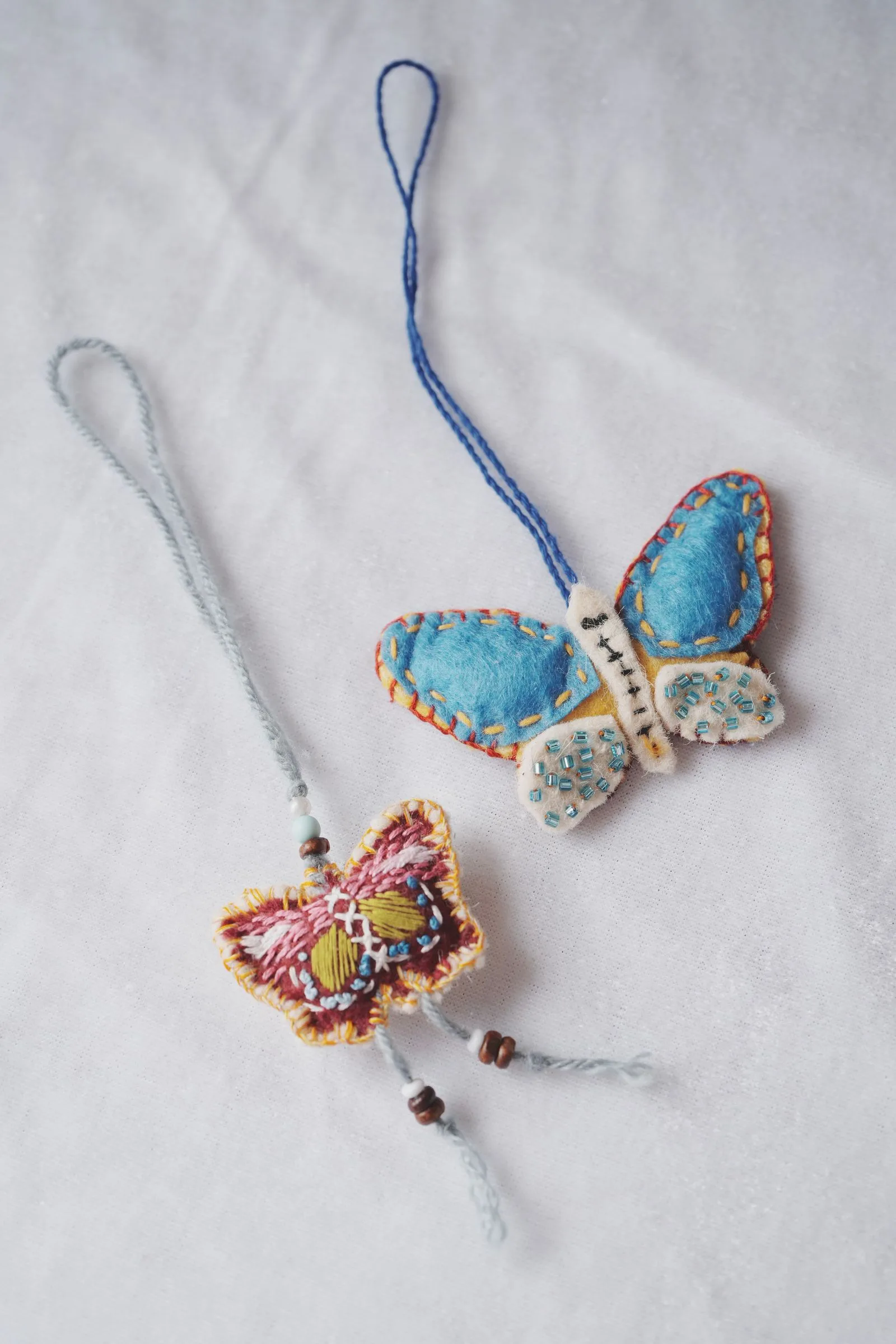
A needle felted butterfly is mostly wing: four flat pieces of wool not much thicker than a coin, carried on a body the size of a fingertip. That changes how you work. Instead of building a solid shape, you felt thin sheets on a foam pad, put fine wire into their front edges so they stay in a pose, and spend most of the time on the markings, because those decide which butterfly it is.
How big should a needle felted butterfly be?
For a first one, life size: about 3½ to 4 in (9 to 10 cm) across for a monarch. Smaller than about 2 in (5 cm) the veins and spots get too fine to place with wool and have to be stitched instead. The table gives the wool for three common sizes, worked out from wings 2 to 3 mm thick at the density of firm felt.
| Wingspan | Good for | Wool for the wings | Wool for the body | Wing wire |
|---|---|---|---|---|
| 2 in (5 cm) | Hair clips, earrings, small brooches | Under 1 g | About ½ g | Usually none; felt the wings firm |
| 3½–4 in (9–10 cm) | Life-size monarch, plant picks, wreaths | 2–3 g | About 1 g | 26 gauge (0.4 mm) |
| 6 in (15 cm) | Wall pieces, a blue morpho at full size | 5–7 g | About 2 g | 24 gauge (0.5 mm) |
Even the large one uses only about ⅓ oz (9 g) of wool, so a butterfly is a good use for leftover colors. Use fine wool for the wings: merino felts into a thin, smooth sheet with crisp edges, while coarse wool stays thick and hairy at this scale.
Which wing method should you use?
Needle felting the wings from loose roving is the standard way and the most flexible, but there are four others. Pick by the look you want and how the butterfly will be used.
| Wing method | Thickness | Look | Takes wire? | Best for |
|---|---|---|---|---|
| Roving felted flat on a foam pad | 2–3 mm | Soft, matte, markings blend at the edges | Yes, couched along the edge | Realistic monarchs and swallowtails |
| Cut from prefelt, then needled | 1–2 mm | Crisp outline, very even | Yes | Matching pairs, small butterflies |
| Fused Angelina fibre sheet | Paper thin | Translucent, iridescent | Glue or stitch it on | Morphos, fantasy and fairy wings |
| Cut from a wet felted sheet | About 2 mm | Firm, flat, colors laid in before felting | Stitched along the back | Batches, ornaments |
| Cut from craft felt sheet | About 1 mm | Flat, hard edged | Stitched between two layers | Children's crafts, quick ornaments |
Methods mix well. A common one is roving wings with a pinch of Angelina blended into the top layer for a glint, or prefelt wings with the veins and spots needled on top. The last two rows are covered at the end of this page.
How do you needle felt butterfly wings flat?
Each wing takes about 15 to 20 minutes of needling at life size. Make them in pairs, left and right together, so they match.
- Draw a template. Trace or draw the forewing and hindwing at full size on paper, then flip the paper over against a window and trace the mirror images. A real butterfly has four separate wings. The forewing overlaps the front of the hindwing at the base, and making them separately is what lets a felted one look the same.
- Lay the wool thin. Put the template on the foam pad, or under a sheet of clear plastic, and lay wisps of the base color over it in two crossing layers, a little past the outline all round. The layer should look see-through before you start.
- Needle straight down with a 38 gauge needle until it holds together, then lift the wing off the pad. It felts into the foam if you leave it, and peeling it off late tears fibre out of the back. Turn it over and needle the other side.
- Make the edge. Fold the loose fibre past the outline back over onto the wing and needle it down along the line. A folded edge is cleaner and stronger than a cut one.
- Couch the wire (next section) before the wing gets firm.
- Firm it with a 40 gauge needle, turning often, until the wing feels like thin card and no fibre lifts at the edge. The method for flat pieces in general is in needle felting techniques.
For a 2 in (5 cm) butterfly, felt each side as a single piece, forewing and hindwing together, and needle a line where they meet. Four separate wings that small are fiddly and the difference does not show.
How do you wire the wings so they hold a pose?
Use 26 gauge (0.4 mm) cloth-covered floral wire for a life-size butterfly. It bends with the fingers and holds, and wool grips the cloth covering far better than bare metal.
- Bend the wire to follow the front edge of the forewing from base to tip, then round the outer margin, ending about ⅜ in (1 cm) short of the base on the back edge. On the hindwing, run it round the outer curve.
- Leave both wire ends long at the base, about 1 in (2.5 cm). They become the stalk that attaches the wing to the body.
- Lay the bent wire on the half-felted wing just inside the edge, cover it with a thin strip of the same wool, and needle beside the wire, never onto it. A needle that hits wire snaps.
- Firm the wing as normal. The wire should disappear; if it shows as a ridge, add one more wisp over it.
A wired wing can be tilted, curved slightly at the tip, or folded up over the back, and it will stay there. It will also take reshaping a few times, but not dozens: fine wire work-hardens and eventually snaps if it is bent at the same point over and over.
How do you make the body and antennae?
The body is three parts, like any insect: a small round head, a thicker thorax that carries all the wings and legs, and a long, tapering abdomen. On a life-size monarch the whole body is about 1 in (2.5 cm) long and no thicker than a pencil.
- Core. Fold a 3 in (7.5 cm) length of armature wire or a pipe cleaner in half. Wrap black or dark brown wool tightly round it, thickest at the thorax, and needle at a shallow angle along the length, not straight in. The fold end is the head.
- Antennae. Two lengths of 28 gauge black wire, each about ¾ in (2 cm) on a life-size monarch, pushed into the top of the head. Give each a small club at the tip: a seed bead glued on, a tiny ball of black wool rolled round the end, or the wire tip bent back on itself twice. The club is what says butterfly rather than moth.
- Legs. Six, from the underside of the thorax, in three pairs, each a short piece of the same black wire wrapped with a wisp of wool and bent at two joints. On a monarch, a painted lady or a morpho the front pair is small and folded up against the chest, so only four legs reach down. Swallowtails use all six.
- Head. Two dark eyes that take up most of the sides of the head. A coiled proboscis of fine wire under the head is a nice extra on a big one.
How do you attach the wings to the body?
Wire to wire, then wool over the top. Glue alone lets the wings swing on the body.
- Hold the body upside down. Place each forewing's wire stalk against the side of the thorax at its front, and the hindwing's just behind it, so the forewing overlaps the front of the hindwing.
- Twist the stalks of each side together, then wrap them twice round the body wire, and trim the ends to about ⅛ in (3 mm). Squeeze the cut tips flat with pliers so they cannot work out.
- Wrap a thin strip of the body color over the joint and needle it at a shallow angle until the thorax is round again and the wire is hidden.
- Pose the wings. Flat and open is how a butterfly basks; a shallow V looks like it has just landed; both pairs folded straight up over the back is how most butterflies rest. When the wings are closed, the underside is what shows, so felt the underside markings too for that pose.
What markings does a monarch butterfly have?
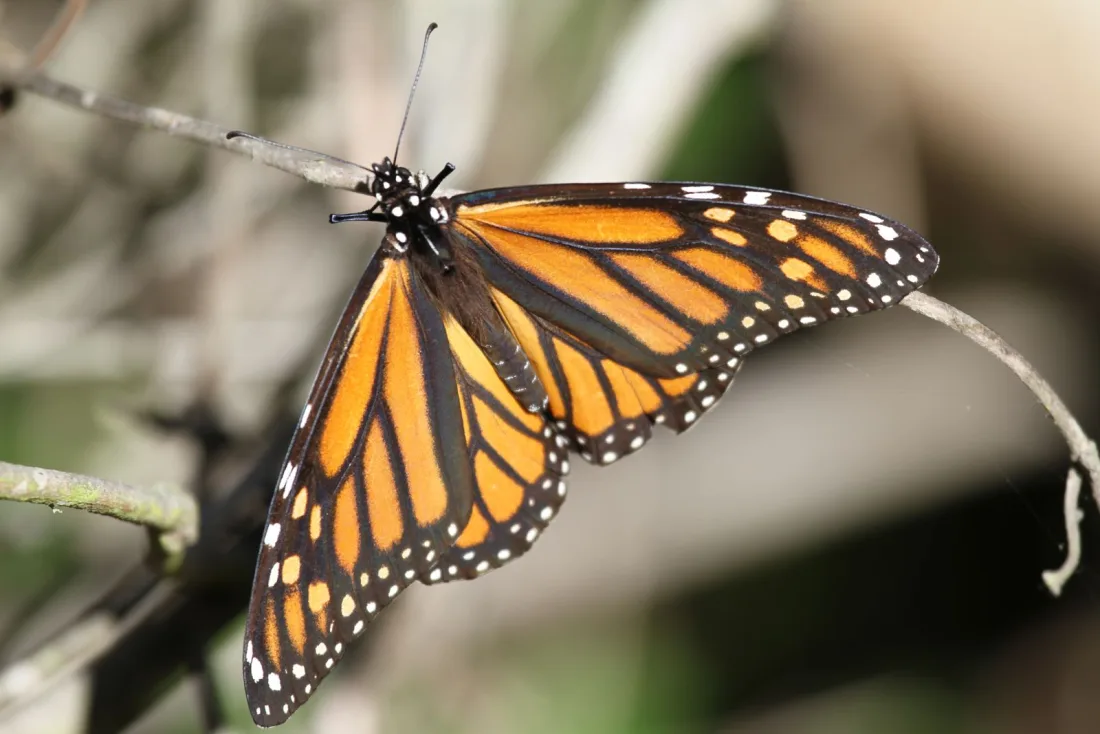
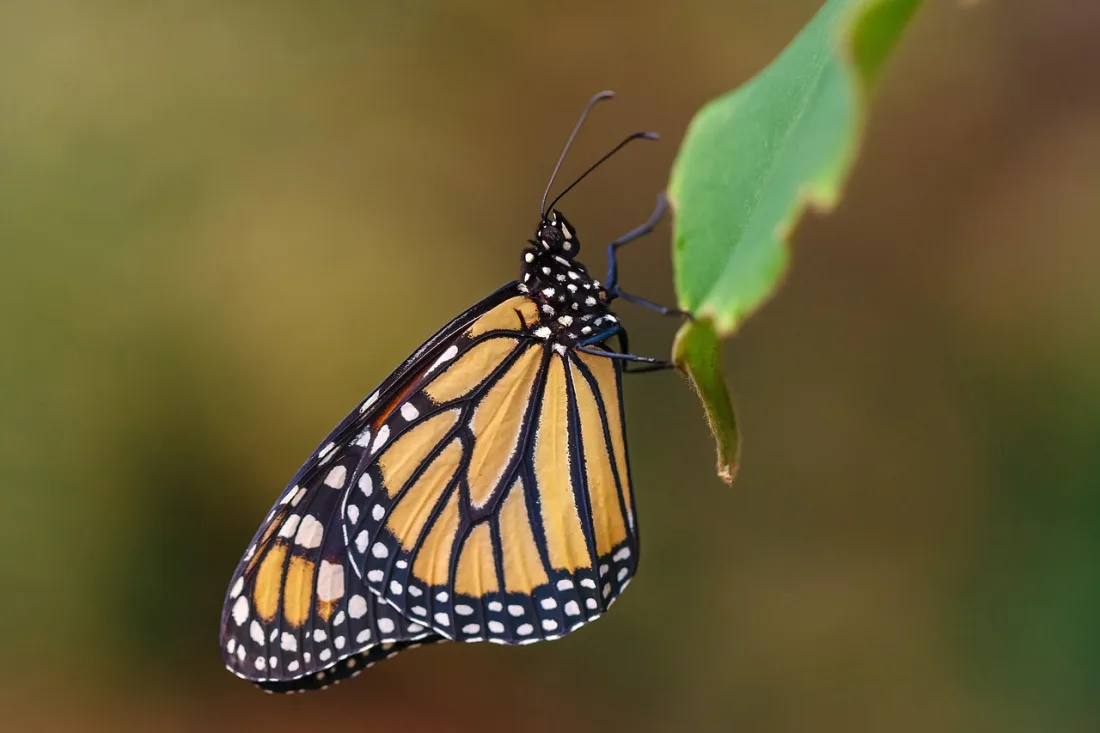
Monarch wings are orange, crossed by black veins, with a wide black border round both pairs that carries two rows of small white dots. The tip of each forewing is black with a band of larger orange and white spots running across it. The body is black with white dots on the head and thorax. Lay them in this order:
- Base color first. Felt the whole wing in orange, a slightly deeper orange towards the body if you want depth. Blending two oranges is covered in how to blend wool colours.
- Black border and wing tip. Lay a band of black about ⅛ to ¼ in (3 to 6 mm) wide round the outer edge, wider at the forewing tip, and needle it down with a 40 gauge needle.
- Veins. Twist a few black fibres between damp fingers into a thread, lay it along the vein line from the base outwards, and tack it every ⅛ in (3 mm) before pressing it in. Twisted fibre makes a line that stays narrow; a flat wisp spreads.
- White dots last. Roll tiny balls of white wool between your fingertips and needle each into the black border. At life size they are only 1 to 2 mm across, so white French knots in embroidery thread are often easier, and look the same.
Males and females differ in a way you can show. A male has narrower veins and a small black spot on a vein in the middle of each hindwing, its scent patch. A female has no spot and noticeably thicker, smudgier veins. Monarch undersides are paler, a buff orange on the hindwings, with the same veins and dots.
Which other butterflies are good to felt?
All of them use the same wings, wire and body. Only the outline and markings change, and the outline matters as much as the colors: a swallowtail without its tails reads as a different insect.
| Species | Real wingspan | Base color | Markings | Felting note |
|---|---|---|---|---|
| Monarch | 3½–4 in (9–10 cm) | Orange | Black veins, black border with two rows of white dots, black forewing tip with orange and white spots | The vein lines are the work; see above |
| Viceroy | A little smaller than a monarch | Orange | Looks like a monarch but with an extra black line curving across each hindwing | Make it next to a monarch and the line is what tells them apart |
| Eastern tiger swallowtail | About 3–5½ in (8–14 cm) | Yellow | Black tiger stripes across the forewings, black borders with yellow spots, blue and orange spots near the tails | Wire right into the hindwing tails so they do not curl |
| Blue morpho | About 5–8 in (13–20 cm) | Bright blue above, brown below | Black or dark brown border with white spots near the forewing tip; underside has eyespots | Blend blue Angelina into the top layer for the metallic shine |
| Painted lady | About 2–3 in (5–7.5 cm) | Orange to pinkish orange | Black blotches, black forewing tips with white spots, small eyespots on the hindwing underside | A good small one for a hair clip |
| Luna moth (a moth, for contrast) | About 3–4½ in (7.5–11.5 cm) | Pale green | One eyespot on each wing, long curving hindwing tails | Feathery antennae and a fat, furry white body |
A tiger swallowtail is the best second butterfly: the stripes are broad bands rather than fine lines, so it is quicker than a monarch, and the wired tails teach the same edge technique on a harder shape.
Butterfly or moth: what changes in the felting?
Three things, and the antennae matter most.
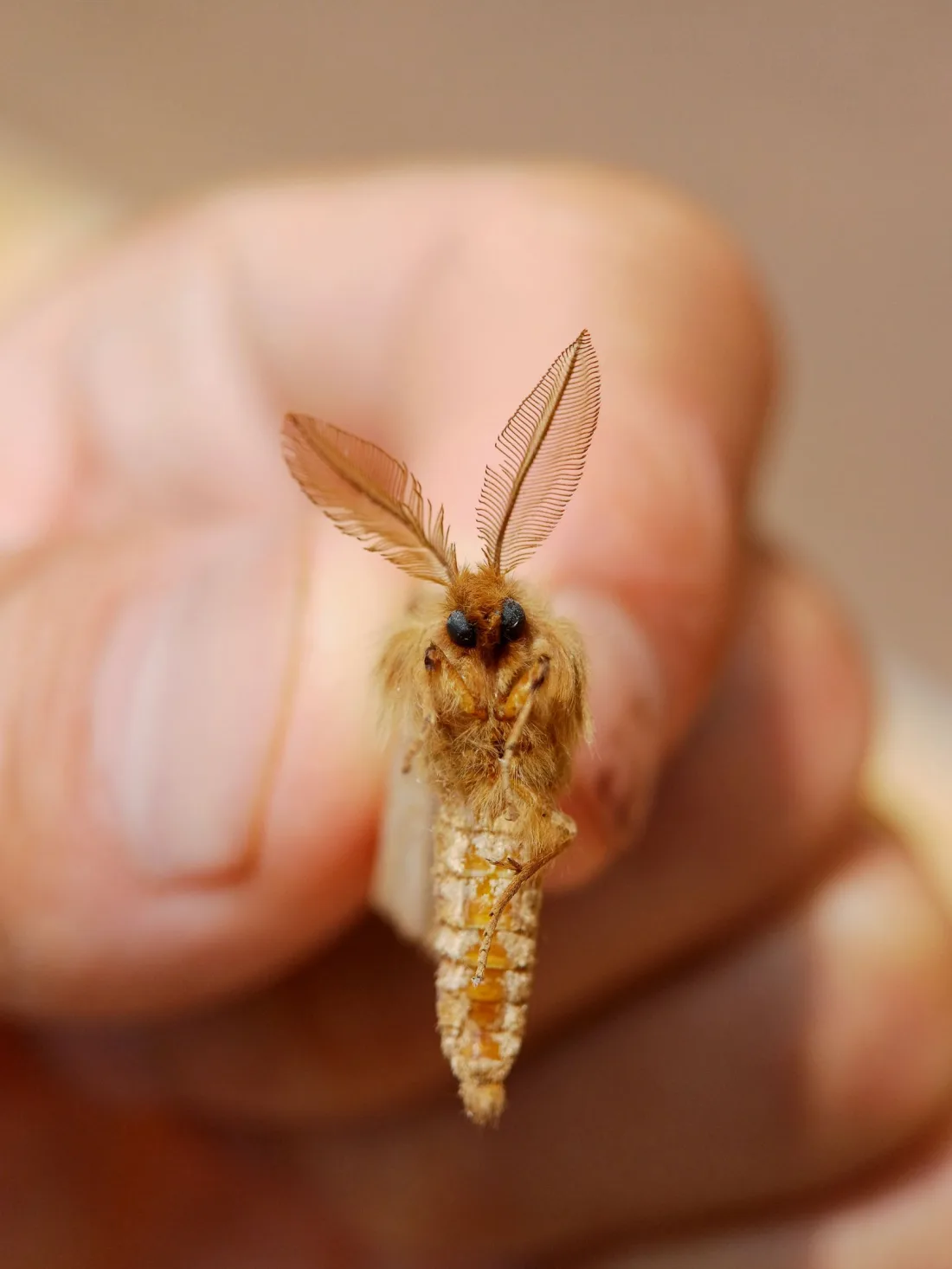
- Antennae. Butterflies have thin antennae with a club at the end. Most moths have feathery antennae, especially the males, or plain ones that taper to a point. For a feathery antenna, needle a narrow strip of wool flat on the pad around a wire, then snip fine cuts in from both edges.
- Body. A moth's body is thicker and furry; brush the surface or use a reverse needle to lift fibre, as described in needle felting fur. A butterfly's body is slim and smoother.
- Resting pose. Butterflies usually rest with their wings closed upright over the back. Many moths rest with the wings flat or folded back over the body like a tent.
The rest of the anatomy is the same for both: four wings and six legs, all fixed to the thorax.
How do you turn a felted butterfly into a brooch, clip or plant pick?
Plan the mount before you attach the wings, because most of them go through the body.
- Brooch. Sew a 1 in (2.5 cm) pin back to a small felt oval, then sew the oval to the underside of the thorax, which puts the pin beneath the heaviest part. Skip the legs and keep the wings fairly flat so it lies against a coat. A brooch made this way is lighter than it looks: about 5 g at life size. Fixings for other felted jewelry work the same way.
- Hair clip. A 2 in (5 cm) butterfly on a 1¾ in (45 mm) alligator clip. Felt a strip of wool around the top arm of the clip first, then stitch the body to that strip. The details, including why glue on its own peels off, are in felt animal hair clips.
- Plant pick. Leave the body wire long when you start, or twist an 18 gauge wire stem to it under the thorax, and wrap the stem in green wool or floral tape. Push it 2 to 3 in (5 to 7.5 cm) into the soil of a pot. A butterfly on a pick pairs well with needle felted flowers on wire stems.
- Hanging. Hold the butterfly on a pin through the thorax to find where it balances, then needle a thread loop in at that point. For several at once, see felt mobiles.
A quicker felt butterfly pattern in sheet felt or wet felt
If you need a dozen butterflies for a garland or a class, cut them from felt rather than needling each wing.
- The pattern. Fold a piece of paper in half. With the fold as the center of the body, draw one forewing and one hindwing as a single shape out from it, about 2 in (5 cm) from fold to forewing tip for a 4 in (10 cm) butterfly. Cut it out and unfold it, and both sides match.
- Sheet felt. Cut two layers from wool or wool-blend felt sheet. Embroider veins on the top layer in black backstitch or stem stitch and add spots in French knots or seed beads before you join the layers. Then lay a length of 26 gauge wire between them along the front edge and blanket stitch round the outside. A black pipe cleaner folded over the middle and twisted makes the body, with the two ends curled into clubbed antennae.
- Wet felt. Lay out a thin sheet of merino on bubble wrap and put the markings straight into it: an orange field, black lines for veins and border, white dots. Felt and full it until firm, as in wet felting for beginners, then cut the butterflies out. Merino shrinks by 35 to 45 percent, so lay the design out about 1.5 to 1.8 times the size you want it to finish, and expect the lines to soften a little.
Sheet felt butterflies are flat, but they hang well, stand up to handling and suit children's crafts. Needle felted ones are for looking at closely.
If a butterfly is your first insect, a needle felted bee is a smaller, quicker way in and uses the same thin-wing ideas. The flat-shape skills here also carry over to the wings and tails of needle felted birds, and fine needles matter for both; felting needles explained lists the gauges.
Frequently asked questions
How do you needle felt a butterfly?
Felt four thin, flat wings on a foam pad, each about 1/16 to 1/8 in (2 to 3 mm) thick, with fine wire couched along the front edge and a wire tail left at the base. Wrap a body in wool over a short wire, twist the wing tails around it at the thorax, cover the join with wool, then add the markings and two clubbed antennae.
How do you make felted butterfly wings hold their shape?
Put wire in them. A 26 gauge (0.4 mm) cloth-covered floral wire along the front edge and round the outer margin lets a wing be bent and stay bent. Wool alone that thin flops; wool felted thick enough to stand on its own looks clumsy.
How many legs and wings does a felted butterfly need?
Four wings and six legs, all attached to the thorax. On a monarch or painted lady the front pair of legs is small and folded against the body, so only four show; a swallowtail shows all six. Legs can be left off a brooch or clip entirely.
How big is a life-size needle felted monarch butterfly?
About 3 1/2 to 4 in (9 to 10 cm) from wing tip to wing tip, the size of a real monarch. Its wings take roughly 2 to 3 g (about 1/10 oz) of wool and the body about 1 g.
How do you tell a felted butterfly from a moth?
By the antennae. Butterfly antennae are thin with a small club or knob at the tip; most moth antennae are feathery or taper to a point. Moths also have stouter, furrier bodies and usually rest with their wings flat or folded tent-like, not held upright over the back.
Topics
Image credits
- Two handmade felt butterfly ornaments on cord loops: a blue one with cream hind wings sewn with turquoise beads, and a smaller red and pink one covered in embroidery — Ravi Kant (Pexels License)
- A monarch butterfly hanging from a leaf with its wings closed, showing the pale orange underside, black veins, white-dotted border and clubbed antennae — Andhoj (Pixabay Content License)
- A monarch butterfly with its wings open on a twig, showing orange wings, black veins and a black border with white dots — Richard Block (Pexels License)
- A small furry tan moth held up on a fingertip, with two large feathery antennae — Juban Chyne (Pexels License)