How to Needle Felt Flowers That Look Like Plants, Not Pancakes
4 min read Beginner
We may earn a commission from links on this page, at no extra cost to you. As an Amazon Associate I earn from qualifying purchases. Learn more.
Petals, centres, leaves and stems. The flat-shape technique that makes botanical work fast, and why irregularity is an advantage here.
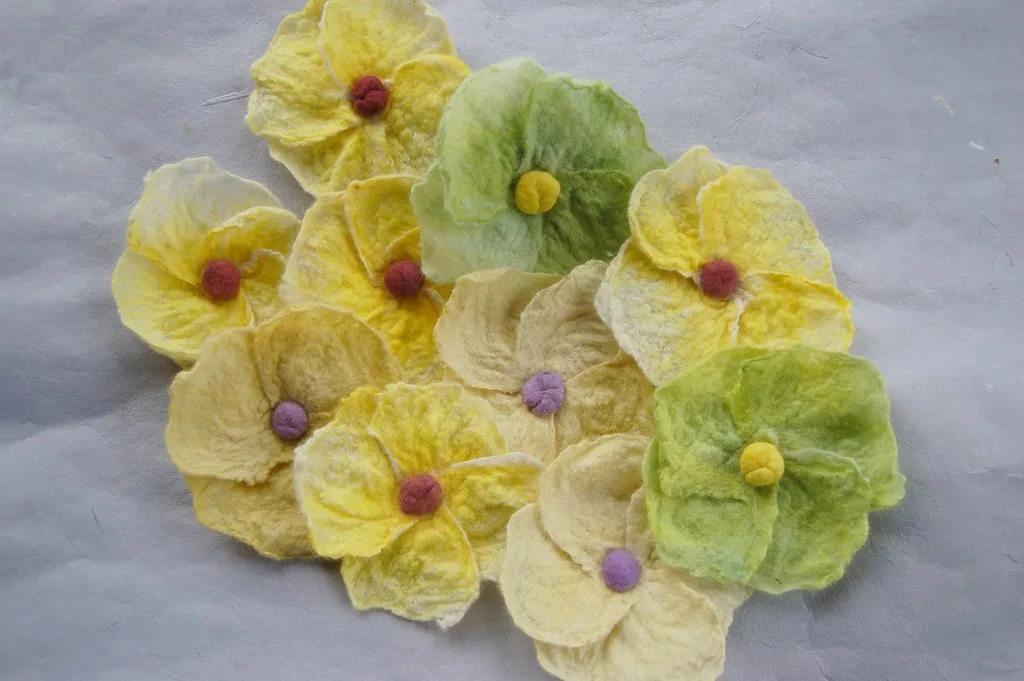
If you would rather cut petals from felt cloth than sculpt them from loose wool, that is a different craft with the same name — see felt flowers.
Flowers are the most forgiving thing a beginner can needle felt. Real petals are asymmetrical, real leaves curl unevenly, and no one has ever looked at a rose and thought the left side should match the right. Every wobble in your work reads as botanical rather than as error.
They are also fast — a simple flower takes twenty minutes, which makes them ideal for practising technique without committing an afternoon.
What you need
- Wool tops in petal and leaf colours, plus something for the centre
- 38 and 40-gauge needles
- A foam pad — a flat one, since most of this work is flat
- Floral wire or pipe cleaners for stems
- Optional: green floral tape
The flat-shape technique
Almost all felted botanicals are made from flat pieces, and the method is the same every time.
- Pull a thin, wide wisp of wool and lay it on the pad in roughly the shape you want, slightly larger than the finished petal.
- Stab all over the surface with a 38-gauge needle until it holds together.
- Peel it off the pad and flip it. This matters — felting only one side leaves a fuzzy back and eventually a piece welded to your mat.
- Work the edges by folding stray fibres inward and stabbing them down. Sharp edges come from folding, never from cutting.
- Keep flipping and working until the piece is firm, even and defined.
Always leave a small tuft of loose fibre at the base of each petal. That is what you will use to attach it, and a petal felted firm all round cannot be joined invisibly.
Shaping petals so they are not flat
A flat petal looks like a cut-out. Real petals curve, and there are two easy ways to get that.
Pinch and felt. Fold the petal gently along its length, hold the fold, and stab along the crease. The felt holds the curve.
Cup it. Lay the petal over your fingertip or the rounded end of a brush handle and stab into the centre. It will form a shallow bowl.
Vary the amount of curve between petals. Identical petals look manufactured.
Building the centre
The centre is what turns a group of petals into a flower.
- A simple ball of contrasting wool, felted firm — see the ball tutorial.
- A flat disc made with the technique above, for daisies and open flowers.
- Stamens from twisted wisps of wool, or from thread knotted at the ends.
- Texture made by stabbing dark wool into a lighter centre in small dots — surprisingly effective on poppies and anemones.
Assembly
Lay your petals in a circle, overlapping each slightly over the next, with their loose tufts pointing to the middle. Stab through all the tufts at once to bind them into a single mass.
Set the centre on top and felt it down through the petal bases. Add a small wisp of wool over the join underneath and work it in to tidy the back.
Petals will sit at whatever angle you attach them, so decide early whether you want an open, flat flower or a closed, cupped one.
Stems and leaves
For a stem, take a length of floral wire, lay a thin strip of green wool along it, and roll while stabbing lightly to bind the wool to the wire. Work slowly — this is a common place to break a needle on the wire.
Attach by fanning the wool at the top of the stem against the back of the flower and felting it in.
Leaves use exactly the same flat technique as petals. Two refinements make them read as leaves rather than green petals:
- Felt a thin line of darker green down the centre for a midrib.
- Make the shape asymmetric, with one side slightly wider than the other.
Which flowers to start with
- Poppies — four rounded petals, a dark centre, no precision required.
- Daisies — many identical narrow petals around a yellow disc; good practice for consistency.
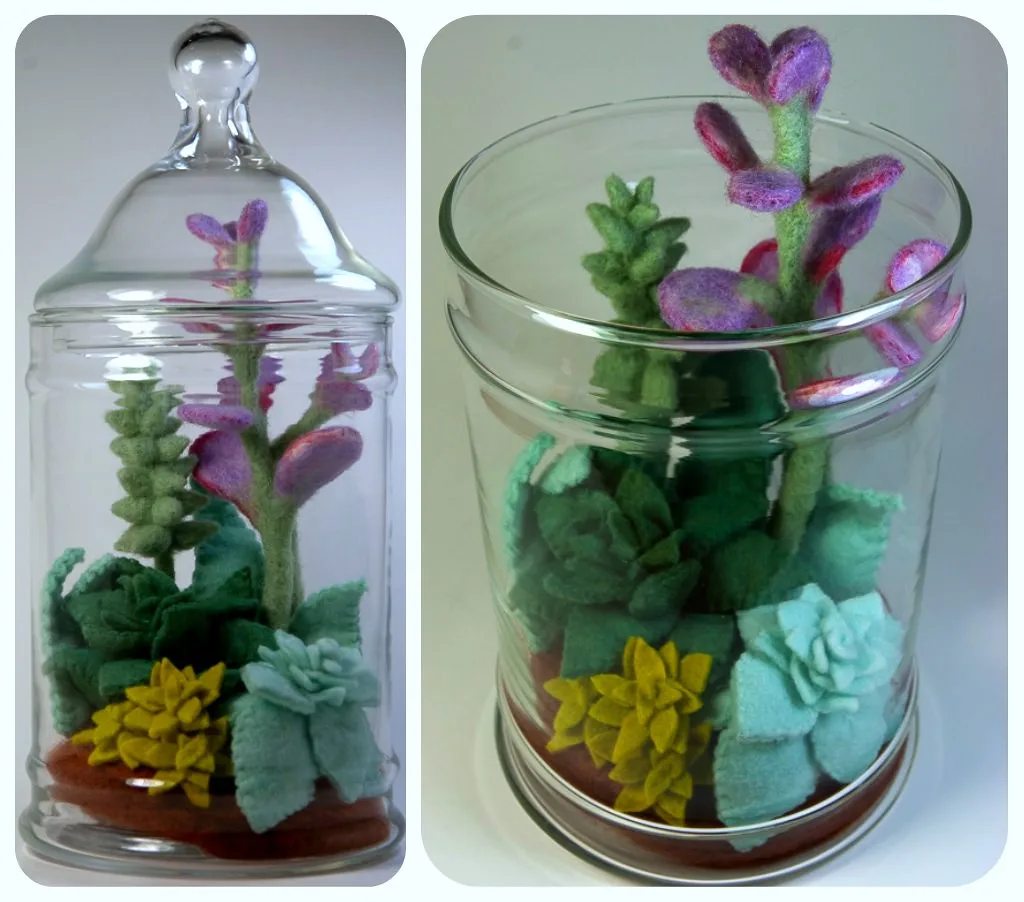
- Succulents — thick, cupped leaves in a rosette, and one of the most forgiving botanicals there is.
- Roses — a rolled strip of felted wool, no separate petals at all. Deceptively easy.
Colour makes the difference
Flat, single-colour petals are what make felted flowers look like craft-kit flowers. Real petals shade from one tone to another.
Lay a wisp of a second colour over the base or the tip of each petal before felting, or blend your own shades first — blending wool colours covers how. A pink petal with a paler tip and a slightly deeper base stops looking like felt and starts looking like a flower.
What to do with them
Wired flowers arrange in a vase like real ones and never need water. Without stems they become brooches, hair clips, garlands or decorations on a bag. A handful of small ones on wire makes a buttonhole that survives the whole wedding.
For more project ideas across the seasons, see felted Christmas decorations.
Frequently asked questions
How do I needle felt a flower petal?
Lay the wool as a rough flat shape on the mat and felt it, then flip it over, fold the loose edges inwards and felt them down. Working both sides is what gives a petal a clean outline rather than a fuzzy one.
How do I stop felted petals looking flat?
Shape them after they are felted: cup each one over a fingertip and work the curve in with the needle, and taper the base so the petal has somewhere to bend from.
Which felted flowers are easiest to start with?
Simple five-petal shapes such as daisies, poppies and wild roses. Anything with layered or ruffled petals is a different order of difficulty and worth saving until the flat-shape technique is comfortable.
How do I make felted flowers look realistic?
Colour, mostly. Lay a gradient from base to tip rather than using one flat shade, because real petals are never a single colour. That change convinces the eye far more than any amount of extra shaping.