Prefelt Wool: What It Is and How to Use It
4 min read Intermediate
We may earn a commission from links on this page, at no extra cost to you. As an Amazon Associate I earn from qualifying purchases. Learn more.
Prefelt is wool stopped halfway — solid enough to cut into shapes, loose enough to still felt onto something else. It is the neatest way to get crisp detail into felt.
Loose wool has no edges. That is the central difficulty of felting anything with a pattern in it: you can lay a stripe, a leaf or a letter out of fibre, but the moment water and friction arrive it spreads, softens and blurs.
Prefelt solves that. It is wool arrested halfway through felting — coherent enough to cut a shape out of, unfinished enough to still bond permanently to whatever you lay it on.
How far is halfway
Pick a piece up by one corner. Prefelt should hold together and lift as a sheet, but stretch noticeably, and pull apart at the edge if you tug it. If it lifts stiffly and refuses to stretch, it has gone too far and will no longer bond — it is felt.
That window is wider than it sounds. Two or three minutes of gentle rubbing on a thin layer will get you there, and a minute either side rarely matters.
Prefelt versus craft felt sheets
Craft felt from a haberdashery is finished, frequently acrylic or a wool blend, and inert. You can sew it, glue it, or cut it into a Christmas decoration, but you cannot felt it into anything — nothing about it will migrate or bond.
Prefelt is pure unfinished wool. Lay a prefelt shape on a wool layout, wet it, and it fuses in until there is no join to see, only a colour change. That is the whole reason it exists.
What to use it for
- Inlay and appliqué in wet felting. Cut shapes, arrange them on your layout, and felt the whole thing at once. Crisp edges survive.
- Lettering and fine lines. Cut a strip 3 mm wide and it will still be 3 mm wide when the piece is finished. Loose fibre will not do this.
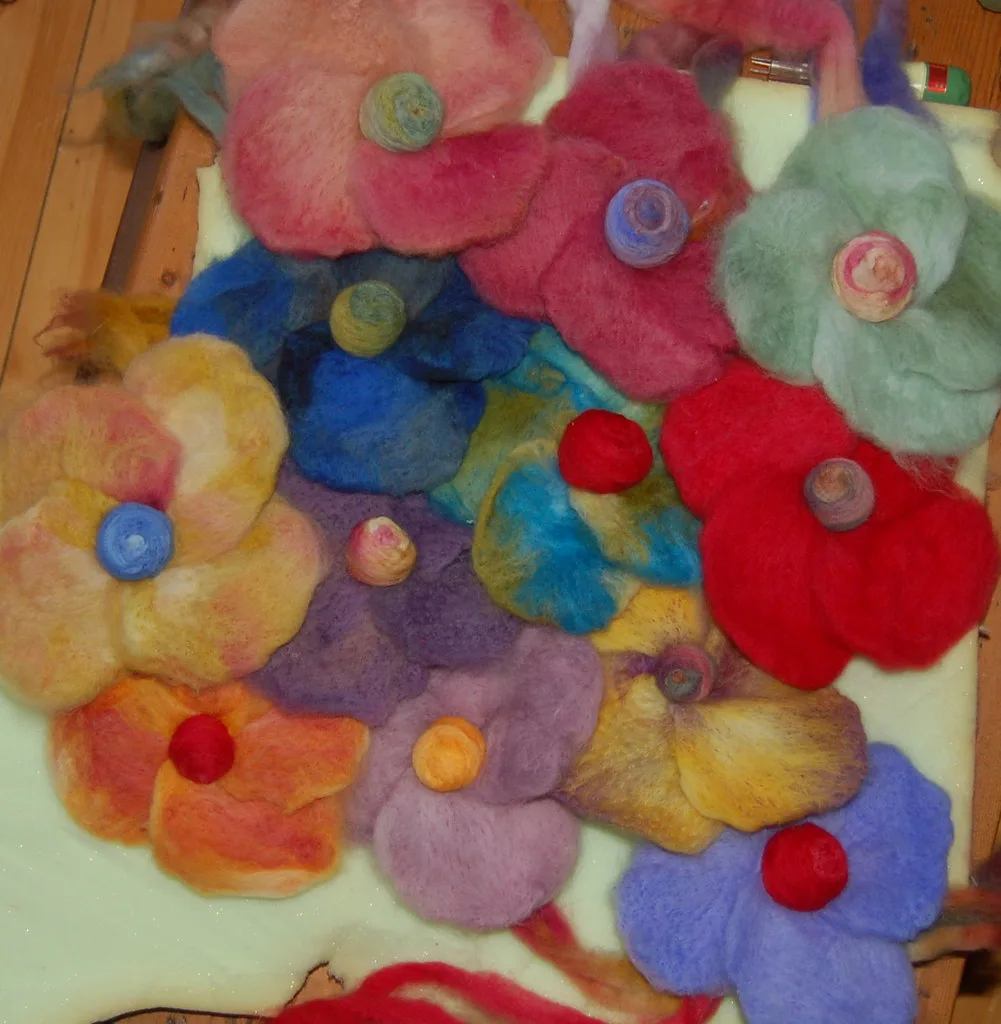
- Needle felted pictures. Cut shapes and needle them down onto a felt background. Far faster and neater than building each element from fibre.
- Reinforcement. A prefelt patch on the inside of a bag base or a slipper sole adds thickness where wear happens.
- Nuno work. Prefelt pieces on silk migrate through the fabric cleanly. See nuno felting.
Making your own
- Lay wool out in two thin layers, the second at right angles to the first, on bubble wrap. Thin — you want a sheet you can just about see light through.
- Cover with net or a second sheet of bubble wrap, wet through with warm soapy water, and press the air out.
- Rub gently through the covering for two or three minutes. Flat palms, light pressure, no rolling.
- Lift a corner and test. When it holds together but still stretches and pulls apart at the edge, stop.
- Rinse the soap out and dry flat.
Home-made prefelt is slightly thicker and more textural than commercial sheets, which is often an advantage. It is also the only way to get prefelt in a colour you blended yourself.
Buying it
Commercial prefelt comes as merino sheets, usually around 1 mm thick, sold by the sheet or the metre in a solid colour range. It is thinner and more even than anything you will make at home, and worth buying if you are doing fine cut-work.
Store it flat. Prefelt that has been folded under weight for months develops creases that felt in permanently, which is an irritating way to lose a whole sheet.
Working with it
Cut with sharp scissors, or a rotary cutter for straight lines. Prefelt does not fray, so no allowance is needed.
Lay shapes on the wool before wetting, not after — sliding a wet prefelt shape into position drags the layout underneath it out of place. Once everything is arranged, wet the whole surface at once from above.
Expect it to shrink with the piece. A prefelt circle 10 cm across on a layout that shrinks by 30% finishes at about 7 cm, and it will distort if the base shrinks unevenly. Allow for it, and see wool shrinkage when felting for the numbers.
When not to bother
For soft, blurred, painterly effects, prefelt is the wrong tool — loose fibre is what gives wet felted landscapes their softness. Prefelt is for when you want the edge to stay where you put it. Both approaches turn up in wet felting art.
Frequently asked questions
What is prefelt wool?
Wool that has been felted just far enough to hold together as a sheet but not far enough to be finished. It can be cut with scissors without falling apart, and it will still felt permanently onto other wool.
What is the difference between prefelt and felt sheets?
Craft felt sheets are finished, often part synthetic, and will not bond to anything — they have to be sewn or glued. Prefelt is unfinished pure wool and fuses into the piece it is laid on, leaving no visible join.
How do you make prefelt at home?
Lay wool out in two or three thin crossed layers, wet it with warm soapy water, and rub gently for two or three minutes — until it lifts as one piece but still stretches and pulls apart at the edges. Rinse, dry flat, and stop there.
Can you use prefelt for needle felting?
Yes. Cut shapes and needle them onto a base for crisp edges that are very hard to achieve with loose fibre, which is exactly how most detailed needle felted pictures are made.