Felt Mobile: Felt Balls, Clouds and Birds on a Frame That Hangs Level
6 min read Beginner
We may earn a commission from links on this page, at no extra cost to you. As an Amazon Associate I earn from qualifying purchases. Learn more.
How to make a felt mobile for a nursery or a window: choosing a hoop, branch or crossbar, what to hang and how heavy it is, drop lengths that look right from below, balancing it, and hanging it safely over a crib.
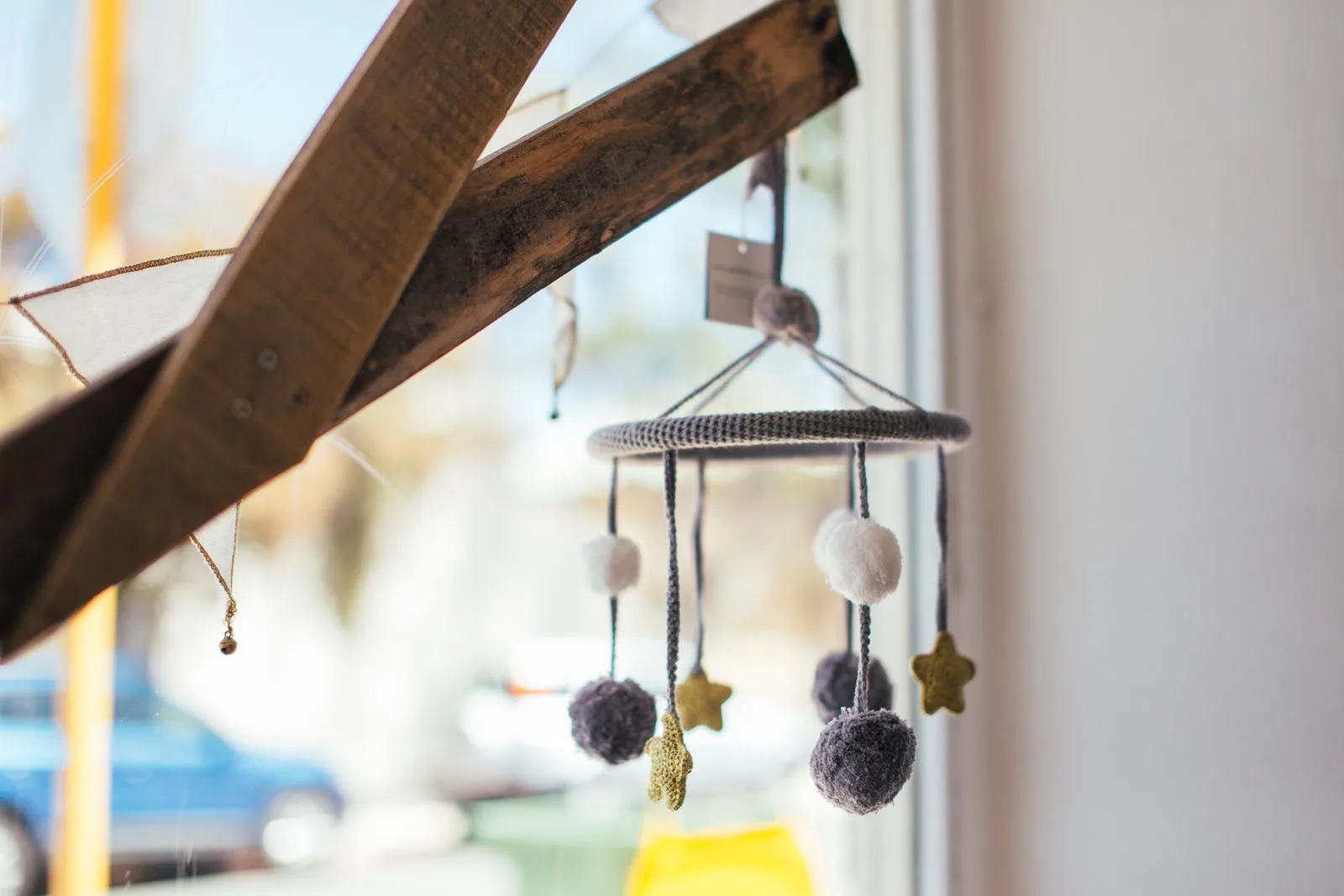
Every piece on a felt mobile is a beginner project: balls, clouds, stars, small birds. The skill is in the frame, the drop lengths and twenty minutes of adjustment at the end, which together decide whether it hangs level.
Felt is the right material for it. It is light, so a mobile can carry a lot of pieces without straining the frame; it is soft and quiet; and it takes colour in a way that reads well from below, which is where a mobile is always seen from.
Hoop, crossbar or branch
| Frame | Size | Movement | Balancing |
|---|---|---|---|
| Embroidery hoop | 6–8 in (15–20 cm) | Turns slowly as one piece | Easy: weights opposite each other |
| Two crossed dowels | 12 in (30 cm) each | Turns as one piece | Moderate: four arms to level |
| A straight branch | 12–18 in (30–45 cm) | Swings and tilts | By hand, piece by piece |
| Hanging arms in tiers | Varies | Every arm turns separately | From the bottom up; the most work |
For a first mobile, use a hoop. Use only the inner ring, sand it if it is rough, and wrap it with yarn or a strip of felt if you want it to look finished. Tie three or four threads of exactly equal length to it at even spacing, and gather them to a small metal or wooden ring above the centre. Equal threads are what make a hoop hang level before anything else is added.
What to hang, and what it weighs
Mix two or three kinds of piece at most; one main shape and one accent is plenty. Rough weights, which matter when you balance it:
- Wet felted ball, ¾–1¼ in (2–3 cm): 1 to 4 g.
- Cloud, star, moon or heart in two layers of felt sheet, lightly stuffed, 2½–4 in (6–10 cm): 2 to 4 g.
- Flat bird or fish in two layers of sheet, 2½–3 in (6–8 cm): 3 to 5 g.
- Needle felted bird, 2–2½ in (5–6 cm): 8 to 15 g, the heaviest thing most mobiles carry.
Balls of ¾ to 1¼ in, threaded later, are in how to make felt balls. Flat, stitched shapes are the fastest and lightest, and they are built exactly like the two-layer stars in felt Christmas ornaments. Needle felted birds are the heaviest and the most charming; see needle felted birds for the shapes, and give them flat tails and wings, which catch the air and make the mobile turn.
Lengths and layout
- Use an odd number of drops. Five or seven on a hoop look more natural than six.
- Stagger the lengths. Somewhere between 6 and 14 in (15 to 35 cm) below the frame, with no two neighbouring drops the same length. Looked at from below, the pieces should overlap rather than form a ring.
- Strands of balls: four to six balls per strand, about 1 in (2.5 cm) apart, with a shape or a larger ball at the bottom as an anchor.
- Graded colour. A gradient from light at the top to dark at the bottom, or round the hoop from one colour to the next, makes even plain balls look considered.
Lay the whole mobile out on a table before threading anything, drops spread out from the frame like spokes. It is much easier to move a cloud on a table than to retie it in mid-air.
Threading and knots
Clear nylon beading thread disappears against a white ceiling; embroidery floss or fine baker's twine is part of the look. Either way:
- Thread a long doll needle and push it straight through the centre of each ball. A hard felt ball needs pliers to pull the needle the last part of the way.
- Tie a knot under each ball to hold it in place, two or three overhand knots on top of each other if the thread is fine. A tiny glass seed bead under the ball works as a stop when a knot alone would pull through.
- For stitched shapes, lay the thread between the two layers and stitch the seam over it, so the seam holds it.
- Tie each finished drop to the frame with a loose slip knot at first, so it can still slide.
The same threading and spacing tricks for a garland are in felt garland.
Balancing it
Hold the mobile up by its top ring, or hang it from a cupboard handle at eye level, and look at it from below as well as from the side.
- On a hoop, the frame tips toward the heavy side. Swap pieces so that heavy ones sit opposite each other, then slide drop knots along the hoop a few millimetres at a time until it hangs flat. Only when it is level, tighten every knot and add a dab of clear nail polish to stop nylon knots from loosening.
- On a branch or crossbar, find the balance point by resting the loaded branch on one finger. Tie the hanging thread there. If the mobile has tiers, balance the lowest arm first, then hang it from the arm above and balance that, working up. Balancing from the top down never settles, because every change below undoes the levels above.
If it hangs completely still in moving air, it is usually too heavy at one point or tied too tight.
Hanging it safely over a crib
A nursery mobile is decoration for a baby to look at, never a toy to reach. Felt balls and stitched shapes are choking hazards, and threads are a strangling hazard.
- Hang it from a ceiling hook screwed into a joist or a proper ceiling fixing, not clipped to the crib rail.
- Keep it out of reach, with the lowest piece well above where a baby could reach even standing on the mattress.
- Take it down or move it once the baby begins to push up onto hands and knees or reaches five months, whichever comes first, as the American Academy of Pediatrics advises for crib mobiles.
- Check it now and then. Knots loosen and felt balls can work along a thread; a quick look whenever you dust is enough.
After that, the same mobile moves happily to a window, a reading corner or above a changing table out of reach.
Themes that work
- Clouds and raindrops: white stitched clouds with strands of small blue, gray and white felt balls hanging beneath them.
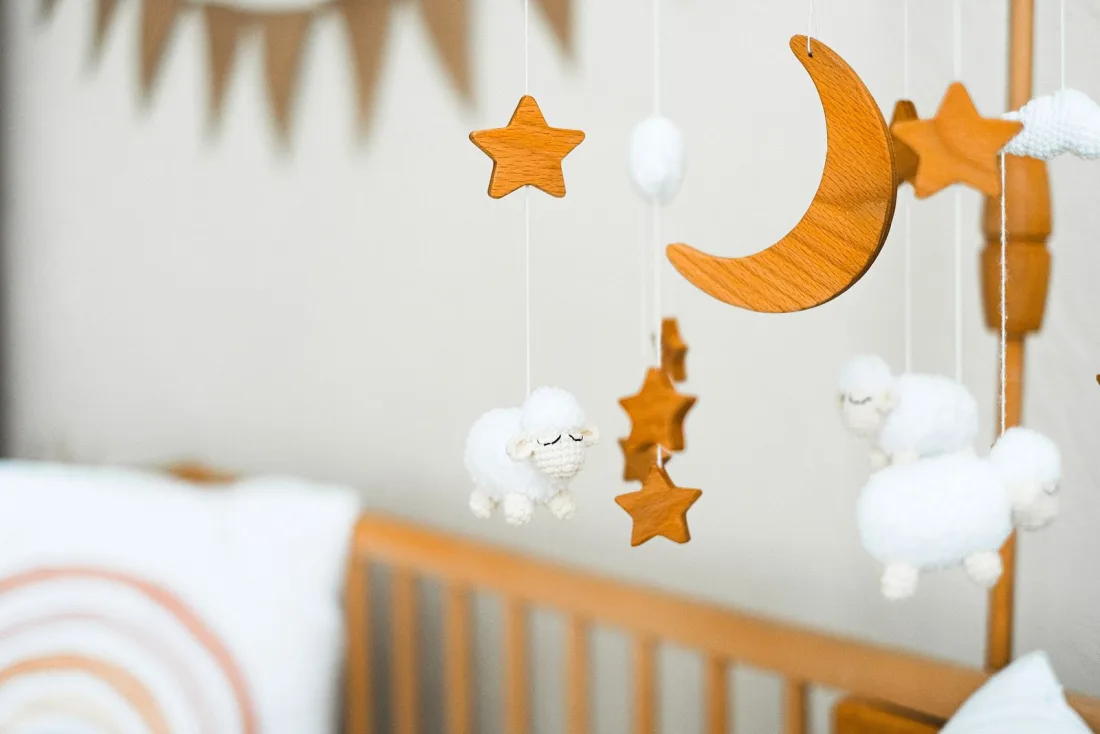
- Moon and stars: a crescent moon, five stars and a few pale balls. Make the moon from two layers and stuff it lightly, so it has a little depth when seen from below.
- Birds: three to five needle felted birds at staggered heights, with nothing else. Wire inside the tails helps them hold their angle.
- Under the sea: flat or needle felted fish and a few bubbles of pale felt balls; the shapes are in needle felted fish.
- A rainbow of balls: seven strands, one colour each, graded round the hoop.
For a Christmas version, hang felt ornaments from a hoop wrapped in green felt instead of a tree. If the balls are the part you enjoy most, the same skill goes into a felt ball rug.
Frequently asked questions
What do you hang a felt mobile from?
An embroidery hoop of 6 to 8 in (15 to 20 cm) is the easiest frame, hung from three or four equal threads tied to a small ring. A straight branch or a pair of crossed dowels works too, but needs balancing by hand. Hang the finished mobile from a ceiling hook, not from the crib.
How many felt balls do you need for a mobile?
For a hoop mobile with five or seven strands of four to six balls each, between 20 and 42 balls of ¾ to 1¼ in (2 to 3 cm). A simpler mobile of single shapes on five to seven drops needs only one piece per drop.
How do you balance a mobile?
On a hoop, hang matching weights opposite each other and adjust by sliding the knots of the support threads. On a branch or crossbar, balance from the bottom up: finish the lowest arm first, find the point where it hangs level, tie it there, and only then work on the arm above.
Is a felt mobile safe over a crib?
Only if it is hung securely from the ceiling well out of reach. Take it down or move it away once the baby begins to push up onto hands and knees or reaches five months, whichever comes first, as the American Academy of Pediatrics advises, because felt balls and threads are a choking and strangling hazard.