Needle Felted Dragon: Pose, Wire Armature, Wings and Scales
9 min read Advanced
We may earn a commission from links on this page, at no extra cost to you. As an Amazon Associate I earn from qualifying purchases. Learn more.
Most of a dragon's outline is neck, tail and wing rather than body, so the pose and the wire decide the build. Which pose balances, wire gauges, wool weights for three sizes, wired wings, scales, spines, horns, eyes and colours.
Most of a dragon's outline is neck, tail and wing, and surprisingly little of it is body. That is why a needle felted dragon is built from the pose outwards: decide how it will hold itself up, bend a wire to suit, and only then reach for the wool. Core wool goes over the wire, the wings are fixed at the shoulders, a merino top coat covers both, and the scales, spines, horns and eyes come last; they are what make it a dragon rather than a lizard.
Which pose is easiest for a needle felted dragon?
Sitting, by a long way. A dragon sitting on its haunches has a wide base made of its back legs, its belly and the root of its tail, so it balances without trying, and the hind legs are folded and thick enough to need no wire. A standing dragon has to carry a heavy head and neck on four thin legs, which is the hardest balancing job in needle felting.
| Pose | Wire needed | How it balances | Good for |
|---|---|---|---|
| Curled up asleep | None, or the tail only | Lies on its own belly; cannot fall over | A first dragon, a shelf or desk piece |
| Sitting upright | Neck, spine, tail and wings | Haunches and tail make a wide base; head can be raised | Most dragons; the one this page builds |
| Standing on four legs | Full skeleton in heavier wire | Only on flat feet, often with a base or the tail touching down | Display pieces once you have made a sitting one |
| Rearing or flying | Full skeleton plus a rod into a base | Must be mounted | Advanced work |
A standing dragon becomes much steadier if the tail curves down and rests its tip on the ground behind it. That gives five points of contact instead of four, and the tail counterweights the head. The other fix is a wooden base with holes drilled for the leg wires, so the feet are pinned in place.
How much wool does a needle felted dragon take?
Less than its outline suggests, because the neck, tail and wings are thin. The figures below are for firm felt, and most of the weight is in the body and haunches. Use core wool for all the bulk and keep the more expensive merino for a thin top coat, the wings and the details.
| Dragon | Size | Total wool | Core wool | Merino top coat | Wings | Main wire |
|---|---|---|---|---|---|---|
| Curled, asleep | About 3 in (7.5 cm) across | 15–25 g (½–⅞ oz) | 12–20 g | 3–5 g | About 1 g, folded flat | Optional, 18 gauge (1 mm) |
| Sitting | 4–5 in (10–12 cm) tall | 30–45 g (1–1½ oz) | 22–32 g | 6–10 g | 2–4 g | 14 gauge (1.6 mm) |
| Standing | About 6 in (15 cm) tall, 10–12 in (25–30 cm) nose to tail | 90–130 g (3¼–4½ oz) | 70–100 g | 15–22 g | 5–8 g | 12 gauge (2 mm) |
What wire do you need for a dragon armature?
Soft aluminium wire for the body, and much finer cloth-covered floral wire for the wings and horns. Aluminium bends by hand, holds a pose and does not rust inside wool. The general method, including wrapping the wire so the wool grips it, is in wire armature for needle felting; what follows is what changes for a dragon.
- The spine line. For a sitting dragon, one length of 14 gauge aluminium wire runs from the nose, down the neck and back, and out to the tail tip. Cut it as long as the dragon measured along that curve, plus 2 in (5 cm) at each end, and fold each end back on itself so neither the nose nor the tail tip has a cut end in it.
- Front legs. A short piece folded in half and wrapped twice round the spine wire at the shoulders. Sitting dragons need no wire in the back legs; the folded haunch is solid wool.
- Wings. Separate frames in 22 gauge floral wire, fixed on later (next section).
- Wrapping. Wind a thin strip of core wool tightly along all the wire before you start building, and needle at a shallow angle along the neck and tail rather than straight in, so the needle runs beside the wire instead of into it.
Bend the neck into an S while the wire is still bare and check the silhouette from the side. The S-curve is what makes a dragon look alert; a straight neck looks like a dinosaur. Build the body round the wire as in needle felted animals for beginners, keeping the neck and tail thin: on a 4½ in (11 cm) sitting dragon the neck is about ⅝ in (1.5 cm) thick and the tail tapers to a point.
How do you make felted dragon wings?
Base them on a bat's wing: a stiff leading edge from the shoulder to a wrist joint, then three or four long finger bones fanning out from the wrist, with a thin membrane stretched between them that dips into a scallop between each pair of fingers. That outline reads as dragon at any size.
- Bend the frame. For a sitting dragon each wing is about 3 in (7.5 cm) from shoulder to tip. Bend 22 gauge cloth-covered floral wire along the leading edge to the wrist, then twist three shorter lengths on at the wrist for the fingers. Leave 1 in (2.5 cm) of wire spare at the shoulder end. Make the second wing as a mirror image.
- Lay the membrane. On the foam pad, cover the frame with wisps of merino, the first layer running along the fingers and the second across them, overhanging the scallops slightly. Needle in the gaps between the wires, never on them, and peel the wing off the foam often so its underside does not felt into the pad.
- Turn and firm. Add a wisp on the back, fold the loose edges in, and firm both sides with a fine 40 gauge needle until the membrane is 2 to 3 mm thick and feels like thin card.
- Mark the bones. Lay a twisted thread of darker wool along each wire on the upper side. It makes the fingers read as bone even where the membrane hides the wire.
The thin-wing technique is the same as the wired wings in needle felted butterfly, just with a different outline. For a faster wing, cut two layers of wool-blend felt sheet to the outline and stitch the wire frame between them, a line of stitching along each side of every wire. It gives a crisper edge but a flatter look.
Fix the wings before the top coat. Push each wire tail into the back at the shoulder, angled down towards the spine wire, and twist it once round the spine if you can reach it through the core wool. Then cover the join and the shoulders with merino, which locks them in.
How do you make dragon scales out of wool?
Mostly by suggestion: a few areas of clear scaling with plain colour between them looks better than an even pattern all over, and takes a fraction of the time. Most dragons use two of these four methods.
| Method | How | Best on |
|---|---|---|
| Needled scale lines | With a single 40 gauge needle, sink short U-shaped lines into the top coat in overlapping rows, the open end of each U facing the head | Back, shoulders, top of the tail |
| Belly plates | Needle straight lines across a paler belly strip every ⅛ to 3⁄16 in (3 to 5 mm), from chest to tail | Throat, chest, underside of the tail |
| Rough texture | Work a reverse needle over the surface to lift a short, rough nap, then trim it | A rugged, hide-like dragon, or a fluffy baby one |
| Cut felt scales | Cut tiny scallops from felt sheet or a thin felted sheet and needle or stitch them on in rows | Large display dragons, metallic or two-tone scales |
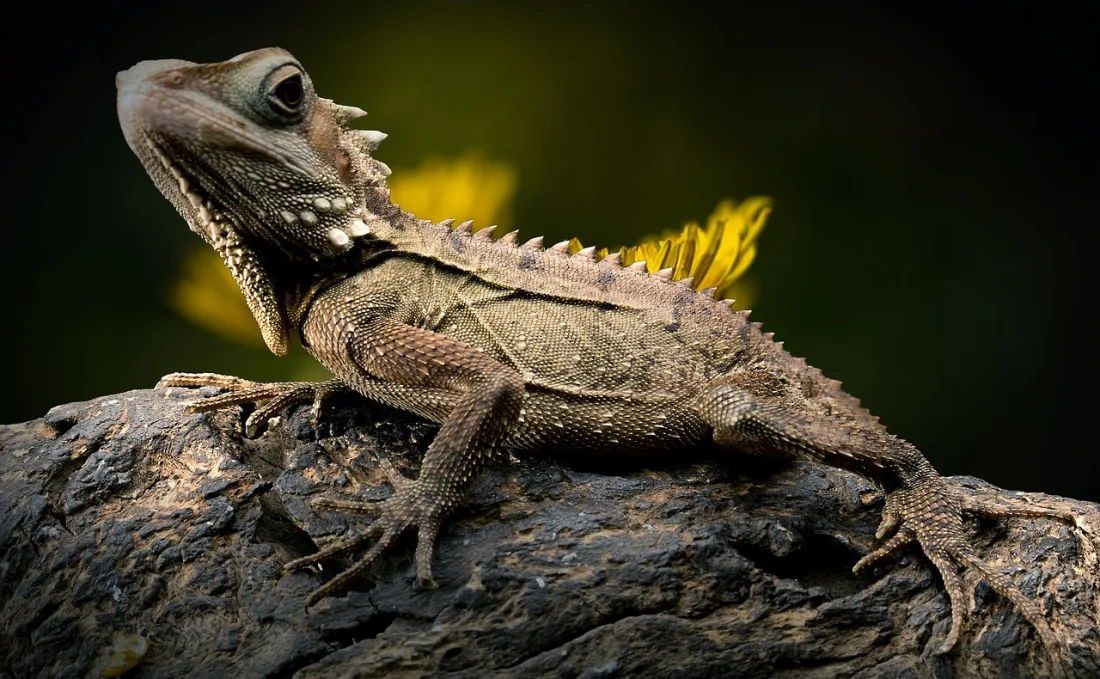
Cut scales go on like roof shingles. Start at the tail tip and work towards the head, each new row covering the attached edge of the row before, so every free edge points back towards the tail. Shading helps too: a darker shade along the spine, fading to the belly colour down the sides, makes even a smooth dragon look scaled at a distance. Use the reverse needle sparingly; on a body this size a full nap hides the shape.
How do you add horns, spines and claws?
- Horns. Wrap ivory or bone-coloured wool tightly round a short piece of 22 gauge floral wire, thick at the base and tapering to a point, and needle it firm. Leave the base fibres loose, push the wire into the head and needle the loose fibre down. The wire lets you curve horns back over the neck and keeps them from flopping.
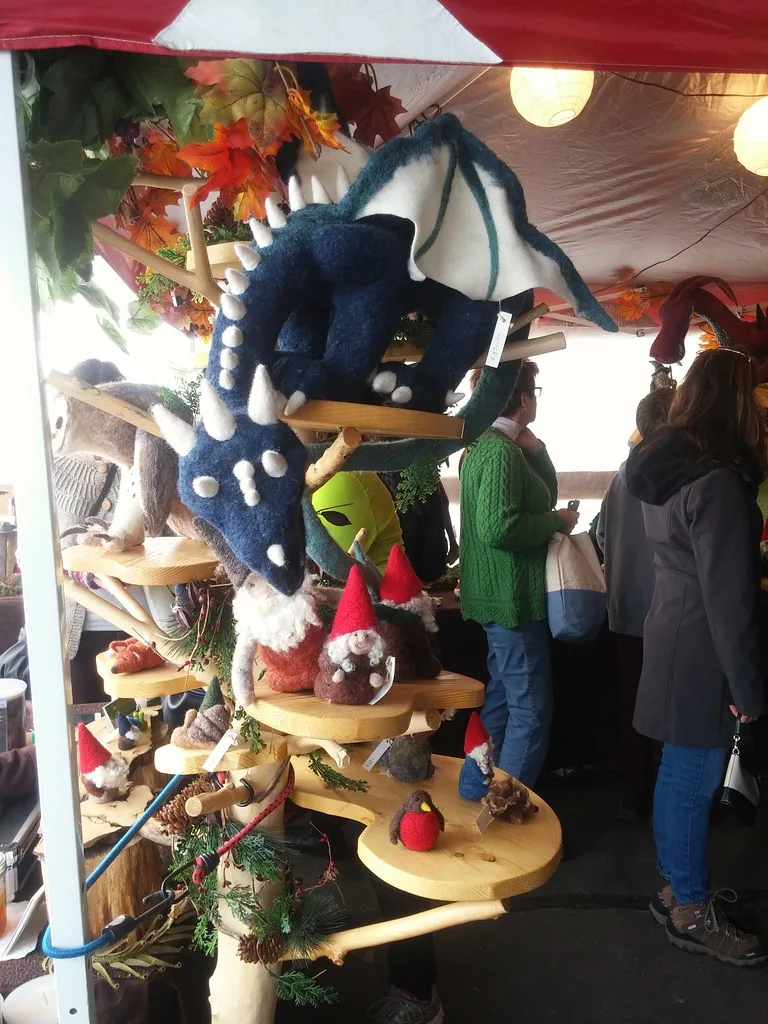
- Spines. Felt small flat triangles on the foam pad with loose fibre left along the bottom edge, then needle each one onto the ridge of the neck, back and tail. Grade the sizes: largest over the shoulders, smaller up the neck to the head and down the tail to a point. A continuous frill, felted as one strip with a scalloped top edge, is quicker and suits a sea dragon.
- Brow ridges. Needle a small ridge of wool over each eye socket. Raised brows are what make a felted head look like a dragon and not a dog.
Should a felted dragon have glass eyes or felted eyes?
Glass eyes for a display dragon, felted eyes for anything a child will hold. Glass catches light the way a real eye does, and pairs with slit pupils, sold for cats and reptiles, are the obvious choice. Use about 4 to 6 mm eyes for a sitting dragon and 8 to 10 mm for a standing one. Set them towards the sides of the head under the brow ridges, recessed into a socket, as described in needle felting eyes. Felted eyes can carry a slit pupil too: a gold or green iris with a thin black vertical line needled down the middle.
What colours work for a felted dragon?
Almost any, as long as the belly is paler than the back and the wings are either lighter than the body or a strong contrast to it.
- Green with a cream or pale yellow belly and ivory horns. The classic, and forgiving, because two or three greens blend into a natural shaded back.
- Red with a gold belly and dark horns. Blend in a little orange along the sides so it does not look flat.
- Blue or teal with a silver-grey belly. A pinch of Angelina fibre in the wing membrane gives it a shine.
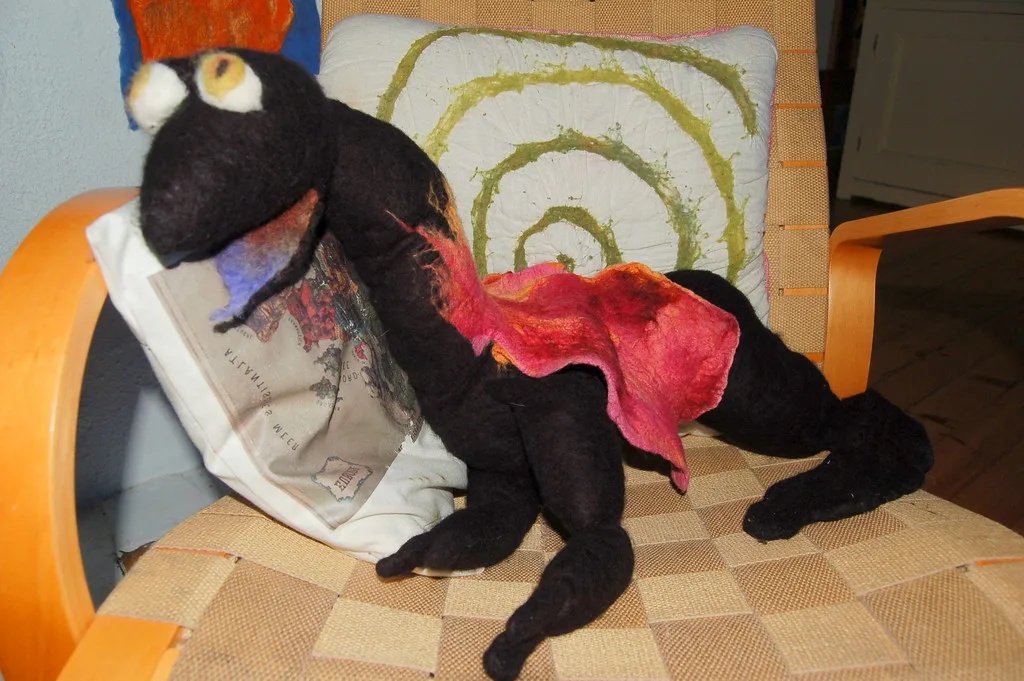
- Black or charcoal with red, purple or orange wings. Dark bodies hide needle marks and scale lines, so let the wings carry the colour.
- White or ice blue with pale grey shading and pearly horns, for a winter dragon.
Blend the body colours before you lay them on rather than needling stripes; the method is in how to blend wool colours.
Is a needle felted dragon a toy?
No, not for small children. A wired dragon has an aluminium skeleton, wire in the wings and horns, glass eyes and small spines, and any of them can work loose or poke through with rough play. Squeeze every cut wire end flat with pliers and bury it deep, and treat the finished dragon as a display piece. For a younger child, make a curled dragon with no wire at all, felted eyes and soft rounded spines; more on the risks is in is needle felting dangerous.
If this is your first animal with wire in it, a needle felted fox curled asleep is a good warm-up: the same body-and-tail shaping, with no wings.
Frequently asked questions
How do you needle felt a dragon?
Pick a sitting or curled pose, bend one length of aluminium wire for the head, neck, spine and tail, and wrap it in core wool. Build the body and haunches round it in core wool, fix two wire-framed wings to the spine at the shoulders, then cover everything in a thin merino top coat and add scales, spines, horns and eyes.
Does a needle felted dragon need a wire armature?
A curled, sleeping dragon does not; the tail can be felted solid round the body. Any dragon with a raised neck, a free tail or wings that stand up needs wire: a neck or wing slim enough to look right sags without it, and one felted stiff enough to stand unaided ends up too thick.
How much wool do you need for a needle felted dragon?
About 30 to 45 g (1 to 1½ oz) for a sitting dragon 4 to 5 in (10 to 12 cm) tall: most of it core wool, 6 to 10 g of merino for the top coat, and 2 to 4 g for the wings. A curled palm-sized one takes 15 to 25 g; a standing dragon 6 in (15 cm) tall takes 90 to 130 g.
How do you make wings for a felted dragon?
Bend a frame of fine cloth-covered floral wire like a bat wing: a leading edge with three or four finger spars fanning out from a wrist joint. Lay thin merino over it on a foam pad, needle beside the wires on both sides until the membrane is 2 to 3 mm thick, and leave a 1 in (2.5 cm) wire tail at the base to fix into the shoulders.
Is a needle felted dragon safe for a child?
Not for a young child. A dragon usually has a wire armature, wired wings and horns, glass eyes and small spines, all of which can come loose or work through the wool with rough play. Treat it as a display piece, and make one with no wire and felted eyes if it is for a child to handle.
Image credits
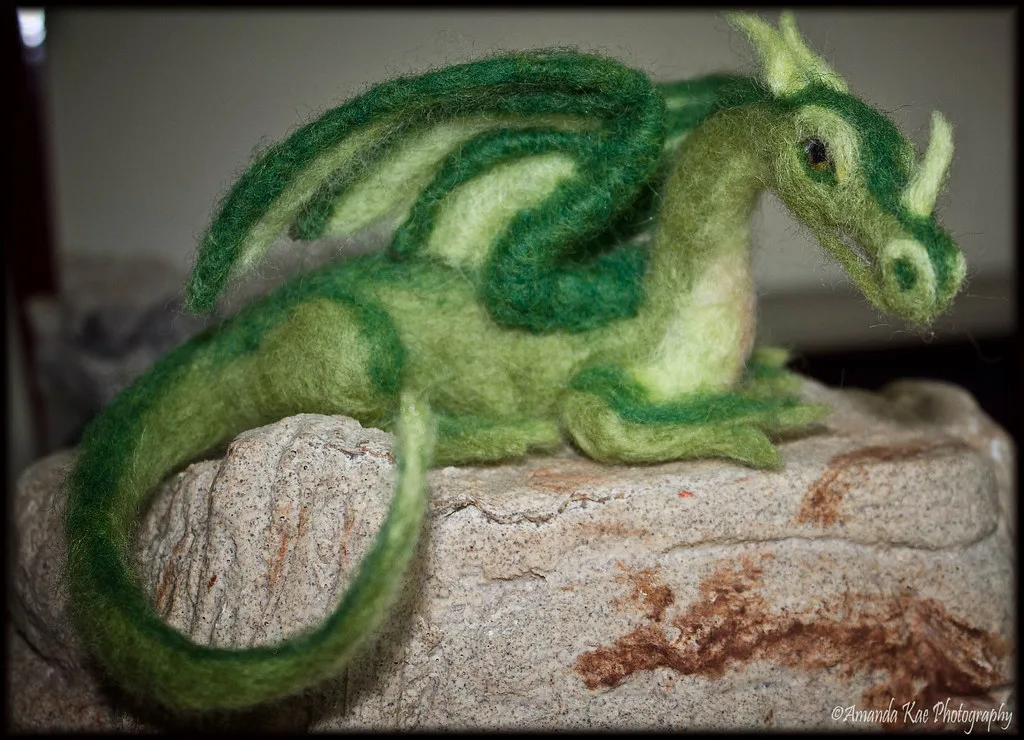
- A green needle felted dragon lying on a rock, with a long curled tail, raised two-tone green wings, a pale green belly and small cream horns — Amanda Kae's Photoz (BY)
- A large dark blue felted dragon with white spikes along its back and white-spotted sides, draped over a wooden display stand above felted gnomes at a craft fair, its blue-veined white wing raised — moonrat42 (BY SA)
- A brown forest dragon lizard on a branch, with a row of pale spines along its neck and back and small overlapping scales on its body — PIRO4D (Pixabay Content License)
- A large black felted dragon with long legs and pale eyes lying across a cushion on a chair, its red and pink felt wings spread over its back — ingermaaike2 (BY)