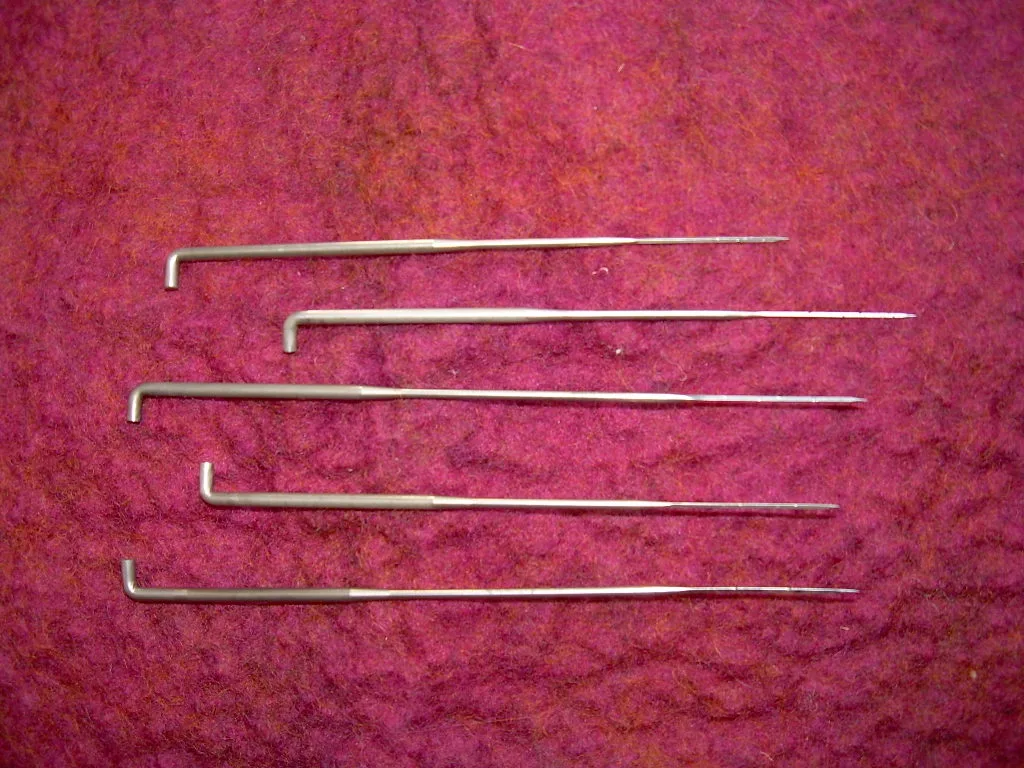
Felting Needles Explained: Sizes, a Gauge Chart and Shapes
6 min read
We may earn a commission from links on this page, at no extra cost to you. As an Amazon Associate I earn from qualifying purchases. Learn more.
A gauge chart from 32 to 46, what each felting needle size is for, how triangle, star and reverse needles differ, and the smallest set that covers everything a beginner makes.
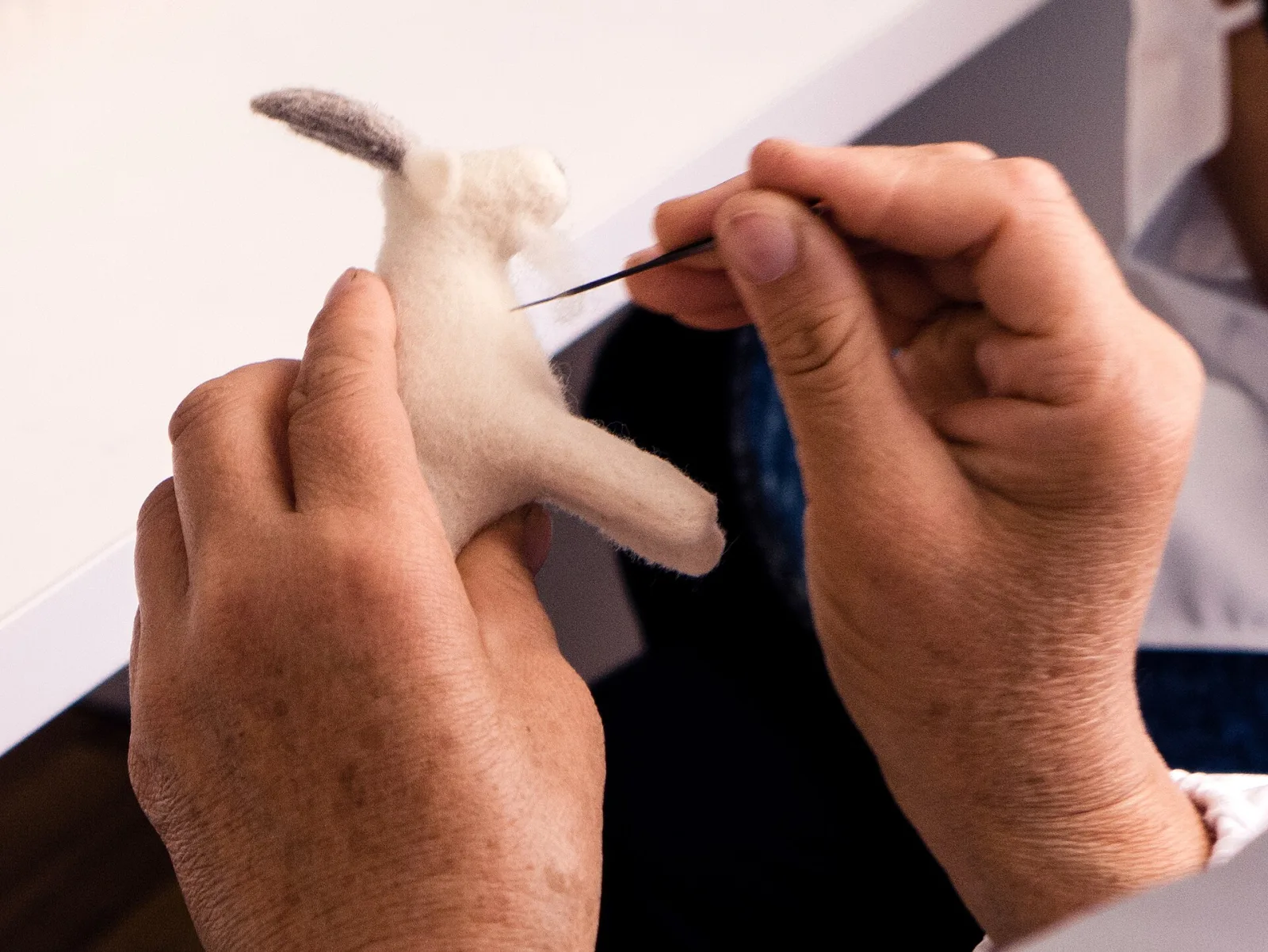
Felting needles look interchangeable and are not. The difference between a 36 and a 40 is the difference between rough shaping and invisible finishing, and using the wrong one is why some projects stay fuzzy no matter how long you work at them.
Here is what the numbers and shapes actually mean.
Gauge: the number is backwards
Gauge measures thickness, and it runs in the opposite direction to intuition: a higher number is a thinner needle. The scale comes from wire drawing, where the number counts how many times the wire was pulled through a die. More passes, thinner wire.
| Gauge | Feel | What it is for | Mark it leaves |
|---|---|---|---|
| 32 | Very coarse | Rugs, carpet wool, heavy joins | Obvious holes |
| 36 | Coarse | Cores, bulk, the first half of any shape | Visible pitting |
| 38 | Medium, all-purpose | Shaping, attaching colour, most of the work | Closes up as you go |
| 40 | Fine | Surface, firming, tidying stray fibre | Almost none |
| 42 | Very fine | Faces, fur direction, thin colour | None visible |
| 46 | Finest | Miniatures, single wisps of fibre | None; snaps easily |
If you take one thing from the chart: coarse for inside, fine for outside. A sensible progression through a single project is 36 for the rough mass, 38 for the shape, 40 for the surface. That order is not a rule someone invented. A fine needle cannot move enough fibre to compact loose wool in reasonable time, and a coarse one always leaves holes you then have to hide.
36: bulk
A 36 moves more fibre per stroke than anything else you will use by hand, which is what you want when a handful of loose wool has to become a firm core. Its cost is the surface: the barbs leave craters that do not disappear later, you cover them. Pair it with cheap undyed core wool and the stage goes quickly.
38: the workhorse
If you own one gauge, own this one. A 38 builds shape at a reasonable speed and leaves marks that close up as you keep working, so you can take a piece from loose wool to nearly finished without changing needles. Most people spend two-thirds of their working time on one, and beginners should start here rather than with a 36: slower progress, no surface to repair.
40: finishing
A 40 firms a surface that is already dense, tucks stray ends back in, and lays a thin layer of colour without dragging the layer beneath into it. It is also the needle to reach for when a piece has gone hard and a 38 has stopped biting. That is a sign to go finer, not to push harder; pushing harder is how needles break.
42 and finer: detail
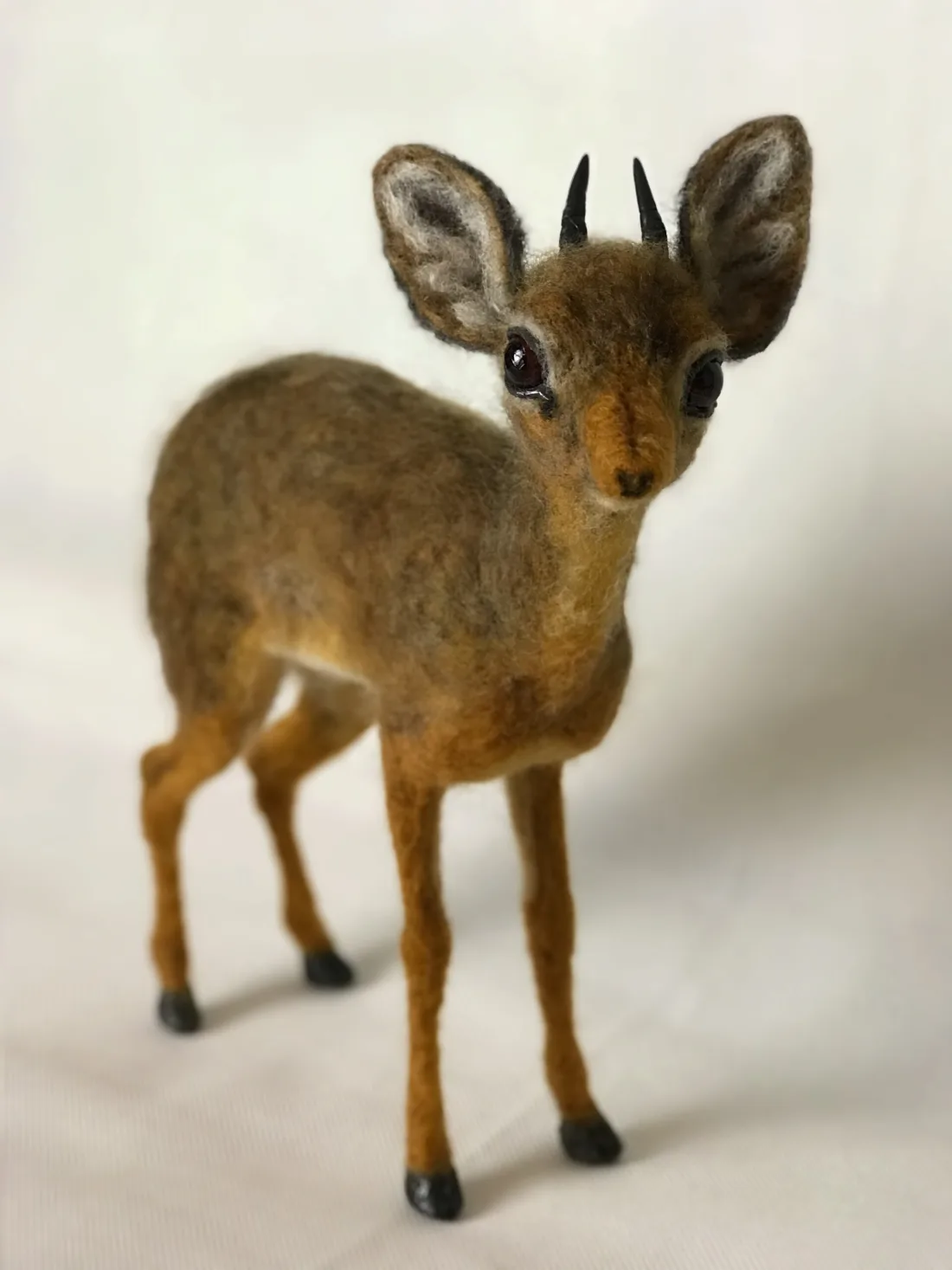
Eye sockets, fur direction, a whisker of colour on a cheek: work where even a 40 leaves too much of a mark. A 42 is noticeably more fragile and snaps if you angle it while it is buried. You will want one the first time you try eyes or an animal's coat.
Why there are no millimetre figures
Because they would be made up. Manufacturers do not publish diameters for craft needles, and a 38 from one maker does not reliably match a 38 from another. Any chart quoting exact millimetres for every gauge is reporting one brand's numbers as if they were universal. Use gauge as a relative scale and calibrate by the mark the needle leaves in your wool.
Colour codes are not a standard either
Many sellers dip the crank in paint so you can sort gauges at a glance, which is genuinely useful, but each seller picks its own colours. Red does not mean 38 everywhere. Keep the packaging, or keep gauges in separate tubes, because once they are loose in a drawer the only way to tell a 38 from a 40 is to felt with them.
Shape: what the cross-section does
Triangle needles
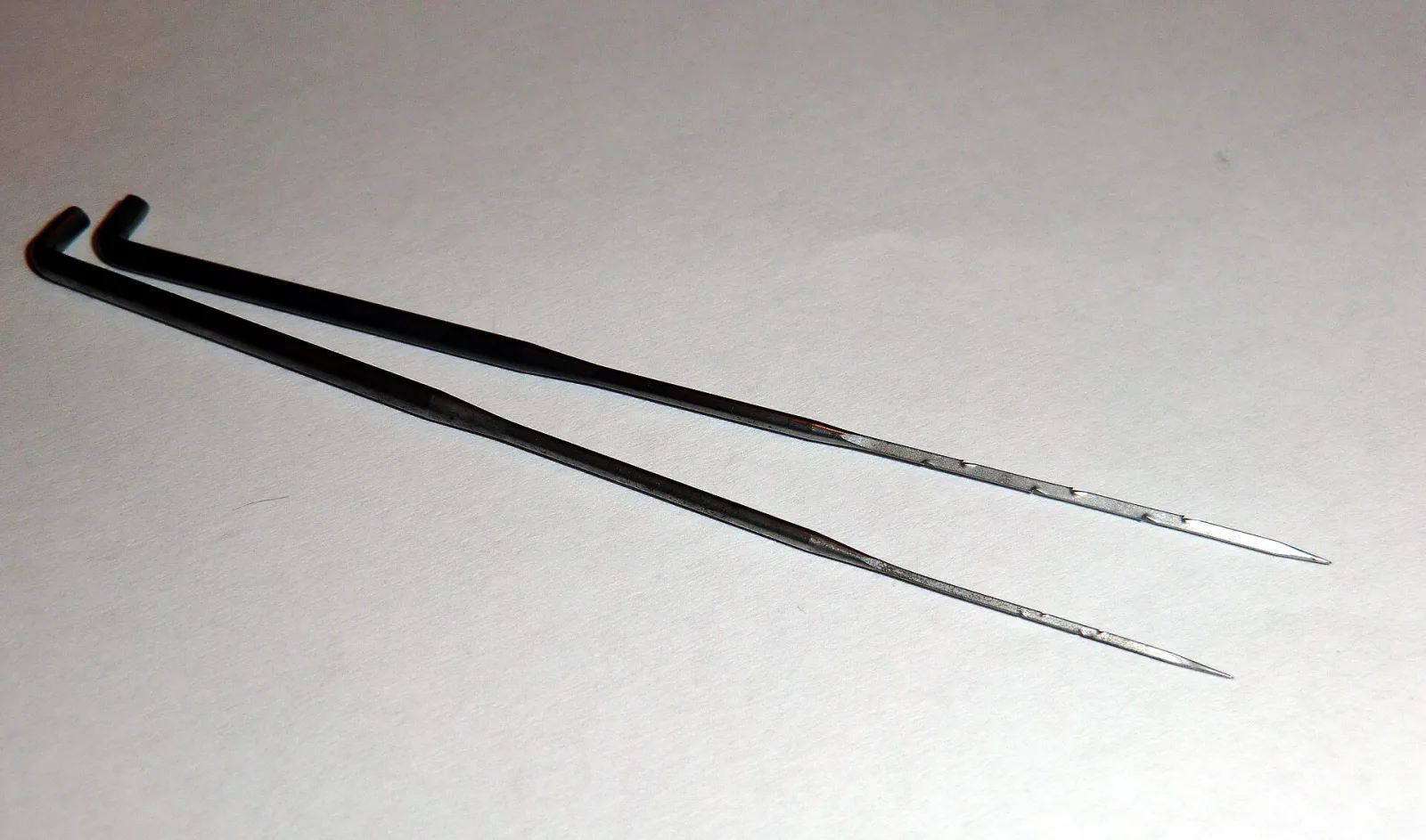
Three sides, barbs on each edge. The default, and what you get in almost every kit. Triangle needles move a lot of fibre per stroke, which makes them efficient but leaves more visible holes than star needles at the same gauge.
Star needles (four-sided)
Four edges instead of three, so more barbs are in contact and each barb does less work. The result is faster felting with a smoother surface and smaller holes. Many felters switch to 38 star needles for general work and never go back.
Reverse needles
The barbs face the other way, so instead of pushing fibre in, they pull it out. This sounds like a mistake and is enormously useful: reverse needles create fur, fluff a matted surface, and pull a contrasting under-colour up through the top layer. They are a texture tool, not a construction tool.
Spiral or twisted needles
A triangle blade twisted along its length, which spreads the barbs around the shaft. They give a very smooth finish and are gentler on the surface. Worth trying once you know what you like; not needed at the start.
Crown needles
Barbs only near the tip. They attach a surface layer without dragging the colour deep into the core — the tool of choice for applying a thin coloured skin over core wool without the under-colour showing through.
Which sizes to own
- Starting out: five 38s, triangle or star. Genuinely enough for the first few projects.
- Once you are making shapes: add two or three 36s for cores and three 40s for surfaces. That is the standard working trio.
- Once you are making faces or animals: add a 42, and a reverse needle for raising fur.
- Rugs, bags or carpet wool: add a 32, and expect it to be the only gauge that copes.
Buy multiples of each. Needles are consumable: they snap, and they lose their bite long before they break. A needle that suddenly feels like it is doing nothing has usually gone blunt.
Multi-needle holders, which grip three to seven needles at once, are worth adding when you start making larger flat pieces; see needle felting pens. On small sculptural work they remove the control you actually need. If you are buying everything at once, felting kits goes through what a packaged needle kit contains and which parts are worth the money.
Matching gauge to wool
Coarse wool takes a coarse needle; fine wool does not. Merino is fine enough that a 36 tears rather than compacts it, so surface work in merino wants a 40 (see merino wool for felting). Coarser breeds and carding blends take a 36 happily and felt faster for it.
If a needle seems to be doing nothing at all, check the wool before the needle: superwash fibre has had its scales stripped and will not felt at any gauge. Why won't my wool felt goes through the other causes.
How long a needle lasts
There is no fixed lifespan. A needle used carefully on soft merino may outlast a dozen used carelessly on dense core wool. Two things end a needle's life:
- Snapping, which is almost always caused by levering sideways rather than by needle quality. The fix is in our guide to needle breakage.
- Going blunt, as the barbs wear smooth. Blunt needles do not break; they just quietly make your work slower and hairier.
Keep a small pot for retired needles rather than mixing them back in with the good ones. Sorting a blunt 38 from a sharp 38 by eye is not realistic.
Storing them safely
Loose needles in a drawer will find your fingers. A cork block, a tin with a foam insert, or the tube they arrived in all work. The important part is that they are stored point-down or fully enclosed, and that gauges are kept separate — the difference between a 38 and a 40 is not something you can judge by looking at it across a table.
Once you have needles sorted, the other half of the equation is fibre: our guide to choosing wool for felting covers which fibres felt fast, which give the best surface, and which will not felt at all.
Frequently asked questions
What do felting needle gauge numbers mean?
The numbering runs backwards: the higher the gauge, the finer the needle. A 36 is coarse and moves wool quickly, a 40 is fine and leaves almost no visible holes, and most of the work in between is done with a 38.
Which felting needle should a beginner buy?
Start with 38-gauge triangles for general work, add a few 40s for finishing the surface and a few 36s for bulking out large shapes quickly. Those three gauges cover almost everything for a long time.
Do felting needle sizes come in millimetres?
Not usefully. Manufacturers do not publish consistent diameters, and the same stated gauge varies between makers, so a millimetre figure from one brand does not transfer to another. Treat gauge as a relative scale and judge by the mark the needle leaves.
What is a reverse felting needle for?
Its barbs face outwards, so it pulls fibre out of the work instead of pushing it in. That makes it a tool for raising fur and texture on a surface that is already felted, not for building shape.
How do I know when a felting needle is blunt?
It begins to drag, and you find yourself pushing harder for the same result. A blunt needle also breaks more readily than a sharp one, so replacing it is as much a safety decision as a quality one.