Felted Jewelry: Earrings, Brooches, Bracelets and Necklaces Made From Wool
8 min read Beginner
We may earn a commission from links on this page, at no extra cost to you. As an Amazon Associate I earn from qualifying purchases. Learn more.
Felt earrings that weigh almost nothing, brooches that sit upright, bead bracelets and necklaces: how dense to felt each one, how to fix the metal parts so they never pull out, and how to keep felt jewelry looking new.
A felt earring the size of a walnut weighs only a few grams, which is why felt is used for bold, oversized pieces that would drag on the earlobe in glass or metal. The cost is wear. Jewelry brushes against hair, collars and coat sleeves all day and rubs harder than anything else you will felt.
Two rules follow from that. Felt every piece well past the point where it looks finished, and fix every metal part through the felt rather than onto its surface. Made that way, a pair of felt earrings lasts for years.
Before you start: wool, findings and weight
- Wool. Fine merino for anything that touches skin, such as earrings that brush the neck and bracelets. Coarser wool felts harder and wears better but can prickle; is merino wool itchy explains where the line is. Brooches sit on clothing, so any wool will do.
- Findings. The metal parts: ear wires, eye pins, head pins, jump rings, pin backs and clasps. For very sensitive ears choose implant-grade titanium or niobium; surgical steel or sterling silver suits most people. Plated base metal is the usual cause of itchy earlobes.
- Weight. Even hard felt is mostly air, so a felt bead weighs a fraction of a glass bead the same size. A 1 cm felt bead is about a quarter of a gram, a 1.5 cm bead well under a gram and a 2.5 cm bead about 3 g. That is what lets felt earrings be big.
Felted earrings
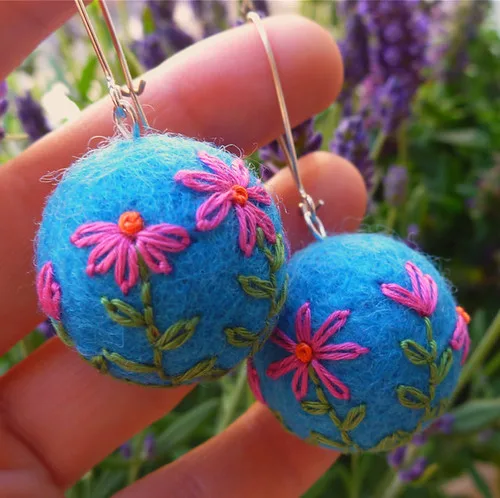
Earrings are seen at close range, so the finish matters more on them than on any other piece. There are four ways to make them.
1. Felt ball drops
The simplest pair: one or two wet felted balls on each ear wire. Make the balls ⅜ to ¾ in (1 to 2 cm) across and very hard, following how to make felt balls; for an exactly matched pair, weigh the wool for each ball so they finish the same size.
- Push an eye pin straight through the centre of the ball, or a head pin if the ball is the bottom of the drop. A long needle opens the channel first if the ball is too hard.
- Add a small metal or glass bead on top if you want one; it hides the hole and stops the felt wearing where the pin exits.
- Trim the wire to about 8 mm above the ball, bend it to a right angle, and turn a loop with round nose pliers.
- Open the loop on the ear wire sideways, never outwards, hook it on and close it.
Felt balls also take embroidery well, and a few lazy daisy flowers or a spiral of running stitch is enough. Use a single strand and stitch with the ball on the eye pin, so you have something to hold.
2. Flat wet felted shapes
Circles, arches, leaves and half moons cut from a sheet of wet felt. Lay out two thin layers of merino, felt it, then full it hard until it is about 2 to 3 mm thick and stiff enough to hold its shape when held by one edge; the method is in wet felting for beginners. A letter-size sheet, 8½ × 11 in, gives dozens of pairs.
Cut the shapes with sharp scissors or a leather punch, then work each cut edge with a little soap until the fibres close over, and rinse. Make the hanging hole 3 to 4 mm in from the edge with an awl, and fit a jump ring. Closer to the edge than that and the ring eventually tears through.
3. Needle felted shapes
Mushrooms, flowers, berries, tiny birds and animals. Keep them under about 1 in (2.5 cm), because a three-dimensional shape is heavier than a flat one and swings more. The fixing has to be built in rather than added:
- Bend a small closed loop in the end of an eye pin, push the straight end down through the core of the shape before the last surface layer goes on, and felt over the loop at the bottom so it cannot pull back through.
- Or felt a short doubled length of strong thread into the top of the core and tie the jump ring to it.
Then felt the surface to the hardness of a ball. The flower and mushroom shapes are the same as full-size ones, scaled down; see needle felted flowers and felted mushrooms.
4. Bead embroidered felt
Here felt is the foundation rather than the feature: seed beads stitched closely onto a small piece of stiff felt, then backed with a second layer.
- Draw the shape on stiff felt and stitch the beads inside the line, starting from the centre; how to sew beads on felt covers the stitches that hold.
- Cut out close to the beads, leaving 1 mm of felt.
- Cut a backing piece the same shape. For a stud, push the post through the backing from the inside first, so its pad is trapped between the two layers instead of glued on.
- Whip stitch or bead stitch the two layers together all the way round.
Felt brooches
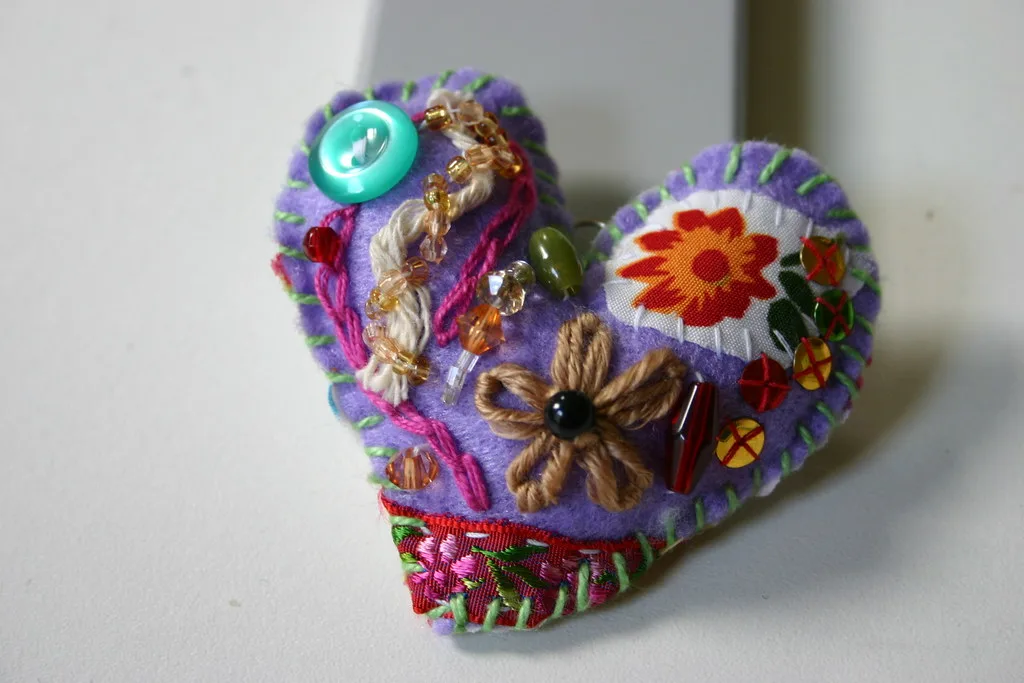
A brooch is the most forgiving felt jewelry, because it is pinned to fabric and does not move against skin. It can be larger, 1½ to 2¾ in (4 to 7 cm), and as decorative as you like.
- Needle felted flat. A bird, cat, fox head, leaf or flower worked flat on a foam pad, 4 to 6 mm thick. Birds suit it especially well; the shapes are in needle felted birds. Keep the back finished but flat, so it sits against the cloth.
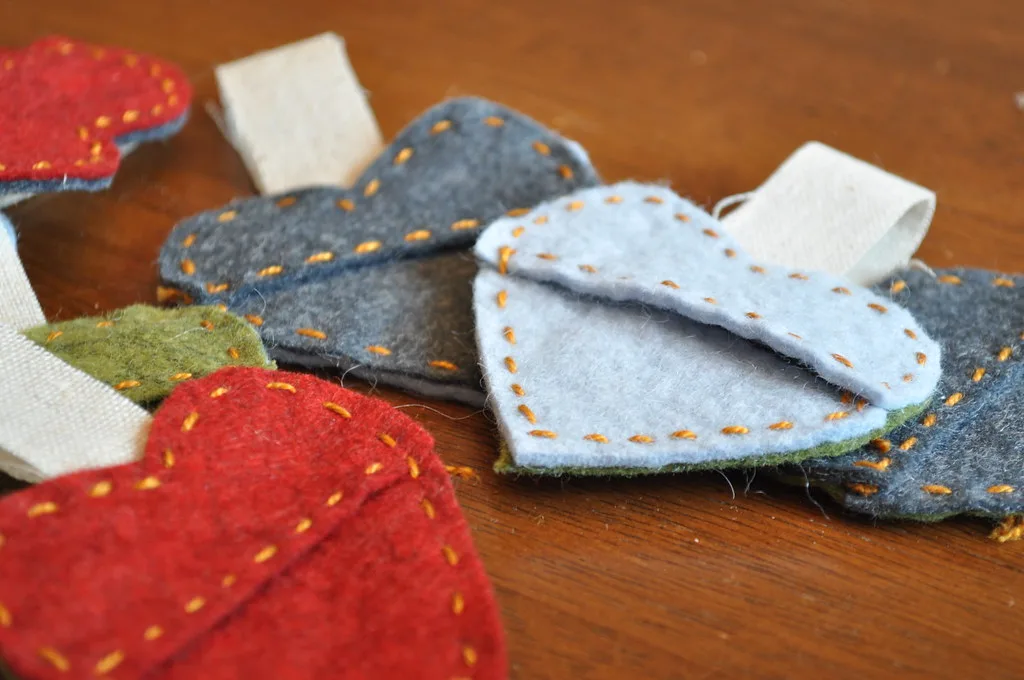
- Cut and stitched. Two layers of felt sheet blanket stitched together, decorated with embroidery and a few beads before the layers are joined. Hearts are the usual shape, and the template is in felted heart.
- Felt flower pin. A rolled rose or a stack of petals from felt flowers, with a felt circle stitched to the back to carry the pin. This is what most "felt flower pin" patterns are.
Attach the pin back properly. Stitch it through the holes in its bar onto a small oval of felt, then stitch that oval to the back of the brooch, so no stitches show at the front. Set it in the upper third, above the brooch's centre of weight. A pin set in the middle lets the brooch tip forward and hang face down from a coat.
Felt bracelets
Bracelets are the hardest test of felt, because a wrist rubs against everything. Two kinds hold up.
Felt bead stretch bracelet
Felt beads strung on 1 mm stretch cord. Measure the wrist and add about ½ in (1.5 cm) for small beads, or about 1 in (2.5 cm) for large ones, because chunky beads take up room on the inside of the circle. A 6 in wrist takes roughly sixteen 1 cm beads, or twelve 1.5 cm beads. Mixing in a few wooden or glass beads gives the bracelet weight so it hangs instead of riding up.
Stretch the cord several times before stringing, so it does not loosen later, then tie a surgeon's knot and pull it back inside the nearest bead. Make the beads around a straw so the holes stay open, as described in how to make felt beads; piercing a bead once it is dry often splits it.
Felt cuff
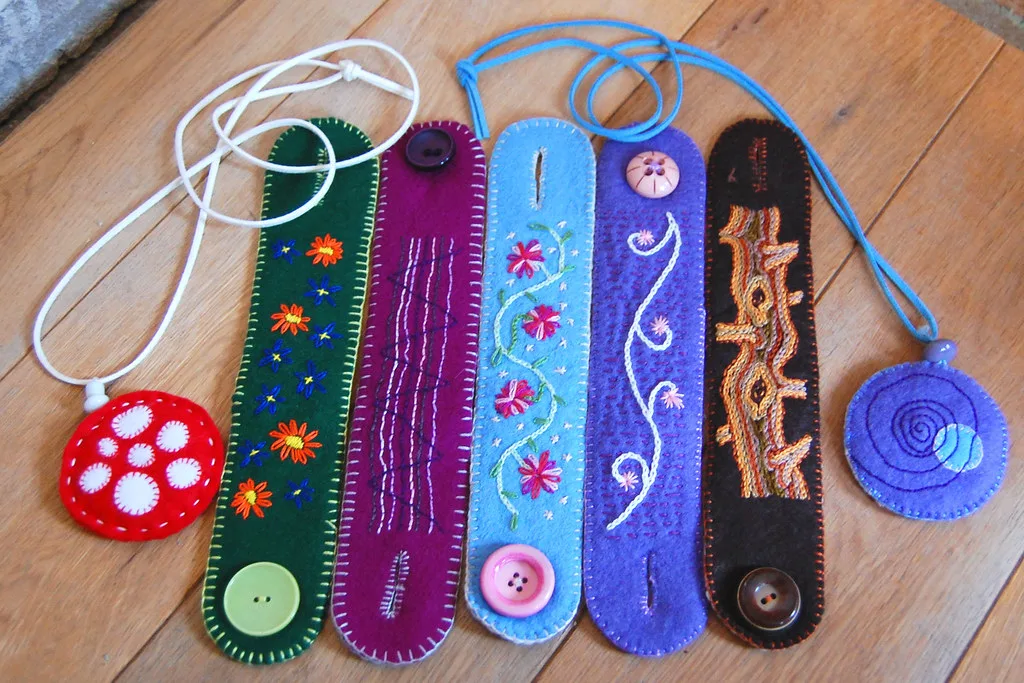
A strip of firmly fulled wet felt, or two layers of felt sheet stitched together, about 1½ to 2 in (4 to 5 cm) wide and long enough to overlap by 1 in (2.5 cm) at the wrist. Close it with a button and a slit buttonhole, or a sew-on snap. Embroider the surface before you stitch any lining, so the back of the stitching is hidden. A nuno felted cuff, with silk felted into the wool, wears noticeably better than plain felt, because the fabric takes the rubbing; see nuno felting for beginners.
Felt ball necklaces and pendants
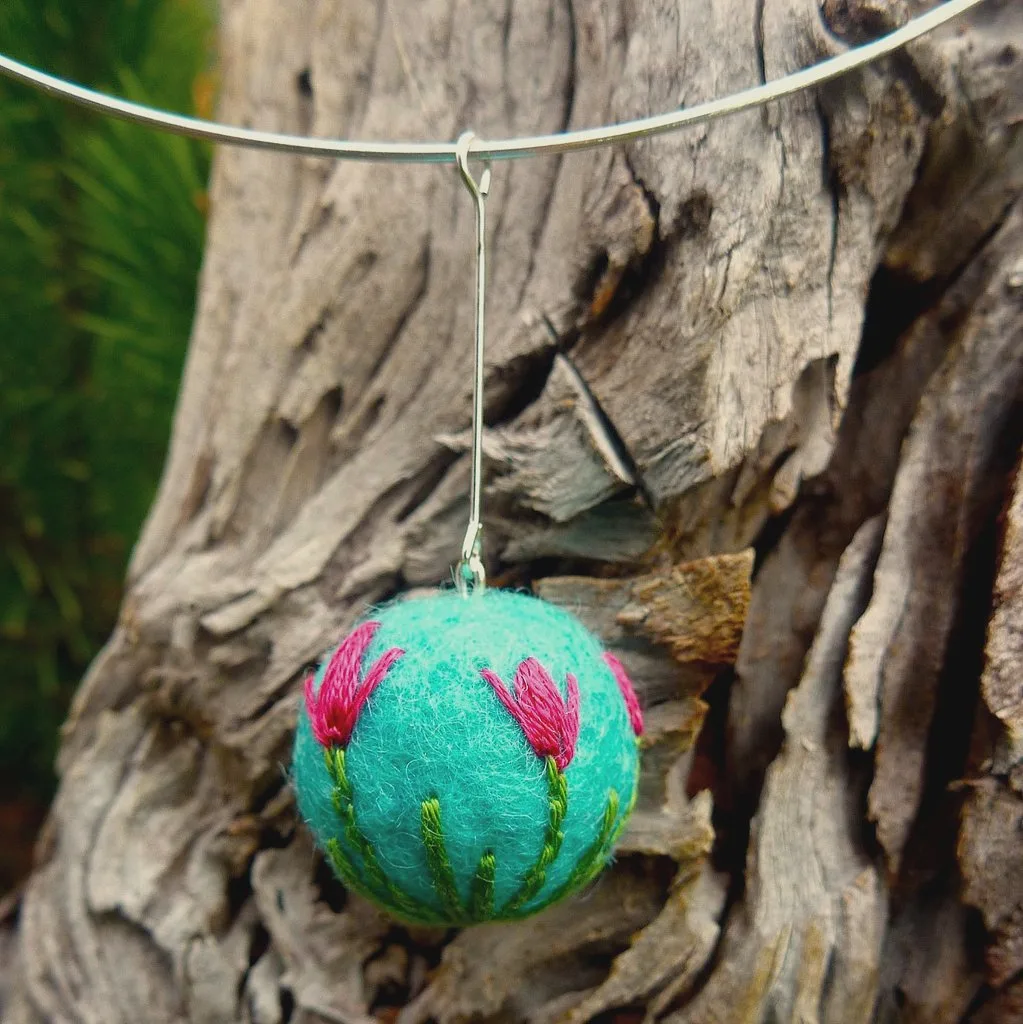
A felt ball necklace is the quickest piece of felt jewelry that looks finished: a row of felt balls, usually graded in size, with smaller wooden or metal beads between them. Knot the cord between beads if you want them to stay spaced, or thread them on a chain using eye pins, as with earrings.
- Lengths: 16 in sits at the base of the neck, 18 in just below the collarbone, and 20 to 24 in hangs onto the chest. Felt balls are large, so most felt necklaces look best at 18 to 20 in.
- A single pendant: one needle felted ball or shape on a leather thong or a neck wire, with the hanging loop felted into the core.
- Children: make them with a breakaway clasp, and never for babies. Felt bead teething necklaces are sold widely, but beaded necklaces on babies are a choking and strangulation risk, and the FDA has warned against teething jewelry altogether.
Pilling, damp and moths
- Hard felt pills less. A finished drop should not dent under a firm pinch. Soft surfaces start to pill within a week of wear.
- Shave pills off. Pills that do appear come off cleanly with a fabric shaver or small curved scissors. Pulling them drags more fibre to the surface.
- Keep it dry. Take earrings and bracelets off before washing your hands or swimming. If a piece gets dirty, dab it with a damp cloth and a drop of wool wash, then let it dry flat.
- Store it flat and boxed. Felt crushes and does not always recover, and a jewelry drawer is the kind of quiet, undisturbed wool store moths like. Keep it in a closed box, and see protecting wool from moths.
The same techniques make small things to wear that are not quite jewelry: felt bag charms on a clasp, and felt animal hair clips, which have their own trick for fixing the clip so it does not peel off.
Frequently asked questions
Are felt earrings heavy?
No, which is their main appeal. A hard 1.5 cm felt ball weighs well under a gram and even a 2.5 cm one only about 3 g, so felt earrings can be large and bold without dragging on the earlobe the way glass or metal pieces of the same size do.
How do you attach an earring hook to felt?
Through the felt, not onto it. For a ball or needle felted shape, push an eye pin right through it, trim and bend the end into a loop, and hang the ear wire from the eye. For a flat piece, make a hole 3 to 4 mm in from the edge with an awl and use a jump ring. Glue alone pulls out within weeks.
How do you attach a pin back to a felt brooch?
Stitch it to a small patch of felt through the holes in the pin back, then stitch or felt that patch onto the back of the brooch, so the stitches never show on the front. Place the pin above the middle, in the upper third, or the brooch tips forward when worn.
How do you stop felt jewelry from pilling?
Felt it harder in the first place, and finish the surface with a fine 40 gauge needle or extra rolling until no fibre lifts under a fingernail. Pills that appear later can be shaved off with a fabric shaver or trimmed with small scissors.
Are felt ball necklaces safe for babies?
No. Felt bead and teething necklaces are a choking and strangulation risk for babies and young children, and the FDA has warned against teething jewelry of any kind. Make felt ball necklaces for adults and older children only.
Topics
Image credits
- Five felt cuff bracelets with embroidered flowers and swirls and button closures, beside two round felt pendants on cords — Studio Paars (BY)
- A pair of turquoise felted ball earrings embroidered with pink flowers and green leaves, held up in front of lavender — gypsy colours (BY)
- A lilac felt heart, blanket stitched round the edge and covered in embroidered flowers, buttons and beads — bymanu (BY)
- A turquoise felted ball pendant embroidered with pink tulips, hanging from a silver neck wire — gypsy colours (BY)