Felt Mouse Ornament: A Christmas Mouse in a Sweater, Needle Felted or Sewn
10 min read Intermediate
We may earn a commission from links on this page, at no extra cost to you. As an Amazon Associate I earn from qualifying purchases. Learn more.
How to make a dressed Christmas mouse ornament that hangs upright: a needle felted mouse with wire in its arms so it can hold a candy cane or a gift, a sewn version from sheet felt with every piece measured, plus ears, tails, tiny sweaters and scarves.
A mouse ornament hangs from one thread behind its ears, and anything it carries in front (a candy cane, a gift, a letter for Santa) tips its nose down unless the arms hold the prop close to the chest. That is why the needle felted mouse here has wire in its arms: they hug whatever it holds and keep the weight over its feet.
There are two versions: a needle felted mouse about 3½ in (9 cm) tall, and a flat sewn mouse cut from sheet felt, a batch of which takes an evening. For a plain mouse with no clothes, start with how to make felt mice; this page builds on that teardrop body.
Needle felted or sewn: which mouse ornament should you make?
| Needle felted | Sewn from sheet felt | |
|---|---|---|
| Shape | Round, standing or sitting, seen from every side | Flat, seen from the front, lightly stuffed |
| Holds a prop | Yes, with wire in the arms | Props are stitched on flat |
| Clothes | Knitted or felt sweater, felt scarf, hat | Sweater and scarf cut from felt and appliquéd |
| Time for one | 3–4 hours with clothes | About 1 hour |
| Good for | A keepsake, a gift for one person | A set for the tree, a class or a gift tag |
Make the sewn one with children, who can stitch the pieces from about age 7.
How big should a needle felted mouse ornament be?
Aim for 3½ in (9 cm) from the top of the head to the soles of the feet, standing upright. At that size the arms are thick enough to cover the wire and the sweater can be knitted on sock needles.
| Height | Body (pear shape) | Head | Wool, before clothes |
|---|---|---|---|
| 2½ in (6 cm) | 1¼ in (3.2 cm) tall | ¾ in (2 cm) across | About ⅛ oz (3–4 g) |
| 3½ in (9 cm) | 1¾ in (4.5 cm) tall, 1¼ in (3.2 cm) wide | 1 in (2.5 cm) across | About ⅓ oz (9–11 g) |
| 4½ in (11.5 cm) | 2¼ in (5.7 cm) tall | 1¼ in (3.2 cm) across | About ¾ oz (19–23 g) |
Most of each weight is core wool, with about ⅛ oz (3 g) of gray or cream on the surface of the middle size; a knitted sweater adds 1–2 g. Keep an ornament for an outer branch under about ½ oz (14 g). The large size belongs on a sturdy inner branch or a shelf.
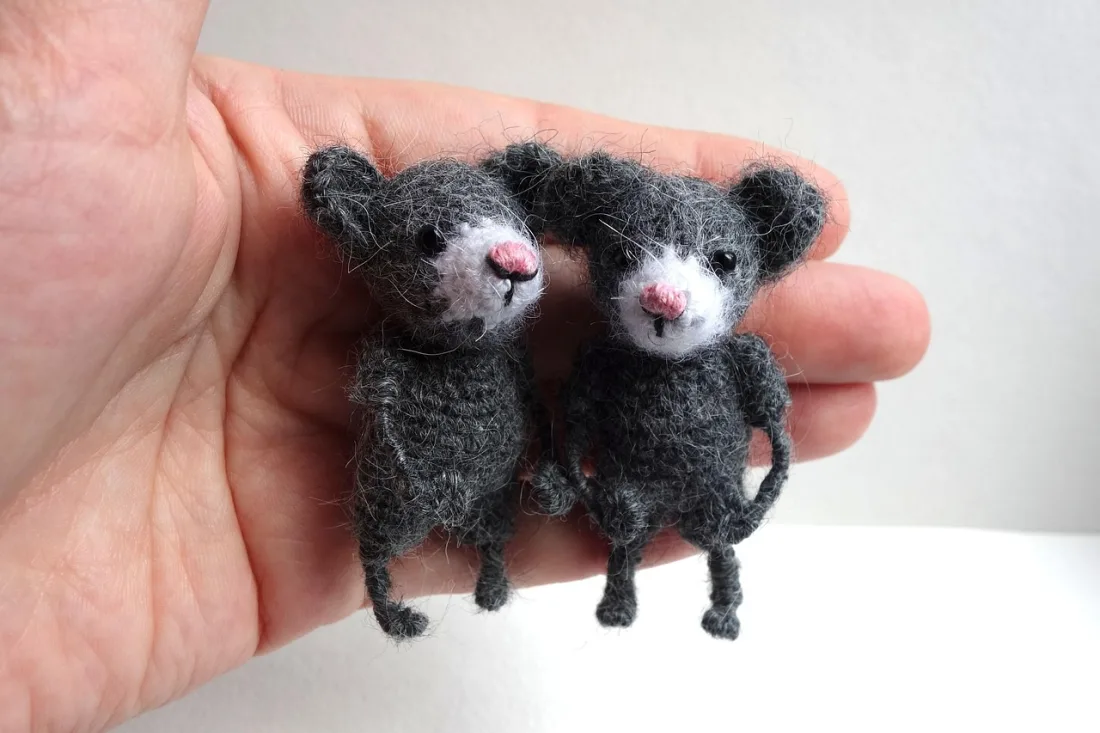
How do you needle felt a Christmas mouse with posable arms?
Build the armature first, then felt around it. If you have never felted over wire, wire armatures for needle felting explains the wrapping, and needle felting for beginners covers needles and foam if this is your first figure.
- Bend the wire. Use two pipe cleaners or 22 gauge craft wire. Bend one into a U for the legs, each leg 1 in (2.5 cm) long with a small flat loop at the bottom for the foot. Lay the second straight across the top of the U for the arms, 3 in (7.5 cm) tip to tip, and twist the two together where they cross. Fold each wire end back on itself by ⅛ in so no cut tip can poke through the wool.
- Felt the body around the frame. Wrap core wool tightly around the crossing point and down to the hips, building a pear that is wider at the bottom. Needle with a 38 gauge, turning it all the time, until it is 1¾ in (4.5 cm) tall and barely gives when squeezed. Keep the needle off the wire; felt beside it, not into it.
- Felt the head separately. Make a 1 in (2.5 cm) teardrop of core wool with the point as the nose, leaving the wide back end loose and fluffy. Needle the loose fibers onto the body from several angles, with the head turned very slightly to one side, so the mouse looks at something.
- Wrap the arms and legs. Wind thin strips of wool around each arm wire from the shoulder outward, needling as you go, to about ¼ in (6 mm) thick. Leave the paws as tiny pink or gray ovals. Give the legs a little more bulk at the thigh and flatten the feet against the foam so the mouse can stand.
- Cover it. Needle thin veils of gray, brown or cream over everything with a 40 gauge at a shallow angle. Under a sweater, the body can stay core wool.
- Add the face. Needle a small pink or black nose onto the tip, then sink two eye sockets close to the nose and fill them with black wool, or use 3 mm black beads stitched through the head. Needle felting eyes shows how to set them so the mouse doesn't look startled.
How do you make the ears and tail?
Ears with a pink inner layer
Felt a flat gray disc about ⅞ in (2.2 cm) across on a foam pad, flipping it often, then lay a thin wisp of pink on one face and needle it in, leaving a gray rim about 1/16 in (2 mm) wide. Cut the disc in half to get two matching ears with a straight base. Fold each base slightly into a cup and needle it onto the head well back and to the sides, the inner pink facing forward. Ears set high and close together make a rabbit. For a hat-wearing mouse, cut slits in the hat for the ears.
Tails: wire-cored wool or cord
- Wire-cored wool. Cut 4 in (10 cm) of fine wire, fold one end into a tiny loop, and wrap a very thin strip of pink or gray wool around it, needling lightly against the foam as you rotate it. Push the bare end ¾ in (2 cm) into the base of the body and needle over the entry point. The tail can then curl around the hanging thread or a branch.
- Cord. A 3 in (7.5 cm) length of pink cotton cord or six strands of floss, knotted at the far end. Push the other end deep into the body with a felting needle or an awl and needle wool over it. It hangs straight down, which is fine for a mouse that dangles.
Either way, make the tail about as long as the body and head together. A short tail looks like a hamster.
How do you dress a felt mouse in a sweater, scarf and hat?
Knitted sweater
Use US 1 or 2 (2.25–2.75 mm) needles and fingering weight wool yarn in red, green or cream. Around the middle-size body, which is about 4 in (10 cm) around, cast on 24 stitches and work in the round. Knit 2 rounds of k1, p1 rib, then plain knit until it is 1 in (2.5 cm) long, and bind off loosely. Pull it on over the head before the ears go on, snip two tiny holes at the sides for the arms, and catch the edges with sewing thread. Sleeves are optional; from the tree, a tube with the arms poking out reads as a sweater.
Felt sweater
Cut a rectangle of thin wool felt 4 × 1 in (10 × 2.5 cm), wrap it around the body under the arms, and whip stitch the overlap at the back. A row of white French knots across the chest gives it a pattern. Or needle felt the sweater straight onto the body in red wool, the lightest option of all.
Scarf and hat
- Scarf: a strip of felt ¼ × 5 in (6 mm × 13 cm), snipped into fringe at each end, wrapped once and tacked at the side of the neck. Or knit one on 4 stitches in garter stitch.
- Hat: a quarter circle of felt with a 2 in (5 cm) radius rolled into a cone and whip stitched, with a white felt ball or a tuft of wool at the tip. Tack it on at a slant over one ear.
What pattern pieces do you need for a sewn felt mouse ornament?
The sewn mouse faces forward, standing, with its ears outside the outline and its arms stitched across its sweater. Cut all pieces at the finished size; the edges are joined with blanket stitch over the cut edge, so there is no seam allowance.
| Piece | Size | Cut |
|---|---|---|
| Head and body, one outline | 3¼ in (8 cm) tall, 2 in (5 cm) wide at the hips, head a 1½ in (3.8 cm) circle | 2 in gray |
| Ears | 1 in (2.5 cm) circles | 4 in gray |
| Inner ears | ⅝ in (1.6 cm) circles | 2 in pink |
| Sweater | The body outline below the neck, 1½ in (3.8 cm) tall | 1 in red or green |
| Arms | 1¼ × ⅜ in (3.2 × 1 cm), rounded ends | 2 in the sweater color |
| Feet | ¾ × ½ in (2 × 1.3 cm) ovals | 2 in pink or gray |
| Tail | 3 in (7.5 cm) of cord or twisted floss | 1 |
A 9 × 12 in (23 × 30 cm) sheet of gray felt holds about twelve body pieces, enough for six mice, with ears cut from the scraps. Sew the sweater and inner ears onto the front piece first, then stitch each pair of ear circles together with the pink side forward. Sandwich the ears, feet, tail end and hanging loop between front and back, blanket stitch around, and stuff lightly with a 1 in gap left at the side. The arms go on last, tacked at the shoulder and crossed over the chest, so a flat felt candy cane or present can be stitched under the paws. Felt appliqué covers the edge stitches.
Where should the hanging loop go so the mouse hangs upright?
Through the head, behind the ears. Thread 8 in (20 cm) of fine cord onto a long doll needle, pass it through the head from one side to the other about ⅛ in (3 mm) below the top, and pull it to even lengths. Before knotting, hold the two ends and let the mouse hang.
- It tips nose down: the prop is too far forward. Bend the arms to pull it into the chest, or move the loop back 1/16 in.
- It leans back: a heavy hat or wire tail is pulling. Move the loop slightly forward or shorten the tail.
- It spins to face the trunk: a single strand twists; two strands knotted at the top hold steadier.
For a mouse that sits on a branch, skip the loop and wrap its wire tail around the branch instead.
What can a Christmas mouse hold?
Keep props no bigger than the mouse's head, so they don't change the balance.
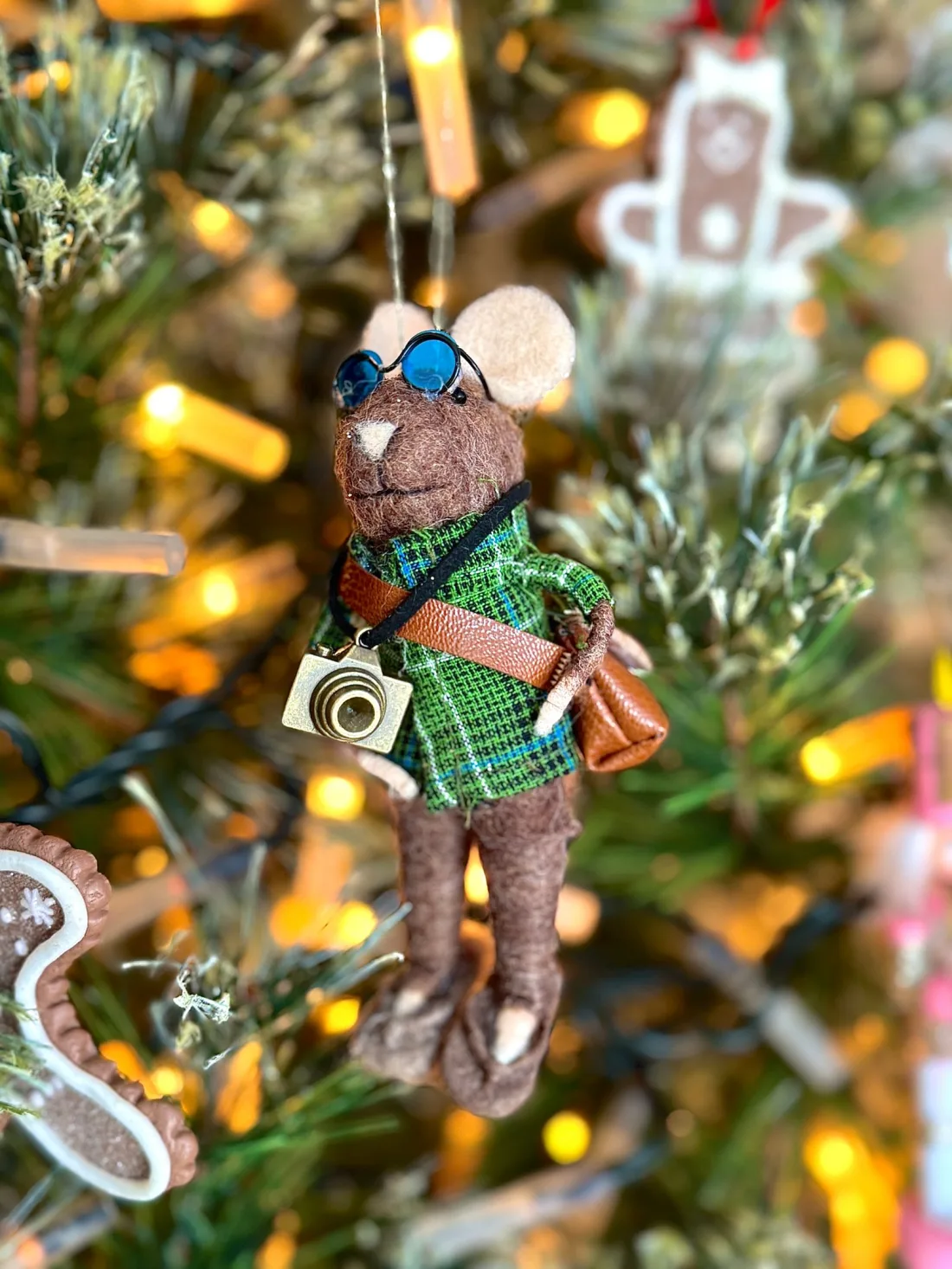
- Candy cane: twist a red and a white strand of wool around 2 in (5 cm) of wire, needle it lightly and bend a hook at the top. Felt candy canes has full-size versions.
- A wrapped gift: a ½ in (1.3 cm) cube of core wool felted square, covered in red, with a cross of thin yarn for ribbon.
- A bell: one of the miniature jingle bells, about ⅜ in (10 mm), sewn between the paws.
- A letter: a scrap of felt with a child's name in fine marker.
Bend the paws around the prop and add one stitch of matching thread through prop and paw, so it stays put when the box of ornaments is packed away.
Is a felt mouse ornament safe for cats and small children?
Nothing on this mouse should end up in a mouth. Its wire, props and thread details can all be chewed loose and swallowed by a cat. Hang it on the upper half of the tree, and if you want a mouse for the cat, make a solid one with no wire from felted cat toys. Beads, bells and small props are choking hazards for children under 3, so for a toddler's tree make the sewn version with embroidered eyes and no small parts. The felting needles belong out of young hands too, because each one is barbed along its tip; is needle felting dangerous has the safe-working rules.
For the rest of the tree, felted Christmas ornaments has the general rules for loops and storage, and the door, mantel and table pieces are on felt Christmas decorations. The same small-scale, light-on-the-branch approach works for a pet in felt dog ornaments and for a felt reindeer.
Frequently asked questions
How big should a felt mouse ornament be?
About 3½ in (9 cm) from the top of the head to the feet for a needle felted mouse, which takes roughly ⅓ oz (9–11 g) of wool before clothes. That is light enough for an outer branch. A sewn flat mouse is usually 3¼ in (8 cm) tall plus ears.
How do you make a felt mouse hold a candy cane?
Put wire in the arms. Lay one pipe cleaner or a length of 22 gauge wire across the shoulders before you cover the body, wrap each arm thinly in wool, and leave the last ⅛ in (3 mm) of wire covered but unfelted so the paw can be bent around the prop. Stitch the prop to the paw with one hidden stitch as well.
Where do you put the hanging loop on a mouse ornament?
Through the head, just behind the ears and slightly forward of the middle if the mouse is holding something in front of it. Hold the mouse up by a pin at that point before you knot the loop; if it tips forward, move the loop back 1/16 in at a time.
Can I give a felt mouse ornament to my cat?
No. A mouse ornament has wire in its arms and tail, glued or stitched props and thin thread details, and none of that is safe in a cat's mouth. Hang it high, and make the cat a solid wool mouse with no wire instead.
What do you make the mouse tail from?
Either fine wool wrapped around thin wire, which can be curled and posed, or a 3 in (7.5 cm) length of pink or gray cord pushed into the body and anchored with a few stabs. For a sewn mouse, cord or a twisted strand of embroidery floss caught in the seam is easiest.
Topics
Image credits
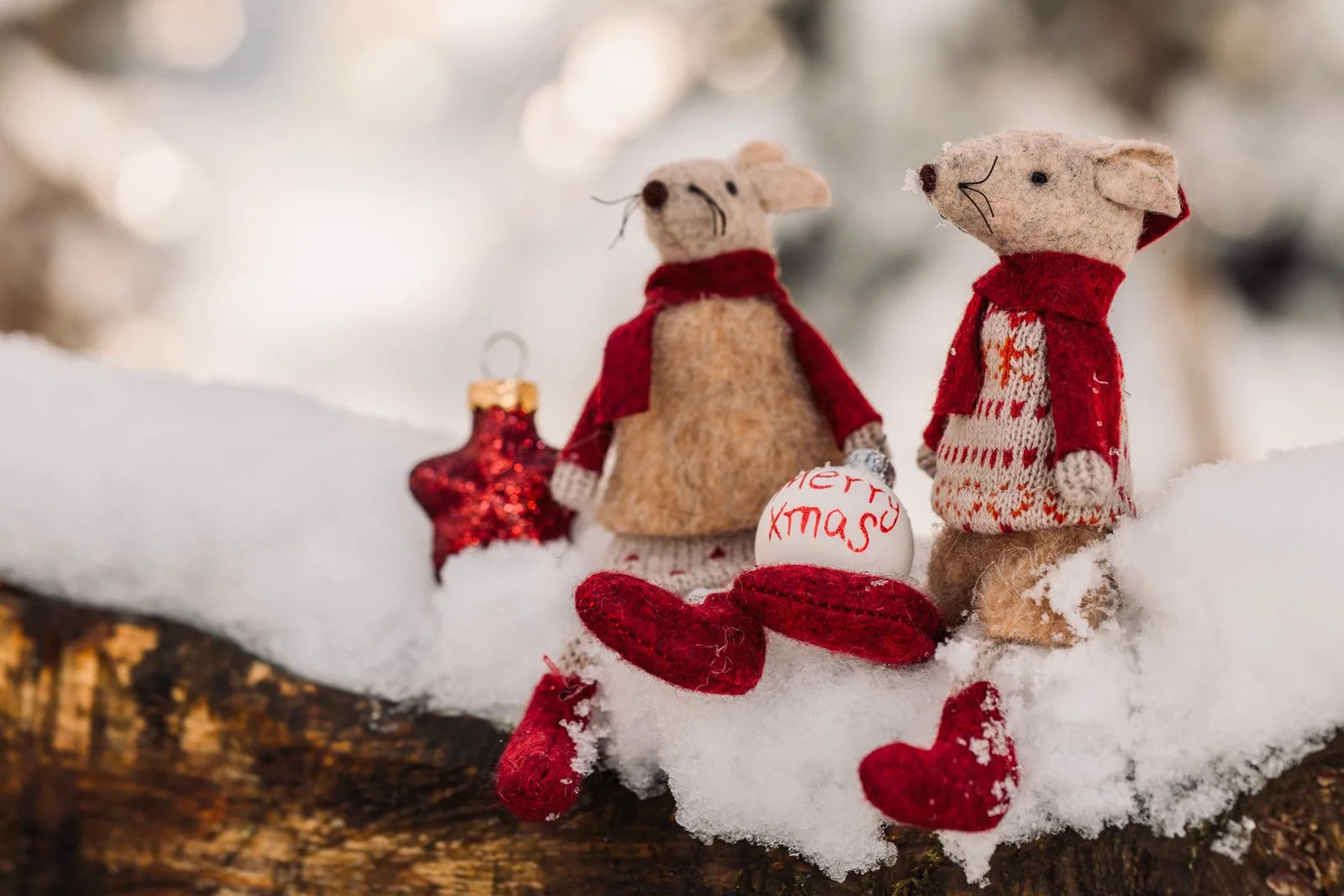
- Two felt mice in red knitted sweaters and scarves sitting in snow beside a Merry Christmas bauble — Susanne Jutzeler, suju-foto (Pexels License)
- Two small gray wool mice with pink noses held in an open hand — Nadejda1985 (Pixabay Content License)
- A felt mouse ornament in a green jacket carrying a camera, hanging on a lit Christmas tree — CE Castillo (Pexels License)