Needle Felted Birds: One Body Shape, Then the Markings That Make the Species
7 min read Intermediate
We may earn a commission from links on this page, at no extra cost to you. As an Amazon Associate I earn from qualifying purchases. Learn more.
How to needle felt a bird: the teardrop body every small bird shares, the markings that turn it into a cardinal, chickadee, bluebird or robin, wire legs, and felt bird ornaments that hang level.
Most small birds are built on the same shape: a teardrop body, a round head set slightly forward, and a tail. What turns a felted bird into a cardinal rather than a robin is not the shape but four or five color blocks and the angle of the tail and head. Get the body right once and every species after that is mostly a matter of markings. This page covers that body, the markings for the birds people most often want to make, and the felt bird ornament that hangs on a tree.
The body every small bird shares
Start with the body as a teardrop of core wool, fat end forward, about 2½ in (6 cm) long and a little over half that across. Needle it firm with a 36 or 38 gauge needle. The head is a separate ball about two-thirds the body's width, attached on top of the fat end and slightly forward, not on the front of it. That forward lean is what makes it look like a bird and not a mouse.
- Needle a flat spot on top of the fat end and on the underside of the head, and stab diagonally down through the head into the body at the edge of the join, moving a few millimeters each time until you have gone all the way around.
- Fill the neck with thin wisps of core wool until the head flows into the body with no waist. Birds have no visible neck.
- Make the tail separately as a flat fan, felted thin and firm on the mat, and attach it to the narrow end. Set it angled up 20 to 30 degrees. A tail pointing down makes the bird look dead rather than perched.
- Flatten the underside slightly if the bird will sit, so it does not roll.
At this point it is a gray-white bird that could become anything. A firm bird of this size takes around 10 g of wool in total. The top colors go on as thin layers over the core, finishing with a 40 gauge needle.
The markings that make the species
| Bird | Body | Key markings | Shape notes |
|---|---|---|---|
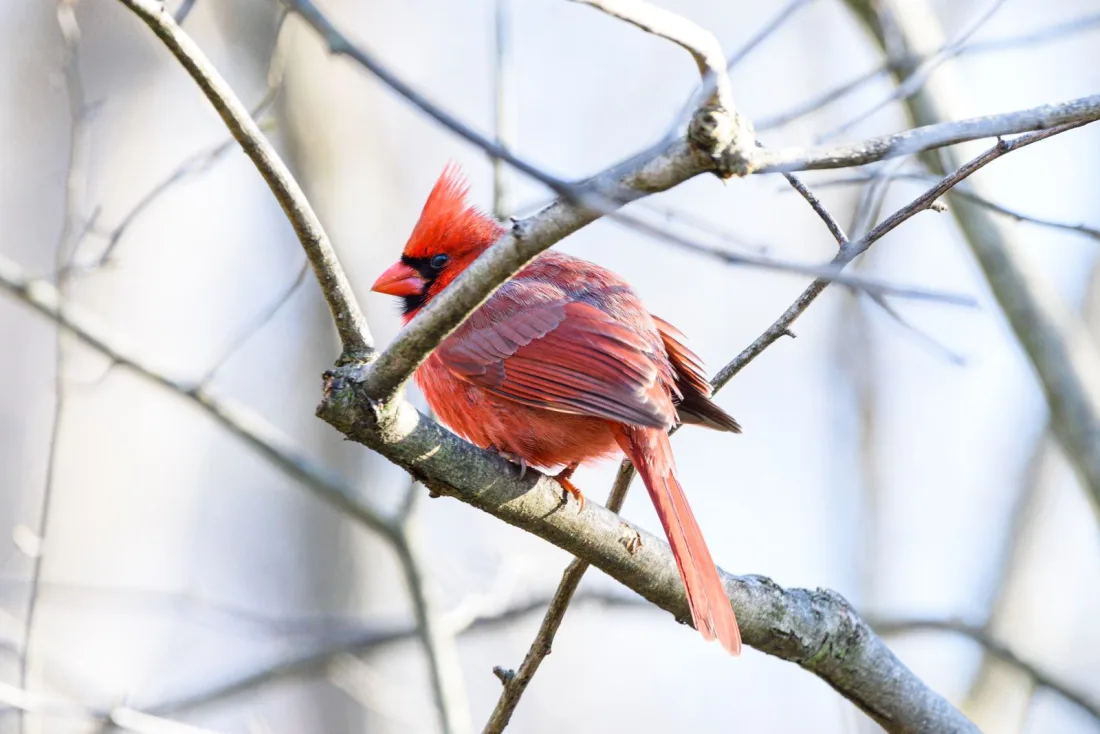
| Northern cardinal (male) | Bright red all over | Black mask around the beak and eyes; thick orange-red cone beak | Pointed crest on the head; long tail |
| Northern cardinal (female) | Warm buff-brown | Red tinge on crest, wings and tail; same orange beak | Same crest and tail |
| Black-capped chickadee | Gray back, white front, buff sides | Black cap and bib with a white cheek patch between them | Very round, big head, longish narrow tail |
| Eastern bluebird | Bright blue back and wings | Rusty orange throat and breast, white belly | Upright posture, short tail |
| American robin | Gray-brown back | Orange-red breast, white eye-ring, yellow beak, dark head | Larger and longer-bodied than the others |
| European robin | Olive-brown back | Orange face and breast edged in gray, white belly | Tiny and round, the robin on British Christmas cards |
| Blue jay | Blue back, pale gray-white front | Black necklace across the throat, black and white bars on wings and tail | Tall crest |
| American goldfinch (male, summer) | Bright yellow; olive-brown in winter | Black cap, black wings with white bars | Small, short notched tail |
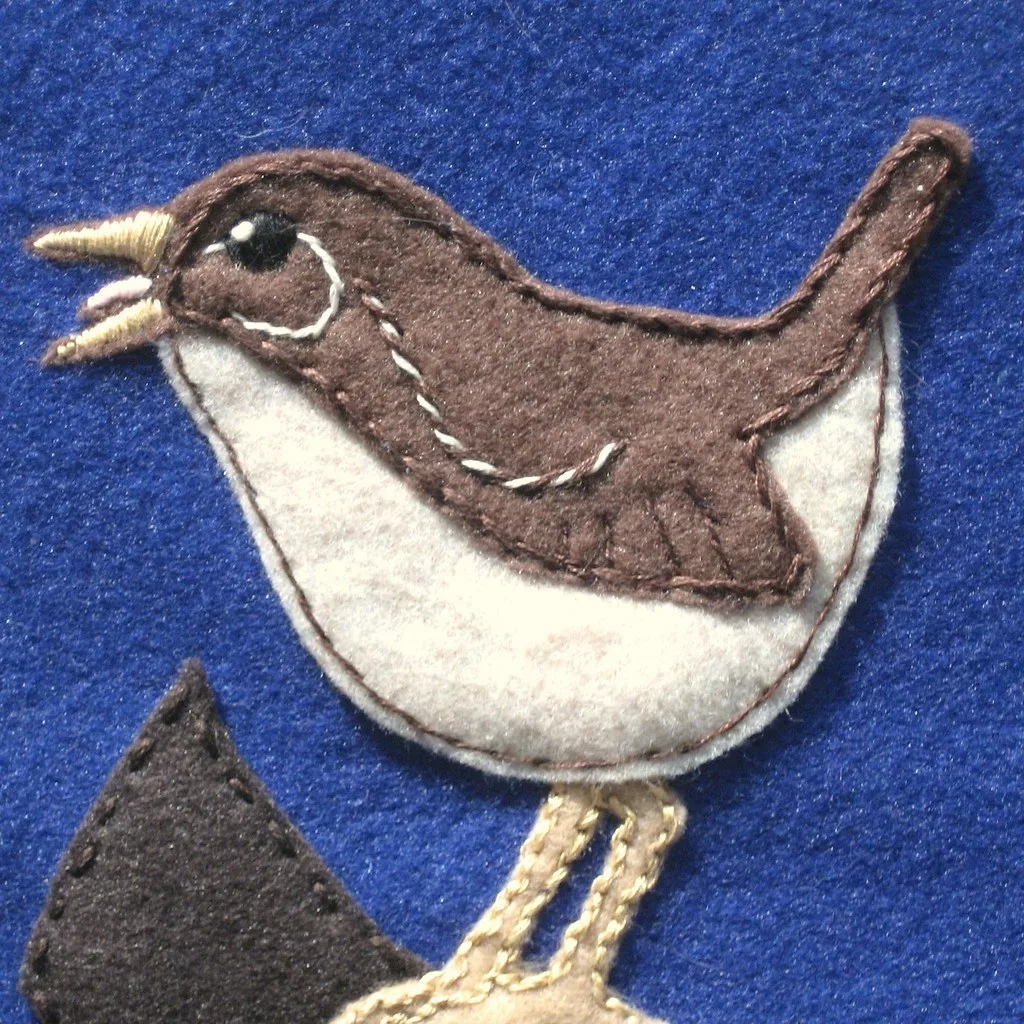
| Wren | Warm brown, finely barred | Pale stripe over the eye | Tail cocked straight up |
The robin needs a note. American readers usually mean the American robin, a long-bodied thrush about twice the length of its European namesake. British Christmas cards show the much smaller, rounder European robin; American ones are more likely to show a cardinal. They are different birds, and making one when somebody wanted the other is the commonest mistake with robins.
Laying color blocks
Lay each color block as a thin layer and needle its edge with a fine needle held almost flat to the surface. That keeps the boundary between colors crisp. For soft blended edges, as on a robin's breast, pull the two colors' fibers into each other at the boundary before needling. Do the largest area first and the smallest last: a cardinal is red all over first, then the mask, then the beak.
The cardinal's crest and mask
Felt the crest as a small flat triangle, firm at the tip and loose at the base, and attach it by the loose fibers so it sweeps back from the top of the head. The mask is a thin black layer that wraps around the base of the beak and runs back through the eyes. Make it too small and the bird looks like a red sparrow. The beak is short, thick and conical, much thicker than a robin's. Its long tail attaches as a separate fan like any other, just cut longer.
Beaks, eyes and legs
- Beaks. Roll a tiny cone of wool very tight and needle it hard, leaving loose fibers at the wide end to attach it. For a fine, pointed beak, wrap the wool around a short piece of wire first. Seed-eaters like cardinals and finches have thick cones. Insect-eaters like wrens and robins have thin, pointed ones.
- Eyes. 2 to 3 mm black glass beads sewn in with the thread pulled tight to sink them slightly, or tiny balls of black wool needled in. Set them in line with the beak's opening, not above it. Needle felting eyes covers both methods.
- Legs. Bend thin floral wire into a leg with three toes forward and one back, then wrap it tightly with brown wool or embroidery floss. Push the top of each wire well up into the body, bend it to grip, and felt over the join. Wire armatures covers the bending. A bird that perches on a branch or a clip can skip legs altogether.
Long tails and wings
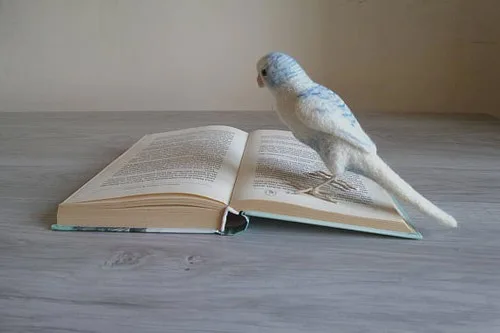
Budgies, swallows and magpies need long tails, and those break the "one body" rule: the tail is too long to attach as a separate piece without a visible join. Instead, felt the tail as a long tapered extension of the body, laying fibers along its length, and keep it thin and flat with the needle at a low angle. Wings are flat shapes felted on the mat, thin at the trailing edge, and attached by their front edge only, so the back edge lifts slightly from the body. Needle felting techniques covers flat shapes.
Felt bird ornaments
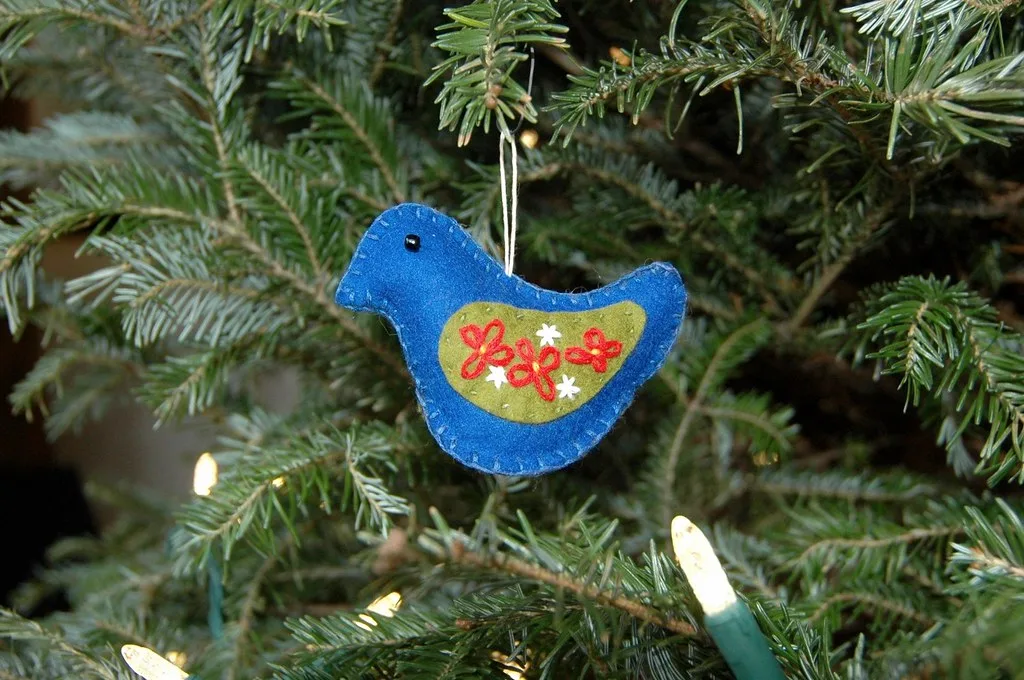
The blue bird at the head of this page is the other kind: sheet felt, not needle felted, and the quicker route to a set of tree ornaments. The difference from a plain felt shape is the wing. Cut it as a separate piece in a contrasting color and embroider it while it is flat, with lazy daisy flowers, a few lines of chain stitch or some beads. Stitch it to one side of the body, then join the front and back with blanket stitch, filling the body lightly so it is plump but still flat enough to hang close to a branch. A felt triangle caught in the seam makes the beak.
Whichever kind you make, find the balance point before adding the hanging loop. Pass a threaded needle loosely through the back and let the bird dangle, moving it until the bird hangs level, and sew the loop there. On a flat felt bird that is usually near the middle of the back. A needle felted bird with a solid head often balances further forward, so test it rather than guess. For birds that perch rather than hang, glue a small bird clip under the body and clip it straight onto a branch.
Two or three cardinals, a chickadee and a robin make a set that looks deliberate on a tree, and birds also look right on a felted wreath.
Other birds on this site
The needle felted owl is the easiest bird of all, because it is nearly a single shape. The penguin is a bird built like a snowman, and the chick is the one to start with if you have never felted an animal. A bee and felted flowers go with garden birds in a spring display.
Frequently asked questions
What is the easiest bird to needle felt?
A chickadee or a European robin. Both are round birds with simple color blocks, so the shape is forgiving. An owl is easier still because it is almost one shape, while birds with very long tails or legs, such as swallows, magpies and herons, are harder.
How much wool do you need for a needle felted bird?
About 10 g in total for a firm bird 2½ in (6 cm) long, mostly core wool under a thin layer of top colors. A 3 in bird takes nearly twice that, because wool goes up with volume, not length.
How do you make legs for a needle felted bird?
Bend thin wire into a leg and three forward toes plus one back toe, wrap it tightly with wool or embroidery floss, and push the top of the wire well up into the body before felting over the join. Felt-only legs are too soft to stand on.
How do I stop a felt bird ornament hanging crooked?
Find the balance point before attaching the loop. Hold a threaded needle loosely through the back at a few points until the bird hangs level, and sew the loop there. On a needle felted bird with a heavy head it is often forward of the middle; on a flat felt ornament it is usually near the middle.
Topics
Image credits
- A blue sheet felt bird ornament with an embroidered green wing panel hanging on a lit Christmas tree — normanack (BY)
- A male northern cardinal perched on a bare branch, showing its crest, black face mask and long tail — Jay Brand (Pexels License)
- A felt wren appliquéd onto blue felt, in brown and cream with stitched wing lines and a cocked tail — Stacy Spensley (BY)