How to Make Felt Beads With Holes That Stay Open
4 min read Beginner
We may earn a commission from links on this page, at no extra cost to you. As an Amazon Associate I earn from qualifying purchases. Learn more.
Felt beads are small felt balls with a hole through them, and the hole is the difficult part. Three ways to make one that does not close up as the wool shrinks.
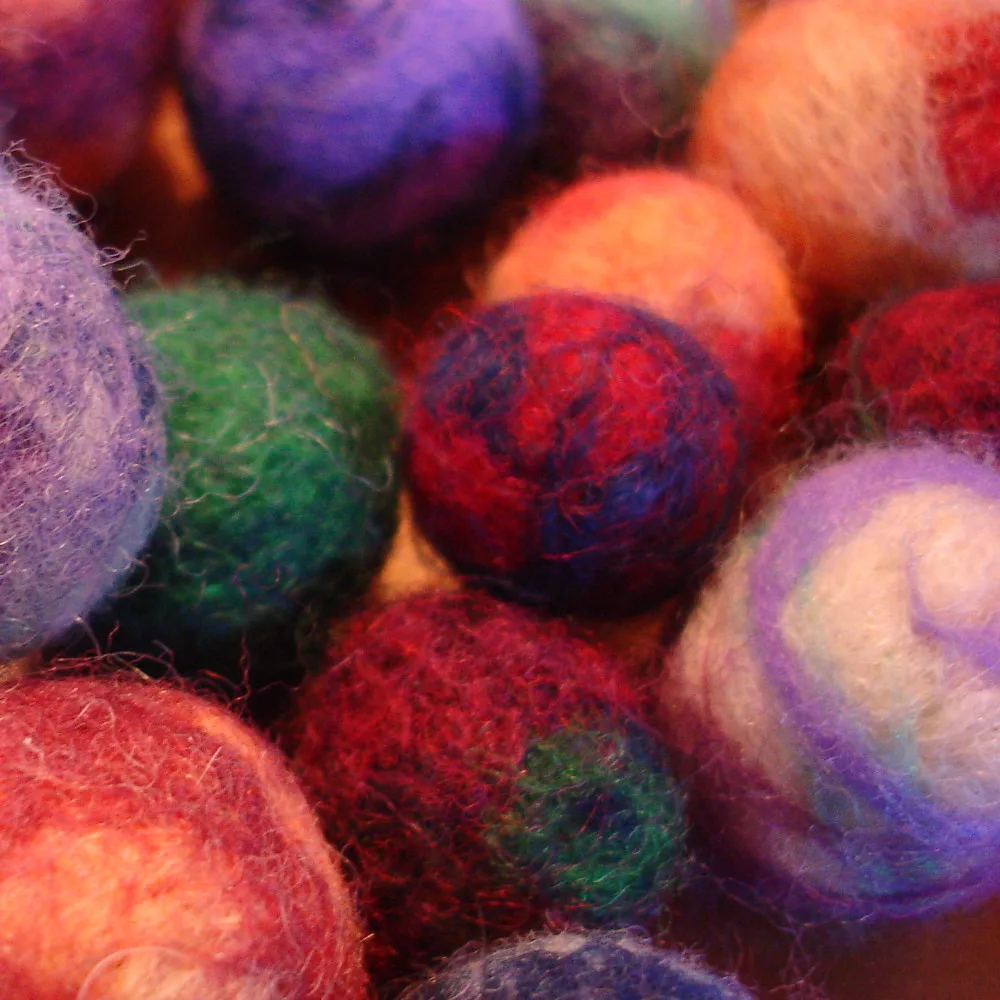
A felt bead is a small, dense felt ball with a hole through the middle. Making the ball is easy — the method is the same as making felt balls, scaled down. Making a hole that survives felting and drying is the actual skill.
Why the hole is the problem
Wool loses 30 to 50% of its volume as it felts, and every part of it contracts, including the hole. A generous 4 mm channel poked into loose wool ends up as a 1 mm dimple in a finished bead, if it survives at all.
The answer is always the same: hold the hole open with something while the wool shrinks around it.
Method 1: Felt around a straw
The most reliable approach.
- Cut a plastic drinking straw or use a bamboo skewer, longer than the bead by a few centimetres each side.
- Wind wool around the middle of it, changing direction every few turns, until the bundle is about twice the finished bead diameter.
- Dip in hot soapy water and squeeze gently.
- Roll the bead between your palms along the straw as well as around it, very lightly at first.
- Increase pressure as the surface firms. Five to eight minutes.
- Rinse in cool water, squeeze, and leave the straw in until the bead is completely dry.
- Twist the straw out. The hole holds.
Straw diameter should be slightly larger than the cord you plan to use, because the hole tightens a little on drying regardless.
Method 2: Felt around the cord itself
Wind the wool directly around the cord the beads will be strung on, spacing several beads along its length, and felt them in place. The cord is captured permanently.
Good for garlands and necklaces where the beads are fixed. No good if you want them to slide, or to restring later.
Method 3: Pierce afterwards
Make solid beads first, then push a large tapestry needle, an awl or a knitting needle through the centre while the bead is still damp. Work the tool back and forth to open the channel, then dry with the tool in place if you can, or with a cocktail stick pushed through.
Faster for batches, less tidy, and the hole is more likely to be off-centre. Piercing a bone-dry bead is much harder and often splits the surface.
Sizing
- 1 cm bead — about 0.25 g of wool, wound to 2 cm
- 1.5 cm bead — about 0.7 g, wound to 3 cm
- 2.5 cm bead — about 3 g, wound to 5 cm
Weigh the wool if you want a matched set. For a necklace of graded sizes, weigh in steps — a difference of a few tenths of a gram is clearly visible when the beads sit side by side.
Getting them properly hard
Beads take more handling than they look like they need. A finished bead should not dent under thumb pressure at all. Soft beads flatten where the cord presses and go misshapen within months.
The critical minute is the first: roll with almost no pressure until the surface tightens, or you will crease folds into it that never come out.
Colour and pattern
- Two-tone: wind a cheap core, then wrap a thin veil of colour over it before wetting.
- Marbled: wind two colours together.
- Spotted: press small tufts of contrast wool onto the surface before the first wetting.
- Striped: wrap thin bands of colour around the wound ball in one direction.
- Blended: card the colours together first — see carding wool by hand.
Needle felted beads
You can needle felt beads instead, wrapping wool around a skewer and needling around it. They come out denser and rounder but take considerably longer per bead, and the skewer breaks needles if you hit it. Worth it for a single statement bead; not worth it for forty.
Stringing them
Waxed cotton cord, leather thong, hemp, or elastic for a stretch bracelet, threaded with a large tapestry needle. Knot between beads if you want them spaced.
Mixing felt beads with wooden or glass beads gives weight and stops a necklace looking uniformly soft. Small felt beads also work as earring drops, on a headpin through the hole. Earrings, bracelets and necklaces are covered in full, with the findings, in felted jewelry.
Embroidering on them
Felt beads take stitch beautifully. A few French knots or a spiral of running stitch in contrasting thread turns a plain bead into something considerably more interesting, and it is easier on a bead than on a flat surface because you can turn it in your hand.
Frequently asked questions
How do you make a hole in a felt bead?
Felt the bead around a straw, cocktail stick or piece of cord so the hole is built in, or pierce a finished bead with a large tapestry needle or an awl. Felting around a former gives a much cleaner hole.
Why does the hole in my felt bead close up?
Because wool shrinks by 30 to 50% as it felts, and the hole shrinks with it. Use a former thicker than the finished hole needs to be, and leave it in place until the bead is completely dry.
How much wool do I need for a felt bead?
Less than most people expect: about 0.7 g for a 1.5 cm bead and about 3 g for a 2.5 cm one. Wind the loose wool to roughly twice the finished diameter before wetting.
What can I string felt beads on?
Waxed cotton cord, leather thong, hemp or elastic, all threaded with a large tapestry needle. Fine jewellery wire works if the hole was made around a matching former.