Needle Felting Eyes: Glass, Bead and Felted, and How to Set Them
5 min read Intermediate
We may earn a commission from links on this page, at no extra cost to you. As an Amazon Associate I earn from qualifying purchases. Learn more.
Eyes are the last thing you add and the first thing anyone looks at. The three types, how to sink them so they belong in the face, and the highlight that brings them alive.
Everything else in a needle felted animal can be slightly wrong and it will still work. The eyes cannot. They are what people look at, and they are where a competent sculpture becomes a convincing one or stays a toy.
Two-thirds of the effect is not the eye itself but the socket it sits in.
The three kinds
Felted eyes
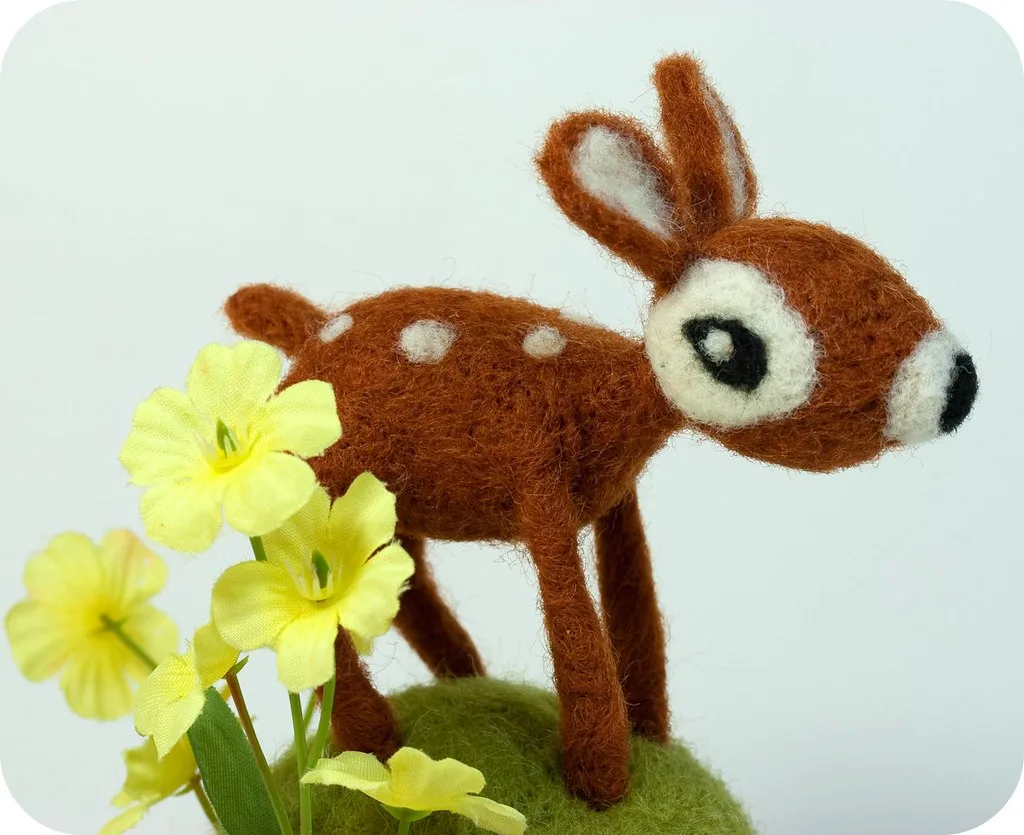
Made from wool, needled directly into the face. Safe for children, softer in character, and completely permanent because there is nothing to come loose.
- Needle a shallow socket.
- Roll a tiny amount of black wool between damp fingertips into a pellet, place it in the socket, and needle it in with a 40 gauge needle.
- Add a ring of coloured iris around it if you want amber or green eyes, then a thin dark outline all round.
- Finish with a single speck of white at the upper edge, angled the same way in both eyes.
Glass eyes on wire
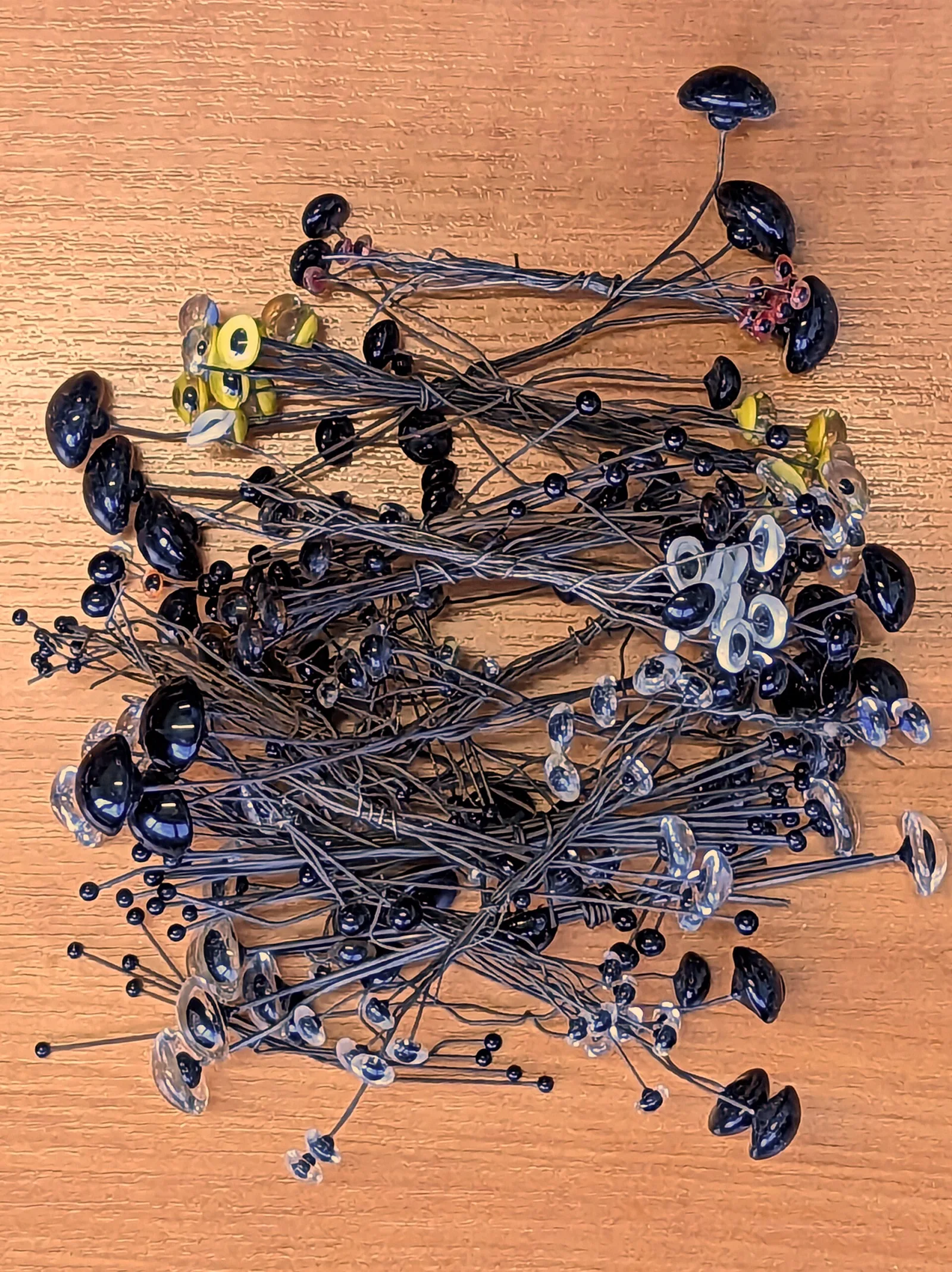
Sold in pairs on a wire loop, in sizes from 3 mm up, with round pupils for most animals and slit pupils sold specifically as cat eyes. The most lifelike option by a wide margin, because glass reflects light the way a real eye does.
- Cut the wire loop to about 1 cm, or leave it long and bend it into a hook.
- Needle the socket deep enough that the eye will sit flush or slightly recessed.
- Put a dab of strong craft glue on the wire and push it in at a slight angle, aiming towards the centre of the head.
- Let it set before doing anything else to the face.
- Work a thin ring of dark wool around the rim with a 40 gauge needle to close the gap between glass and felt. This step is what makes the eye look set in rather than stuck on.
Bead eyes
Small black beads sewn on. Cheap, quick, and the round pupil is right for birds and rodents. Sew right through the head from one eye to the other with strong thread and pull firmly — the tension pulls both eyes into their sockets and creates the socket depth at the same time.
Placement
Get this wrong and no amount of detail rescues it.
- Predators face forward. Cats, dogs, foxes and owls have both eyes on the front of the head, looking at you.
- Prey animals look sideways. Rabbits, sheep, mice and horses have eyes on the sides, barely visible from directly in front.
- Height: roughly halfway up the head for most mammals, two-thirds up for cats, low and central for owls.
- Spacing: about one eye-width apart for dogs and cats; wider for prey species.
- Symmetry. Mark both socket positions with pins before committing, and look at the head from directly in front and from above. Eyes that are 1 mm out are visible; 2 mm out looks like a stroke.
The socket
Needle repeatedly into one small spot with a 38 gauge needle until a definite hollow forms. The wool compacts and the surrounding surface rises slightly, which gives you a brow and a cheek at the same time. Work both sockets alternately, a few strokes each, so they stay matched.
A common shortcut is to place the eyes and then needle around them. It never looks as good — the socket should exist before the eye does.
The four details that make eyes alive
- Recession. The eye sits below the surrounding surface, never proud of it.
- A dark rim. A fine line of black or dark brown around the whole eye, thicker on top like an eyelid.
- A highlight. One white speck, in the same position in both eyes. This is the single highest-value thing in this article.
- A brow. A small wisp of wool above the eye, needled in and shaped, changes the expression completely — angled down towards the nose reads as cross, up as worried, level as calm.
Species notes
- Cats. Large, almond, angled with the outer corner higher, and a vertical slit pupil. See needle felted cat.
- Dogs. Rounder, dark, set forward and fairly close. Visible white at the inner corner in some breeds.
- Owls. Enormous, round, close together, low on the facial disc — see needle felted owl.
- Rabbits and sheep. Dark, oval, on the sides of the head, barely visible from the front.
- Hedgehogs and mice. Tiny and black. Resist enlarging them.
- Bears. Small, dark and close together, set high and just behind the start of the snout. Deliberately smaller than the animal's size suggests — it is the main thing separating a bear from a teddy, as in needle felted bear.
- Frogs. On top of the skull rather than the sides, domed and proud of the outline, so they are built up rather than set in. See needle felted frog.
- Dolls and humanised figures. A different problem entirely — see needle felting a face.
Safety
Anything for a child under three should have felted eyes and nothing else — no beads, no glass, no wire. Even for older children, a glass eye glued into wool is not a secure attachment under determined handling. This is one of the genuine risks in an otherwise gentle craft, alongside the needles themselves; see is needle felting dangerous.
Buying
Glass eyes are sold by fibre and taxidermy suppliers in 1 mm increments, usually a few pounds a pair. Buy a mixed pack of 4, 5 and 6 mm in black and amber and it will cover almost every animal you make. Slit-pupil cat eyes and yellow bird eyes are worth adding separately.
Frequently asked questions
How do you attach eyes to a needle felted animal?
Needle a shallow socket first, then either push a glass eye on a wire loop into the felt with a dab of glue, sew a bead eye through the head and pull it tight, or needle a felted disc into the socket. In every case the eye should sit below the surrounding surface.
What size eyes should I use?
For most animals, roughly a tenth of the head width — 4 to 6 mm on a 5 cm head. Cats, owls and anything meant to look young take larger eyes; dogs, sheep and hedgehogs take smaller. When in doubt, go slightly larger, because eyes look smaller once they are sunk.
Are glass eyes safe for children's toys?
No. Glass eyes on wire can be pulled out and are a choking hazard, and the wire is sharp. For anything a child under three will handle, use felted eyes needled directly into the head, with no separate components at all.
Why do my felted animal's eyes look dead?
Usually three things: they sit on the surface instead of in a socket, there is no highlight, and there is no darker rim around them. Adding a socket and a single white speck fixes most of it.
Topics
Image credits
- Trays of small glass eyes of the kind used in felted animals — PaulT (Gunther Tschuch) (BY SA 4.0)