Felt Reindeer: A Sewn Ornament, a Face Ornament and a Needle Felted Standing Reindeer
10 min read Intermediate
We may earn a commission from links on this page, at no extra cost to you. As an Amazon Associate I earn from qualifying purchases. Learn more.
Three ways to make a felt reindeer: a flat sewn ornament with stiff antlers and a Rudolph nose, a round reindeer face, and a needle felted standing reindeer on a wire frame. With a reindeer vs deer proportions table.
Reindeer are the only deer in which the females grow antlers as well as the males, and the timing matters for anyone sewing one for Christmas: adult males usually drop their antlers in late fall or early winter, while females carry theirs through to spring. A felt reindeer with a full rack in December is, if anything, a cow, as female reindeer are called.
There are three versions below, with measurements: a flat sewn ornament, a round reindeer face, and a needle felted reindeer that stands on a wire frame. The sewn ornament takes about an hour, the standing one most of a weekend.
How is a reindeer different from a deer?
Heavier body, shorter legs, smaller ears, bigger feet. Reindeer and North American caribou are one species, built for snow, and most differences from a white-tailed deer follow from that.
| Feature | Reindeer | White-tailed deer | What it means in felt |
|---|---|---|---|
| Antlers | Both sexes; long beams sweeping back, then up and forward | Males only; beams curve forward over the face | Antlers on any reindeer are correct; angle the beams back from the head |
| Brow tine | A flat "shovel" pointing forward over the face, often on one side only | Small, upright points | One flattened tine at the front of one antler is the giveaway detail |
| Neck | Thick, with a pale shaggy ruff hanging underneath | Slim and smooth | A cream crescent or loose cream wool under the neck |
| Ears | Short and rounded | Large, tall, set wide | Keep the ears about half the size you would give a deer |
| Muzzle | Broad, blunt and furred all over | Narrower, with a bare black nose | A wide muzzle in a lighter color; Rudolph's red nose replaces the dark one |
| Hooves | Wide, splayed, crescent shaped | Small and pointed | Make the feet visibly broader than the legs |
| Tail | Very short, white underneath | Long, raised to flash white | A small cream stub, or none at all on a flat ornament |
For deer, does and spotted fawns, needle felted deer covers the build in detail, including the hock bend in the back legs that applies here too.
How do you make a flat felt reindeer ornament?
Cut a side-on standing reindeer as one outline, head and legs included, and attach the antlers, ears and ruff separately so each can be a different color and stiffness. The finished ornament is 4½ in (11.5 cm) from nose to tail and 3½ in (9 cm) from hooves to the top of the head, with the antlers adding another 1¾ in (4.5 cm).
Pattern pieces
- Body, cut 2 in mid brown: a deep barrel about 3 in (7.5 cm) long and 1½ in (3.8 cm) deep, a thick neck rising at the front at about 45 degrees, and a blunt head with a square-ended muzzle. Draw the legs at least ⅜ in (1 cm) wide, wider than life, so there is room to stitch both edges.
- Antlers, cut 2 in tan or dark brown: each a main beam 1¾ in (4.5 cm) tall curving back, with two or three short tines on the upper side and one flattened brow tine at the base pointing forward.
- Ears, cut 2: small rounded leaves ⅝ in (1.5 cm) long.
- Ruff, cut 2 in cream: a crescent 1¼ in (3.2 cm) long with a scalloped lower edge, to sit under the throat.
- Rump patch and tail, cut 2 in cream: a small oval ¾ in (2 cm) long at the back end.
A 9 × 12 in (23 × 30 cm) craft sheet takes four to six body pieces, depending on how closely you nest the legs and turn alternate pieces, which is two or three ornaments.
Antlers that do not flop
Ordinary 1 mm felt cut into antler shapes droops forward within a day. Choose one of these instead:
- Stiffened craft felt, about 1.5 mm thick, cut single. It holds tines as narrow as ⅛ in (3 mm).
- Two layers fused with iron-on fusible web, then cut.
- Two layers with wire between: lay 26 gauge wire along the main beam, cover with the second layer and blanket stitch around. The antlers can then be bent to angle backward, which a flat cut shape cannot do.
Assembly
- Decorate the front piece flat. Stitch on the ruff and rump patch with a small whip stitch in matching thread. Add an eye as a French knot in black embroidery floss, set high on the side of the head, a little behind the muzzle.
- Place the extras. Lay the back body piece down. Set the antler bases and ears along the top of the head, and a 7 in (18 cm) loop of thread or narrow ribbon at the balance point above the shoulders, not at the head, or the reindeer will hang nose down.
- Stitch around the edge with blanket stitch about ⅛ in (3 mm) in and ⅛ in apart, going through every antler, ear and loop end as you pass it. More edge stitches are on felt applique.
- Stuff the body lightly with small tufts of polyester fiberfill through a 1 in (2.5 cm) opening left along the underside. Leave the legs and neck flat; stuffing narrow legs pulls the seam open.
- Close the opening, then pass the needle out through the body and snip the thread flush so the end disappears inside.
The Rudolph variant
Stitch a ½ in (12 mm) red pom-pom or a red felt ball to the tip of the muzzle, through its center and into the seam. A felt ball holds up better than a pom-pom, which sheds; how to make felt balls gives the method for a batch of small red ones.
How do you make a felt reindeer face ornament?

Start from a 3 in (7.5 cm) circle. A round face holds a bigger nose and leaves room for a hat and scarf, as in the photo above. It also differs from the teardrop reindeer head in felted Christmas ornaments, so the two can hang together.
- Face, cut 2 in mid brown: a 3 in circle.
- Muzzle, cut 1 in tan or cream: an oval 1¾ × 1¼ in (4.5 × 3.2 cm), set so its lower edge sits ¼ in (6 mm) above the bottom of the face.
- Ears, cut 4: leaves 1 in (2.5 cm) long, stitched in pairs, angled out sideways rather than up.
- Antlers, cut 2 pairs: 2 in (5 cm) tall, using any of the stiffening methods above.
- Nose: a ¾ in (2 cm) red pom-pom or felt ball, or a red felt circle for a flat version.
- Eyes: two ¼ in (6 mm) black felt circles or French knots, on the horizontal midline of the face, 1 in (2.5 cm) apart.
For the hat and scarf in the photo, cut a red triangle 2 in (5 cm) across the base with a white band, stitched on before the layers are joined, and knot a plaid strip ½ × 6 in (1.3 × 15 cm) under the chin.
How do you needle felt a standing reindeer?
Build the wire frame first, then the body, and leave the antlers until last, because they are fragile and get knocked off while you work. The proportions below are for a reindeer 4 in (10 cm) tall at the shoulder, with a white-tailed deer of the same height for comparison.
| Part | Reindeer | Deer at the same height |
|---|---|---|
| Body, chest to rump | 4¼ in (11 cm) | 4 in (10 cm) |
| Chest depth | 1¾ in (4.5 cm) | 1½ in (3.8 cm) |
| Leg, belly to ground | 2¼ in (5.7 cm), about 1.3 times the chest depth | 2½ in (6.3 cm), about 1.7 times the chest depth |
| Head length | 1½ in (3.8 cm), blunt and wide | 1½ in, narrower and tapering |
| Ears | ⅜ in (1 cm), rounded | ¾ in (2 cm), tall |
| Antlers above the head | 2–2½ in (5–6.3 cm) | 1½–2 in on a stag only |
| Hoof width | ⅜ in (1 cm), wider than the leg | ¼ in (6 mm), narrower than the leg |
| Wool in all | About 1½ oz (40–50 g) | About 1¼ oz (35 g) |
What you need
- About 1 oz (28 g) of core wool for the bulk
- ½ oz (12–15 g) of mid brown or gray-brown wool for the coat, and a few grams of cream for the ruff, rump and tail
- Dark brown or black scraps for the hooves and eyes
- 24 in (60 cm) of 1 mm aluminum armature wire for the legs and spine
- 12 in (30 cm) of 22 gauge paper-wrapped floral wire for the antlers
- 36, 38 and 40 gauge needles; felting needles explained covers what each one is for
Steps
- Bend the frame. Make two U shapes from the 1 mm wire, one for the front legs and one for the back, each arm about ¾ in (2 cm) longer than the finished leg. Bind them to a spine wire that carries on up and forward for the neck. Wire armature for needle felting shows how to wrap the joins.
- Kink the hocks. Bend each back leg so the joint points back toward the tail, a third of the way up from the ground.
- Wrap the legs thin. Wind core wool down and back up each leg and needle it firm. Stop at about ⅜ in (1 cm) thick; reindeer legs are sturdier than a deer's, but a fat leg still looks like a pony.
- Build the barrel. Wrap core wool around the spine into a deep, heavy body, deepest just behind the front legs. Needle it hard with the 36. If the legs look long, add wool to the belly rather than shortening the wire.
- Neck and head. Wrap the neck thick at the base. Add a ball for the head and needle it into a blunt wedge with a wide, square muzzle.
- Coat. Cover everything in thin layers of brown, then add cream to the neck, rump and the underside of the tail. Pull the cream under the neck into a loose fringe and needle only its top edge, so the ruff hangs shaggy.
- Hooves. Trim the wire, fold the last ⅛ in back so no end is sharp, and cover each foot with dark wool shaped wider than the leg, with a shallow notch at the front for the split hoof.
- Face and ears. Set the eyes high on the sides of the head. Needle felting eyes covers placement. Make the two small rounded ears flat on the mat and attach them just behind and above the eyes.
How do you make branched antlers?
Cut a 3½ in (9 cm) main beam from the floral wire for each side, leaving ½ in (1.3 cm) at the base to push into the skull. Twist two or three 1 in (2.5 cm) pieces onto the upper half of each beam as tines, and one short piece near the base pointing forward. Wrap each wire in a thin wisp of pale brown wool while twisting the wire, then needle the wraps lightly with a 40. For the shovel brow tine, bend a ½ in loop of wire, wrap it and needle it flat into a paddle. Put it on one antler only, as on most real reindeer. Push both bases into the skull about ⅜ in (1 cm) apart, angle the beams back, and cover the joins with a ring of wool.
Work slowly around the wire: a needle that hits it snaps at the tip. Needles are barbed and very sharp, so read is needle felting dangerous before working with children nearby.
Is a felt reindeer safe for small children?
Not with a pom-pom nose, felt ball nose, seed bead eyes or wire antlers. Small parts are a choking hazard for children under 3, and wire can work its way out of felt. For a toddler, cut a larger reindeer, about 8 in (20 cm) long, embroider the eyes and nose, cut the antlers from a double layer of felt with no wire, and stitch the edge closely.
Where to use them
Flat reindeer sewn single from thick felt hang well on a felt garland, spaced between red felt balls. A standing reindeer pairs naturally with a felt polar bear for an arctic scene on a mantel. Wall, door and table projects to set around them are on felt Christmas decorations.
Frequently asked questions
How do you make felt reindeer antlers stand up?
Cut them from stiffened craft felt, fuse two layers of felt together with iron-on fusible web, or sandwich a length of 26 gauge wire between two layers and blanket stitch around it. A single layer of ordinary 1 mm felt flops forward within a day of hanging.
What is the difference between a felt reindeer and a felt deer?
A reindeer is heavier and shorter in the leg, with a thick pale ruff under the neck, short rounded ears, a broad furred muzzle, big splayed hooves and a very short tail. Both males and females grow antlers, and they sweep back with a flat brow tine pointing forward over the face.
How much wool does a needle felted reindeer take?
About 1½ oz (40–50 g) for a reindeer 4 in (10 cm) tall at the shoulder: roughly 1 oz (28 g) of core wool, ½ oz (12–15 g) of brown or gray-brown for the coat and a few grams of cream for the ruff, rump and tail.
What do you use for Rudolph's red nose?
A ½ in (12 mm) red pom-pom or a red felt ball for a sewn ornament, or a small ball of red wool needled straight onto the muzzle of a felted one. Stitch it through its center rather than gluing it, and leave it off any reindeer meant for a child under 3.
Do girl reindeer have antlers?
Yes. Reindeer are the only deer in which both sexes normally grow antlers. Adult males usually drop theirs in late fall or early winter, while females keep theirs until spring, so an antlered reindeer in late December is quite likely to be female.
Topics
Image credits
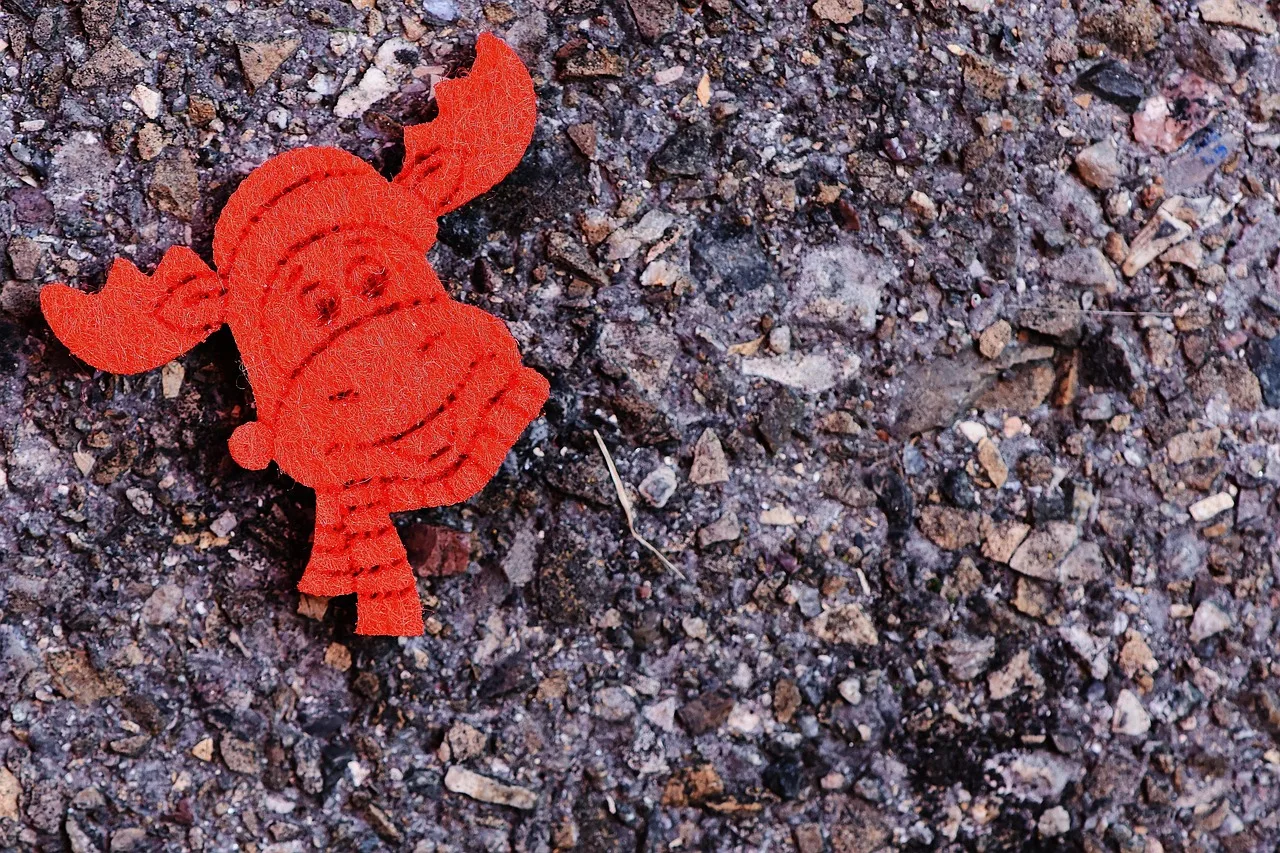
- A red felt reindeer cut-out with antlers lying on gray gravel — Alexas_Fotos (Pixabay Content License)
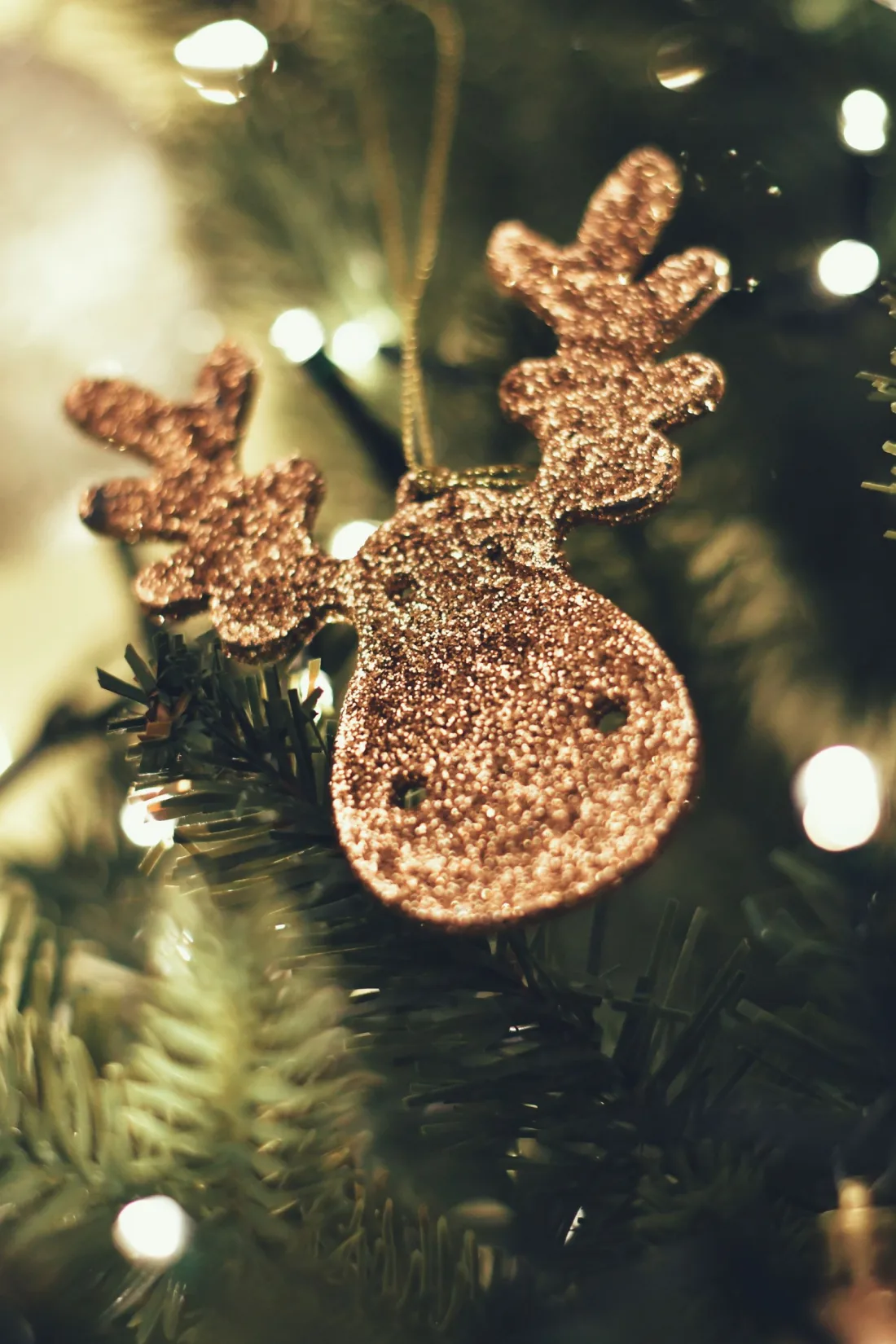
- A glittery reindeer head ornament hanging on a Christmas tree — Iunia Vinersar (Pexels License)
- A brown felt reindeer face with antlers, a red Santa hat and a plaid scarf, lit by Christmas lights — JuliaBoldt (Pixabay Content License)