Felt Trilby Hat: Trilby vs Fedora, Where the Name Came From, and How to Wear One
10 min read
We may earn a commission from links on this page, at no extra cost to you. As an Amazon Associate I earn from qualifying purchases. Learn more.
A felt trilby is a fedora cut down: a brim of about 1½–2 in, snapped down at the front and flipped up at the back, on a shorter, tapered crown. How it differs from a fedora, the 1894 novel and 1895 play behind the name, felt against straw and fabric, wool against fur felt, fit and care.

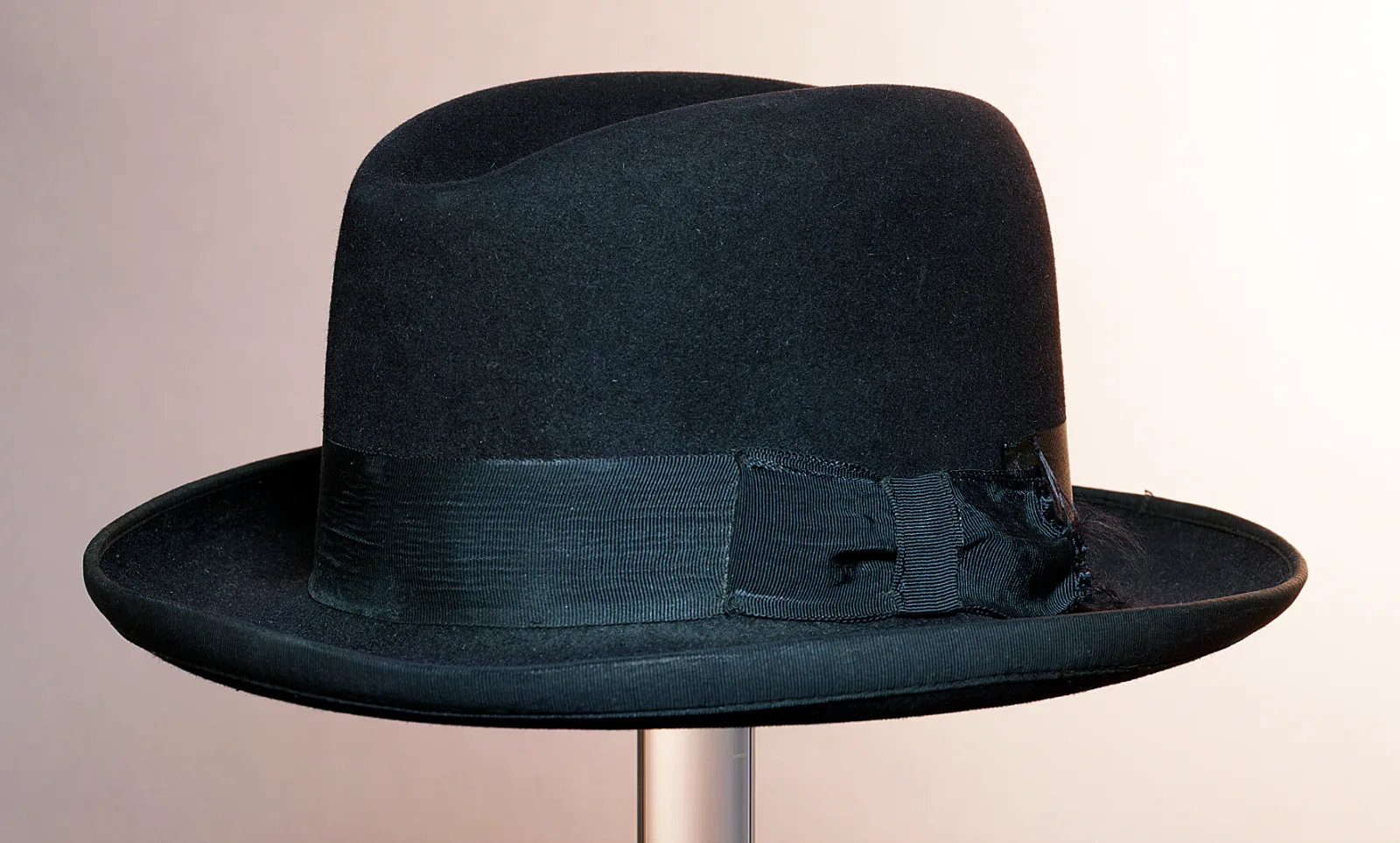
Lock & Co., the London hatter that has sold hats since the 17th century, is widely quoted describing the trilby as a hat with a "shorter brim which is angled down at the front and slightly turned up at the back". Most of the definition is in that sentence. Put the same soft felt on the same block, cut the brim to about 1½–2 in (4–5 cm), snap the front down and the back up, and a fedora becomes a trilby.
Shops blur the line constantly, and "trilby fedora" is a common listing title for hats that are one or the other. The short brim also changes which felt is worth buying, and how the hat should be worn.
What is the difference between a trilby and a fedora?
The brim width, the way the brim is set, and the crown height. Both are soft felt hats with a pinched front and a creased top, and many hats sit in between. The ranges below are typical rather than fixed: hat guides and makers draw the trilby line anywhere from under 1½ in to about 2 in, and some call anything under 2½ in a "stingy brim".
| Trilby | Stingy-brim fedora | Fedora | |
|---|---|---|---|
| Brim width, typical | About 1½–2 in (4–5 cm) | About 2–2⅜ in (5–6 cm) | About 2⅜–3 in (6–8 cm) |
| Brim set | Angled down at the front, flipped up at the back; the slope is part of the shape | Usually snapped down at the front, level or slightly up at the back | Snap brim, worn level or down at the front |
| Crown | A little shorter, tapering toward the top | Fedora height, sometimes slightly lower | Taller, fuller |
| Crown crease | Teardrop or center dent, with a front pinch | Teardrop, center dent or C-crown | Teardrop, center dent, C-crown or diamond |
| Where it sits | Higher on the head | Between the two | Lower, closer to the brow |
| Reads as | Casual to smart; the least formal of the three | Mid-century, jazz, smart casual | Smart casual to formal |
Two practical tests in a shop: measure the brim at the side, from the base of the crown to the edge, and look at the hat in profile. If the back of the brim kicks up in a line that continues the slope of the front, it is a trilby whatever the label says. If the brim runs level all around and is wider than about 2⅜ in, it is a fedora. The fedora's own creases and widths by build are covered in felt hats for men.
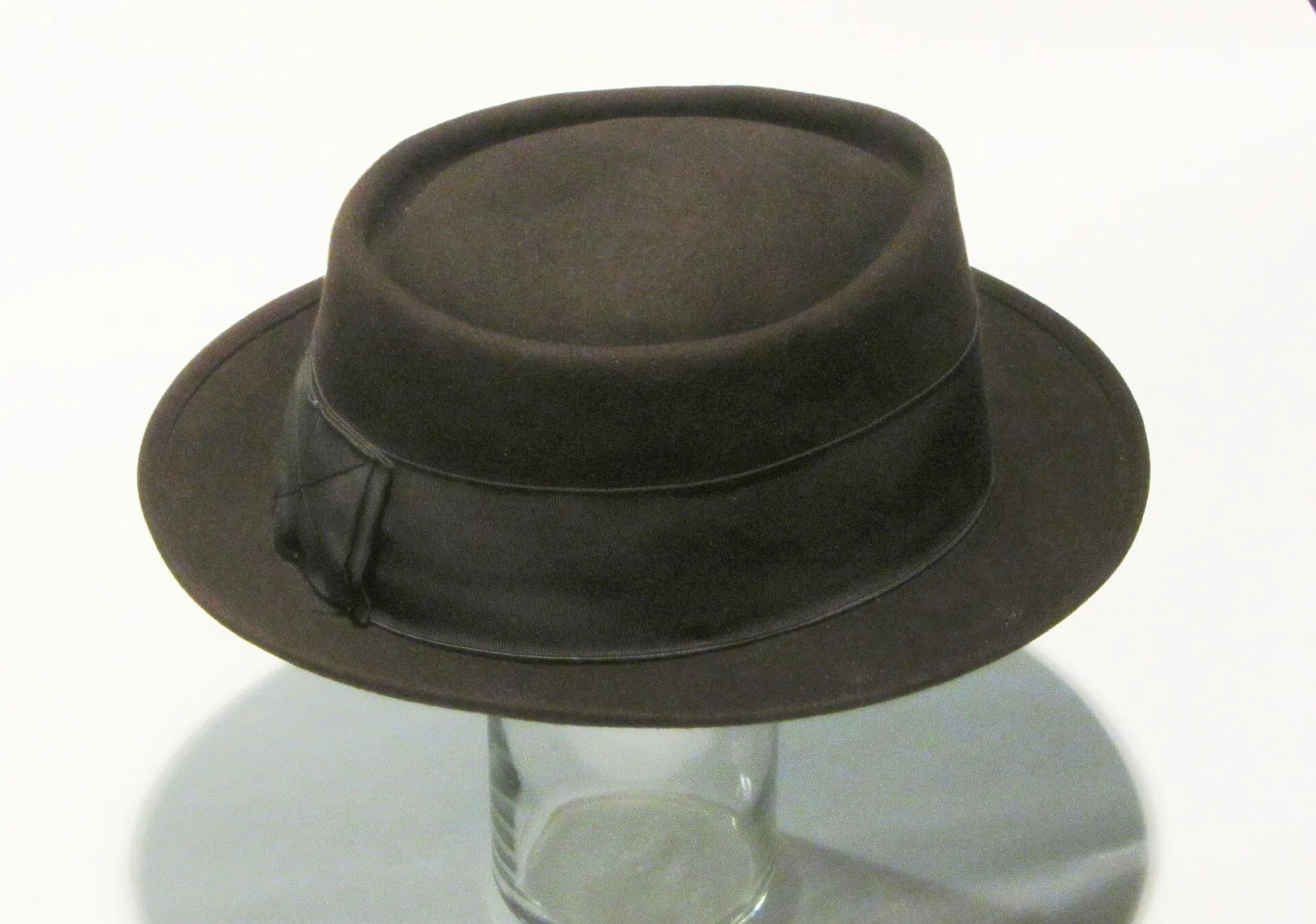
Two short-brimmed cousins get confused with the trilby. A pork pie hat has a flat top with a circular crease and a brim turned up all around, not snapped down. A homburg has a single dent and a stiff, evenly curled brim with a bound edge. Neither has the trilby's forward slope.
One more source of confusion is regional. In British usage "trilby" is often used loosely for almost any soft felt hat with a pinched crown, including what an American shop would sell as a fedora. A British listing for a "brown trilby" may have a 2½ in brim.
Where did the trilby get its name?
From a novel and the play made from it. George du Maurier's Trilby was published in 1894 and became one of the best-selling books of the decade; its heroine is Trilby O'Ferrall, an artists' model in Paris who falls under the hypnotist Svengali. Paul Potter turned it into a play that opened in the United States in 1895. Herbert Beerbohm Tree bought the British rights, played Svengali himself, and opened it at the Haymarket Theatre in London on October 30, 1895, after a tryout in Manchester that September.
A soft felt hat with a narrow brim was worn in that first London production, and the style became known as a Trilby hat. Which character wore it, and exactly what it looked like, is not well recorded; accounts agree on the production and the name, not on the details of the prop. The fedora has a similar origin: it is named after Victorien Sardou's 1882 play Fédora.
Who wore the trilby, and why did it come back?
In Britain the trilby became a gentleman's hat for the country and the racecourse: a brown felt trilby with tweeds became a familiar sight at race meetings, and it was once seen as the rich man's favored hat for the country, softer and less formal than a bowler or a homburg. The short brim was practical: it catches less wind than a wide brim, and its low profile is often given as one reason it suited the motoring age.
Men's hat wearing in general fell away after the Second World War, and the trilby went with it. It came back in a different form. In the 1990s and especially the 2000s the trilby became a fashion accessory, worn by musicians and then sold everywhere, usually pushed to the back of the head. Most of the hats sold in that wave were not felt at all but tweed, cotton, straw or polyester, cut short in the brim and often made in one or two sizes. That is why a search for a trilby today brings up as many cheap fabric hats as felt ones, and why the shape picked up a slightly comic reputation it never had in felt.

Felt, straw or fabric: which trilby should you buy?
The material decides the season and whether the hat can be reshaped. The shape is the same in all three.
- Felt. Blocked from a felt cone with steam and heat, so the crown pinch and brim flip are set into the material. It can be reshaped with steam for its whole life. Fall to spring wear, and the best of the three in a shower.
- Straw. Woven or braided straw blocked into the same shape. Light and ventilated for summer. It cracks if crushed and does not like rain; a straw trilby is a second hat, not a replacement for felt.
- Fabric. Tweed, cotton, linen or polyester, sewn from panels over a stiffened lining. Fabric hats are not blocked, so a crushed crown cannot be steamed back to a crisp pinch. A good tweed trilby is a real country hat; a thin polyester one is a costume.
If a listing just says "felt", check the fiber. A hat that turns out to be polyester will look flat and slightly shiny and will not take steam; the felt hat burn test on one fiber from inside the sweatband settles it.

Is a wool felt trilby good enough?
Usually, yes, and for a reason that has nothing to do with the felt itself. Wool's main weakness in a hat is a brim that droops, and a trilby barely has one. (The fiber-by-fiber comparison of wool, rabbit, hare and beaver is in beaver felt hats.)
- Brim droop. A wide wool brim sags at the front after a season of handling and damp. A brim of 1½–2 in has very little leverage on the felt, so a wool trilby keeps its line much better than a wool fedora does.
- The pinch. This is still where wool shows its age first, because the front pinch is where you pick the hat up. A few seconds of steam puts it back.
- Rain. Wool wets through in a heavy shower, and a short brim sheds less water off your face than a wide one either way. If you will wear the hat every day in wet weather, fur felt earns its cost.
So for a first trilby, or one worn a few times a month, wool felt is a sensible buy in a way a wide wool fedora often is not. For a hat worn daily for years, fur felt is still the better material. Where makers and their price brackets are concerned, see felt hat brands.
How should a trilby fit?
Measuring and converting to a US size work as for any felt hat, with the table in felt hats for men. Three points matter more on a trilby than on a wider hat:
- It sits higher. A trilby is meant to sit a little above where a fedora would, with the brow showing under the front of the brim. That only works if the size is right; a trilby that is too big drops to the ears and the short brim makes the mistake obvious.
- Avoid "one size" and two-size ranges such as S/M and L/XL if you can. They are common in fashion trilbies and rely on an elastic or drawstring band. A hat sold in eighth sizes, with a proper sweatband, fits better.
- Between sizes, take the larger and fit a strip of foam sizing tape behind the sweatband. A soft felt crown gives a little with wear; it will not stretch a full size.
How do you wear a trilby?
Level, or tipped slightly forward, with the front of the brim down over the brow and the back turned up. That is the angle the brim is cut for. Tilted far back it shows the whole forehead, and the up-turned back of the brim presses against the collar; the 2000s fashion trilby was often worn that way, and that look is now dated.
The short brim is the whole point, so wear it where a short brim works:
- With a smaller frame or a narrow face. A short brim keeps the hat in proportion on someone who would be swamped by a 3 in fedora brim.
- With a large head or broad shoulders, with care. A brim much narrower than the face makes the head look bigger. Try the 2 in end of the range, or a stingy-brim fedora instead.
- With casual and country clothes. Tweed, a field jacket, a sweater, a waxed coat. With a dark suit and overcoat a trilby looks under-dressed beside a fedora or homburg.
- In wind and in cars. A short brim catches less wind and clears a car's door frame and headrest, which is the practical case for it over a fedora.
- Women's trilbies are the same hat in smaller sizes. The proportions for a smaller head, and wearing a hat over long hair, are in felt hats for women.
Brown, gray, olive and charcoal are the traditional trilby colors; black is more city than country. What each shade does next to different coats is covered in felt hat colors. For a broader view of where the trilby sits among other hats, including the gambler and the top hat at the other extreme of brim and crown, see types of felt hats.
How do you look after a felt trilby?
A soft hat brush after wearing and a dry at room temperature after rain cover most of it; stains and sweatbands are in how to clean a felt hat. The trilby's own risks are at the back of the brim and the front of the crown:
- Protect the back flip. The turned-up back of the brim is the feature most easily lost. Do not rest the hat on its brim or hang it on a hook that presses the back down; use a hat stand or rest it upside down on its crown.
- Reset the flip with steam. If the back has flattened, hold that section of brim over steam for a few seconds, curl it up with your fingers, and hold it until it cools. A handheld garment steamer is easier to aim than a kettle. Do the same for a softened front pinch.
- Pick it up by the brim, front and back, not by the pinch. On a short brim that means a lighter grip, but it saves the crown.
- Packing. A soft felt trilby travels better than a wide-brimmed hat. Stuff the crown with a rolled T-shirt and pack it crown-down in the top of a bag; do not fold it.
- Moths eat wool and fur felt alike. A hat put away for summer needs the precautions in protecting wool from moths.
If you would rather make one, a trilby is one of the easier shapes to block at home: a soft wool felt cone steamed over a fedora-style crown block, with the brim cut short and shaped by hand. The cones and blocking steps are in felt hat blanks.
Frequently asked questions
What is the difference between a trilby and a fedora?
The brim and the crown. A trilby has a short brim, usually about 1½ to 2 in (4 to 5 cm), angled down at the front and turned up at the back, on a slightly shorter crown. A fedora's brim is wider, about 2⅜ in (6 cm) and up, and sits flatter. There is no fixed cut-off, and makers draw the line in slightly different places.
Why is it called a trilby?
After Trilby, George du Maurier's 1894 novel, and more directly the stage version that opened in London at the Haymarket Theatre in 1895. A soft hat of this kind was worn in that first London production, and people began calling it a Trilby hat.
Is a wool felt trilby worth buying?
Yes, more so than a wool fedora. The weak point of wool felt is a wide brim that droops, and a trilby brim is too short to droop much. Fur felt is still lighter and better in rain, but wool is a sound first trilby.
Should a trilby be worn tilted back?
It can be, and that is how the 2000s revival wore it, but the traditional way is level or tipped slightly forward, with the brim down over the brow and up behind. Pushed far back it shows the whole forehead and reads as a fashion accessory rather than a hat.
Can you steam a felt trilby?
Yes. A soft felt trilby is shaped with steam in the first place. Hold the dented part over steam for a few seconds until it feels warm and limp, shape it by hand, and hold it until it cools. Fabric and polyester trilbies do not respond to steam the same way.
Topics
Image credits
- A young man in a white shirt and black suspenders wearing a dark gray short-brimmed trilby with a pinched crown — Sabine Meier (Pexels License)
- A man with a waxed mustache in a checked jacket wearing a dark teal felt trilby with a short brim and a bow at the band — furkanfdemir (Pexels License)
- Black and white profile of an older man wearing a light-colored short-brimmed trilby with a band — CESAR A RAMIREZ VALLEJO TRAPHITHO (Pexels License)