Is Your Felt Hat Wool? The Burn Test, and What to Do If It Scorches
3 min read
Wool smoulders, smells of burnt hair and crushes to ash. Polyester melts into a hard bead. Thirty seconds and one loose fibre tells you what you actually bought.
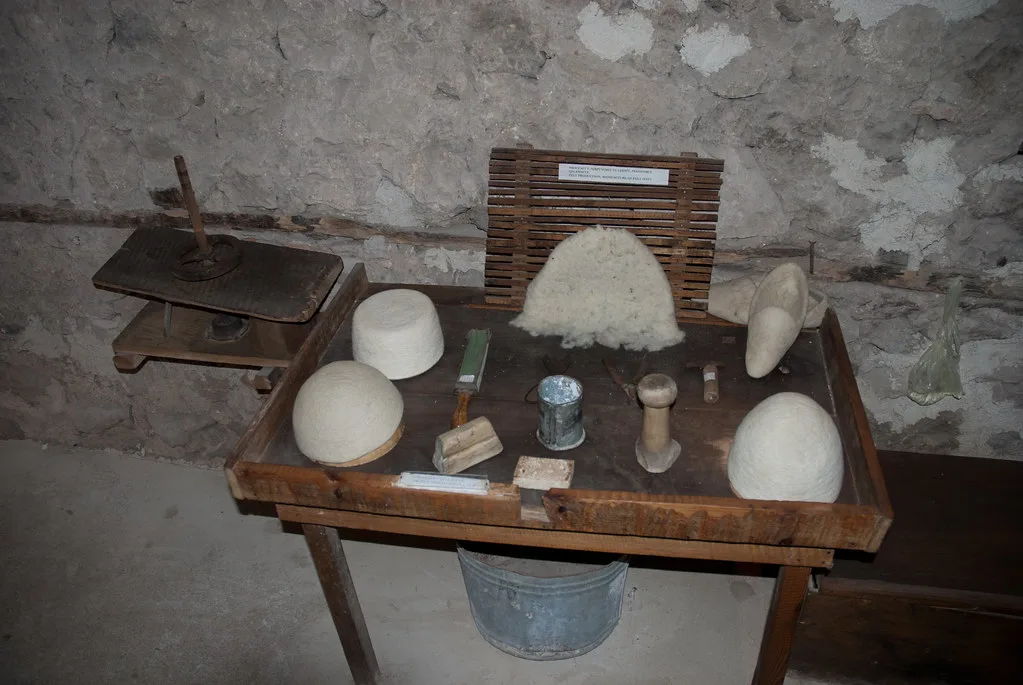
"100% wool felt", "wool blend" and "felt" mean three very different things, and the last of the three usually means polyester. The listing is not always honest, but the fibre always is.
How to run the test
- Take a fibre from somewhere hidden. Under the sweatband, inside the crown at the seam, or the raw edge of the brim underside. A few millimetres is plenty.
- Work over a ceramic saucer, near a sink, well away from the hat and anything else flammable.
- Hold the fibre in tweezers and bring a lighter flame to the end.
- Watch three things: what it does approaching the flame, how it smells, and what the residue does when you crush it.
Reading the result
Wool
- Curls away from the flame and smoulders rather than flaring
- Smells strongly of burning hair or feathers
- Goes out on its own once the flame is removed
- Leaves a brittle black ash that crushes to powder between your fingers
Polyester or acrylic
- Shrinks away from the flame, then melts and drips
- Smells chemical or sweet — plastic, not hair
- Often keeps burning with a sooty flame
- Leaves a hard, shiny bead you cannot crush
Rabbit or beaver fur felt
- Behaves like wool, because it is also keratin — smoulders, smells of hair, crushable ash
- The fibres are noticeably finer and shorter than wool; under a magnifier there is no crimp
A blend gives you both at once: a smell of burnt hair with a small hard bead left behind. That is the answer to "wool blend" — there is enough plastic in it to melt.
Tests that do not involve fire
- Water drop. A drop on wool felt sits and beads before soaking in slowly. On polyester it either runs straight off or sits on the surface indefinitely.
- Steam. Wool relaxes and reshapes under steam. Polyester does not move at all — and past about 150°C it starts to gloss and melt.
- Feel and weight. Wool felt is warm to the hand and slightly springy. Synthetic felt is cool, slick and stiff in a way that does not soften with wear.
- Weight. A wool felt fedora is 120–180 g. Much lighter than that is a costume hat.
The same tests work on felt fabric by the metre — see wool felt fabric for what the different blends are sold as.
Singeing: burning as a finishing step
Hatters deliberately pass a fur felt hat body through a flame to burn off the fine protruding fibres, then pounce it with fine abrasive paper and brush it. That is what gives a good fur felt hat its smooth, close surface.
It is a production process on bare felt with the body held taut and moving continuously. It is not something to attempt on a finished hat with a band, a lining and a leather sweatband on it, and a wool hat will scorch and yellow long before a fur felt one does.
If a hat gets scorched
- Let it cool completely before touching the mark.
- Brush firmly along the nap with a stiff hat brush. On wool, light scorching sits on the fibre tips and much of it lifts.
- Sand very lightly with 400-grit paper or a fine sanding sponge, in small circles, checking constantly. You are removing burnt tips, not felt.
- Steam and re-brush to raise the nap again.
- Assess the colour. Wool yellows where it has been heated; if the shade has shifted, the fix is to darken the whole hat, not the patch.
None of this works on melted synthetic felt: the fibres have fused into a hard glazed patch, and sanding it only makes a rough hard patch. That hat is decoration now.
For everything short of fire damage — rain marks, sweat, dust and general dulling — the routine is in how to clean a felt hat.
Frequently asked questions
How can you tell if a felt hat is real wool?
Burn a single fibre pulled from inside the sweatband. Wool smoulders rather than flares, smells of burnt hair, self-extinguishes, and leaves a black ash that crushes to powder. Polyester shrinks from the flame, melts, smells chemical and leaves a hard bead.
Is the burn test safe on a hat?
Yes, if you take the fibre from a hidden place — the underside of the sweatband or the inside of the crown seam — and burn it over a saucer well away from the hat itself. Never hold a flame to the hat.
Do hat makers really burn felt hats?
Yes. Singeing, or "flaming", is a finishing step: the hat is passed briefly through a flame or over a gas jet to burn off protruding fibre ends, then brushed and sanded. It is done on bare unfinished felt by people who do it daily.
Can you repair a scorched felt hat?
A light surface scorch on wool felt often brushes and sands out, because only the fibre tips are affected. A melted mark on synthetic felt is permanent — the fibre has fused and cannot be raised again.