Hat Stiffener: Sprays, Brush-On Stiffeners and Firming a Floppy Felt Brim
9 min read
We may earn a commission from links on this page, at no extra cost to you. As an Amazon Associate I earn from qualifying purchases. Learn more.
A floppy felt brim has lost the stiffener it was finished with, and steam alone will not put it back. The kinds of hat stiffener, spray against brush-on, how to stiffen a felt or cowboy hat brim without a shine, stiffening a hat you are blocking, and the craft-felt version.
A new felt hat is not just felt. At the factory the body is treated with a stiffener, a resin or similar size that coats the fibers and binds them together as it dries, and that is what gives a brim its spring and keeps a crease sharp. Rain, sweat, years of handling and long steaming all wash or soften it out. When a brim flops down over your eyes and will not stay where steam puts it, it is short of stiffener, and a hat stiffener puts some back.
The products split into sprays for finished hats, brush-on stiffeners that milliners use, and craft stiffeners for flat felt. They are not interchangeable, and the wrong one, or too much of the right one, leaves a hat shiny, board-stiff or cracked.
Do you need stiffener, or just steam?
Most brim problems are shape problems, not stiffness problems, and steam fixes shape. Try steam first: soften the brim, put it back where it belongs, hold it until it cools, and let the hat sit for a day. The method is in hat steamers.
Then test it. Flex the edge of the brim gently up and let go. A healthy felt brim springs back to its line. A brim that needs stiffener stays bent, sags back down under its own weight within a day or two, or waves along the edge when you wear it in a breeze. That is the point at which stiffener is the fix, and not before.
Some hats should never be stiffened. A crushable or packable felt is soft by design, and so are most slouch hats, many cloches and almost every bucket hat. Stiffening a soft hat turns it into a different, worse hat, and the stiffener cracks the first time it is folded.
The kinds of hat stiffener
| Type | What it is | Best for | Watch for |
|---|---|---|---|
| Hat stiffening spray | A resin stiffener in an aerosol or pump bottle | A finished hat whose brim needs a little more body; western hats | Fumes and flammability; overspray on the outside of the hat |
| Water-based millinery stiffener | A brush-on liquid that dries clear; low odor, cleans up with water | Hand-blocked felt and fabric hats, and straw | It wets the felt, so the felt softens until it dries |
| Spirit-based millinery stiffener | A brush-on stiffener in an alcohol-type solvent, the traditional choice for felt | Blocking felt hoods; firm brims | Strong fumes, flammable; needs good ventilation |
| Fabric stiffener | A craft product for flat fabric and felt | Ornaments, bookmarks, bowls and other craft felt | Made for crafts, not for a hat you wear in the rain |
| Diluted white glue | White craft glue thinned about half and half with water | Craft felt and hand-felted hats | A slightly plastic feel; can shine on dark felt |
Hard felt hats are a separate case. A bowler's crown is stiffened with shellac or a resin until it is rigid, and a homburg's curl is set with stiffener and heat. Those are hatter's work. Restiffening a bowler at home rarely ends with an even finish; see felt bowler hats for how they are made.
Spray or brush-on?
For a finished hat you wear, a hat stiffening spray is usually the right first try. It goes on thin and even, it dries quickly, and you can build it up a coat at a time until the brim holds. Its weakness is depth: a spray coats the surface it hits, so on a very limp brim it may add a crisp skin without much spring underneath.
Brush-on stiffener soaks into the felt. That gives a firmer, more even result through the thickness of the brim, which is why milliners use it when blocking. It is also easier to overdo, and a heavy coat that soaks right through to the top surface can show.
If your brim is merely soft, spray. If it hangs like cloth, or you are making the hat, brush.
How to stiffen a felt hat brim
- Clean the hat first. Brush off dust and deal with any marks. Stiffener seals in whatever is on the felt.
- Shape it with steam and let it dry completely. Stiffener fixes the brim in the shape it is in when the stiffener dries, so get the shape right first.
- Test on a hidden spot. The inside of the crown, near the band, is the place. Let it dry and check for darkening, shine or a white bloom.
- Protect what you do not want coated. Tuck paper between the sweatband and the felt, and slip the outer band off if it lifts easily. Avoid masking tape on the felt itself; it can lift the nap when you peel it.
- Apply to the underside of the brim, thin and even, from the base of the crown to the edge. Spray in light passes from the distance the can recommends, or spread brush-on stiffener with a foam brush and stop before it pools. Leave the top of the brim alone; that is where a shine shows.
- Support the brim while it dries. A flat brim dries flat on a clean table with the crown hanging over the edge or sitting in a ring. A curled western brim dries in its curl, with rolled towels under it. Put the crown on a head form so it keeps its shape too.
- Let it dry fully, overnight at least, at room temperature. Do not use a hair dryer or a heater on it.
- Test, then repeat if needed. A second and third thin coat build stiffness more evenly than one heavy one.
If the crown has gone soft too, the same stiffener goes on the inside of the crown, applied thin, with the hat on a form so the crease is held.
Working safely with sprays and solvent stiffeners
- Work outdoors or with a window open and air moving. Aerosol stiffeners and spirit-based brush-on stiffeners give off fumes you should not breathe in a closed room.
- Treat them as flammable. Keep them away from flames, a gas stove and heaters, and do not put a freshly sprayed hat over a hot steamer. Let it dry and air out first.
- Keep pets and children away while you work and while the hat dries.
- Read the label for the maker's ventilation and glove advice, and follow it.
Cowboy hat stiffener
Cowboy hats are the commonest reason people buy a hat stiffening spray, because a wide western brim puts a lot of leverage on the felt. A 4 in (10 cm) brim droops long before a 2 in one does, and wool felt has less spring than fur felt to begin with.
- Wool felt westerns are the usual candidates. After a soaking, or a season of being picked up by the brim, the front starts to dip. Reset it with steam, and if it will not hold, stiffen the underside.
- Fur felt westerns rarely need it unless they have been soaked repeatedly or steamed hard. A good fur felt hat that has gone soft is worth taking to a hatter, who can restiffen and reblock it properly.
- Set the curl before you stiffen. Roll both sides of the brim with steam, compare them from the front, and only then apply stiffener, with the brim drying in that curl.
Felt grades, crown creases and how much brim is too much for wool are covered in felt cowboy hats.
Stiffening a hat you are making
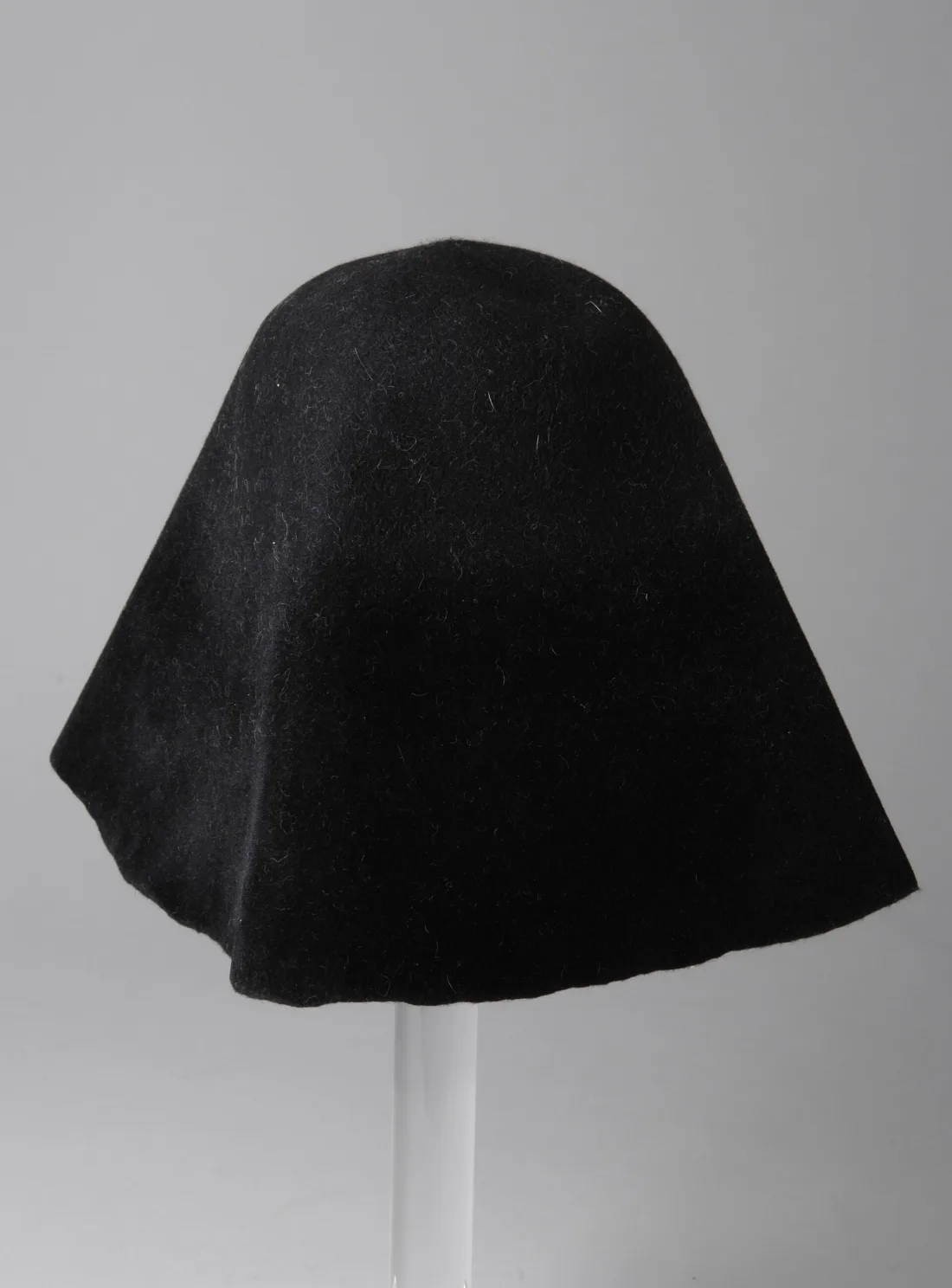
If you block your own hats, stiffener is part of the process rather than a repair. Felt hoods and capelines are sold either pre-stiffened or unstiffened. An unstiffened hood is softer and easier to pull over a block, and the stiffener goes on afterward if you want structure. A pre-stiffened hood takes a sharper shape but needs more steam to soften it.
One common order is to block the hat, let it dry on the block, then brush stiffener on the inside of the crown and the underside of the brim before the final shaping. Keep it off the outside surface. The blanks themselves, and the rest of the blocking steps, are in felt hat blanks.
Hand-felted hats made over a resist follow the same idea in a simpler form: a wash of diluted white glue on the inside of the brim, or a wire stitched into the brim edge. The steps for that are in wet felting a hat. A cloche usually wants very little: just enough at the brim edge to keep the turn-down even. Its shapes and fit are in felt cloche hats.
Felt stiffener for crafts
Craft felt is a different job. For ornaments, bookmarks, bowls and anything cut from flat felt, use fabric stiffener or white glue thinned half and half with water. Brush or dip, press out the excess, and pin the piece flat on a board covered in plastic wrap, or shape it over a form, until it is completely dry.
- Thick wool felt rarely needs it. At 2–3 mm (about 1/16–⅛ in) it holds a cut shape on its own.
- Thin acrylic craft felt nearly always does, especially for spokes, points and anything that has to stand up.
- Stiff felt sheets come already treated and save the step, at the cost of drape.
Worked examples are in felt snowflake ornaments and the felt bookmark. For a felted vessel that needs to stand rigid, wet felting a bowl covers stiffening on the inside.
Common mistakes
- Too much at once. A heavy coat soaks through, dries with a shine or a white bloom, and makes the brim brittle. Thin coats, more of them.
- Stiffener on the top surface. The top of the brim and the outside of the crown are what people see. Spray from underneath and shield the top with your hand or a sheet of paper.
- Stiffening the wrong shape. Whatever shape the brim dries in is the shape you are fixing. Steam and shape first.
- Drying with heat. Heat on felt shrinks and hardens it unevenly. Room temperature, and patience.
- Long steaming afterward. Steam softens stiffener, which is why short bursts are the rule on any stiffened hat.
- Stiffening synthetic felt. A polyester hat may already be heavily stiffened, and more stiffener on it tends to crack. Check what the hat is with the felt hat burn test.
Can stiffener be taken out?
Partly, and not reliably. Water-based stiffener softens again with water and steam, which is one reason a soaked hat can go limp. Solvent-based stiffeners and factory finishes are harder to shift at home. If a hat has been over-stiffened and is cracking or shining, a hatter is the person to ask; trying to wash it out risks shrinking the felt, as how to clean a felt hat explains.
Frequently asked questions
How do you stiffen a felt hat brim?
Steam the brim into the shape you want and let it dry. Then apply a thin coat of hat stiffener to the underside of the brim, by spray or brush, and let it dry fully with the brim supported flat or in its curl. Add a second thin coat if it is still soft. Several thin coats are better than one heavy one.
Is hat stiffening spray or brush-on stiffener better?
Spray is quicker and easier to keep even on a finished hat, and suits a brim that needs a little more body. Brush-on millinery stiffener gets deeper into the felt and gives a firmer result, which suits a very limp brim or a hat you are blocking yourself.
Can you use glue to stiffen a felt hat?
White glue thinned about half and half with water works as a household stiffener, mostly for craft felt and hand-felted hats. On a bought hat it tends to leave a slightly plastic feel and can show as a shine, so a stiffener made for hats is the better choice there.
Why does my cowboy hat brim keep drooping?
Usually because the felt has softened: from rain, from long steaming, or simply because wool felt has less spring than fur felt. Reset the brim with steam first. If it droops again within days, the felt needs stiffener on the underside of the brim.
Should you stiffen a soft or crushable hat?
No. A crushable or packable hat is made soft on purpose so it can be rolled and shaken back out. Stiffening it stops it doing the one thing it was bought for, and the stiffener cracks the first time the hat is folded.
Topics
Image credits
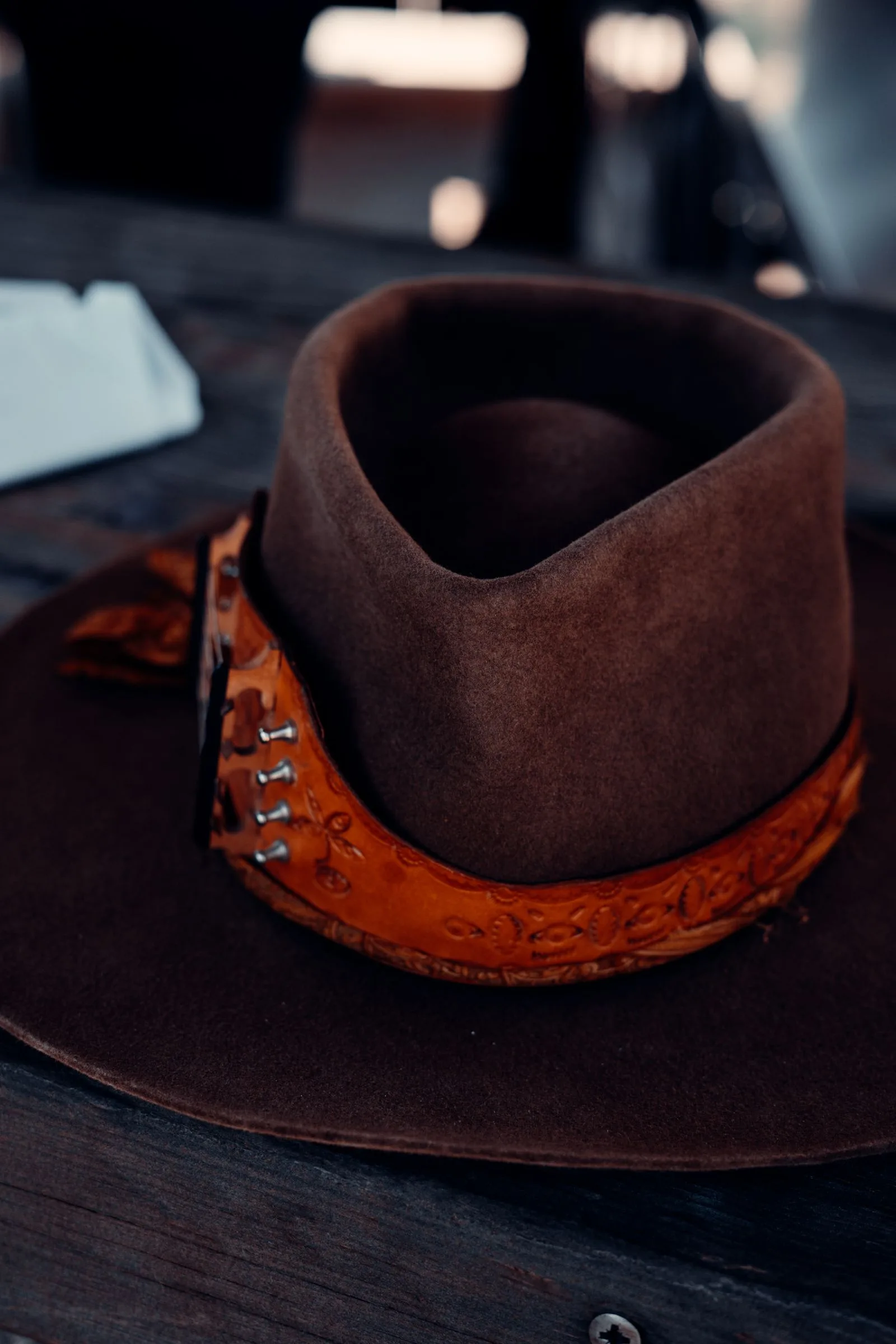
- A brown felt western-style hat with a pinched crown, a wide flat brim and a tooled orange leather band, resting on a dark wooden table — Çağın KARGI (Pexels License)
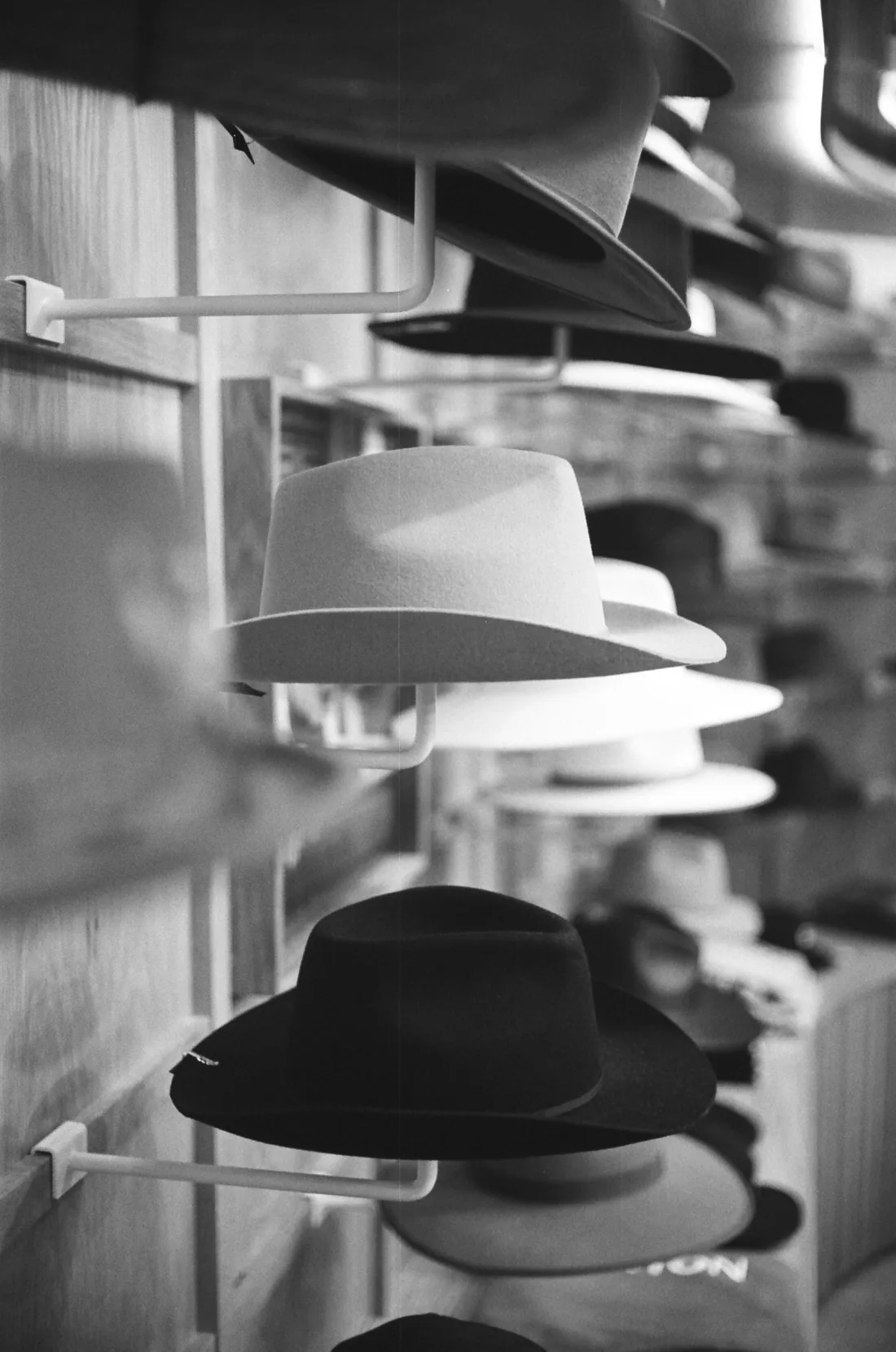
- Black and white photo of felt hats with wide flat brims hanging on wall hooks in a hat shop, a pale hat and a black hat in focus — Mark Neal (Pexels License)
- A black wool felt hat hood, a tall bell-shaped blank with an uneven raw edge, on a clear museum stand — Museum Rotterdam (BY SA 3.0)