Felt Pork Pie Hat: The Telescope Crown, Where It Came From, and How to Keep It Flat
11 min read
We may earn a commission from links on this page, at no extra cost to you. As an Amazon Associate I earn from qualifying purchases. Learn more.
A pork pie is a felt hat with a flat top, a circular telescope crease, a low crown and a short brim. How it differs from a fedora, a trilby and a stingy brim, its history from the 19th century to jazz and ska, wool against fur felt, sizing, and how to steam the crease back in.
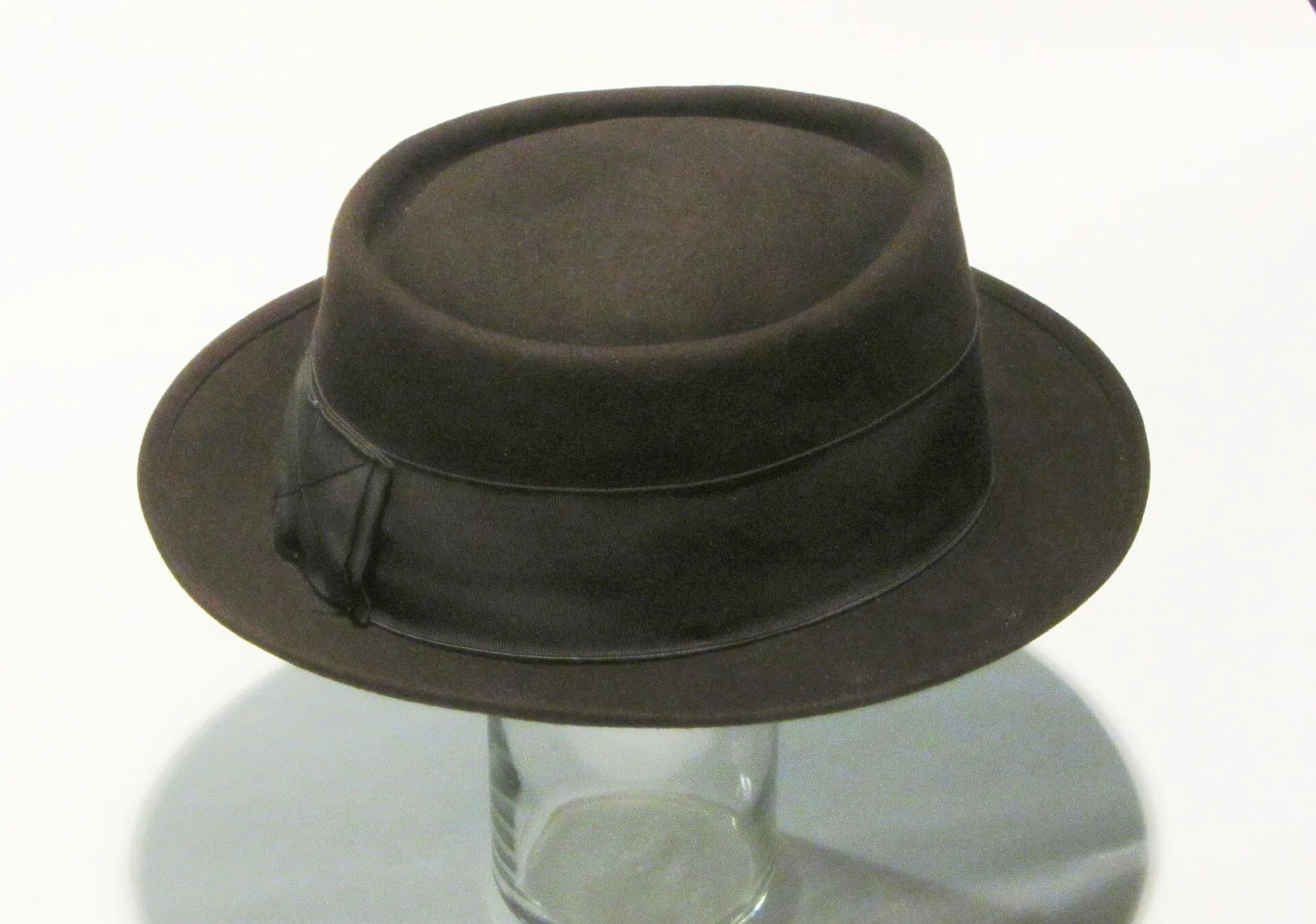
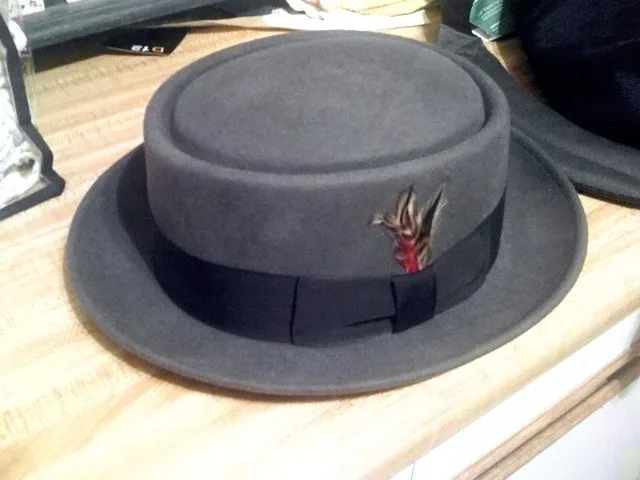
Look down on a pork pie from above and the top of the crown is flat, with a ring-shaped groove running around its edge about ½ in (1.3 cm) in from the side. Hatters call it a telescope crown, because the flat center is pushed down inside the walls the way the sections of a telescope slide into one another. Push it up from inside and the hat turns into a plain, round, flat-topped crown with no character at all. That one fold is the whole style.
Around it, the rest of the hat is low and compact: a crown about 3–3¾ in (8–9.5 cm) tall, a brim of roughly 1½–2 in (4–5 cm), and a ribbon band, often with a small bow at the side or back. Most pork pies wear the brim snapped up all around or turned down slightly at the front, but the brim is never wide.
What does a pork pie hat look like up close?
Four features identify it, and a hat sold under the name should have all of them:
- A flat top. Not domed like a bowler, not ridged like a fedora. Laid flat, the top surface is level from side to side and front to back.
- A telescope crease. A continuous groove around the top, set in from the edge. The center may sit slightly below the rim or almost level with it; a deep groove looks more dramatic, a shallow one more restrained.
- A low crown. Shorter than a fedora's, which is part of why it reads as casual and slightly sharp.
- A short brim. Usually snapped up at the back and sides. Some are turned up all the way around, some dipped a little at the front over the eyes.
The crown is not always perfectly round. Many are a gentle oval following the head, and a few makers block a slightly squared, flat-sided crown. What you will not find on a true pork pie is a front pinch. Once a hat has pinches it is a fedora or a trilby with a flattened top, however it is labeled.
Pork pie vs fedora vs trilby vs stingy brim
These four get used interchangeably in shop listings, and sometimes the same hat is sold under all four names. The differences are in the crown and the brim, and they are easy to see once you know where to look.
| Pork pie | Fedora | Trilby | Stingy brim | |
|---|---|---|---|---|
| Crown top | Flat, with a circular telescope groove | Center crease front to back | Teardrop or center crease | Usually a fedora crease |
| Front pinches | None | Two | Two, often sharp | Usually two |
| Crown height | Low, about 3–3¾ in (8–9.5 cm) | Medium to tall | A little shorter than a fedora, tapering toward the top | Medium |
| Brim | 1½–2 in (4–5 cm), mostly snapped up | 2⅜–3 in (6–8 cm), snapped down at the front | About 1½–2 in (4–5 cm), down at the front, up at the back | Narrower than a standard fedora, roughly 2⅜ in (6 cm) or less |
| What the name describes | The crown shape | The whole hat | The whole hat | Only the brim width |
That last row is where the confusion comes from. "Stingy brim" is a brim width, not a style, so a narrow-brimmed fedora is a stingy brim and so is a narrow-brimmed pork pie. The trilby is the hat most often mislabeled as a pork pie, and it has its own page: felt trilby. Wider fedora brims and pinches are covered in felt hats for men, and the full list of named felt styles is in types of felt hats.
Where does the pork pie hat come from?
The name is a description. A traditional English pork pie is a raised pie with straight sides, a flat lid and a crimped rim, and a flat-topped hat with a groove around the edge looks like one. Encyclopaedia Britannica dates its popularity, with both men and women, to the mid-19th century; hat retailers often give a tidier range of about 1830 to 1865, which is hard to trace to a period source. The women's version of that era was small, worn tipped forward on the head, with a narrow brim curled up toward a flat crown, often in straw or velvet rather than felt.
The men's felt pork pie is largely an American story of the early 20th century. Three names come up again and again:
- Buster Keaton. The silent film comedian wore a low, flat pork pie as part of his screen costume through the 1920s. By his own account, given in an interview in 1964, he made them himself, cutting down good Stetson felt hats into flat pork pies and stiffening the brims with a sugar-water solution so they held their flat shape. The hats were part of the joke: a deadpan face under a small, rigid, slightly too formal hat.
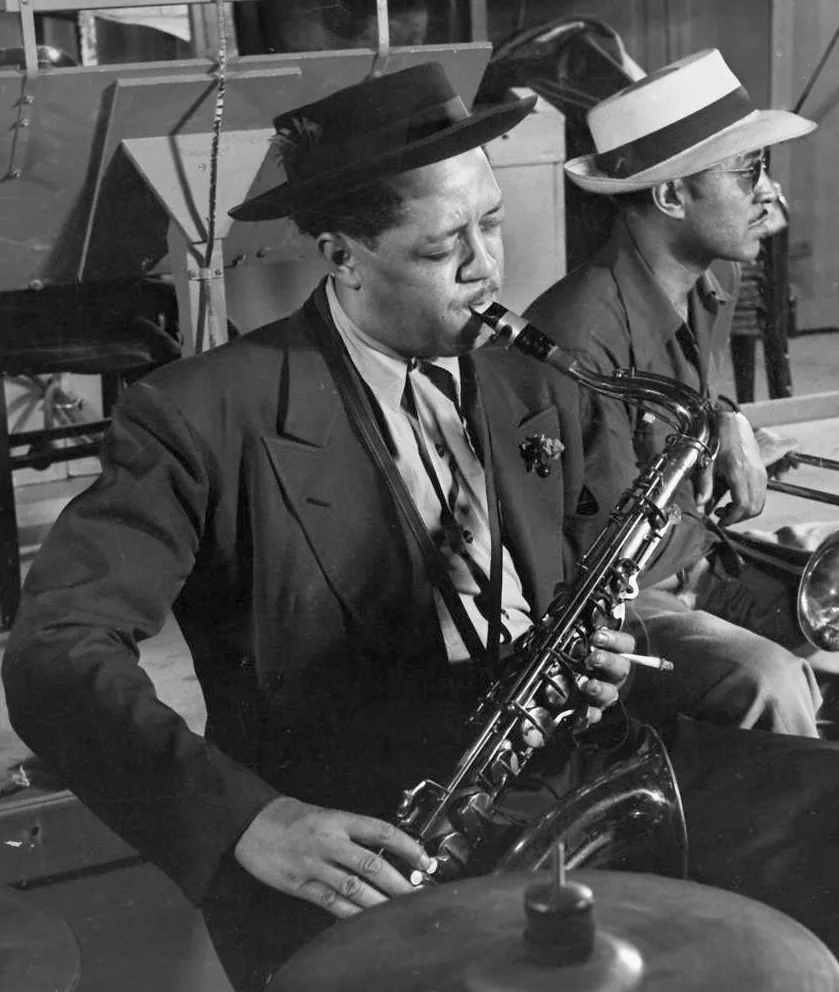
- Lester Young. The tenor saxophonist, who played with Count Basie's band and alongside Billie Holiday, wore a pork pie on stage so consistently that the hat became part of how people pictured him. His was a flat-topped hat with a slightly wider brim than Keaton's. After Young died in 1959, Charles Mingus recorded "Goodbye Pork Pie Hat" in his memory, and the title has kept the hat attached to jazz ever since.
- The 1930s revival. Newspaper fashion pages of the mid-1930s describe the pork pie as a current style, made with a snap brim and a slightly taller crown, and insist that the true version only looks right when worn telescoped.
Later the hat moved through several very different groups. In 1960s Jamaica it was part of the sharp, tailored look of the rude boy subculture that grew up around ska. The British 2 Tone ska revival of the late 1970s, with bands such as The Specials and The Selecter, brought it back in the UK with black-and-white suits and loafers. Then a black pork pie became the visual signal of Walter White's alter ego "Heisenberg" in the television series Breaking Bad (2008–2013); the hat from the show was later donated to the Smithsonian. That one character probably explains a good share of the people still searching for the hat by name.
Why does a pork pie need a stiff felt?
A flat panel of felt has nothing holding it up except its own stiffness. On a fedora, the center crease and pinches act like folds in a sheet of cardboard and keep the crown rigid. A pork pie top has only the ring of the telescope crease at its edge, so a soft or thin felt sags in the middle, especially after rain or a hot day. In practice:
- Wool felt pork pies are fine as a first hat or for occasional wear. Look for one described as stiff or firm, not "crushable" or "packable", because a crushable wool pork pie loses its flat top quickly. Expect to reset the crease with steam now and then.
- Fur felt pork pies (rabbit or hare, sometimes blended, and beaver at the top end) hold a crisp, flat top and a sharp groove for years. Beaver and beaver blends are discussed in beaver felt hats.
- Unlabeled hats. If a listing does not say what the felt is, a single fiber from inside the sweatband will at least tell natural fiber from synthetic; see felt hat burn test.
The wider comparison of the two felts, for any hat, is in felt hats for men. Hat makers who sell the style range from heritage firms to fashion labels; felt hat brands covers who makes their own felt and who buys bodies in.
Why does a low crown make fit harder?
A low crown changes the fit more than people expect. With less height, the hat sits closer to the top of the head, and there is less room for it to rest at different depths. A taller hat that is a fraction loose drops a little and still looks fine. A pork pie that is loose drops onto the ears and the flat top ends up looking like a lid.
- Measure around the head with a soft tape, level across the middle of the forehead and just above the ears, where the sweatband will sit.
- Convert to a US hat size using the size chart in felt bowler hat.
- Try the depth. The band should sit about 1 in (2.5 cm) above the eyebrows, and the flat top should be level or tipped very slightly forward.
If you fall between sizes, take the larger and add a strip of foam sizing tape behind the sweatband. On a soft wool pork pie a slightly tight hat will ease over a few weeks; a stiff fur felt one will not ease much, so size it accurately from the start.
Face shape matters more with this hat than with a fedora. A low, flat crown and a short brim add little height, so the pork pie flatters a long or narrow face and can make a round, broad face look wider. If your face is broad, choose a pork pie with a slightly taller crown and a brim at the wide end of the range, and wear it tipped forward rather than on the back of the head.
How do you keep the telescope crease?
The crease gets pushed out in ordinary wear. Lifting the hat by the crown, leaving it in a hot car, or getting caught in rain all tend to pop the flat center back up. The fix is the same steam method used on any felt hat, aimed at the top of the crown. General brushing, stains and sweatband care are in how to clean a felt hat; this is only the crease.
- Steam the top only. Hold the crown over a kettle or a handheld garment steamer for about 5–10 seconds, until the felt feels warm and very slightly damp. Do not soak it.
- Press the center down. With the hat on its brim, press the flat of your hand onto the middle of the top until it drops below the rim by the depth you want, usually ¼–½ in (6–13 mm).
- Set the groove. Run your fingertips slowly around the groove, pressing it into a clean, even ring the same distance from the edge all the way around. Look down on it from above to check it is centered.
- Hold it while it cools. Felt keeps the shape it has when it cools and dries. Keep your hand on it for a minute, then leave the hat to dry fully on its brim or on a hat stand before wearing.
For a wool hat that keeps losing its shape, a light coat of millinery stiffener brushed inside the top of the crown after reshaping will help. Use it sparingly; a stiffened crown cracks if it is later crushed. Fur felt rarely needs it.
Day to day, the habits that save the crease are simple. Pick the hat up by the brim, front and back, never by pinching the crown. Store it upside down on its crown or on a hat stand, as with any felt hat; the recessed center sits clear of the shelf, so only the rim of the crown takes the weight. Brush it after wearing with a soft hat brush, working around the groove as well as across the top, because dust collects in the fold.
How do you wear a felt pork pie hat through the year?
The pork pie is a hat with a long casual history (jazz clubs, ska, a chemistry teacher), and it suits casual and smart-casual clothes better than formal ones. For formal wear, the stiffer homburg is the traditional choice. Within that range, the felt does most of the seasonal work:
- Fall. The natural season for a wool or fur felt pork pie. Brown, olive and gray go with tweed jackets, chore coats, heavy knits and denim. A brown pork pie with a matching or slightly darker band is the most forgiving color.
- Winter. Black, charcoal and dark navy with an overcoat or peacoat. A low crown does not keep the ears warm, so it is a city hat, not a cold-weather hat. A fur felt one copes with snow flurries far better than wool.
- Spring. Lighter felts in gray, sand and light brown, with a contrasting band. This is when the snap-up brim and short crown look sharpest with an unstructured jacket or a short raincoat.
- Summer. Felt gets hot. Most people switch to a straw pork pie in the same shape, or a lightweight felt in a pale color worn only in the evening.
Band colors change the mood quickly. A tonal band (same color as the felt) is quiet and classic; a black band on gray felt is the 2 Tone look; a wide contrasting band reads as more fashion than tradition. The matching of felt colors to skin and hair is covered in felt hat colors, and women's proportions, where pork pies are usually blocked with a smaller crown, are in felt hats for women.
Can you block a pork pie from a felt hat body?
Yes, and it is one of the more forgiving shapes to try at home. Keaton's habit of cutting down a Stetson shows that it can be done without a dedicated block, though a flat-topped crown block gives a much cleaner result.
Steam a wool felt cone until it is soft, pull it down over a low crown block about 3½ in (9 cm) tall, and tie it off at the base. Let it dry completely. Then trim the brim to about 2 in (5 cm), press the telescope groove into the top with your fingertips while the felt is still damp from a second steaming, and stiffen the inside of the crown. Finishing a brim with a bound edge or a raw cut edge, and the blocks and cones to start from, are described in felt hat blanks. If you would rather felt the hat from loose fiber, the soft-crown method in wet felting a hat works, but the flat top will need a stiffener to stay flat.
Other short-crowned and stiff styles in the same family are the felt top hat, at the opposite extreme of crown height, and the felt bowler, which shares the low profile but has a hard dome instead of a flat top.
Frequently asked questions
What is the difference between a pork pie hat and a fedora?
The crown. A fedora has a center crease running front to back and two pinches at the front, so it rises to a ridge. A pork pie has a flat top with a circular groove around the edge (the telescope crease), no pinches, and a lower crown, usually about 3–3¾ in (8–9.5 cm). Its brim is also shorter.
Is a pork pie hat the same as a stingy brim?
No. Stingy brim describes only the brim: one narrower than a standard fedora brim, roughly 2⅜ in (6 cm) or less. A stingy brim hat normally has a fedora-style pinched crown. A pork pie is defined by its flat telescope crown, and many pork pies also have a fairly narrow brim, which is why the two names get mixed up.
Why is it called a pork pie hat?
Because the flat top with a raised rim around it looks like a traditional English pork pie, a raised pie with a crimped edge. The name dates from the mid-19th century, when a small version of the hat was fashionable with women as well as men.
How do you fix a pork pie crease that has popped up?
Steam the top of the crown for a few seconds until the felt feels warm and slightly damp, press the center down with the flat of your hand from above, run your fingertips around the groove to set the edge, and hold it until the felt cools. Work in short bursts rather than soaking the hat.
Should a pork pie hat be wool or fur felt?
Wool felt is the cheaper option and fine for occasional wear, but it softens over a season or two and the flat top can start to sag. Fur felt is lighter, sheds light rain and holds a crisp telescope crease for years, which matters more on a pork pie than on most hats.
Topics
Image credits
- A brown felt pork pie hat from the 1940s on a glass stand, with a flat telescope-creased top, a short brim and a tonal ribbon band — KDS444 (BY SA 3.0)
- A gray felt pork pie hat on a wooden counter, seen from above the front, showing the ring-shaped telescope groove round its flat top, a black band and a small feather — mythwhisper (BY 2.0)
- Black and white photograph of Lester Young playing tenor saxophone in a dark suit and a dark flat-topped pork pie hat, with another man in a pale straw hat behind him — Photograph by Gjon Mili. Time Inc. (PUBLIC DOMAIN)