Felt Top Hat: Beaver, Silk Plush, the Opera Hat, and How to Make One
11 min read
We may earn a commission from links on this page, at no extra cost to you. As an Amazon Associate I earn from qualifying purchases. Learn more.
The first top hats were beaver felt, the classic ones were silk plush, and almost every top hat bought today is wool or fur felt. The history (including the 1797 riot story that probably never happened), the collapsible opera hat, buying a felt topper, and the measurements for making one from craft felt, plus a mini top hat for a snowman or doll.
For most of the 19th century the best top hats were not felt at all. They were silk plush, a long-pile fabric stretched over a stiffened frame and polished until it shone. The top hats that came before them were beaver fur felt, and nearly every top hat sold today, from a formal fur felt topper to a steampunk costume hat, is felt again, usually wool. The hat has gone full circle on its material while the shape has barely changed: a tall, flat-topped cylinder with a short brim curled at the sides.
That simple shape is also why a top hat is the easiest hat to make yourself. It is a tube, a circle and a ring. The measurements for a full-size costume hat and for a snowman-sized one are further down this page.
What were real top hats made of?
The tall hat began as a felt hat. In the late 18th century the finest men's hats were made from beaver fur, felted, blocked into a tall crown and finished with a brushed nap. Beaver felt is dense, light and sheds rain, and it holds a crisp shape, which is why it was the hatter's best material for two centuries. The demand for it helped drive beavers close to extinction in large parts of North America and Europe, and by the 1830s the fur was scarce and costly. The fur grades that hatters still talk about are covered in beaver felt hats.
Silk plush replaced it. Plush, sold to the trade as hatter's plush, is a silk fabric woven with a long pile, made to look like the nap of a good fur felt. It was cut and sewn over a body stiffened with shellac, then ironed and polished to a deep gloss that beaver could not match. A London hatter, George Dunnage, is often credited with a silk-covered hat in 1793, but most accounts put the real switch from beaver to silk in the 1830s and 1840s, when French mills were producing plush in quantity. By the middle of the century the shiny black silk topper was the standard dress hat in Europe and America.
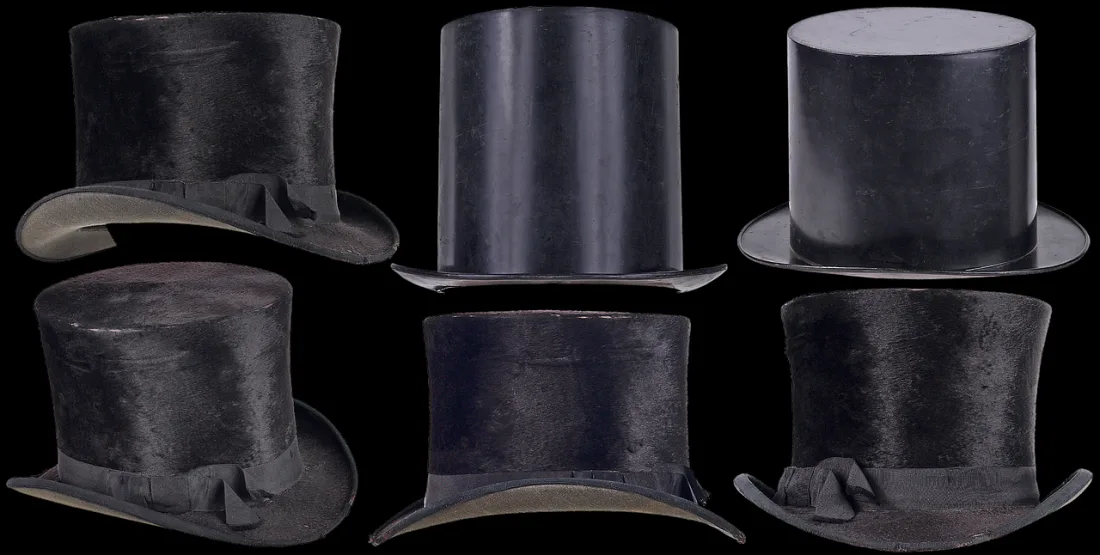
Silk plush is the reason a true Victorian topper can't be copied today. By most accounts the plush of the old quality has not been woven in any quantity since the mid-20th century, so the silk top hats sold now are mostly restored antiques, and formal toppers worn at weddings and race meetings are usually fur felt, often rabbit, in black or gray. The types of felt hats list places the top hat with the bowler and homburg among the stiffened hats.
Did John Hetherington really start a riot in a top hat in 1797?
Almost certainly not, though it is the most repeated story about the hat. In the usual version, a London haberdasher named John Hetherington stepped out in January 1797, most often dated the 15th, wearing a tall hat with a shiny surface. Crowds gathered, women fainted, a boy's arm was broken in the crush, and Hetherington was arrested and bound over to keep the peace for wearing "a tall structure having a shining luster and calculated to frighten timid people".
Three things count against it. Nobody has found a report of the incident from 1797; the earliest printed versions found so far date from the late 1890s, about a century later, and one trade paper it is often credited to, the Hatters' Gazette, did not start until the 1870s. The dates and details vary from one retelling to the next. And tall hats were already being worn in London in the 1790s, so one more would hardly have caused a panic. Enjoy it as a hatters' legend, not as the invention of the top hat.
What is a collapsible opera hat?
An opera hat, or gibus, is a top hat with a folding crown. Steel springs inside the crown let it collapse flat, so a gentleman could slide it under his theater seat, and a sharp tap from inside pops it back up to full height with a snap. That noise gave it the French name chapeau claque.
The idea is older than the name. A London hatter, Thomas Dollman, patented a sprung, collapsible hat in 1812. The version that stuck is credited to Antoine Gibus of Paris, whose designs, patented in the 1830s, were so successful that collapsible top hats are still called gibus hats. Sources disagree on the exact years. Opera hats were usually covered in matte ribbed silk or fine wool cloth rather than plush, because plush would have been crushed by the folding.
Real sprung opera hats turn up as antiques and are still used on stage. The cheap "collapsible" top hats sold for magic acts are a different thing: usually a soft felt or fabric crown that squashes and pulls back up without springs.
What is a modern felt top hat?
There are three kinds on sale, and the listing rarely says which you are looking at.
| Fur felt topper | Wool felt top hat | Costume top hat | |
|---|---|---|---|
| Material | Rabbit or hare fur felt, stiffened | Stiffened wool felt | Thin wool-blend, polyester felt or flocked card |
| Crown | Firm, holds a crisp edge at the top | Firm, softer at the top edge | Thin; dents easily |
| Brim | Curled at the sides, bound edge | Curled at the sides, usually bound | Often flat, sometimes only glued on |
| Sizing | Real hat sizes | Real sizes or S/M/L | "One size" |
| Use | Formal events, morning dress | Steampunk, Victorian costume, stage | One night of costume |
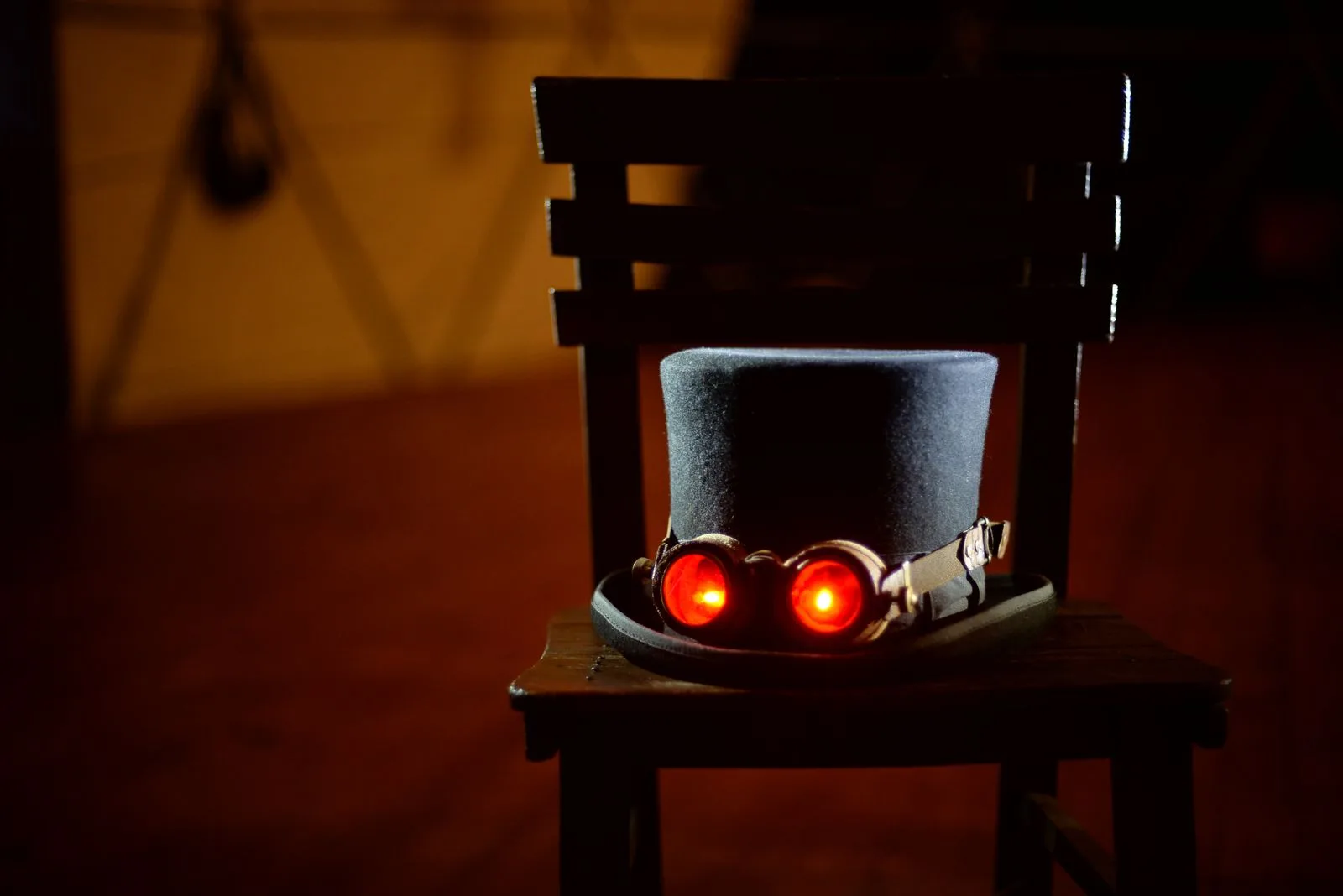
A wool felt top hat is the right buy for most people who want one to wear more than once. Look at the crown height: most are around 5–6 in (13–15 cm), which suits most faces, while the taller "stovepipe" shape, closer to 7 in (18 cm), reads as 1860s American or as stage costume. Gray and brown wool toppers suit steampunk better than black, and they take decoration well: a leather band with a buckle, goggles around the crown, a feather. The hat at the top of this page is a gray wool felt one with goggles. Ideas for trimming are in felt hat accessories.
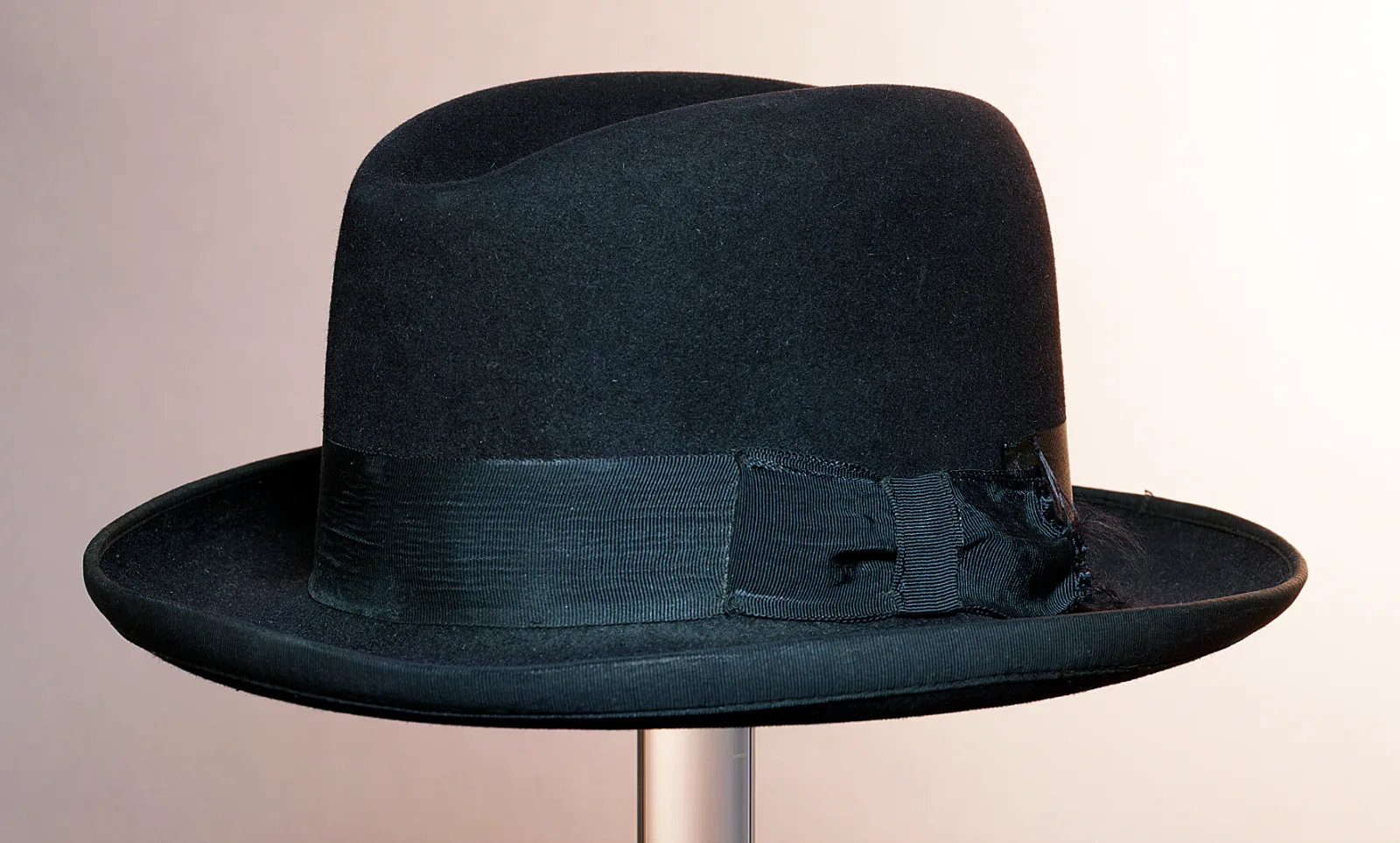
Fit it the way you would a felt bowler hat, because a stiff crown does not mold to the head: measure your head and buy by size, taking the larger size if you fall between two. Rest a top hat on its flat crown, never on its brim, and pick it up by the brim at front and back, not by squeezing the crown. For more Victorian and western shapes that suit the same outfits, see the felt gambler hat.
How do you make a felt top hat from craft felt?
A costume top hat is three flat pieces: a rectangle rolled into the crown, a circle for the top and a ring for the brim. The only real skill is getting the sizes right, and they all come from one measurement.
Choose the felt
- Stiff felt (craft felt treated with a resin stiffener, about 1/16 in (1–2 mm) thick) stands up on its own at a crown height of 6 in (15 cm). It is the simplest choice, but it comes in sheets, so the crown has to be joined from two pieces.
- Wool-blend felt from the bolt looks and drapes much better and lets you cut the crown in one piece. It is too soft to stand by itself, so back it with heavy fusible interfacing, or slip a tube of thin card or plastic canvas inside the crown. Test the iron on a scrap first: an iron hot enough to fuse interfacing can glaze or melt acrylic felt, so use a pressing cloth and the lowest setting that works.
The differences between craft felt, wool-blend and pure wool felt are explained in wool felt fabric.
Work out the sizes
Measure round your head where the hat will sit, level across the forehead and just above the ears. Add ½ in (13 mm) of ease so the hat sits on the head rather than gripping it. That is the crown circumference. Everything else follows from it:
- Crown strip: the crown circumference plus ½ in (13 mm) for the overlap seam, by the crown height you want.
- Crown diameter: the crown circumference divided by 3.14. This is the size of the top circle and of the hole in the brim.
- Brim ring: outside diameter is the crown diameter plus twice the brim width. For a 2 in (5 cm) brim, add 4 in (10 cm).
| Head | Crown circumference | Crown strip length | Top circle and brim hole | Brim outside, 2 in brim |
|---|---|---|---|---|
| 20 in (51 cm), child | 20½ in (52 cm) | 21 in (53.5 cm) | 6½ in (16.5 cm) | 10½ in (26.5 cm) |
| 21 in (53.5 cm) | 21½ in (54.5 cm) | 22 in (56 cm) | 6⅞ in (17.5 cm) | 10⅞ in (27.5 cm) |
| 22 in (56 cm) | 22½ in (57 cm) | 23 in (58.5 cm) | 7⅛ in (18 cm) | 11⅛ in (28 cm) |
| 23 in (58.5 cm) | 23½ in (59.5 cm) | 24 in (61 cm) | 7½ in (19 cm) | 11½ in (29 cm) |
A crown height of 6 in (15 cm) looks right on most adults; go to 5 in (13 cm) for a child. Real heads are oval, longer front to back, and a round crown will sit with a little gap at the sides. That is fine for costume. If you want an oval, draw one about 7⅞ by 6⅜ in (20 by 16 cm) for a 22 in head, which has the same perimeter as the 7⅛ in circle, and use it for both the top and the brim hole.
Cut and assemble
- Cut the crown. From felt by the yard, cut the strip in one piece. From a 12 by 18 in (30 by 45 cm) stiff felt sheet, cut two strips 6 by 18 in (15 by 45 cm), join them end to end with a ½ in (13 mm) overlap, then trim to the length in the table. The brim and the top circle each need a sheet of their own, so allow three sheets in all. If you are using interfacing, fuse it on now, while the piece is flat.
- Roll the tube. Overlap the ends by ½ in and glue the seam with fabric glue or a line of hot glue, then clip it with clothespins until it sets. Put the seam at the back.
- Add the top. Cut the top circle to the crown diameter. Run glue around the top edge of the tube and set the circle on it, or whip-stitch it on with matching thread for a cleaner edge.
- Cut the brim. Draw two circles from the same center: the outside diameter, and a second circle 1 in (2.5 cm) smaller than the crown diameter. Cut out the ring. Then snip from the inner edge out to the crown-diameter line every ¾ in (2 cm) or so, making ½ in (13 mm) tabs.
- Join brim and crown. Fold the tabs up, slide the brim over the open end of the crown, and glue the tabs to the inside of the tube. Glue a strip of felt or grosgrain ribbon around the inside to cover them.
- Finish. A band of grosgrain ribbon around the base of the crown hides any glue at the join. To curl the brim at the sides like a real topper, stiffen it with interfacing or a thin wire glued along the edge, then bend the sides up gently.
A hat made this way is a costume piece, not a blocked hat. To shape felt properly over a block with steam, start with a cone or capeline from felt hat blanks instead.
How do you make a mini top hat for a snowman or doll?
The same geometry works at any size, with one change: below about 2 in (5 cm) across, the tabs get too fiddly, so make the brim a solid disc and glue the crown on top of it.

For the 4 in (10 cm) needle felted snowman, whose head is about 1 in (2.5 cm) across, the hat should be a little narrower than the head, with a brim that just overhangs it:
- Crown: a strip of stiff black felt 2½ by ¾ in (6.4 by 2 cm), rolled into a tube about ¾ in (2 cm) across with a ⅛ in (3 mm) overlap.
- Top: a ¾ in (2 cm) circle glued over one end.
- Brim: a solid 1¼ in (3 cm) circle glued to the other end.
- Band: a thin strip of red felt or narrow ribbon around the base of the crown.
Tacky craft glue is easier to control than hot glue at this size. Fix the finished hat with a few stitches or a dab of glue, tilted slightly to one side, which looks more natural than dead straight. If you would rather needle felt it, roll black wool into a firm short cylinder, flatten both ends on the mat, and needle it onto a thin disc of flat-felted black wool for the brim; the result is softer-edged but all one material.
For a doll, measure around the doll's head where the hat should sit, add about ¼ in (6 mm) of ease, and use the full-size method above, scaling the crown height to roughly the depth of the doll's face from chin to hairline. Doll proportions in general are covered in how to make felt dolls.
If children are helping: a mini top hat is a small part and a choking hazard for children under 3, as is any wire in a curled brim, so keep finished ornaments out of their reach. Felting needles are very sharp and break easily, and a hot glue gun burns, so those steps are for an adult or an older child with supervision.
Frequently asked questions
What were old top hats made of?
The earliest were beaver fur felt. From around the 1830s silk plush, a long-pile silk fabric often called hatter's plush, took over because it was cheaper than beaver and could be polished to a high gloss. A silk plush hat is built over a stiffened frame, so it is not felt at all.
Is the John Hetherington top hat story true?
Probably not. The tale of a London haberdasher arrested in January 1797 after his tall shiny hat frightened a crowd was printed again and again from the late 1890s on, but no one has found a record of it from 1797.
What is an opera hat?
A collapsible top hat with springs inside the crown, so it folds flat for storage under a theater seat and springs back up with a tap. It is also called a gibus, after the Paris hatter Antoine Gibus, whose designs of the 1830s made it popular, and a chapeau claque, from the snap it makes when it opens.
How big should I cut the crown of a homemade felt top hat?
Cut a strip as long as your head circumference plus 1 in (2.5 cm): ½ in of ease and ½ in for the overlapping seam. For a 22 in (56 cm) head that is 23 in (58.5 cm), and a height of about 6 in (15 cm). The rolled crown is then about 7⅛ in (18 cm) across, which is also the size of the top circle.
How do you make a tiny top hat for a snowman?
For a snowman with a 1 in (2.5 cm) head, cut a strip of stiff black felt 2½ in by ¾ in (6.4 by 2 cm), roll it into a tube about ¾ in across and glue the seam, then glue on a ¾ in (2 cm) circle for the top and set the tube on a 1¼ in (3 cm) circle for the brim. Keep it away from children under 3, because it is a small part.
Topics
Image credits
- A gray felt top hat with a pair of glowing red steampunk goggles around its band, resting on the seat of a dark wooden chair — Cihan Yüce (Pexels License)
- Six antique black top hats in two rows, most with a fuzzy, slightly worn plush surface and curled brims, one with a smooth straight-sided crown — AlLes (Pixabay Content License)
- A small snowman figurine in a black top hat with a red band and buckle, a red plaid scarf and twig arms, sitting in real snow — Susanne Jutzeler, suju-foto (Pexels License)