Felt Bowler Hat: The Hard Derby, How It Holds Its Shape, and How to Wear One
9 min read
We may earn a commission from links on this page, at no extra cost to you. As an Amazon Associate I earn from qualifying purchases. Learn more.
What makes a felt bowler a bowler: a hard, shellac-stiffened dome and a short brim curled at the sides. Where it came from in 1849, wool felt against fur felt, how a bowler should fit, how to care for one without ruining the stiffening, and how it differs from a fedora and a homburg.
A felt bowler is the only common felt hat you can knock on. The crown is a rigid dome, stiff enough that the hat sits on a table without the top giving under your hand, and the brim is short, about 1½–2 in (4–5 cm), curled up tightly at the sides and dipped slightly front and back. Everything about buying, fitting and caring for one follows from that hard shell.
Americans call it a derby; the British call it a bowler. It is the same hat. Its history explains the shape, and the stiffening explains the fitting and care rules that come after it, along with what a home milliner can and cannot make.
What makes a bowler hat a bowler?
Three things, and a hat needs all of them:
- A hard crown. The felt is stiffened right through, not just pressed into shape. A soft felt hat with a round top is a different hat, usually sold as a "soft derby" or a round-crown fedora.
- A rounded dome with no crease. No pinch at the front, no dent along the top. The crown is a smooth half-egg.
- A short brim rolled at the sides. The edge is usually bound with grosgrain ribbon, and the sides curl up in a fixed roll that does not flatten when the hat is handled.
Inside there is normally a leather or fabric sweatband and often a lining. A narrow ribbon band, usually in the same color as the felt, runs around the base of the crown. That is the whole design, and it has barely changed since the 1850s.
The bowler sits in the stiffened group in types of felt hats, beside the homburg and the top hat, rather than with the soft fedoras and trilbies.
Where did the bowler hat come from?
The usual account runs like this. In 1849 a London hatter in St James's, Lock & Co., was asked for a close-fitting, hard-topped hat by the Coke family of Holkham in Norfolk. Which Coke placed the order is less certain: Lock's own records are usually read as pointing to Edward Coke, younger brother of the 2nd Earl of Leicester, but many older accounts, and some still repeated today, name William Coke. The hat was meant for gamekeepers on horseback, who kept losing tall hats to low branches and needed something that would protect the head. Lock & Co. is said to have had it made by Thomas and William Bowler, felt hatmakers in Southwark, and the hat took the makers' name in most of Britain. At Lock it is still called a "Coke".
The story that the customer stamped on the first hat to test it is widely repeated and appears in the hatter's own account, but it is a story; treat it as one. The facts that matter are the date, the purpose and the result: a hard felt hat that a working man could ride in.
From there it spread fast. By the late 1800s it was worn by clerks and laborers in Britain, by men across the American West (photographs of the period show derbies on ranch hands, lawmen and outlaws alike), and later by comic actors in silent films. In Bolivia and Peru, Quechua and Aymara women took up the bowler in the early 20th century, by most accounts in the 1920s, and it is still a part of traditional dress there. The American name is usually traced to horse racing and the Derby at Epsom, though no one has pinned down exactly how it crossed over.

Bowler vs derby vs fedora vs homburg: what is the difference?
The first two are one hat. The other two are different hats with a different crown and brim, and they behave differently when you clean or reshape them.
| Bowler | Derby (US) | Fedora | Homburg | |
|---|---|---|---|---|
| Crown | Hard, rounded dome | Hard, rounded dome; sometimes a little taller | Soft, pinched at the front, creased on top | Stiff, with a single dent running front to back |
| Brim | 1½–2 in, curled up at the sides | Same | 2–3 in, flat or snapped down at the front | About 2 in, stiff, upturned all around with a bound edge |
| Felt | Stiffened wool or fur felt | Same | Soft wool or fur felt | Stiffened fur or wool felt |
| Can you reshape it with steam? | Barely | Barely | Yes, that is how it is shaped | Carefully, at the brim |
| Formality | Smart day wear | Smart day wear | Smart to casual | Formal |
The fedora's pinches and brim widths are covered in felt hats for men, and western crowns and brims, which are a further step away from the bowler, are in felt cowboy hats.
How does a felt bowler hold its shape?
Shellac. In the traditional process the hat body is felted from wool or fur into a cone, shrunk down, then soaked in a shellac solution (dissolved in alcohol, or as a water-based borax solution) so the stiffener runs through the felt. The stiffened body is softened with heat and pressed onto a bowler-shaped block, and the brim is curled over a heated form. As the shellac cools it sets, and the felt becomes a shell.
Modern bowlers may use synthetic resins instead of shellac, but they work the same way: heat softens, cooling sets. That is the reason for every care rule below. Moisture and heat that only relax a soft fedora can unset the stiffening in a bowler, and a soft spot in the dome does not go back by itself.
Wool felt or fur felt bowler?
| Wool felt | Fur felt | |
|---|---|---|
| Made from | Sheep's wool | Rabbit or hare fur, sometimes blended |
| Surface | Matte, slightly fuzzy | Smooth, fine, with a slight sheen |
| Weight | Heavier for the same stiffness | Lighter for the same stiffness |
| Rain | Spots and can soften in a heavy shower | Sheds light rain much better |
| Cost | The cheaper option by a wide margin | Several times the cost of wool |
| Best for | Costume, occasional wear, a first bowler | A hat worn every week for years |
Most derbies sold for costume, weddings and themed events are wool felt, and many are lightly stiffened, so the crown flexes more than an old hatter's bowler would. If the listing does not say, the felt hat burn test on a fiber from inside the sweatband will tell wool from fur, and both from a synthetic. For buying in general, felt hat brands compares makers and where to buy.
How should a bowler hat fit?
Closer than a soft hat. A fedora shapes itself to your head within a few weeks of wear; a bowler never does, because the crown is rigid. So the size has to be right from the start.
- Measure around your head with a soft tape, about ⅛ in (3 mm) above the ears and across the middle of the forehead, where the hat will sit. Take it twice.
- Convert it using the table below. US hat sizes are roughly the circumference in inches divided by 3.14.
- Check your shape. Most heads are an oval longer front to back. A head that is rounder or longer than average often finds a stiff hat pressing at the temples or the forehead even in the right size.
| Head circumference | US hat size | Letter size (approx.) |
|---|---|---|
| 21⅝ in (55 cm) | 6⅞ | S |
| 22 in (56 cm) | 7 | M |
| 22⅜ in (57 cm) | 7⅛ | M |
| 22¾ in (58 cm) | 7¼ | L |
| 23⅛ in (59 cm) | 7⅜ | L |
| 23½ in (60 cm) | 7½ | XL |
| 23⅞ in (61 cm) | 7⅝ | XL |
A bowler that fits sits level, about 1 in (2.5 cm) above the eyebrows, and stays on when you nod. If you are between sizes, go up and fit a strip of foam sizing tape behind the sweatband; you can take a stiff hat in, but you cannot stretch one much. A hatter can open a crown slightly on a hat stretcher, but that is a professional job on a shellacked hat.
How do you wear a bowler hat?
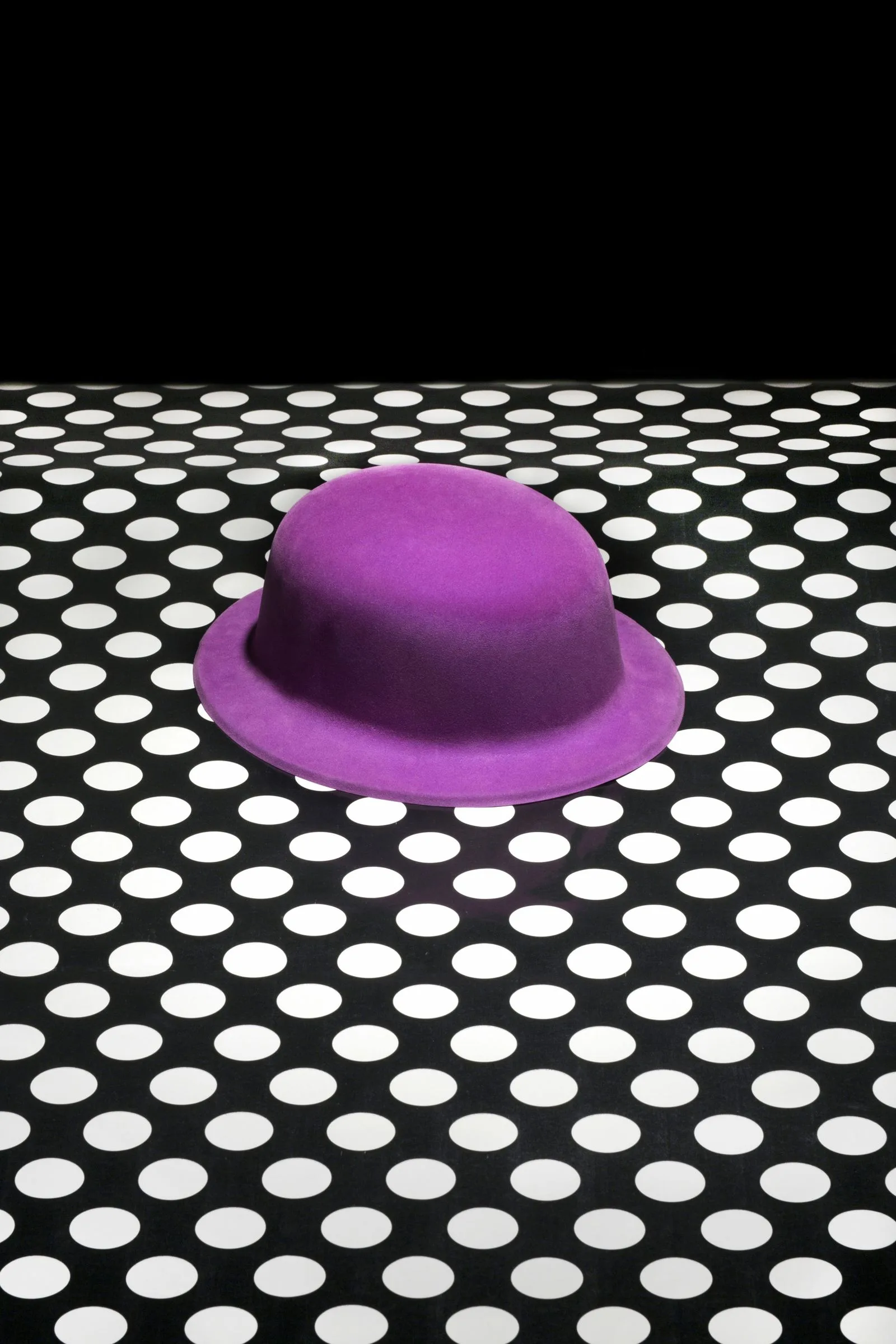
Level, or tipped very slightly forward. A bowler pushed to the back of the head looks like a costume; tilted hard to one side it looks like a character in a musical, which may be what you want. Black and charcoal go with dark tailoring and a heavy overcoat. Brown suits tweed. Gray is the softer, more country choice, and colored bowlers, such as the purple at the top of this page, are fashion and costume hats rather than traditional ones. The undertones that go with each skin and hair color are in felt hat colors.
Women wear bowlers too, usually with a narrower brim and a smaller crown; felt hats for women covers proportions for a smaller head.
How do you look after a felt bowler hat?
The routine is the same as for any felt hat: brush it after wearing with a soft hat brush, always in one direction, counterclockwise around the crown and then around the brim. The full method, with grease marks and the sweatband, is in how to clean a felt hat. What differs for a bowler:
- Do not steam it like a fedora. A few seconds over a kettle can lift a shallow dent. A minute will soften the stiffening, and the dome may come back lumpy or out of round. Never iron the brim.
- Rain: shake off the water, blot with a dry towel, and let it dry at room temperature on a surface that supports the crown, away from radiators and hair dryers. Wool felt bowlers can spot and go slightly soft in a downpour; take an umbrella.
- Storing it: rest a bowler on its crown or on a hat stand, not flat on its brim. Its weight on the brim slowly flattens the side curl. A round hat box with a little tissue in the crown is the best home for it out of season.
- Picking it up: hold it by the brim at front and back, not by pinching the crown. A stiff crown cracks if you squeeze it.
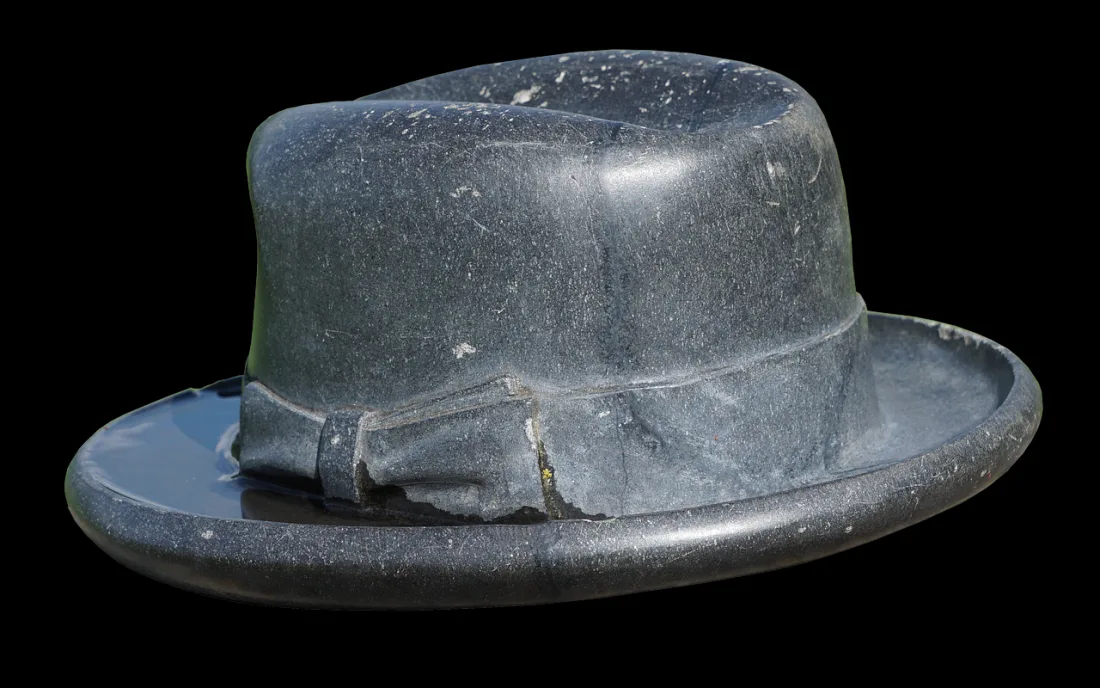
- Old bowlers: a weathered hat with a dull surface and a few scuffs, like the one above, often only needs a careful brushing and a fresh ribbon. A crack in the crown, or a brim curl that has gone flat, needs a hatter.
Can you make a felt bowler at home?
You can make a derby; you cannot easily make a hatter's bowler. The hard shell depends on shellac and heated metal blocks and presses that home milliners do not have.
What does work is blocking a wool felt hat body over a bowler-shaped crown block. Steam the body until it is soft, pull it down over the block and tie it off, leave it to dry for at least a day, then brush a hat stiffener into the inside of the crown and let that dry too. The brim is cut to about 1¾ in (4.5 cm), wired or bound at the edge, and rolled at the sides by hand over a rolled towel or a shaped brim block. The result is firm but not rock hard, and it looks the part. The cone and capeline bodies to start from, and the blocking steps, are in felt hat blanks.
Wet felting a bowler from loose wool is not realistic: a hand-felted crown can be made firm, and stiffened afterward, but it will not hold the crisp curled brim. If you want to felt a hat from fiber, start with a soft style instead, as in wet felting a hat.
Frequently asked questions
Is a bowler hat the same as a derby?
Yes. Bowler is the British name and derby the American one for the same hat: a hard, rounded felt crown with a short brim that curls up at the sides. Some American makers use derby for a slightly taller crown, but there is no fixed rule, and shops use the two names for the same thing.
Why is a bowler hat hard?
The felt is stiffened, traditionally with shellac worked into the hat body before it is blocked under heat. When it cools the shellac sets and the dome becomes rigid. The original 1849 hat was made hard on purpose, to protect a rider's head from low branches.
Can you steam a bowler hat?
Only very briefly, and only to lift a small dent. Heat softens the shellac that keeps the crown rigid, so a long steaming of the kind used to reshape a soft fedora can leave the dome soft, wrinkled or out of round. A badly crushed bowler is a job for a hatter.
How should a bowler hat fit?
Snug all the way around, sitting level about an inch above the eyebrows, without pressing at the temples. A stiff crown cannot give the way a soft felt does, so choose the size by your measured head circumference and the shape of your head, which is usually a longer oval front to back. Between sizes, take the larger and pad the sweatband.
Can I make a bowler hat at home?
You can block one from a wool felt hat body over a bowler-shaped block, using steam and a hat stiffener, but it will not be as hard as a factory bowler made with shellac and heated metal blocks. A hand-blocked one is softer, more like a stiff derby, which is still a wearable hat.
Topics
Image credits
- A purple bowler hat on a black and white polka dot surface — Valentin Ivantsov (Pexels License)
- A man in a black bowler hat and dark coat raising a glass of champagne in the street — Alexander Zvir (Pexels License)
- A weathered gray bowler hat showing the domed crown and the narrow brim curled up at the sides — Momentmal (Pixabay Content License)