Felt Garland: Felt Balls, Cut Shapes and Felted Holly on One String
8 min read Beginner
We may earn a commission from links on this page, at no extra cost to you. As an Amazon Associate I earn from qualifying purchases. Learn more.
How to make a felt garland that hangs properly: how many balls a length takes, how to get a needle through a hard felt ball, spacing that stays put, and Christmas, Halloween and Valentine versions.
A felt garland is about the simplest project in the craft. That does not stop most homemade ones from going wrong: the balls slide together into a lump at the lowest point of the swag, the needle refuses to go through, or a 6 ft run turns out to need twice the balls you made. All three are planning problems, and this page deals with each before you start.
Four kinds of felt garland
| Type | What it is | Time for 6 ft (1.8 m) | Best for |
|---|---|---|---|
| Felt ball | Wool balls threaded on a cord, touching or spaced | An evening if the balls are bought, a weekend if you felt them | Year-round, nurseries, Christmas trees |
| Cut shapes | Stars, hearts, leaves or pumpkins cut from sheet felt and sewn in a line | An hour or two | Seasonal sets, children helping |
| Felted shapes | Leaves or hearts cut from homemade felt or needle felted, with balls between | A weekend | Holly, autumn leaves, heirloom pieces |
| Mixed | Balls as spacers between cut or felted shapes | Between the two | The look most shops sell |
Ball garlands are the ones that sell, and they also need the most planning, so most of this page is about them.
How many balls a garland takes
Each ball takes up its own diameter plus whatever gap you leave after it. Divide the length you want by that figure and you have the count. Measure along the swag rather than straight between the two hooks, because a garland that dips needs 10 to 20% more length than the distance between its ends.
| Ball size | Spacing | Balls per foot | Balls for 6 ft (183 cm) |
|---|---|---|---|
| 2 cm (¾ in) | Touching | 15 | 92 |
| 2 cm | 3 cm (1¼ in) gaps | 6 | 37 |
| 2.5 cm (1 in) | Touching | 12 | 73 |
| 2.5 cm | 5 cm (2 in) gaps | 4 | 24 |
| 3 cm (1¼ in) | Touching | 10 | 61 |
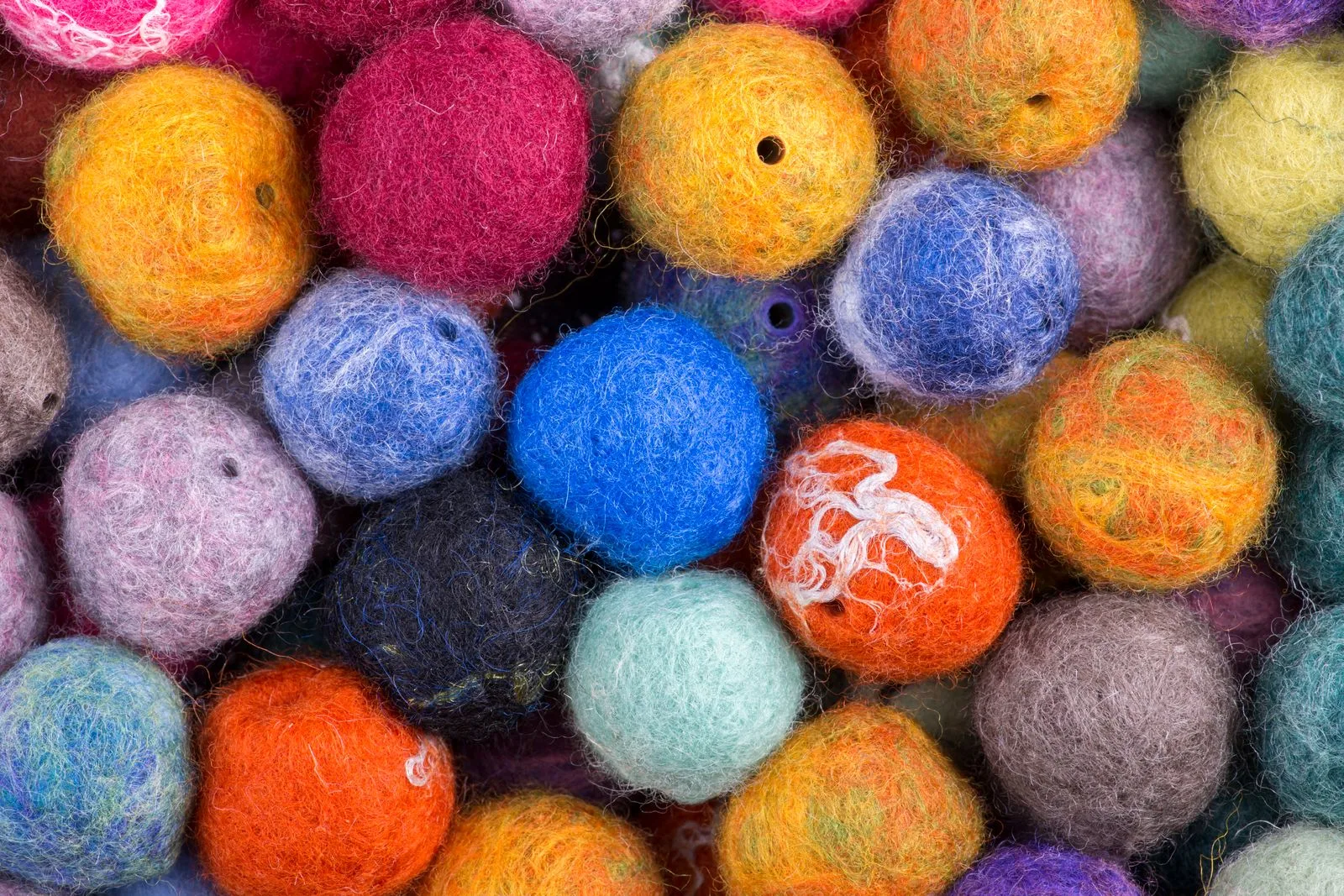
Felt balls are sold by their metric diameter even in the US, which is why the sizes here are in centimeters first. A touching garland of small balls is the one that surprises people: 92 balls is a lot of felting, and a fair amount of money if you buy them.
Felting the balls or buying them
Bought balls are even and already hard. Homemade balls are cheaper and come in exactly the colors you want, and making them is a satisfying way to spend an evening. The method is in how to make felt balls, with a method for batches. Firm felt weighs about 0.22 g per cubic centimeter, so a 2 cm ball takes roughly 1 g of wool and a 2.5 cm ball nearly 2 g. The 37-ball garland above is about 35 g, a little over an ounce. The 73-ball one is around 130 g, close to 5 oz.
Felt the balls hard. A soft ball dents where the cord crosses it and puckers at the hole, and it goes fuzzy on a tree within a season. If you would rather needle felt them, how to needle felt a ball gives more control over size, but at one ball per twenty minutes, it suits a garland with a few balls between larger shapes better than an all-ball run. Leftover balls are not wasted: sewn together in a hexagon of nineteen they make a felt coaster.
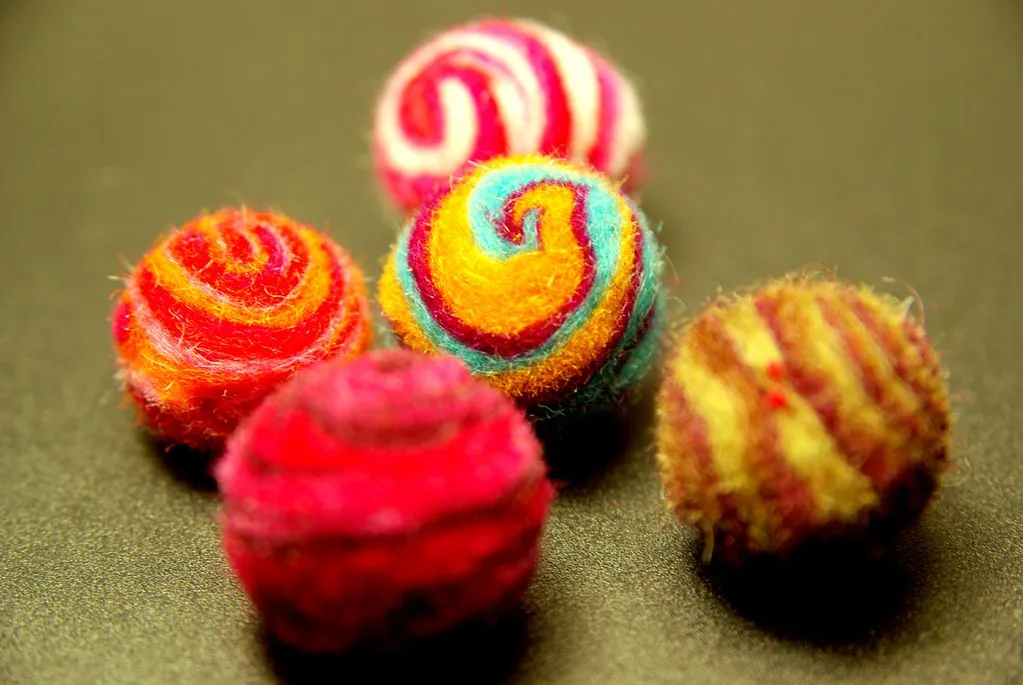
Plan the colors before you roll. Two or three colors plus a neutral read as a design; a bag of mixed rainbow balls reads as a bag of mixed rainbow balls. Repeating a sequence, say red, white, red, green, gives a pattern the eye can follow along the swag. Random order looks better than a repeat only when the colors are all close in tone.
Getting a needle through
This is where people give up. A well-felted ball is dense enough that a needle will not go through on finger pressure, and forcing it bends the needle or drives the eye into your palm.
- Use a long, sharp needle with the smallest eye your thread will pass through. Doll needles of 3 to 5 in are made for this. A big-eyed tapestry needle has a blunt point and tears a wide hole.
- Thread it with a single strand of floss or twine, not doubled. A doubled thread doubles the drag.
- Push the point into the center of the ball with a thimble on your pushing finger until it shows on the far side.
- Grip the point with small pliers and pull straight out. Pull in line with the needle, not at an angle, or it snaps.
- For a long garland, push the needle through three or four balls before pulling the cord through all of them at once. It is quicker than taking the needle out after every ball.
Rubbing the needle on a bar of soap or a candle helps it slide. Wetting the ball does not: damp felt grips harder.
Spacing that stays put
A spaced garland left loose slides into a heap at the lowest point of the swag within a day. There are three ways to fix the balls in place.
- Knot either side. Tie an overhand knot on the cord, thread the ball, tie another knot snug against it. Two knots per ball is slow but permanent, and the knots disappear into the felt if you push the ball over them.
- Spacer beads. Wooden or glass beads between the balls hold the gap without knots and add a second texture. A bead whose hole is smaller than the end knot also stops balls sliding off the end.
- A dab of glue at the hole. A drop of fabric glue where the cord enters each ball, after the spacing is set. Fast, but you cannot adjust it later.
Touching garlands need none of this: the balls hold each other. Leave a hand's width of bare cord at each end for tying up, and finish each end with a knot and a loop.
Cut shape garlands from sheet felt
Stars, hearts, Christmas trees, leaves or pumpkins cut from sheet felt make a garland in an afternoon, and a child can do most of the cutting. Wool-blend felt cuts cleaner and keeps its shape on a hot mantel better than the cheap acrylic squares, which sag and pill. For a lot of identical shapes, see felt cutting machines; a die cutter turns out a garland's worth in minutes.
The quickest way to join them is on a sewing machine. Set a medium straight stitch, feed the first shape under the foot and sew down its middle, then keep sewing for an inch or two of thread with nothing under the needle before feeding the next shape. The machine chains the thread between shapes by itself, and the whole garland is done in minutes. Shapes cut double and stitched together around the edge, with a little stuffing, hang better and look the same from both sides; see felt appliqué for stitching that holds. Hand-sewing works too: a running stitch through the top of each shape, or a large needle passed sideways through each one.
Felted holly, leaves and hearts
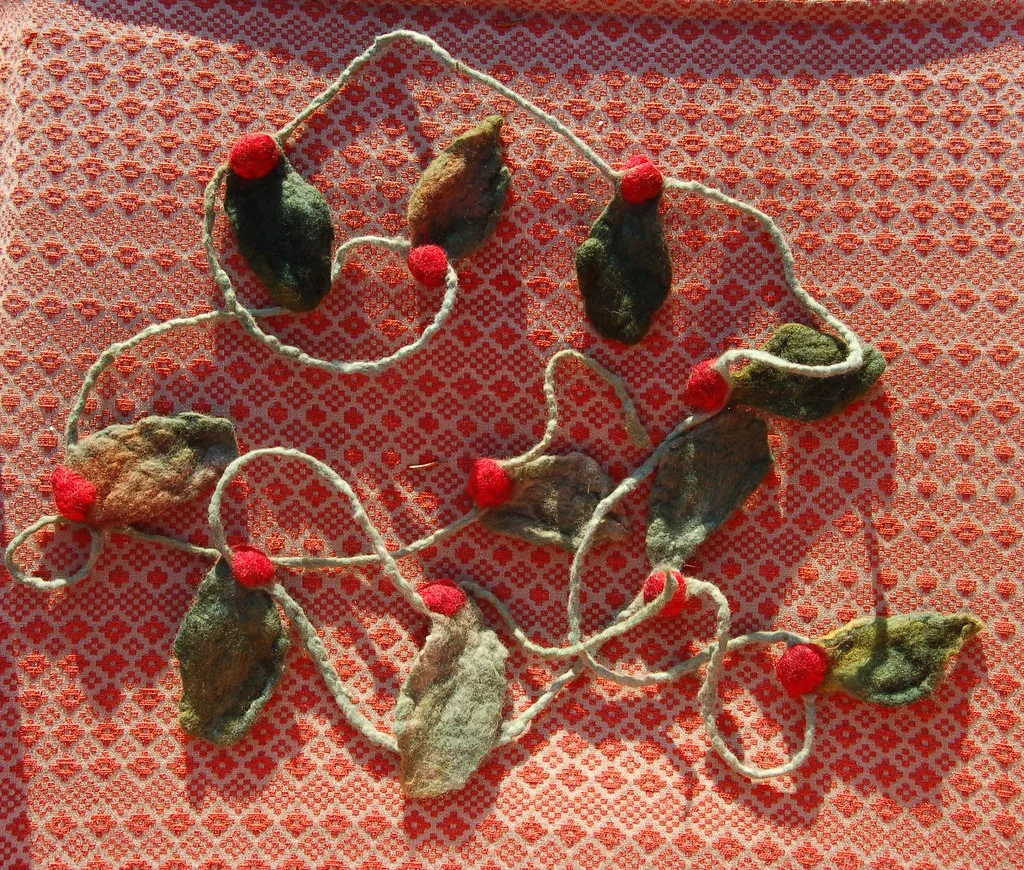
Felted leaves on a cord, holly for Christmas or oak and maple for autumn, look less like anything from a store than any other garland. Wet felt a sheet of green felt from prefelt or loose wool, let it dry flat, then cut holly leaves from it; homemade felt cut with sharp scissors holds an edge without fraying. Felt red 1 to 1.5 cm balls for berries. Sew the leaves to a twisted cord in pairs or threes, with a cluster of berries at each join. The same method works for autumn leaves in rust, gold and brown. Prefelt gives the most even sheet to cut from.
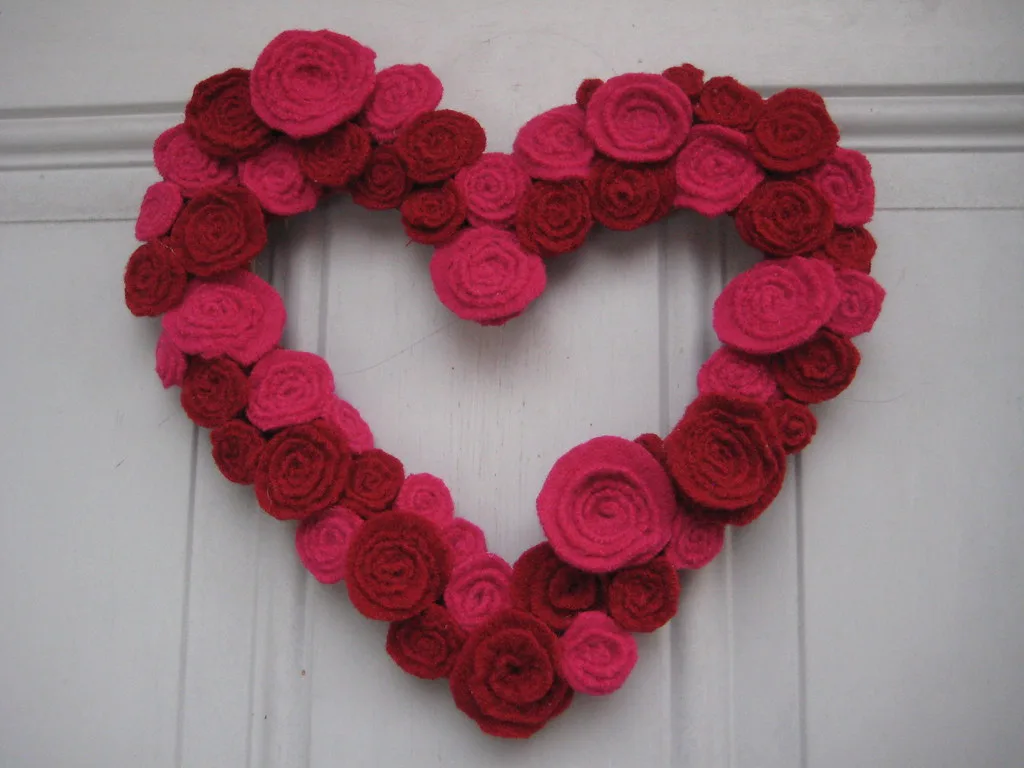
Needle felted hearts strung sideways make the classic Valentine version. Make them flat and firm, about 3 cm across, and thread through the widest part rather than the top so they sit upright. Felted heart covers the shaping, and felt Valentine crafts has more to hang alongside them.
Seasonal garlands
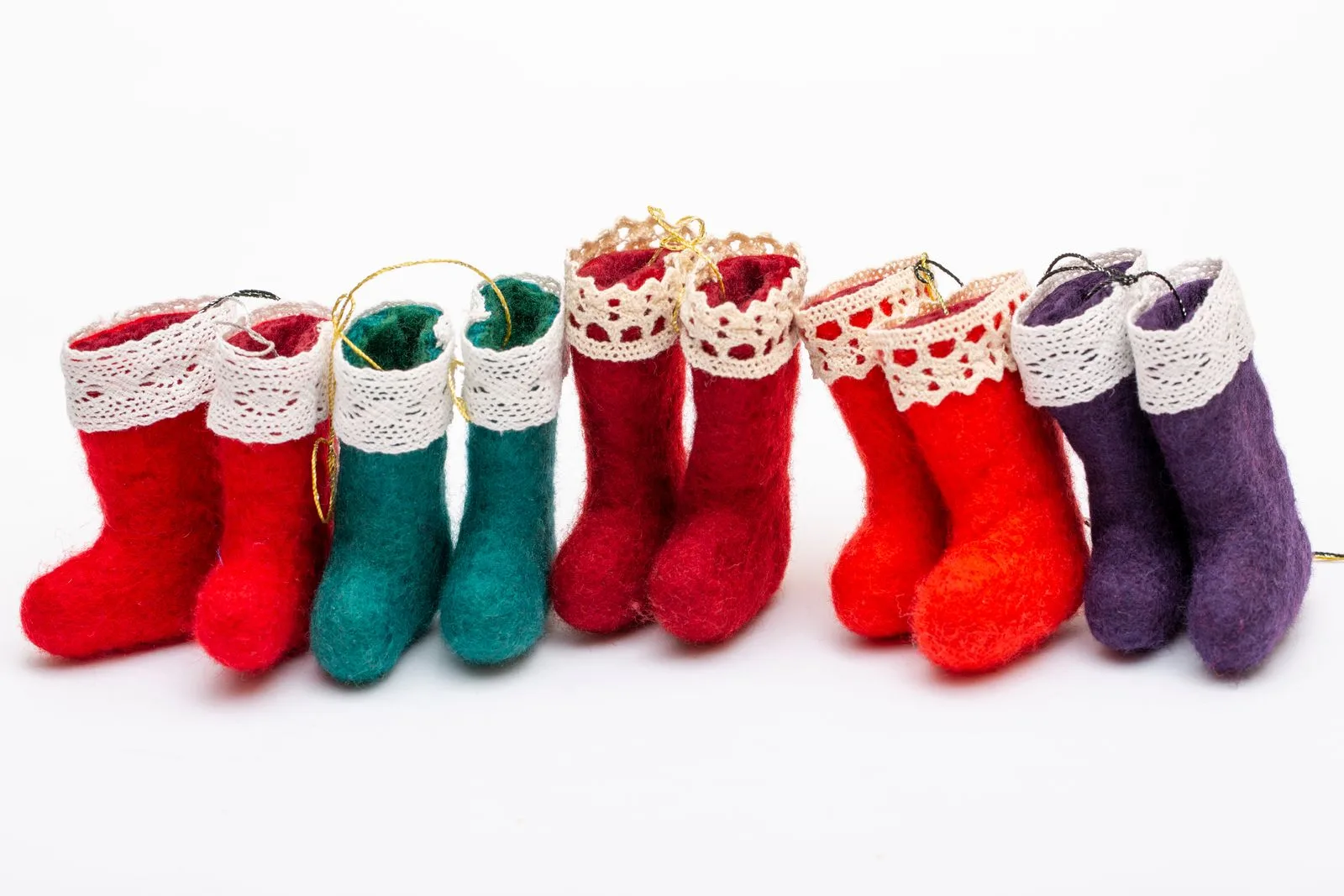
- Christmas. Red, white and green balls, or white and natural with a few gold. Felted stars every sixth ball. A garland of 2 cm balls draped on a tree, real or felt, replaces tinsel and survives being packed away, and one along the mantel frames a row of felt Christmas stockings. For hanging ornaments to go with it, see felted Christmas balls and felt Christmas ornaments.
- Halloween and fall. Orange balls with a few black and purple, or a pumpkin garland: orange balls flattened slightly and given a short brown stem of needle felted wool. Felted pumpkins shows the shape, and felted mushrooms fit the same autumn garland.
- Valentine's Day. Felted hearts in reds and pinks, with white balls between.
- Spring. Pastel balls with cut felt flowers or needle felted blossoms; see felt flowers.
- Nursery. Soft grays, whites and one accent color, hung across a wall well above the crib.
Hanging it safely
Felt garlands are light enough for removable adhesive hooks, so there is no need to put nails in a mantel. On a tree, start at the top and drape in loose swags, with the cord resting on branches rather than hanging from the tips.
Keep garlands of small balls out of reach of children under three: a 2 cm ball is a choking hazard. Cats are the other risk. A cat that chews and swallows string can end up with a linear foreign body, an intestinal blockage that needs surgery, so hang the garland where a cat cannot reach the dangling end. Wool burns less readily than cotton or acrylic but it does burn, so keep garlands away from candles and older hot incandescent bulbs. LED string lights are fine.
Storing it between seasons
Wind the garland around a piece of stiff card rather than coiling it loose, which tangles, and pack it in a sealed box. Wool decorations left in an attic for eleven months are exactly what clothes moths look for; protecting wool from moths covers what keeps them out.
Frequently asked questions
How many felt balls do I need for a garland?
Divide the length by the space each ball takes up, which is its diameter plus the gap you leave after it. A 6 ft (183 cm) garland of 2 cm balls spaced 3 cm apart needs about 37 balls. Push 2.5 cm balls tight together and the same length takes about 73.
How do you get a needle through a felt ball?
Use a long, sharp needle with a small eye, push it in until the point shows on the far side, then pull it the rest of the way with small pliers. A properly hard ball will not let a needle through by finger pressure alone. A thimble on the pushing finger saves a lot of pain.
What string is best for a felt ball garland?
Embroidery floss or baker's twine for most garlands, because both are soft enough to pull through a ball and thick enough to grip a knot. Clear fishing line disappears but does not hold knots well, so it suits garlands where the balls are pushed together rather than spaced.
Is a felt ball garland safe around babies and pets?
Not within reach. Small felt balls are a choking hazard for children under three, and cats will chew string, which can cause a serious intestinal blockage. Hang the garland well out of reach rather than at crib or floor level.