Felted Christmas Balls: Wool Baubles That Do Not Break
4 min read Beginner
We may earn a commission from links on this page, at no extra cost to you. As an Amazon Associate I earn from qualifying purchases. Learn more.
A tree full of wool baubles that survive being dropped by children and cats. Three methods, what each one actually weighs, and how to hang them so the loop holds.
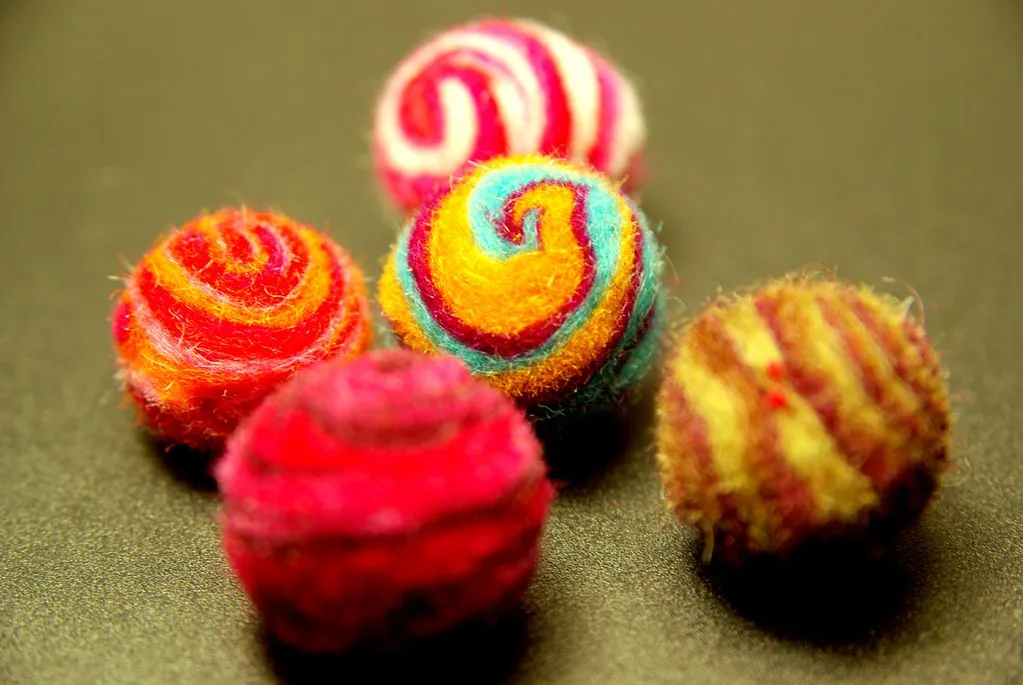
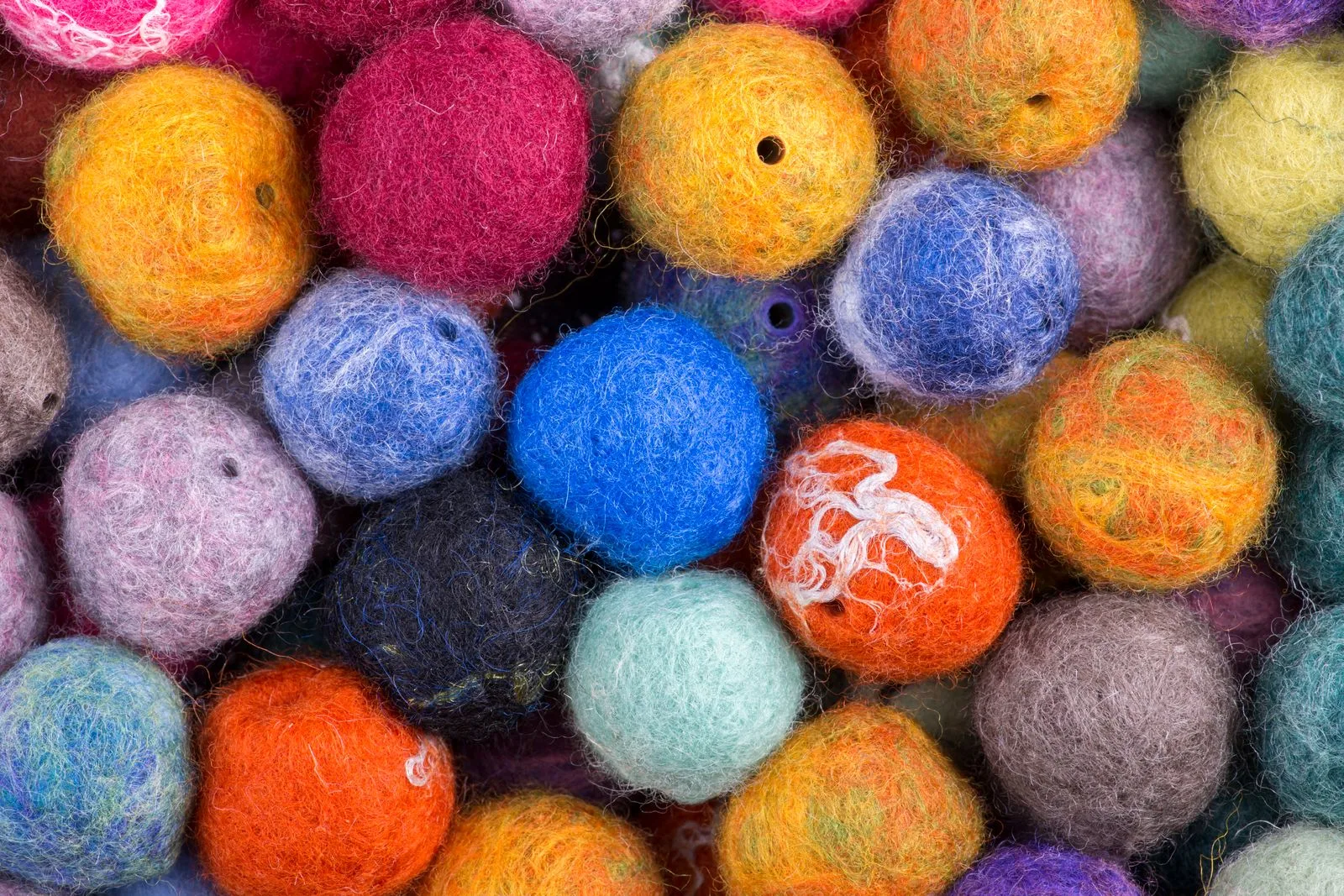
Glass baubles break, plastic ones look like plastic, and wool ones cost pennies each in materials. A felted Christmas ball takes ten minutes, uses 3 to 4 g of wool over a polystyrene core or around 14 g made solid at 5 cm, and can be dropped from the top of a tree onto a floor without consequence.
Three methods
- Solid wet felted. Wound and rolled by hand, the way felt balls are made. Dense, satisfying, and heavier than it looks.
- Over a polystyrene core. Wool felted as a skin around a bought ball, so the middle is air. Fastest, lightest, and perfectly round.
- Needle felted. Firmest and most controllable, best when the bauble carries sculpted detail. Solid, like the wet felted version, and slowest per ball.
For a whole tree, use the polystyrene method. For a set of six good ones, felt them solid.
What each one weighs
The difference between the two is not a detail, and it is the thing that decides where a bauble can hang. A solid ball, wet felted or needle felted, is wool all the way through at roughly 0.22 g per cubic centimetre once it is properly hard: 7 g at 4 cm, 14 g at 5 cm, 25 g at 6 cm, 40 g at 7 cm. The weight goes up with the cube of the diameter, so a 7 cm bauble is nearly six times the 4 cm one, not twice.
The same ball built over a polystyrene core is a two-layer skin around air, and 5 cm of it is 3 to 4 g — about a quarter of the solid weight. That is the only way to get a 5 or 6 cm bauble down into single figures, and it is why a wool bauble quoted at a few grams is almost always a cored one. Hang solid baubles on thick inner branches and cored ones out at the tips, where a solid 6 cm ball would simply bend the branch down.
Solid wet felted baubles
- Wind wool into a ball roughly twice the finished diameter, changing direction every few turns so the fibres cross.
- Dip in hot soapy water and squeeze most of it back out.
- Roll between your palms with almost no pressure for the first two or three minutes — this is what separates round baubles from creased ones.
- Increase pressure as the surface tightens, changing the axis of rotation constantly.
- Roll until genuinely hard: it should not dent under thumb pressure.
- Rinse in cool water, squeeze, and dry for a day or two.
For a batch, wind all the cores first and work them in rotation. Thirty baubles is an afternoon rather than a week.
Over a polystyrene ball
- Wrap thin veils of wool around a 5 cm polystyrene ball in several directions until no white shows through.
- Add a second layer at right angles to the first.
- Slide it into the toe of a pair of tights, or hold it in a piece of net, and knot it closed.
- Dip in hot soapy water and roll gently in your hands for five minutes.
- Remove the netting, roll directly a little longer to smooth the surface, rinse and dry.
The polystyrene stays inside for good. A 5 cm bauble made this way is 3 to 4 g against about 14 g for the same ball felted solid, which is what lets you hang it on a branch tip.
Hanging loops that hold
This is where homemade baubles fail. Glue does not hold in wool.
- Sewn through: thread a long doll needle with strong cord, pass it right through the ball, and knot the ends together at the top. The knot pulls into the wool and disappears. Strongest method by far.
- Felted in: lay a loop of cord across the wound core before wetting, with both ends buried in the wool, and felt over it. Invisible and permanent.
- Stitched cap: a small circle of felt with a ribbon loop, stitched onto the top of the ball.
Decorating them
- Spots: press small tufts of contrast wool onto the surface before the first wetting and they felt in place.
- Stripes: wrap thin bands of colour around the wound ball in one direction.
- Marbled: wind two colours together and let them blur.
- Beaded: a spiral of seed beads or a few French knots — see how to sew beads on felt.
- Needled motifs: a star, a snowflake or an initial needled on afterwards with a 40 gauge needle.
- Wrapped: a length of gold thread wound round and stitched down at each end.
Colour sets
A tree of thirty baubles in three colours plus white looks considered; thirty in every colour you own looks like a jumble sale. Pick two or three shades and a neutral, and vary the size instead — 4 cm, 5 cm and 7 cm together read far better than thirty identical spheres.
Storing them
Loose in a box, not squashed. Wool baubles compress if packed tight and come out with flat sides that need rolling back into shape. Add a lavender bag — moths eat wool decorations in a loft over eleven months quite happily.
Other things for the same tree
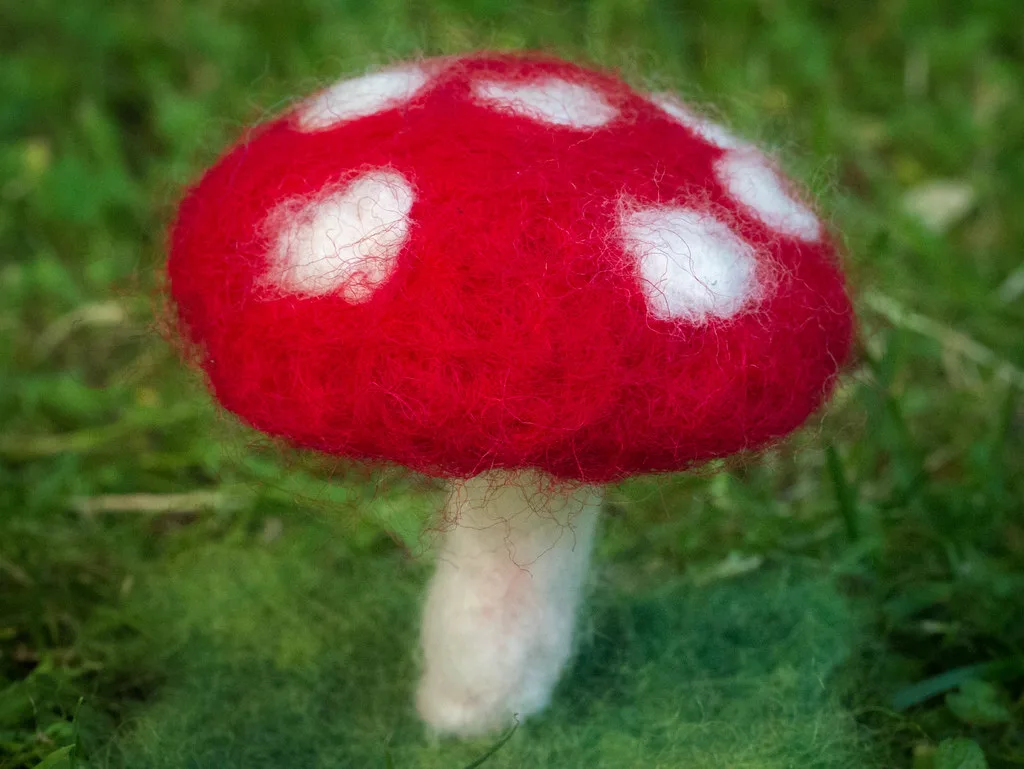
Felted mushrooms, gnomes and stars all use the same wool and the same evening. See felted Christmas ornaments for the wider set, and felted gnome for the one everybody asks for.
Frequently asked questions
How much wool do you need for a felted Christmas ball?
It depends entirely on whether the inside is wool or air. Made solid, firm felt runs about 0.22 g per cubic centimetre, so a 5 cm bauble is around 14 g and a 6 cm one around 25 g. Felted as a skin over a polystyrene ball it is only 3 to 4 g. Thirty cored baubles is barely 100 g of wool; thirty solid ones is closer to half a kilo.
How do you attach a hanging loop to a felted ball?
Sew it through the ball with a long needle and strong thread rather than gluing it on, or felt a loop of cord into the ball while it is still loose. Glued loops pull out within a season.
Can you felt over a polystyrene ball?
Yes, and it is much faster than felting a solid one. Wrap thin layers of wool around the ball, wet felt the surface, and leave the polystyrene inside permanently as a light core.
Are felted baubles safe with children and pets?
They are unbreakable, which is the main reason to make them. Keep loose wool away from cats, though — wool in a digestive tract is a serious veterinary problem.