Felt Turkey: A Sewn Pattern, a Needle Felted Turkey and a Thanksgiving Garland
8 min read Beginner
We may earn a commission from links on this page, at no extra cost to you. As an Amazon Associate I earn from qualifying purchases. Learn more.
A measured felt turkey pattern for a 4 inch ornament, a needle felted turkey with a fan tail made flat on the foam, a turkey garland and a "thankful" banner, and a no-sew version children can glue together.
A Thanksgiving turkey is a pear-shaped brown bird with a fan of feathers behind it, and that shape survives being simplified more than almost any animal does. Three pieces of brown felt, five feathers and a red wattle are enough for anyone to recognize it from across the room. Plan the fan before you cut anything: on a sewn turkey it is trapped between the body layers, and on a needle felted one it is made separately and attached last.
Below are a sewn ornament with every piece measured, a needle felted turkey about 3 in (7.5 cm) tall, a turkey garland and a "thankful" banner, and a no-sew version for children.
Which felt turkey should you make?
| Version | Time | Best for |
|---|---|---|
| Sewn ornament, stuffed | About 45 minutes | Hanging, place settings, a set to give away |
| Flat sewn turkey, unstuffed | About 20 minutes each | Garlands, napkin rings, cards |
| Needle felted turkey | 2–3 hours | A centerpiece figure that stands on the table |
| No-sew handprint turkey | About 20 minutes | Children, a classroom table |
Felt turkey pattern: the pieces
This makes a stuffed ornament about 4 in (10 cm) tall including the fan, and 4½ in (11.5 cm) across the tail. Draw the shapes on paper, or on freezer paper ironed shiny side down onto the felt, which lets you cut small curves cleanly and peels off without a mark.
| Piece | Size | Cut | Color |
|---|---|---|---|
| Body (head and body in one, a pear or snowman outline) | 3 in (7.5 cm) tall, 2¼ in (5.5 cm) wide at the base, 1¼ in (3 cm) across the head | 2 | Brown |
| Tail feathers (long teardrops, rounded at the top) | 2½ in (6.5 cm) long, 1 in (2.5 cm) wide | 5, one of each color | Rust, orange, gold, cream, dark brown |
| Wing (teardrop) | 1½ in (4 cm) long | 1 or 2 | A darker brown, or the body color with stitched lines |
| Beak (triangle) | ½ in (1.2 cm) wide | 1 | Gold or orange |
| Wattle (a long teardrop) | ¾ in (2 cm) long | 1 | Red |
| Feet (three toes each) | ¾ in (2 cm) across | 2 | Orange |
Wool or wool-blend felt is worth it here. Acrylic craft felt stretches when you stuff it and goes fuzzy along cut edges, and on pieces this small the difference shows; see wool felt fabric for how to tell them apart.
How to sew a felt turkey ornament
- Face first. On one body piece only, stitch the beak just below the center of the head with two or three tiny stitches, then tack the top of the wattle just under the beak so it hangs down the throat and over the chest. Eyes are black French knots or two straight stitches, set either side of the beak and a little above it.
- Wings. Stitch the wing to the front body piece, pointing down and back, with a running stitch around its edge. Two or three stitched lines across it read as feathers.
- Fan the tail. Lay the back body piece face down. Arrange the five feathers in a fan behind the upper body, overlapping each by about a third, with the darkest in the middle or the lightest at the outside, as you like. The outer feathers tuck about ½ in (1.2 cm) under the body; the middle ones sit lower behind the head, so their rounded tips rise only about 1 in (2.5 cm) above it. Pin or dab with glue.
- Feet and loop. Tuck the feet under the bottom edge the same way. For an ornament, fold 6 in (15 cm) of jute twine into a loop and tuck its ends between the layers at the top of the head.
- Close it. Lay the front body piece on top and blanket stitch around the edge in brown floss, catching the feathers, feet and loop as you pass them. Leave a 1 in (2.5 cm) gap at the side.
- Stuff and finish. Push in small pinches of polyester fiberfill with the blunt end of a pencil, enough to round the body without straining the stitches, then close the gap.
For a garland or a card, skip the stuffing and the back piece: cut one body, glue or stitch the feathers behind it, and back the whole bird with a single piece of brown felt cut slightly larger than the fan so it stays flat.
Real turkey details worth copying
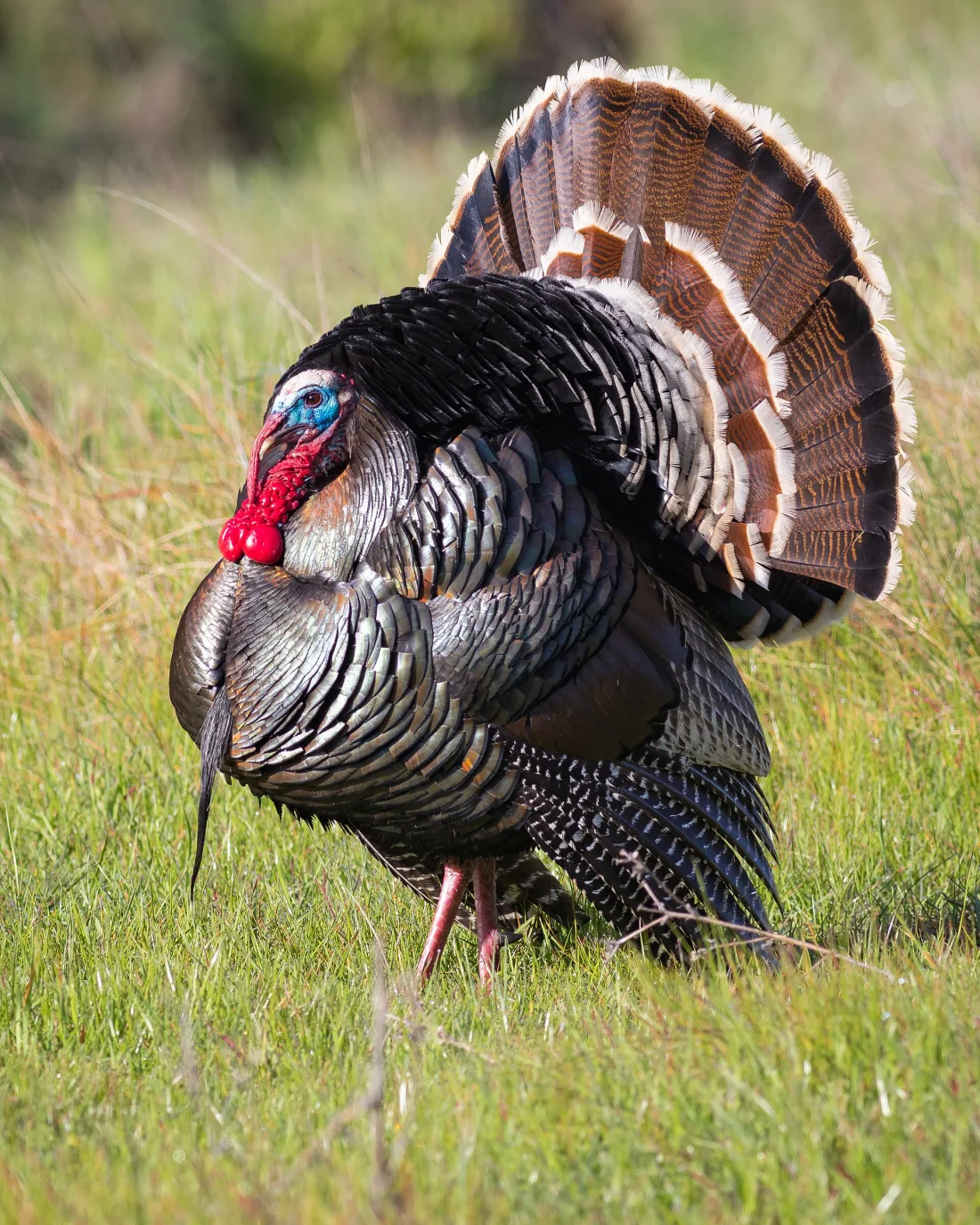
A craft turkey only needs a fan and a wattle, but three more details make one look like a turkey and not a generic bird:
- The fan is banded. A wild turkey's tail feathers are brown with fine dark bars and a pale or chestnut band at the tip. On felt, a cream or tan crescent stitched across the top of each feather, or a second, shorter feather layered in front, does the same job.
- The head is bare and colorful. A tom's head is blue and white with red skin below, and a fleshy snood hangs over the beak. A tiny blue patch around the eye and a snood draped over the beak are what people notice on a needle felted turkey.
- The beard. A tom has a tuft of coarse, hair-like feathers hanging from the middle of the chest. A few strands of black or dark brown wool, or three straight stitches of black floss, add it.
Needle felted turkey
This one is about 3 in (7.5 cm) tall and sits on its own flat base, so it needs no legs or armature. Plan on 2–3 hours and about ½ oz (12–15 g) of wool.
What you need
- About 8 g of brown or undyed core wool for the body
- About 2 g of dark brown or bronze wool for the surface
- 3–4 g in total of rust, orange, gold and cream for the tail
- Wisps of red, blue and gold for the head
- 36, 38 and 40 gauge needles (see felting needles explained) and a foam pad
Building it
- Body. Roll the core wool into an egg about 2 in (5 cm) long and felt it firm with the 36 gauge, flattening one side so it sits without rolling. The narrow end is the chest.
- Head and neck. Felt a ball about ⅝ in (1.5 cm) across, leaving a tail of loose fiber, and attach it on a short neck above the chest by needling the loose fiber into the body. A turkey's head is small for its body; if it looks right on a duck, it is too big.
- Surface. Cover the body with thin veils of dark brown or bronze wool, needled at a shallow angle with the 38. Lay a slightly darker wing on each side, pointing down and back.
- Tail fan, made flat. On the foam, lay a half circle about 4½ in (11.5 cm) across in rust and orange, add a band of gold and then cream along the curved edge, and needle it from both sides into a flat, firm sheet about ⅛ in (3 mm) thick. Lines needled in with a single needle from the base to the edge divide it into feathers.
- Attach the fan. Stand the fan upright behind the body, the middle of its straight edge against the rump so the curve rises well above the head, and needle it on from behind and below, working loose fiber from the fan into the body. Tilt it slightly back so it reads from the front.
- Head details. A pinch of gold for the beak, a blue patch above it for the face, and red wool for the snood over the beak and the wattle under the chin. Use the 40 gauge for all of it. For the eyes, see needle felting eyes; at this size, 2–3 mm black beads or two tiny balls of black wool are right.
The body follows the same egg-and-ball method as the songbirds in needle felted birds, if you want to practice the shape on something smaller first.
Felt turkey garland and a Thanksgiving banner

Flat, unstuffed turkeys hang straight on a string where stuffed ones turn sideways. For a 6 ft (1.8 m) mantel garland, make seven or eight and leave about 6 in (15 cm) of jute twine between them, stitching each to the twine through the back layer at two points so it cannot spin. Between them, felt balls in rust and gold or a few cut felt leaves fill the gaps; felt garland covers the spacing and how many balls a length takes.
A "thankful" or "give thanks" banner is the other Thanksgiving felt garland people look for. Cut one pennant per letter, triangles about 5 in (12.5 cm) wide and 6 in (15 cm) tall, from cream or burlap-colored felt; a 9 × 12 in (23 × 30 cm) sheet gives four if you nest them point to base in two rows. Letters about 3 in (7.5 cm) tall in rust, gold and brown go on with a running stitch or fabric glue. "Thankful" in eight pennants with 1 in (2.5 cm) gaps makes a banner about 4 ft (1.2 m) long. Cutting clean letters is covered in felt letter ornaments.
A no-sew handprint turkey for kids
Trace a child's hand, fingers spread, on rust or orange felt and cut it out: the fingers are the tail feathers. A second hand traced in gold and cut slightly smaller, glued on top and offset, gives a two-color fan. Glue a brown body, the pear shape from the pattern above, over the palm, then add a beak, a wattle and feet. Craft glue works on felt but needs about an hour to set flat under a book.
- Children from about four can do this with an adult cutting the smaller pieces.
- Use drawn or felt eyes, not googly eyes, for anyone under three; googly eyes are a choking hazard once they come off.
- Needle felting the turkey above is for older children: supervised from about 8 and on their own from around 10 to 12, as set out in is needle felting dangerous.
Turkeys on the Thanksgiving table
- Place cards. A flat turkey glued to a wooden clothespin clips onto a folded name card or the rim of a glass.
- Napkin rings. A strip of brown felt 6 × 1½ in (15 × 4 cm), joined into a loop, with a small flat turkey stitched over the join.
- A centerpiece. The needle felted turkey on a wooden board with felted pumpkins and felted acorns around it lasts every year and does not mind being packed in a box.
After Thanksgiving, the same body pattern turns into a Christmas ornament with a change of color: the sewn method and blanket stitch carry straight over to the felt gingerbread man.
Frequently asked questions
How do you make a felt turkey?
Cut a pear-shaped brown body about 3 in (7.5 cm) tall twice, five tail feathers about 2½ in (6.5 cm) long in fall colors, a small beak, a red wattle and two feet. Stitch the face details on the front body piece, tuck the feathers between the two body layers, and sew around the edge with blanket stitch, stuffing lightly before you close it. It takes about 45 minutes.
What colors of felt do you need for a turkey?
A mid or chocolate brown for the body and wings, a gold or mustard and an orange for the beak and feet, a red for the wattle, and four or five fall shades for the tail: rust, orange, gold, cream and a darker brown look more like a real bronze turkey than a rainbow does. One 9 × 12 in (23 × 30 cm) sheet of each tail color cuts about 36 feathers, enough for three dozen turkeys.
How much wool does a needle felted turkey take?
About ½ oz (12–15 g) for a turkey 3 in (7.5 cm) tall: roughly 8 g of core wool and 2 g of brown surface wool for the body, a pinch for the head, and 3–4 g of colored wool for the tail fan, which is felted flat on the foam pad and attached last.
How long should a felt turkey garland be?
Six feet (1.8 m) covers most mantels and takes seven or eight flat turkeys, each about 4½ in (11.5 cm) across, with about 6 in (15 cm) of jute twine between them. For a shorter table garland, alternate turkeys with felt leaves or felt balls and use half as many.
Can kids make a felt turkey?
Yes. The no-sew version uses a traced hand as the tail, cut from felt and glued to a felt body with craft glue, and suits children from about four with help on the cutting. Needle felting is for older children: supervised from about 8, independently from around 10 to 12. Leave googly eyes off anything for a child under three.
Image credits
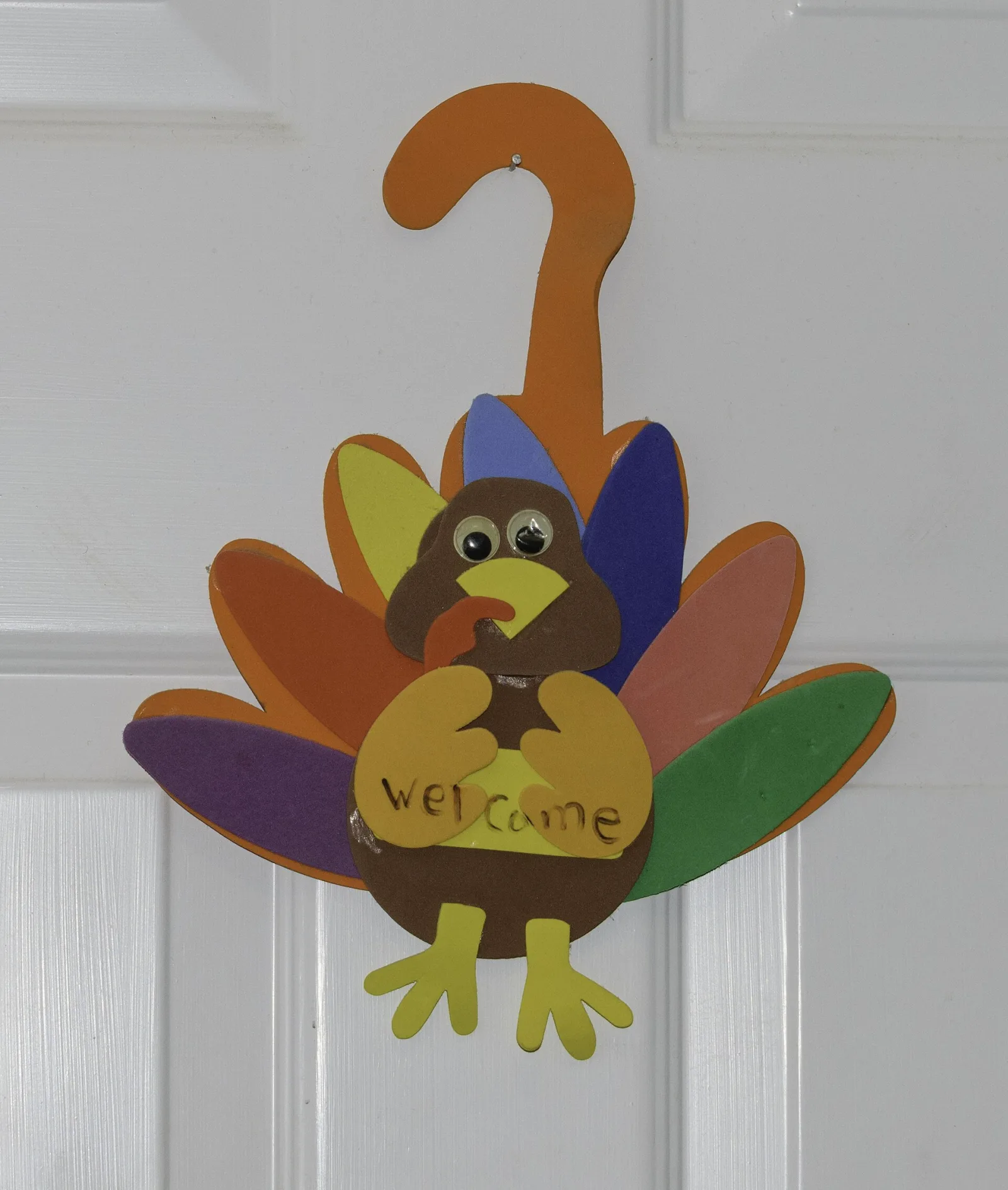
- A handmade turkey door hanger with a brown body, googly eyes, a red wattle, yellow feet and a fan of purple, orange, yellow, blue, pink and green feathers, holding a "Welcome" sign — PumpkinSky (BY SA 4.0)
- A male wild turkey displaying on grass, its banded brown tail fanned behind it, a red wattle and snood, a blue face and a dark beard hanging from its chest — Frank Schulenburg (BY SA 4.0)
- Felt letters in blue, gold, yellow, red, pink and purple spelling "thankful" on a burlap background — Magda Ehlers (Pexels License)