Needle Felted Pig: The Straight Snout, a Real Pig Colour, and Breeds From Old Spot to Boar
6 min read Beginner
We may earn a commission from links on this page, at no extra cost to you. As an Amazon Associate I earn from qualifying purchases. Learn more.
Felted pigs go wrong in two predictable ways: a dip above the snout that makes a bear, and pink wool that makes a sweet. How to avoid both, which ears belong to which breed, and how much wool a piglet really takes.
Put a pig skull on the table and the first thing you notice is a line. From between the eyes to the end of the snout, the top of the face runs dead straight. There is no brow and no dip. That single line is what separates a pig from every other round-bodied animal, and it is what most felted pigs get wrong.
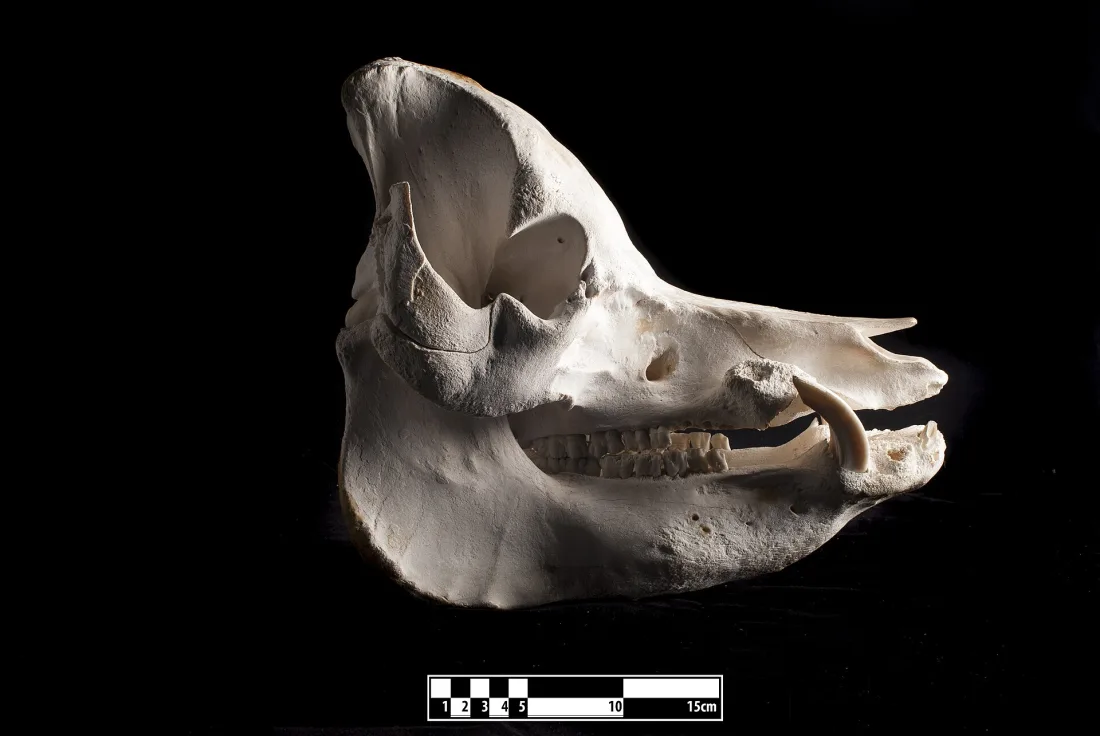
The usual method is a ball for the head with a smaller ball stuck on the front for the snout, which leaves a shallow valley where they meet. A valley between forehead and nose is a bear's face. The second common mistake is colour: bright pink wool, which makes a pig look like a sweet. This page is built around avoiding both, then choosing a breed.
Checklist before you start
| Part | Right | Wrong |
|---|---|---|
| Face in profile | One straight slope from forehead to snout | A dip at the brow (bear or dog) |
| End of the snout | A flat disc with a rim, nostrils near the middle | A rounded point (a nose, not a snout) |
| Colour | Dusty fawn with grey in it | Candy pink |
| Neck | Almost none; the head is carried low and forward | A raised head on a visible neck |
| Legs | Short, underneath the body | Attached at the sides, splayed |
| Ears | Fully up or fully forward, by breed | Half raised |
Making the pig
Materials for a 9 cm pig
- Core wool: 25–30 g
- Cream, pale grey and a pinch of dusty pink corriedale to blend: about 10 g in total
- Dark brown or black scraps for the nostrils, eyes and trotters
- 38 and 40 gauge needles, a foam pad or brush mat, and a cocktail stick
Steps
- Body. Needle a squat barrel about 8 cm long and 5 cm across, rounded at both ends and roughly the same width along its length, with a slight dip in the back. Work it until it barely gives. How to needle felt a ball covers getting core wool firm.
- Head as a wedge. Roll a separate piece about 4 cm long and needle the front two-thirds into a blunt wedge that tapers slightly towards the snout. Check it from the side as you go.
- Straighten the profile. Lay a thin veil of wool over the join between the domed top of the head and the snout, and needle it flat. Repeat until a ruler laid along the top of the face would touch it from between the eyes to the end of the snout. This is the step that matters most.
- Flat snout. Stand the head on the mat snout down and needle straight into the tip until you have a hard, flat disc about 12 mm across with a clear rim.
- Nostrils. Two holes near the centre of the disc, a little apart. Push the 40 gauge into the same spot about twenty times and the wool packs down into a real hole. Darken each with a wisp of brown.
- Attach the head low. Spread the loose fibres at the back of the head into the front of the barrel and blend the join until the shoulders run into the cheeks.
- Legs. Four stubby cylinders about 3 cm long, attached well under the body so the belly sits close to the ground. For a standing pig that will not sag, run a short wire through each leg; see wire armature for needle felting.
- Colour. Cover everything in your blended fawn (below), a little greyer along the back and shoulders and paler on the belly.
- Ears, eyes and trotters. Ears as flat triangles about 2 cm at the base, set wide on the sides of the head, not on top. Eyes small and dark, high and well back, near the ears and far from the snout (needle felting eyes). Darken the last centimetre of each leg and split the tip with a deep needle line for the cloven trotter.
- Tail. Last, as described below.
Fixing a pig that already has a dip
Do not try to carve the forehead down. Add wool instead: lay a thin sheet from the brow forward over the dip, needle it flat, and repeat until the line is straight. Adding is much easier to control than removing, which holds for most felting repairs (needle felting mistakes).
A pig colour that is not pink
A pale pig is greyish beige skin under sparse pale bristles, and only looks pink in strong sunlight. Blend your own:
| Wool | Parts | Where to use more |
|---|---|---|
| Cream | 6 | Belly and inside the legs |
| Pale grey | 2 | Back, shoulders and top of the head |
| Dusty pink | 1 | Inside the ears and on the snout disc |
Pull the wools apart and recombine them two or three times until no streaks show. How to blend wool colours shows the method with hand carders or just your fingers.
Breeds: ears, colour and face
| Breed | Colour | Ears | Worth knowing |
|---|---|---|---|
| Large White | Pale fawn blend | Upright | The classic farm pig |
| Landrace | Pale fawn blend | Big, flopping forward over the eyes | Longer body than the Large White |
| Gloucester Old Spot | Pale fawn with 3–4 irregular black patches | Flopping forward | Put one patch over an ear and eye |
| Tamworth | Ginger to rusty red | Upright | Longer snout, leaner body |
| Berkshire | Black with white feet, tail tip and snout | Upright | Short face |
| Middle White | Pale | Big and upright | A short, sharply upturned face: the one breed where the straight line does not apply |
| Wild boar | Dark grizzled brown | Upright, small | A raised ridge of coarse hair along the spine, lifted with a reverse-barb needle |
For the ears: on floppy breeds, needle only the base and let the tip hang free. On upright breeds, make a firmer triangle and needle it all the way round the base. For the boar's bristly ridge, see needle felting fur.
The curly tail
Roll a wisp of your surface blend between damp fingers, needling as you go, into a rope about 5 cm long and barely 3 mm thick. Wind it tightly round a cocktail stick and hold it in the steam from a kettle for a few seconds. Hold the stick, not the wool, and keep your hand out of the steam: it scalds worse than boiling water. Let it dry, slide it off, and needle one end high on the rump. If it uncurls, the rope was too thick or not firm enough before winding.
Piglets and scale
Wool needed grows with volume, not length. Halve the length and you need about an eighth of the wool, not half:
| Length | Core wool | Notes |
|---|---|---|
| 9 cm pig | 25–30 g | The build above |
| 6 cm young pig | 7–9 g | Legs slightly longer in proportion |
| 4.5 cm piglet | 3–4 g | Longer legs, bigger ears, rounder face |
Piglets look best in a litter of three, and a sow with piglets on a felted straw base makes a good gift.
Quick fixes
- Looks like a bear: add thin layers over the brow until the profile is straight.
- The snout looks like a nose: stand it snout down and needle the tip flat, then redo the nostrils.
- Looks like a sweet: reblend towards fawn and lay a thin veil over the whole pig.
- Legs splay: firm the body and reattach the legs underneath it.
- Sleeping pig instead: a barrel on its side with the legs tucked in needs no wire and takes about an hour.
The barrel body and short legs are the same structure as a felted sheep, and the profile problem is the reverse of a felted dog, where the step between forehead and muzzle is exactly what you need. If basic shapes are still a struggle, needle felted animals for beginners takes them one at a time.
Frequently asked questions
Why does my needle felted pig look like a bear?
There is a dip between the forehead and the snout. A pig's face runs in one straight line from between the eyes to the end of the snout, while a bear has a clear step at the brow. Fill the dip with thin layers of wool and needle them flat until the line is straight.
What colour wool should I use for a felted pig?
A dusty pale fawn, not pink. Real pale pigs are a greyish beige that only looks pink in bright light. Blend roughly six parts cream, two parts pale grey and one part dusty pink. Pure pink wool is why so many felted pigs look like sweets.
How do you make a curly pig tail from wool?
Needle a very thin rope of wool about 5 cm long between your fingers until it is firm, wind it tightly round a cocktail stick, hold it in steam from a kettle for a few seconds, and let it dry before sliding it off. It keeps the curl, and you attach it by one end.
Do pig ears stand up or flop?
It depends on the breed. Landrace and Gloucester Old Spot pigs have big ears that flop forward over the eyes. Large White, Tamworth, Berkshire and wild boar carry them upright. Pick one and commit to it, because a half-raised ear looks like a mistake.
How much wool does a felted piglet need?
Far less than half. A piglet at half the length of a pig has about one eighth of the volume, so if a 9 cm pig takes 25 g of core wool, a 4.5 cm piglet takes only 3 to 4 g.
Topics
Image credits
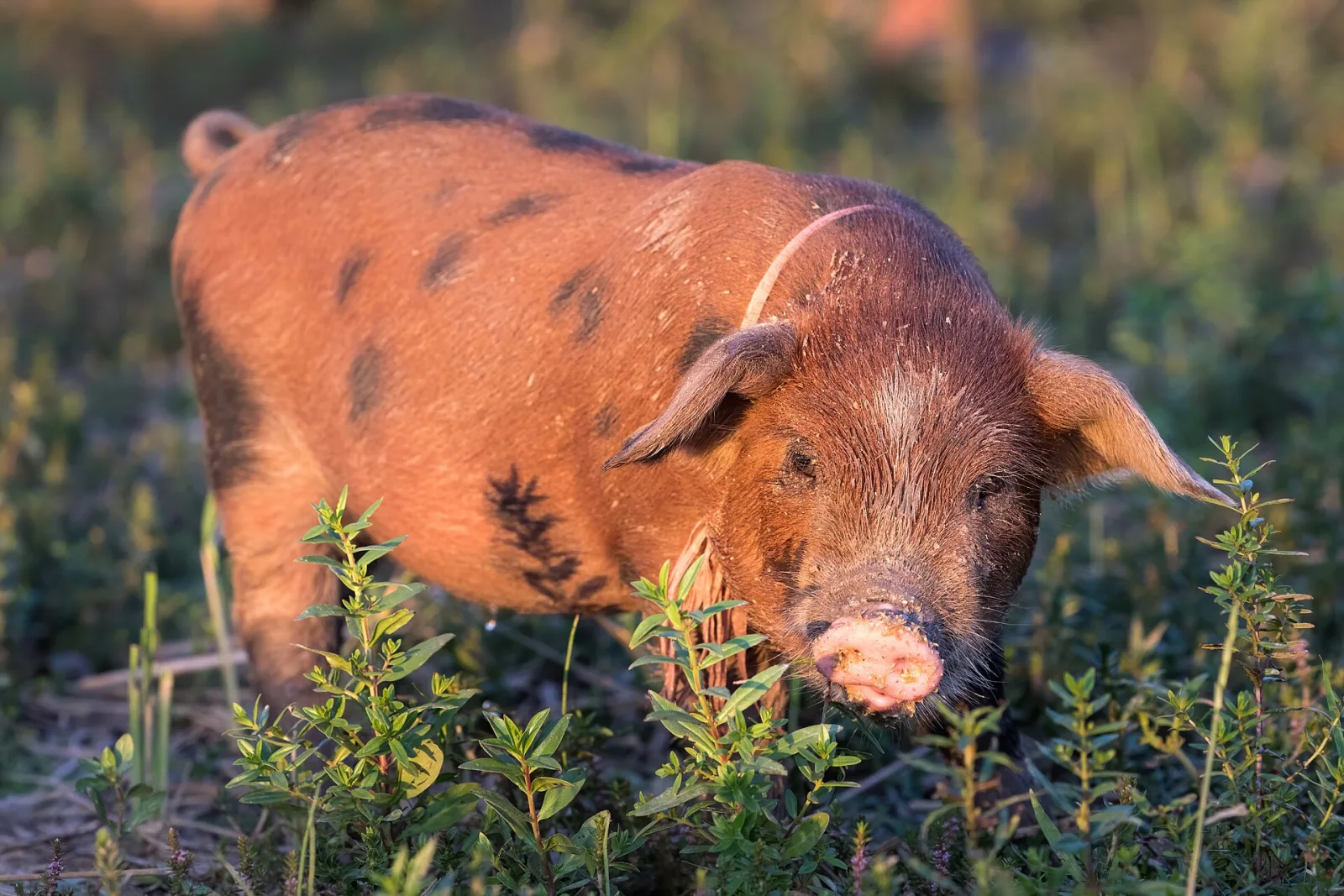
- A piglet standing in profile showing the barrel body and short legs — Basile Morin (BY SA 4.0)
- A pig skull showing the long straight snout — Museum of Veterinary Anatomy FMVZ USP / Wagner Souza e Silva (BY SA 4.0)