Needle Felted Pet Portraits: Making a Likeness from a Photograph
4 min read Advanced
We may earn a commission from links on this page, at no extra cost to you. As an Amazon Associate I earn from qualifying purchases. Learn more.
A portrait is not a better sculpture — it is a different problem. How to read a photograph, which four features carry the likeness, and what to charge.
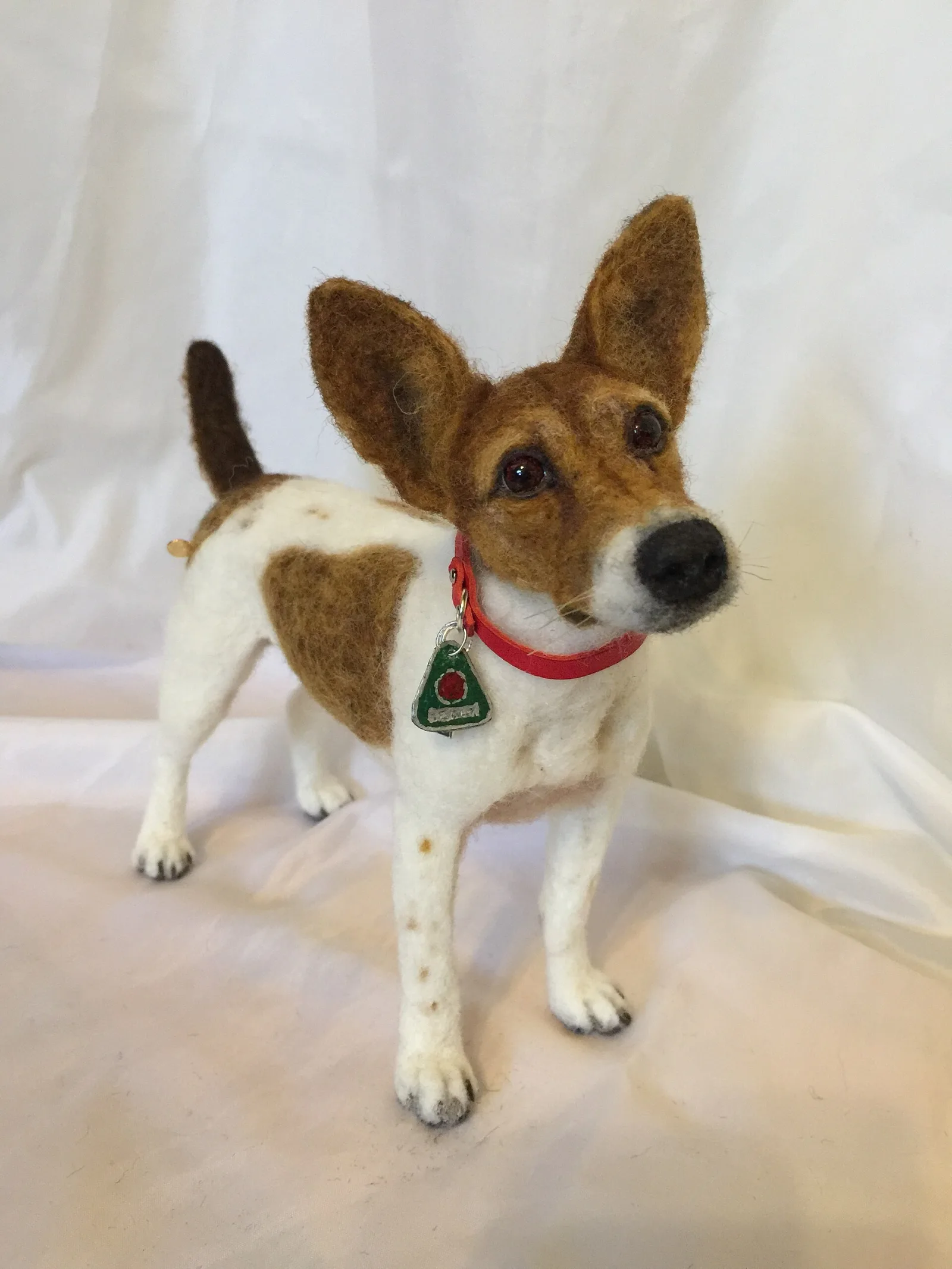
Making a dog is one skill. Making that dog is another, and the second one is mostly about looking rather than felting. People commission portraits because they recognise their animal, and recognition lives in a surprisingly small number of measurements.
Choosing the reference photographs
Ask for more than you think you need, and specify what you want:
- Straight on, at the animal's eye level. This is the one that gives you eye spacing and muzzle width. Photos taken from human height distort both.
- Full profile. Muzzle length, stop depth, ear set, skull shape.
- Three-quarter view. How the features sit together in the round.
- Full body standing, if you are making a sculpture.
- Anything in daylight. Flash flattens the face and kills the markings.
Print them. Working from a phone screen means the scale keeps changing and the colours are wrong.
The four things that carry a likeness
- Eye spacing and size. Measure it on the printed photo as a fraction of the head width and reproduce that fraction. This single measurement does more than any other.
- Muzzle length and width. Not the breed standard — this animal's. Individual dogs vary enormously within a breed.
- Ear set and carriage. How high, how far apart, how they fold, and whether one sits differently from the other. Asymmetry is often the thing that makes an owner say "that's him".
- Facial markings. The exact shape of a blaze, a patch over one eye, the boundary between colours. Copy these precisely; do not tidy them.
Everything else — body, tail, pose, coat length — is context. Get it plausible and move on.
The working method
- Build a generic animal of the right breed first. Use the ordinary method in needle felted dog or needle felted cat. Do not attempt a likeness during this stage.
- Leave the head slightly under-worked. Under-firm wool can still be reshaped; dense felt cannot. Stop before the head is fully hard.
- Set up the comparison. Prop the printed front-view photo behind the piece at the same scale and look at both at once, from a metre away. Distance shows errors that close inspection hides.
- Adjust in small increments. Add a wisp, needle a depression, look again. Photograph your piece from the same angle as the reference and compare the two images — the camera is far more honest than your eye.
- Do the markings last, and copy their outlines exactly.
- Add eyes late. Once the eyes go in, the piece acquires a personality and you will stop seeing its faults.
The flat portrait alternative
A 2D portrait — wool laid onto a felt or fabric background inside a frame — is the easier route to a good likeness, because you are copying a photograph in two dimensions rather than reconstructing a head in three.
- Trace the main shapes from the photo onto the backing.
- Lay in the background and the base coat colour with a multi-needle tool.
- Build the coat in layers from dark to light, following fur direction.
- Do eyes and nose last with a 40 gauge needle and tiny amounts of fibre.
The technique is the same as any wool picture — see wool painting.
Using the animal's own fur
Many commissions ask for it, especially memorial pieces. Brushed undercoat is short, smooth and does not felt well alone, so blend it roughly half and half with wool and use it only for the surface layer. Keep a note of which is which, because owners will ask. See felting with dog hair and felting with cat hair.
Memorial commissions
A large share of pet portrait work is for animals that have died. Two practical points: the photographs will be whatever exists rather than what you asked for, so be honest early about what a poor reference will and will not allow; and build in more time than the work needs, because these commissions attract revisions and emotional weight in equal measure.
Pricing
Time it once, properly. A detailed 15 cm sculpture is commonly 10–20 hours including the head rework, and a framed flat portrait 5–10. Then:
- Set an hourly rate you would accept for skilled work.
- Add materials — modest, usually under a tenth of the total.
- Add packaging and postage, which for a fragile sculpture is not trivial.
- Take a deposit of a third up front, non-refundable, before you buy wool.
Sculptures priced below about a day's skilled wage tend to attract more work than the maker can sustain, which is how most people burn out of commissions within a year.
Photographing the finished piece
You will sell the next commission with this photograph. Daylight near a window, a plain mid-tone background, the camera at the animal's eye level, and no flash. Shoot the same three angles you asked the owner for — it also makes a useful before-and-after pair beside the reference photo.
Frequently asked questions
How do you needle felt a dog from a photo?
Work from three photos — front, side and one at eye level — printed at the size you intend to make. Build a generic dog of the right breed first, then spend the last third of your time adjusting only the head until it matches the reference.
What makes a pet portrait actually look like the animal?
The distance between the eyes, the length and width of the muzzle, the exact set of the ears, and the shape of the markings around the face. Coat colour and body pose contribute almost nothing to recognition.
Should a pet portrait be a sculpture or a flat picture?
Flat 2D portraits are quicker, more forgiving, and easier to match to a photo because you are copying an image rather than reconstructing a solid. Sculptures carry far more weight as a keepsake and take three to four times as long.
How much should I charge for a needle felted pet portrait?
Work out your hours honestly — a good sculpture is 10 to 20 — and price at a real hourly rate plus materials. Most commissioned portraits sell for the equivalent of a day or two of skilled work, and undercharging is the most common reason people stop taking commissions.