Felt Dog Ornament: A Pattern Traced from Your Own Dog, Sewn or Needle Felted
9 min read Beginner
We may earn a commission from links on this page, at no extra cost to you. As an Amazon Associate I earn from qualifying purchases. Learn more.
Make a Christmas ornament that looks like your dog: trace a side-view photo into a felt pattern, show the ears, muzzle and tail of the breed, match the coat with layered felt patches, then add a ribbon collar, a name and the year. Plus a small needle felted version at ornament scale.
Start with a photo of your dog standing side-on, taken at the dog's own height rather than from above. Printed so the dog measures 4 in (10 cm) from nose to rump, that outline is your pattern. What makes the ornament look like your dog rather than a generic one is how the ears are set, how long the muzzle is, how the tail is carried and where the color patches fall, and every one of those is visible in a side view.
The main method is a flat sewn ornament from sheet felt, followed by a small needle felted dog or head at ornament scale. A full-size felted dog, with an armature and a coat built up in layers, is a bigger project, covered step by step in needle felted dog.
How do you make a felt dog ornament pattern from a photo?
- Pick the photo. The dog standing square, all four legs visible, head level, shot from the side at about the height of its shoulder. A photo from above shrinks the legs and swells the head.
- Scale it. Print it, or resize it on screen, so the body is 3½–4 in (9–10 cm) from nose to rump, not counting the tail.
- Trace the outline onto tracing paper or printer paper held against a window. Follow the body, not the fluff: on a long-coated dog, draw the line about halfway between the skin and the tips of the fur.
- Simplify. Redraw the outline as smooth curves. A ruffled chest or a feathered tail becomes two or three scallops, not twenty spikes. Felt can't be cut cleanly into points smaller than about ⅛ in (3 mm).
- Thicken the thin parts. Widen any leg narrower than ⅜ in (1 cm) and any tail narrower than ¼ in (6 mm). Under that, there is no room for the edge stitch and the leg folds when the ornament is stuffed.
- Draw the extras separately. Trace each ear, each large color patch and the nose as its own piece on a second sheet, overlapping the body outline by about ⅛ in so the edges tuck under.
For a head-only ornament, use a front-facing photo instead and scale the head to 2½–3 in (6.5–7.5 cm) across, including the ears. Heads are quicker, and they suit breeds whose face is the whole point: pugs, bulldogs, terriers with beards.
How do you show your dog's breed in felt?
Get these features right and owners will recognize the breed before they see the coat color.
| Feature | Examples | In sheet felt | Needle felted |
|---|---|---|---|
| Upright ears | German Shepherd, Corgi, Husky | Part of the body outline, with a pink or darker inner triangle appliquéd on | Flat triangles felted firm, inner edge pinched into a cup |
| Drop ears | Beagle, Labrador, spaniels | A separate piece stitched only at the top, so it hangs over the head seam | Thin flaps attached at the top edge, the bottom left free |
| Folded or half-up ears | Collie, terriers, Greyhound | A small separate flap, tacked folded forward | A short triangle needled upright, tip folded down and fixed |
| Long muzzle | Collie, Greyhound, Dachshund | Keep the full length from the photo; don't around it off | Pull wool forward into a narrow wedge |
| Short, flat muzzle | Pug, French Bulldog, Boxer | A front-facing head, with a separate dark muzzle patch | Flatten the face and build a raised muzzle pad below the eyes |
| Curled tail | Pug, Shiba Inu, Husky | A separate curl stitched onto the back above the hip | Wire-cored tail curled over the back |
| Feathered tail and legs | Golden Retriever, setters | Scalloped edges on the tail and backs of the legs | Loose wool needled in at the root only, then brushed |
| Curly coat | Poodle and poodle crosses | French knots in floss, or bouclé yarn couched on | Tiny loops of curly locks needled at one end |
| Short legs | Dachshund, Corgi, Basset | Trust the photo; the legs will look absurd and correct | Short thick legs on a long body; no wire needed |
Trust the photo over what you remember. Most people draw their dog's ears bigger and legs longer than they are, and the tracing is there to stop that.
How do you match your dog's colors with layered felt?
Cut the whole body in the dog's main color, then add the markings as patches on top, darkest last. A tricolor beagle, for example, is a white body, a tan patch over the head and ears, and a black saddle over the back, with the black overlapping the tan by ⅛ in. Sew each patch down with a small running stitch or whip stitch in matching thread, or use a dot of fabric glue for children's ornaments. Felt appliqué explains both stitches.
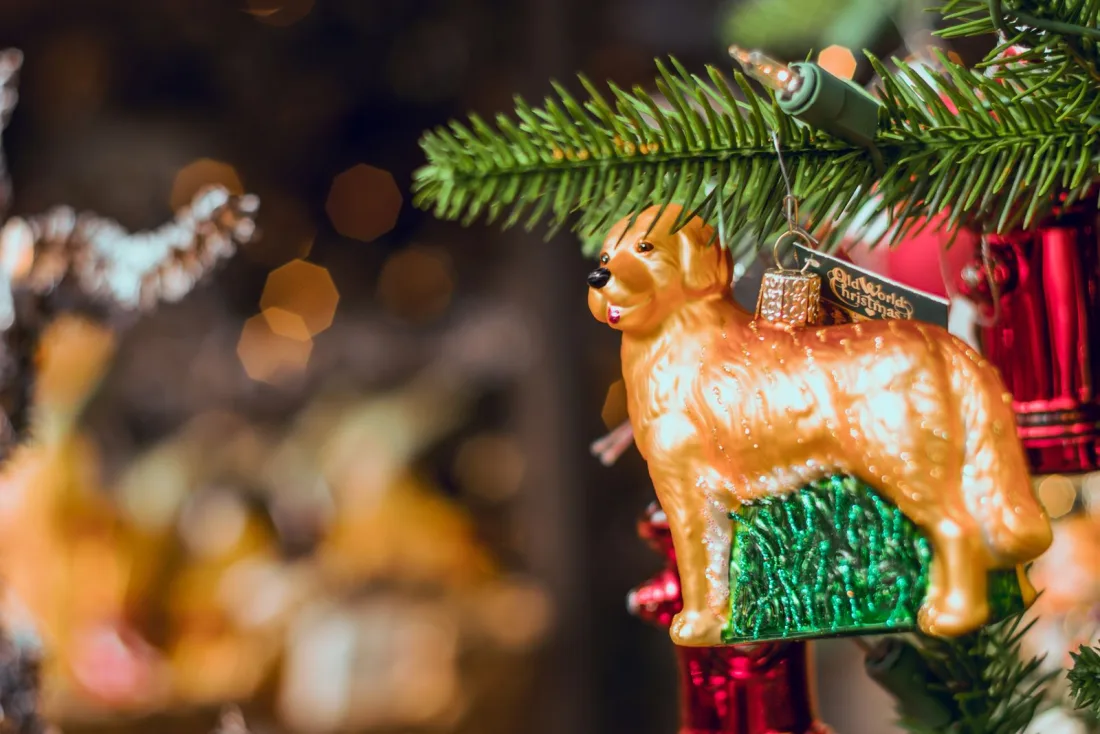
- Golden and yellow dogs: felt sold as gold or mustard is usually too bright. A camel or caramel body with a cream patch on the chest and muzzle is closer to life.
- White dogs: use cream or ivory. Bright white felt looks blue next to a white dog's real coat, and it shows every mark.
- Black dogs: stitch the eyes in dark brown with a single white stitch for a highlight, or they disappear. A gray or brown edge stitch keeps the outline visible.
- Brindle and ticking: don't cut stripes or spots. Embroider them in floss over the base color: long straight stitches for brindle, scattered seed stitches for ticking.
- Tan points: small patches over the eyes, on the cheeks and on the lower legs, as on a Rottweiler or a black and tan Dachshund.
Stitch the eye as a French knot or a tiny circle of black felt, set one-third of the way from the nose to the ear, and the nose as a ⅜ in (1 cm) rounded triangle of black felt at the very tip.
How do you sew a felt dog ornament together?
- Cut the pieces. Iron freezer paper copies of the pattern onto the felt, wool setting for wool felt and the lowest setting for acrylic, and cut through paper and felt together. Cut two body pieces, one reversed. Wool or wool-blend felt about 1 mm thick is the easiest to stitch; wool felt fabric explains why.
- Decorate the front with patches, eyes, nose and name while it is still a single flat piece.
- Add the loop. Fold 7 in (18 cm) of ribbon or cord in half and lay the ends between the layers at the top of the back, just behind the shoulders. That is about where a flat dog balances, but pinch the two layers together and hang them from a pin first to check.
- Stitch around the edge in blanket stitch with two strands of floss, about ⅛ in (3 mm) from the edge. Catch drop ears into the seam only at the top.
- Stuff lightly with small tufts of polyester fiberfill pushed into the legs first, then the head, then the body, through a 1 in gap under the belly. Stop at about ⅜ in (1 cm) thick so the dog hangs flat.
- Close the gap with the same blanket stitch and hide the final knot between the layers.
How do you add a name, the year and a collar?
Names go on the front piece before sewing. Write them first in water-soluble marker, keep the letters about ⅜ in (1 cm) tall, and backstitch them with two strands of floss. A long name fits better on a separate felt tag, a 1 × ¾ in (2.5 × 2 cm) rectangle or a bone shape, stitched or hung from the collar. Cut felt initials are another option, and felt letter ornaments has letter sizes. Stitch the year on the back so a set of ornaments from different Christmases can be told apart.
Collars are ⅛ in (3 mm) grosgrain ribbon wrapped around the neck after the ornament is sewn, overlapped at the back and caught with two stitches. Match the dog's real collar if it has one people know it by. A tiny bell, or a felt tag in the shape of a disc, hangs from the front.
How do you needle felt a small dog ornament?
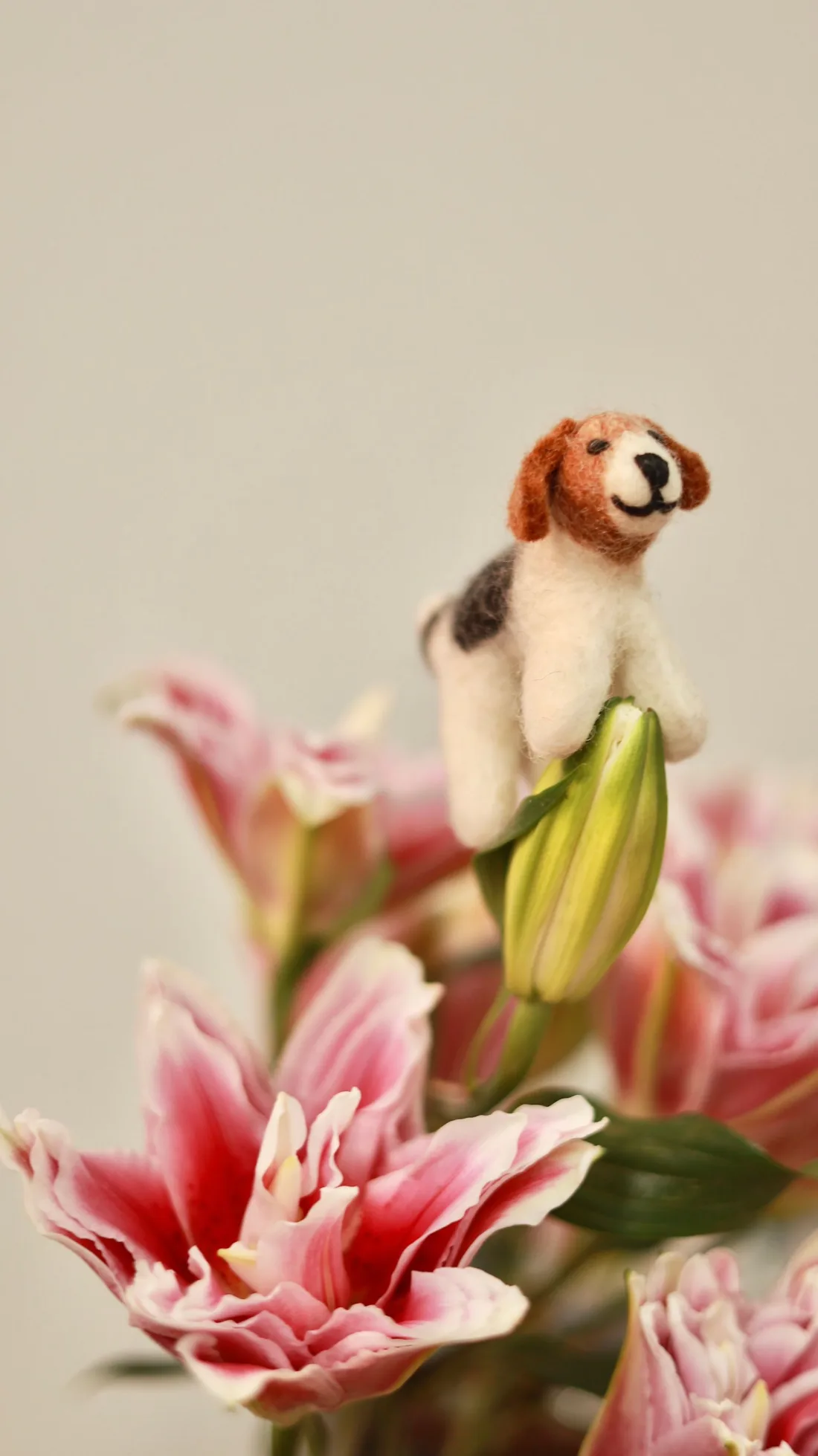
At ornament scale, lighter is better. A whole standing dog 3 in (7.5 cm) long takes about ⅓ oz (8–10 g) of wool, and a head-only ornament 1½ in (3.8 cm) across takes about ¼ oz (6–8 g). Anything much heavier than ½ oz (14 g) bends the branch tip and turns to face the trunk.
| Ornament | Size | Core wool | Top color | Wire |
|---|---|---|---|---|
| Head only | 1½ in (3.8 cm) across | 4–5 g | 2–3 g | None |
| Lying-down dog | 3 in (7.5 cm) long | 6–7 g | 3 g | None |
| Standing dog | 3 in (7.5 cm) long | 5–6 g | 3–4 g | Two pipe cleaners for the legs |
Build it the way the larger dog is built, only smaller: a firm core wool body, a head added at the right angle, ears felted flat and attached, then a thin top coat in the dog's colors. A standing dog needs legs on a bent pipe cleaner, or they sag; wire armatures for needle felting shows how to bend one. A lying-down pose, chin on paws, needs no wire at all and is the easiest to make look like a particular dog. For the hanging loop, pass a needle and cord through the back of the neck rather than the head, which keeps a whole dog level.
For a closer likeness, the methods for reading a face from a photo in needle felted pet portraits work at this size too.
Needle felting needles are sharp and barbed, and small dogs have thin legs that put your fingers close to the work, so use a finger guard; is needle felting dangerous covers the rest.
Can you make the ornament with your dog's own fur?
Yes, if the dog has a soft undercoat. Brushings from a double-coated dog, such as a Husky, Samoyed, or German Shepherd, felt well when blended about half and half with wool and used for the outer layer of a needle felted ornament. Short single coats, like a Boxer's or a Dalmatian's, are too short and slick to felt well. Felting with dog hair explains how to wash, card and blend it. For a sewn ornament, a pinch of fur can simply go in with the stuffing.
A memorial ornament for a dog that has died
A felt ornament of a dog that has died is one of the kindest gifts to make, and it needs no special technique, only a favorite photo and some patience. Use the photo the family loves rather than the clearest one. Stitch the name and the years on the back, or a short phrase they used for the dog. If they kept some fur from the brush, put a little in a small felt pocket stitched to the back of a sewn ornament, or blend a pinch into the surface of a felted one, and tell them it is there. Give it before the tree goes up, not on Christmas morning, so it can be opened quietly.
Keeping a dog ornament safe on the tree
A wool ornament smells interesting to a dog, and one made with the dog's own fur even more so. Swallowed wool, ribbon or a bell can cause a blockage, so hang dog ornaments high. Bells, beads and small felt tags are also choking hazards for children under 3. More ornament ideas, with general rules for loops and storage, are in felted Christmas ornaments, and the rest of the season's projects are collected in felt Christmas decorations.
Frequently asked questions
How do you make a felt dog ornament pattern?
Print a side-view photo of the dog standing, scaled so it measures about 4 in (10 cm) from nose to rump, and trace the outline onto paper. Smooth the fur into a few clean curves, widen any leg narrower than ⅜ in (1 cm), and draw the ears and markings as separate pieces. Cut two body pieces, one reversed.
What size should a felt dog ornament be?
About 4 in (10 cm) long for a flat sewn dog and about 3 in (7.5 cm) long for a needle felted one. A sewn ornament weighs almost nothing; a needle felted dog of that size takes about ⅓ oz (8–10 g) of wool, which is the most an outer branch carries well.
How do you put a name on a felt dog ornament?
Backstitch it with two strands of floss on the front piece before the ornament is sewn together, with letters about ⅜ in (1 cm) tall, or stitch it on a separate felt tag hung from the collar. Put the year on the back so the front stays uncluttered.
Can you make a felt ornament with your dog's fur?
Yes. Brushed-out undercoat from a double-coated dog can be blended about half and half with wool and needled onto the surface of a felted ornament. For a sewn ornament, a little loose fur can go in with the stuffing or in a small pocket stitched to the back.
Is a felt dog ornament safe around dogs?
Hang it out of reach. Wool ornaments, especially ones made with the dog's own fur, smell interesting to dogs, and swallowed wool, ribbon or bells can block a dog's gut. Keep it on the upper half of the tree.
Image credits
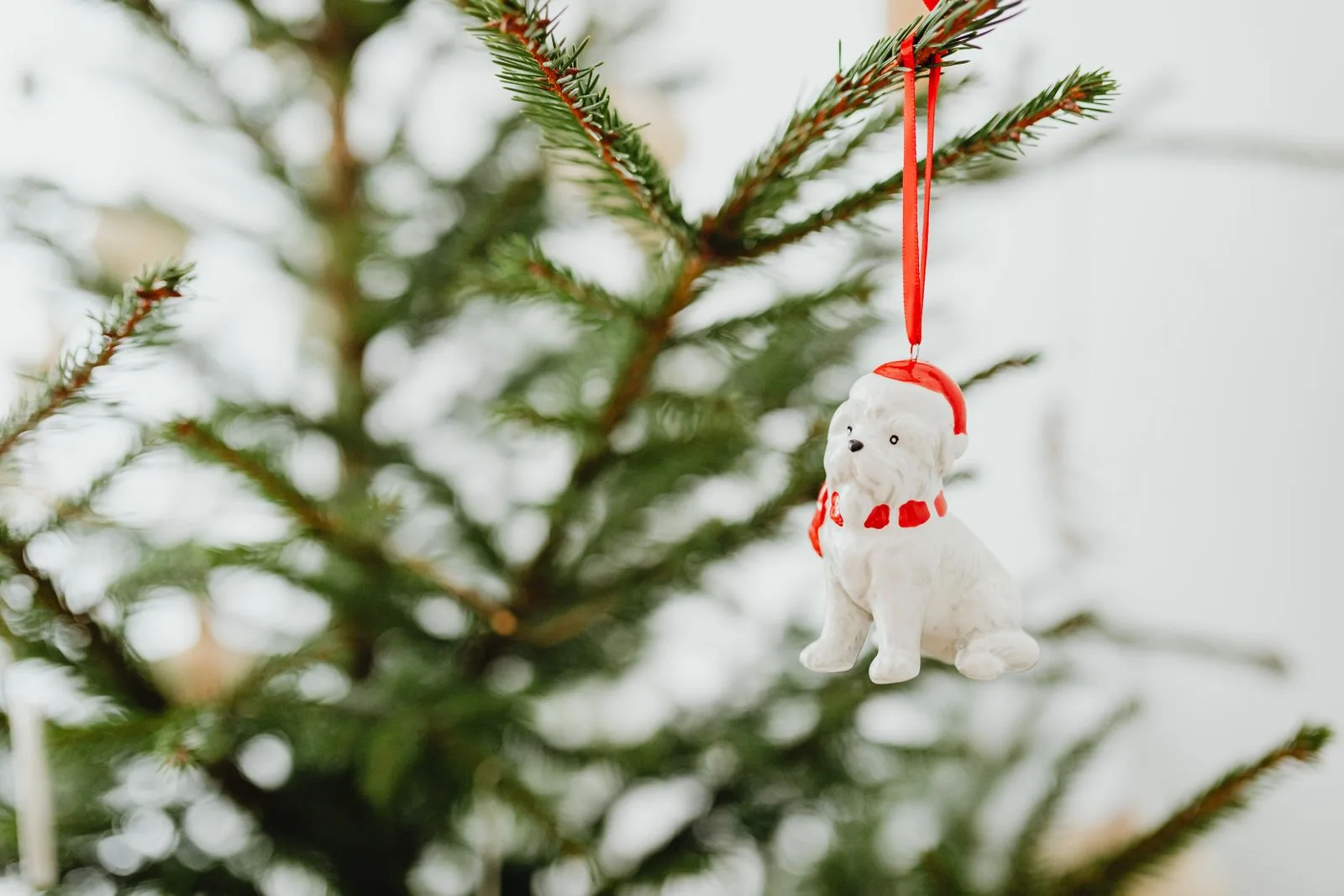
- A white dog ornament in a red collar hanging from a red ribbon on a Christmas tree branch — https://kaboompics.com/ (Pexels License)
- A golden retriever ornament hanging on a lit Christmas tree — Chris G (Pexels License)
- A small needle felted beagle standing among pink lilies — zhangliubin (Pexels License)