Needle Felting Pens and Holders: Multi-Needle, Punch and Electric Tools
5 min read Beginner
We may earn a commission from links on this page, at no extra cost to you. As an Amazon Associate I earn from qualifying purchases. Learn more.
A pen holds three to seven needles and covers ground several times faster than one. Where that speed is worth having, where it ruins the work, and which tool to buy.
The single biggest complaint about needle felting is that it is slow. A pen tool answers that directly: instead of one barbed needle entering the wool per stroke, you drive five, and the fibre compacts at roughly five times the rate.
What nobody says on the packaging is that the tool changes what you can make. Understanding that trade is the difference between a pen that saves you hours and one that lives in a drawer.
How a pen tool works
Felting needles are brittle and unpleasant to hold in a bunch, so a pen encloses them. Push down, the needles descend past a plastic foot into the wool; release, and a spring lifts them clear while the foot holds the wool down so it does not ride up with the barbs.
That foot is the important part. It is what makes multi-needle work possible at all, and it is also what limits the tool: the wool must be flat enough for the foot to sit on. A pen cannot get inside a curve.
The three types you will see
Pen-style holders (Clover and similar)
The Clover pen style tool is the reference product — a plastic body holding five needles, with a sprung guard and a lid so it can go in a bag safely. It takes standard needles and Clover sells refills. Perfectly good, widely copied, and the copies are usually fine.
These are the right choice for the majority of people. They are quiet, controllable, and you can pull needles out to run three instead of five when you want less bite.
Punch tools and multi-needle blocks
Larger handles gripping seven, twelve or more needles, sometimes in a wooden block. Designed for covering area — backgrounds in wool painting, laying colour across a large panel, or bonding fibre to backing cloth. Heavy, crude, and unbeatable at the one job.
Electric felting pens
A small motor drives the needles up and down at several hundred strokes a minute; you hold it against the wool and move it around like a sander. Speed is genuinely dramatic. So is the needle breakage — the machine has no feel, so it keeps punching when a single-needle user would have felt resistance and stopped.
Buy one only if you already know you are doing repetitive flat work in quantity. See felting machines for the larger stationary versions of the same idea.
Single-needle holders
Not every holder is a multi-needle tool. A single-needle holder is a wooden or metal handle with a collet or screw cap that grips one needle, and for most sculpture it is the better first purchase than a pen.
- Comfort. A bare needle is pinched by its bent crank, which gets sore within an hour. A handle the thickness of a pencil does not.
- Control. You still feel exactly what one needle is doing, which a pen takes away.
- Swapping gauges. A collet holder takes any needle, so one handle moves from a 36 to a 40 in seconds. Some hold two or three needles side by side, which is a useful middle ground.
Look for a holder that grips the shaft rather than just the crank, or the needle wobbles and snaps.
Where a pen is the right tool
- Flat panels and backgrounds. Covering a 6 × 8 in area in colour takes minutes rather than half an hour.
- Attaching wool to fabric. The foot keeps the cloth flat while the needles bond fibre through it — see needle felting on fabric.
- Flattening and joining prefelt. Bonding two sheets together across their whole face — more on the material in prefelt wool.
- Bulk cores. The tedious first stage of any large sculpture, before shaping begins.
- Finishing large surfaces where you want an even texture rather than a modelled one.
Where it will ruin the work
- Anything under about 2 in. The needle spread is wider than the shape.
- Concave surfaces. The foot bridges the hollow and the needles never reach it.
- Faces and features. Five needles cannot make an eye socket — see needle felting a face.
- Fine surface detail such as fur direction, spots and lines. One 40 gauge needle, every time.
The sensible pattern is to use both: pen for the bulk, single needle for everything that anyone will actually look at.
Choosing needles for a pen
Gauge matters more in a pen than in your hand, because five needles multiply whatever the gauge does.
- 36 gauge — coarse and aggressive. Cores only; it leaves visible holes.
- 38 gauge — the default. Fast enough, marks less.
- 40 gauge — fine, for surfaces and for wool that is already firm.
- Star or triangle — triangle is fine for most work; star blades cut faster and blunt sooner.
Which gauge does what is set out in the chart in felting needles explained.
Mixing gauges in one pen is a mistake: the finer needles are the same length but do less work, so the coarse ones dominate and you get an uneven surface. The full range is explained in felting needles explained.
Why pens break needles, and how to stop it
Needles snap when they bend, and they bend when the tool moves sideways while they are buried. In a pen that is far easier to do than with a single needle, because you cannot feel each needle individually.
- Push straight down and lift straight up. No twisting, no dragging.
- Do not push through to the mat — the needles hit foam that pushes back at an angle.
- Stop when the wool stops yielding. Dense felt is what breaks needles.
- Replace the whole set at once, so all five are the same length.
More on the mechanics in why felting needles break, and on the surface you work into in felting mat alternatives.
What to buy first
A five-needle pen-style tool with a guard and a pack of 38 gauge refills. It costs about the same as two skeins of yarn, covers every flat job, and does not commit you to anything. Add a punch block later if you take up wool painting, and consider an electric pen only when you can name the specific repetitive task it would solve.
Frequently asked questions
What is a needle felting pen?
A spring-loaded holder that grips several felting needles at once, usually three to seven, behind a plastic guard. You press it down and release, and it does the work of that many single-needle strokes per push.
Is a needle felting pen worth buying?
For flat work, large surfaces and attaching wool to fabric, yes — it is roughly three to five times faster. For small sculpture and detail it is the wrong tool, because you lose the precision that makes needle felting worth doing.
Can you replace the needles in a felting pen?
Yes, and you will need to. Most pens take standard 36 to 40 gauge needles held in a chuck or clip; Clover sells refills for its own tool. Always replace the full set with the same gauge, or the shorter needles do nothing.
Are electric needle felting pens any good?
They are fast and they are noisy, and they break needles constantly if your wool is dense or you angle the tool. They earn their place for large flat surfaces and production work, not for beginners or sculpture.
Topics
Image credits
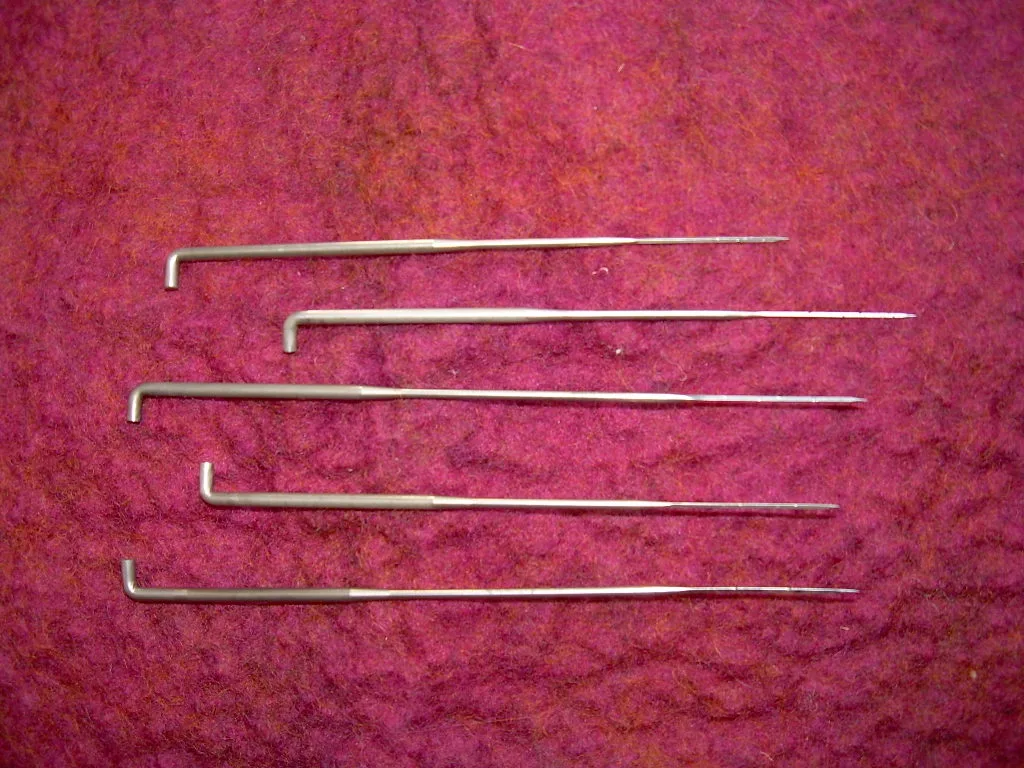
- Barbed felting needles of the kind a pen tool holds — Danielle Keller (Danielle_dk) (PUBLIC DOMAIN)
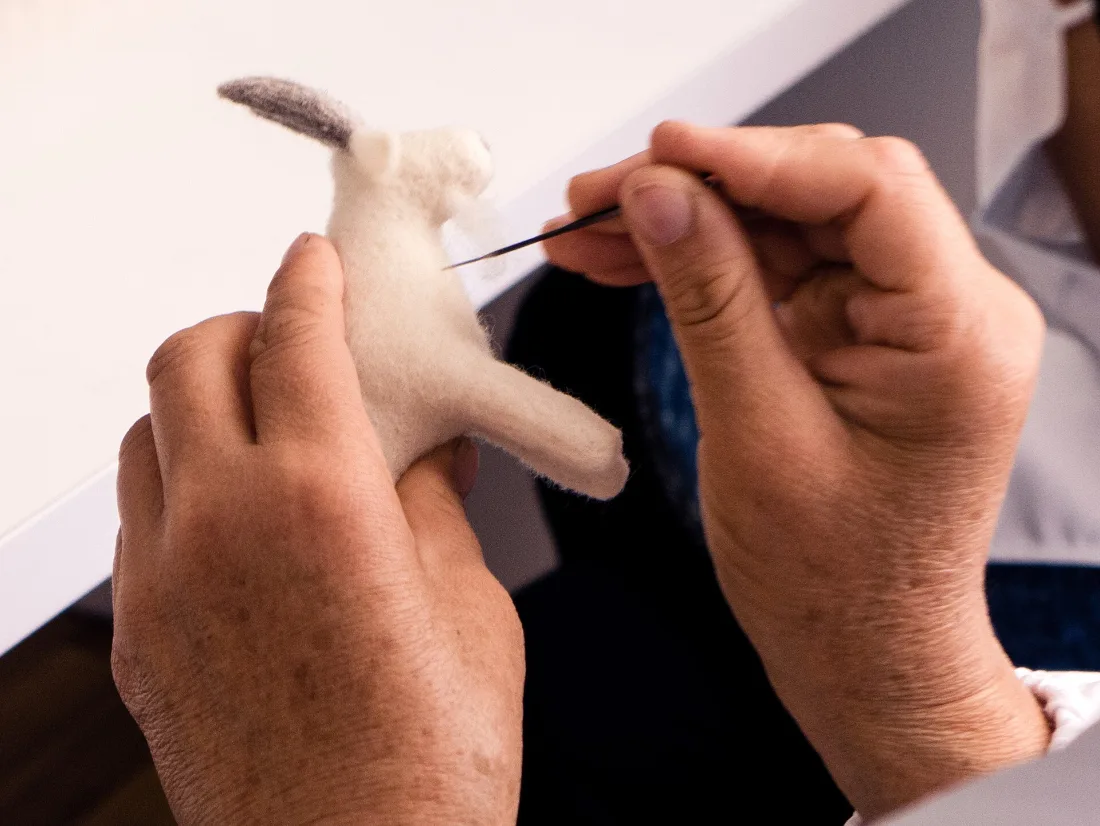
- A felting needle worked into wool at close range — Fabienkhan (BY SA 4.0)