Why Felting Needles Break — and How to Stop Snapping Them
4 min read
We may earn a commission from links on this page, at no extra cost to you. As an Amazon Associate I earn from qualifying purchases. Learn more.
Needles almost never break because they were cheap. Four habits account for nearly every snapped needle, and all four are easy to unlearn.
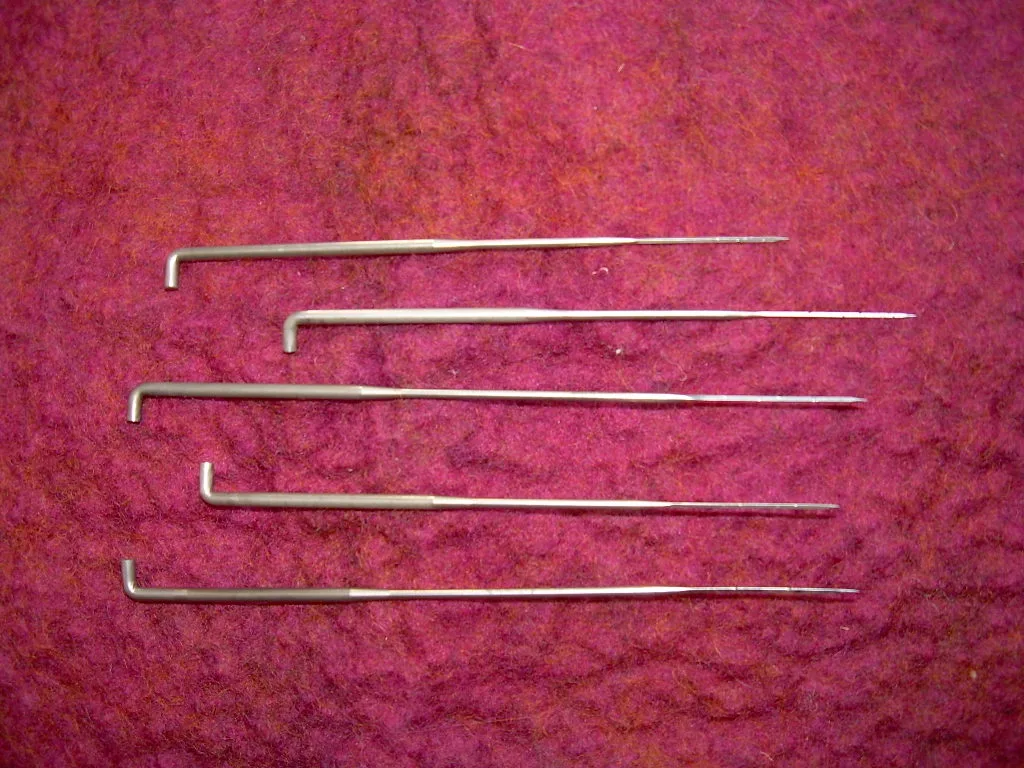
A felting needle is a thin steel shaft with notches cut into it. Those notches are what make it work, and they are also stress points — the needle is engineered to be sharp and grippy, not strong. It will tolerate enormous force along its length and almost none across it.
Understanding that one fact explains every broken needle you will ever have.
How to hold and use a felting needle
Almost every breakage traces back to how the needle is held and moved, so this comes first.
- Grip it like a pencil, by the crank or in a holder, with your fingers close enough to the wool that the needle cannot flex between them.
- Choose the angle before you go in. Straight down for firming, shallow and nearly parallel to the surface for attaching and smoothing. Whatever the angle, the needle leaves along the same line it entered.
- Go only as deep as the job. About ¼ in to work a surface, ½ to 1 in to firm a core. The barbs only sit on the lower part of the blade; burying the needle to the crank does nothing but load the shaft.
- Keep the rhythm light. A quick, shallow, repeated stab felts faster than a hard one, and your wrist lasts longer.
1. Levering sideways
This causes the overwhelming majority of breakages. The needle goes in straight, then your hand rotates slightly, or you tilt the needle to change angle before pulling out, or you turn the work while the needle is still buried.
The barbs are locked into compressed wool at that moment, so the shaft takes the full bending load — and snaps, usually about halfway down where the notches are.
The fix: in and out along exactly the same line, every time. If you want a different angle, withdraw first, then reposition. This feels slow for a day and then becomes automatic.
2. Hitting something hard
The needle passes through the wool and meets a table, a work surface, a pair of scissors on the pad, or the wire of an armature. Steel against steel breaks the needle instantly.
The fix: use a dense foam block at least 2 in (5 cm) thick, or a brush mat. Replace foam once it is visibly chewed — a shredded pad no longer stops the needle. And keep the mat clear of anything except the work.
3. Working over an armature carelessly
Armature wire is the single most reliable needle-killer, because you cannot see it once it is wrapped.
The fix: know where the wire runs and approach at an angle that skims alongside it rather than aiming at it. Work the wool around the armature, building bulk beside the wire rather than stabbing straight down onto it. Wrapping the wire generously before you start felting gives you a margin.
4. Forcing dense felt with a fine needle
A 40-gauge needle is thin. Driven hard into a piece that is already firm, it flexes — and a flexing needle is a bending needle.
The fix: match the needle to the density. Coarse gauges for compacting, fine gauges for finishing an already-formed surface. If a fine needle is meeting real resistance, you are using it for the wrong job. The gauge chart is in felting needles explained.
Things that are not the cause
- Cheap needles. There is some quality variation, but a mid-range needle used correctly outlasts a premium one used carelessly. If you are breaking several a session, technique is the variable.
- Stabbing too fast. Speed alone does not break needles. Speed combined with imprecision does, because fast work is where sideways movement creeps in.
- Hard wool. Coarse fibre is harder work but does not itself snap needles.
Blunt is not broken
Needles are far more likely to wear out than snap. As the barbs abrade smooth, the needle stops moving fibre — the work feels slow, the surface stays fuzzy, and people assume they are doing something wrong.
How to tell: a sharp needle grips slightly as you withdraw it. A blunt one slides out freely. Compare against a new needle and the difference is unmistakable.
Keep a separate pot for retired needles. Sorting a worn 38 from a fresh 38 by eye is not possible.
When one breaks mid-project
The broken tip is usually still in the wool, and it is genuinely dangerous — especially in anything a child will handle.
- Stop and account for both pieces before doing anything else.
- If the tip is buried, a strong magnet passed over the piece will usually locate or extract it.
- If you cannot find it and the piece is a toy, cut it open. This is unwelcome advice and it is still the right call.
Dispose of broken needles in a sealed rigid container, not loose in a bin.
How many should you expect to break?
An experienced felter might break one needle every several projects. A beginner will break more, and that is normal — needles are consumables, and the number drops sharply once the straight-in, straight-out habit sets in.
Buy them in packs of ten rather than singly. Running out mid-project is what makes people rush and break more.
For the wider set of habits that make needle felting go smoothly, see common needle felting mistakes.
Frequently asked questions
Why do my felting needles keep breaking?
Almost always because they are being levered sideways. The needle is brittle steel designed to take force along its length only, so entering the wool at one angle and leaving at another snaps it.
Does stabbing faster break more needles?
No. Speed is not the cause, angle is. You can work quickly and never break one, provided the needle leaves along the same line it went in.
How many felting needles should I expect to break?
A few across your first project or two, while the movement is still settling, and very few after that. If you are still breaking one a session a month in, the angle of your stroke is the thing to examine.
What should I do if a needle breaks inside the work?
Stop and find the fragment. Broken tips migrate through the wool, and a piece left inside a finished animal is a genuine hazard, particularly for anything going near a child or a pet.