Felt Polar Bear: Needle Felted Proportions and a Flat Ornament Pattern
10 min read Intermediate
We may earn a commission from links on this page, at no extra cost to you. As an Amazon Associate I earn from qualifying purchases. Learn more.
How to needle felt a polar bear that doesn't look like a white teddy: the long neck, low-set ears, Roman nose and missing shoulder hump, which white wool to use and how to keep it clean, wool weights for a 3 in ornament and a 5 in standing bear, and a flat felt ornament pattern.
Stand a polar bear next to a brown bear and the highest point of its back is the hips, not the shoulders. Polar bears have no shoulder hump. Their neck is long, their head is long and narrow, and their small ears sit so far back that from the front they almost vanish. Felt a white bear with a round head, short snout and ears on top, and it reads as a white teddy, whatever wool you use.
The needle felted bear comes in two sizes, a 3 in (7.5 cm) ornament and a 5 in (13 cm) standing bear, and there is a flat sewn ornament cut from cream felt as well. For the brown bear, whose hump and dished face are the opposite problem, see needle felted bear.
What makes a felted bear look like a polar bear?
Six proportions do most of the work. Check each against the table before adding any surface wool, while the shape can still be changed.
| Feature | Polar bear | Brown bear | Teddy |
|---|---|---|---|
| Back line | Rises gently to the hips | Highest at the shoulder hump | Level or none (seated) |
| Neck | Long, about half the head length, carried forward | Short and thick | None |
| Head | Long, narrow, flat-topped | Broad and boxy | Round |
| Profile | Straight to slightly convex (Roman nose) | Dished between brow and snout | Bulging forehead, stub snout |
| Ears | Very small, round, set back and a little low on the skull | Small, round, on the upper back corners | Large, high and forward |
| Paws | Very wide and furry, toes slightly turned in | Long claws, flat soles | Small pads |
The long neck is the one people resist. Measured on the finished bear, the distance from the shoulder to the back of the skull should be about half the length of the head itself. If it looks too long while you work, it is probably right.
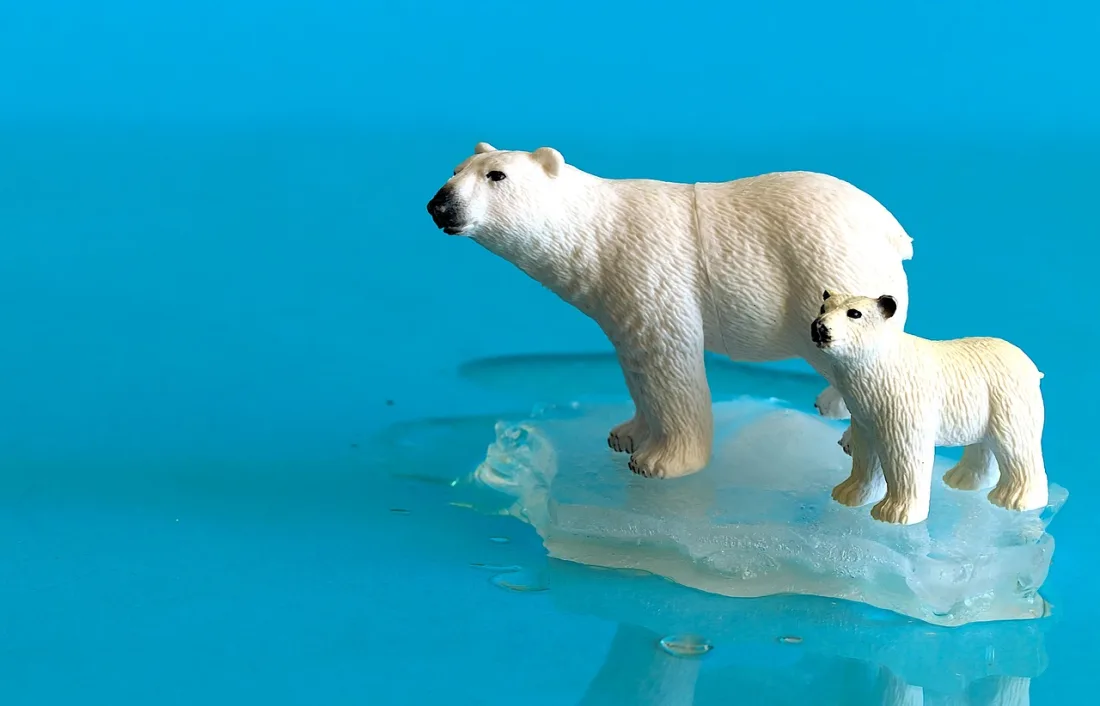
The ears are tiny: on a 5 in bear, each is a disc only about ⅜ in (1 cm) across. Place them behind the line of the eyes and wide apart, a little lower on the side of the skull than you would put a brown bear's, but still above the eye line. Drop them down level with the eyes and the head turns into a seal's.
Which white wool should you use for a polar bear?
Use cream, ivory or natural undyed white, not bright bleached white. Polar bear fur looks cream to pale yellow in daylight, and optic white wool looks like plastic next to it. A natural white also hides small marks that a bleached white shows.
- Core: undyed white or very pale core wool. Gray or brown core shows through a thin cream top coat as a dull patch, so keep the core pale too.
- Top coat: a medium wool such as Corriedale gives a slightly coarse, fur-like surface; merino gives a smoother, toy-like one. Either works; Corriedale hides needle marks better.
- Shading: a wisp of pale gray, or gray mixed with a little blue, under the chin, inside the legs and along the belly. Use far less than you think: you want shadow, not a gray bear.
- Black: a pinch of black merino for the nose and paw pads, and either black wool or 4 mm safety eyes for the eyes.
Keeping white wool clean
White wool picks up skin oils, hand cream and every dark fiber in the room. Wash your hands before you start and halfway through, skip hand cream, and keep a foam pad or brush mat just for pale wool. Felt the bear before any dark colors that day, and add the black nose and eyes last. A lint roller lifts stray fibers from the finished surface. The same rules apply to any white figure; the needle felted snowman page has more on keeping white wool white.
How much wool does a needle felted polar bear take?
These are for a bear standing on all fours, felted firm. Most of the weight is in the body barrel.
| 3 in (7.5 cm) ornament | 5 in (13 cm) standing bear | |
|---|---|---|
| Length, nose to tail | 3 in (7.5 cm) | 5 in (13 cm) |
| Height at hips | About 1¾ in (4.5 cm) | About 3 in (7.5 cm) |
| Body barrel | 2 × 1 in (5 × 2.5 cm) | 3¼ × 1¾ in (8.3 × 4.4 cm) |
| Head, back of skull to nose | ⅞ in (2.2 cm) | 1½ in (3.8 cm) |
| Core wool | 5–6 g | About ⅞ oz (25 g) |
| Cream top wool | 2–3 g | About ⅜ oz (10–12 g) |
| Total | About ¼ oz (7–9 g) | About 1¼ oz (35–40 g) |
| Wire | Not needed | Two pipe cleaners for the legs |
The 5 in bear is a shelf or mantel piece; on a tree it pulls the branch down.
How do you needle felt a polar bear?
- Felt the barrel. Roll core wool tightly into a sausage about a third longer than the finished body and needle it with a 38 gauge, turning it constantly, until it is firm with nearly parallel sides. Make the rear end very slightly fuller than the front.
- Add the legs. For the 5 in bear, bend two pipe cleaners into U shapes, fold the cut ends back, and push one through the body behind the chest and one in front of the hips, so four legs hang down. Wrap them in core wool to about ⅝ in (1.6 cm) thick. Polar bear legs are thick and straight, like columns. The 3 in ornament needs no wire: felt four short thick legs separately and needle them on. Wire armatures for needle felting covers the bending and wrapping.
- Make the paws wide. Add a pad of wool to the bottom of each leg so the foot is noticeably wider than the leg above it, and needle the soles flat so the bear stands. Turn the front toes very slightly inward.
- Build the neck. Needle a tapered roll of core wool onto the front of the body, angled slightly downward, so the head will be carried low and forward. Build the back line so it climbs gently from the neck to the hips, with no bump over the shoulders.
- Felt the head separately. Shape a long, narrow wedge with a flat top. Keep the profile straight from forehead to nose, or let it curve very slightly outward along the bridge. Don't needle a dip between brow and snout; that dip is what makes a brown bear.
- Attach the head to the end of the neck with the loose fibers left at its back, needling from all sides until the joint is invisible.
- Add the ears. Felt two very small, thick discs, about a quarter the size of a teddy's, and needle them on behind the eyes and wide apart.
- Cover in cream. Lay thin veils of cream over everything with a 40 gauge, working at a shallow angle. Two thin layers give a smoother white than one thick one. Add the faint gray shading under the chin and belly last.
- Finish the face. A small black triangle for the nose at the very tip of the snout, eyes small and set close to the top of the head, about a third of the way back from the nose. Then add black paw pads on the soles if the bear will be seen from below.
For a shaggier coat, as on the backs of the legs and around the neck of a real bear, add a little loose wool needled in at the root only, then brush it out; needle felting fur shows the technique. Keep it light, or the shape disappears under fluff. If this is your first animal on four legs, try a simpler figure from needle felting for beginners first.
How do you make a flat felt polar bear ornament?
Draw the bear in side view, walking, about 4 in (10 cm) long and 2½ in (6.5 cm) tall at the hips. Keep the same rules as the felted bear: a long neck, a narrow head, the back rising to the hips, and the ear as a tiny rounded bump on the outline behind the eye. Thicken the legs to at least ½ in (1.3 cm) so the edge stitch has room.
- Body: two pieces in cream wool felt, one reversed. A 9 × 12 in (23 × 30 cm) sheet holds about eight, enough for four bears.
- Face: a black French knot for the eye, and a nose of satin stitch in black embroidery floss at the tip. Stitch them on the front piece before joining.
- Scarf: a red felt strip ¼ × 4 in (6 mm × 10 cm), fringed at the ends, wrapped once around the neck after sewing and tacked in place.
- Loop: 7 in (18 cm) of ribbon or cord, folded and caught between the layers above the middle of the back. A long head pulls the front down, so test the balance on a pin before sewing; the right point is often a little forward of center.
Blanket stitch around the edge in white or cream floss, leaving a 1 in gap under the belly, stuff lightly to about ⅜ in (1 cm) thick, and close. For a sitting bear that faces forward, which suits a scarf and hat better, cut a pear-shaped body 3 in (7.5 cm) tall with the head as a separate 1½ in (3.8 cm) oval stitched on top.
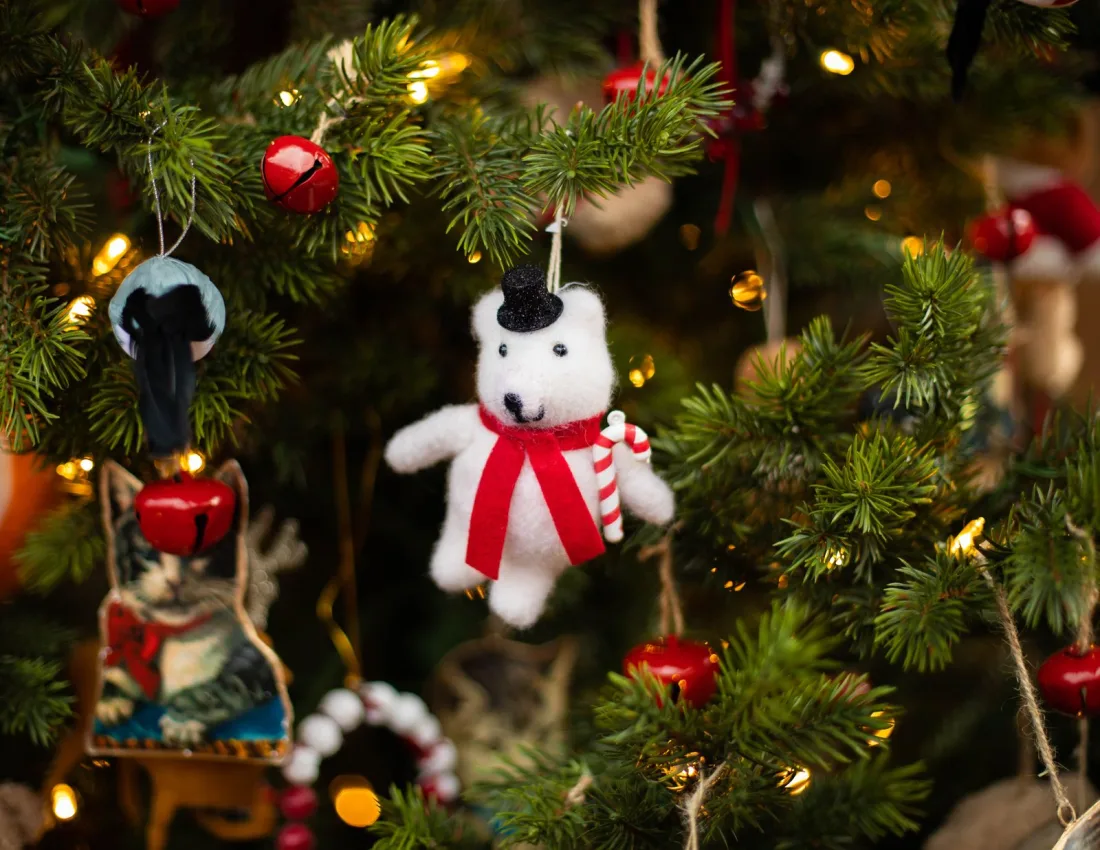
Polar bear variations: a cub, a bear in a scarf, a sleeping bear
Cub
A cub is the one time to round things off. Give it a shorter muzzle, a head about a third bigger in proportion to the body, and slightly larger ears, still set back. A cub 2 in (5 cm) long standing beside a 5 in mother takes about 3 g of wool and makes a good pair for a mantel.
Bear in a scarf or hat
A red scarf is the most common Christmas polar bear, and it does a useful job: it hides the join between neck and head. Cut it from thin felt, ¼ in wide for the ornament and ⅜ in (1 cm) for the 5 in bear, or knit a strip on 4 stitches with fingering yarn. A hat is a cone of felt or felted wool with a pompom, tacked behind one ear.
Sleeping bear
Lying flat with its chin on its front paws and its back legs stretched behind, a sleeping bear needs no wire and no balancing, so it is the easiest polar bear to make well. The eyes are two short curved lines of black wool or black floss. Pass a cord through the shoulders for a loop, or leave it to sleep on a shelf or a felted wreath.
Common problems with a felted polar bear
- It looks like a white teddy. The head is too round and the ears too big and too high. Make the ears smaller and move them back first, then lengthen the snout.
- It looks like a brown bear painted white. There is a shoulder hump or a dip in the face. Flatten the shoulders and fill the dip with a pad of wool.
- It looks like a seal or a dog. The ears are too low or the legs too thin. Raise the ears to above the eye line and thicken the legs.
- It has gone gray. Dirty hands or a used foam pad. Add a fresh thin layer of cream over the worst areas, and next time keep a separate pad for white.
- It won't stand. The paws are too small. Add wool to widen the soles and needle them flat.
Safety and where the bear goes next
Glass and safety eyes, small pompoms and bells are choking hazards for children under 3, so for a young child's ornament needle the eyes in black wool or embroider them. Needle felting needles are sharp and barbed, especially when holding a small piece like the ornament; is needle felting dangerous covers finger guards and safe habits. A polar bear goes well with snowmen, snowflakes and white felt balls; felted Christmas ornaments has loops, sets and storage, and the mantel and table pieces to go with it are in felt Christmas decorations.
Frequently asked questions
How is a polar bear different from a brown bear in needle felting?
A polar bear has no shoulder hump, so its back rises toward the hips rather than the shoulders. Its neck is long, its head is long and narrow with a slightly convex Roman-nosed profile instead of a dished one, and its ears are smaller and set further back. Its paws are wide and its legs are thick.
What color wool should I use for a needle felted polar bear?
Cream, ivory or natural undyed white, not bright bleached white. Real polar bear fur looks cream to pale yellow, and optic white wool looks like plastic and shows every mark. Shade under the chin and belly with a pale gray or gray-blue.
How much wool does a needle felted polar bear take?
A standing bear 5 in (13 cm) from nose to tail takes about 1¼ oz (35–40 g): roughly ⅞ oz (25 g) of core wool and ⅜ oz (10–12 g) of cream top wool. A 3 in (7.5 cm) ornament takes about ¼ oz (7–9 g) in all.
How do you keep white wool clean while needle felting?
Wash your hands, skip hand cream, use a foam pad or brush mat kept only for pale wool, and felt the bear before working any dark colors that day. Add the black nose and eyes last. A lint roller lifts stray dark fibers from the surface.
How do you make a flat felt polar bear ornament?
Cut two side-view bear shapes about 4 in (10 cm) long and 2½ in (6.5 cm) tall from cream wool felt, embroider a black nose and eye on the front piece, add a red felt scarf, then blanket stitch the pieces together with a loop between them over the shoulders and stuff lightly.
Topics
Image credits
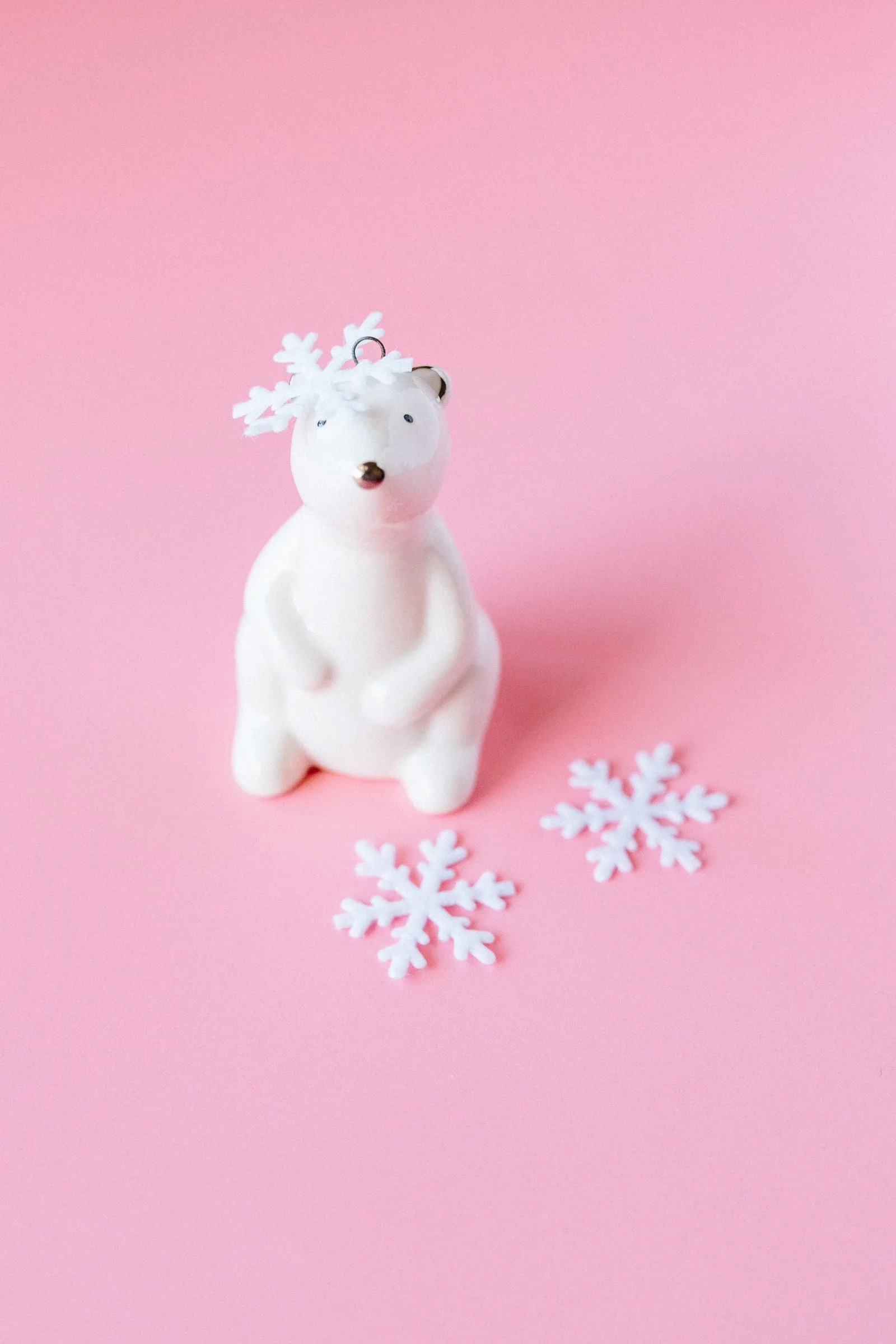
- A small white polar bear ornament sitting on a pink background beside paper snowflakes — Nataliya Vaitkevich (Pexels License)
- Polar bear figurines, a mother and cub, standing on a block of ice — 28366294 (Pixabay Content License)
- A white bear ornament with a red scarf hanging on a lit Christmas tree — Valeria Boltneva (Pexels License)