Needle Felted Snowman: Proportions, a White That Stays White, and the Ornament Version
6 min read Beginner
We may earn a commission from links on this page, at no extra cost to you. As an Amazon Associate I earn from qualifying purchases. Learn more.
How to needle felt a snowman that stands up and looks right: the size ratio between the balls, how much wool it takes, keeping white wool clean, plus a hanging ornament and a sewn sheet felt snowman.
A snowman is three balls, a nose and a scarf, so it is usually the second or third thing anyone needle felts. Where first snowmen go wrong is almost always proportion or color. Proportion: three balls of about the same size make a caterpillar standing on its end. Color, because white wool goes gray from the core wool underneath it and from the dirt on your fingers. Sort out both and the rest is easy.
Proportions that read as a snowman
Make each ball about three-quarters the diameter of the one below it. That ratio is what the eye accepts as a snowman. Push the difference too far, so the head is half the base or less, and it starts to look like a cartoon, which is fine if that is what you want.
| Finished height | Base | Middle | Head | Wool, firm |
|---|---|---|---|---|
| 2¼ in (5.5 cm), ornament, two balls | 1⅓ in (3.4 cm) | — | 1 in (2.5 cm) | about 6 g |
| 4 in (10 cm), three balls | 1¾ in (4.5 cm) | 1⅓ in (3.4 cm) | 1 in (2.5 cm) | about 17 g |
| 6 in (15 cm), three balls | 2⅔ in (6.8 cm) | 2 in (5 cm) | 1½ in (3.8 cm) | about 57 g (2 oz) |
The heights are a little less than the three diameters added up, because each ball sits slightly into the one below. The weights rise steeply with size because wool scales with volume, not height: the 6 in snowman is only half as tall again as the 4 in one, but it takes over three times the wool. All of them are firmly felted, at about 0.22 g per cubic centimeter.
A white that stays white
Build each ball's core from core wool, which is cheap and felts fast, then cover it in white merino. Core wool is often off-white or cream, and a single thin layer of white over it reads as gray once it is felted down. Lay on two or three thin layers instead, each needled in before the next, until the color is even when you hold the ball up to a window.
Pure white also shows every bit of dirt. Wash your hands before you start and again after handling colors, especially black, which sheds fibers. Keep a clean cloth over the part of the mat you are not using; foam mats hold onto dyed fibers from earlier projects and push them into whatever you felt next. A brush mat is cleaner for white work than a foam pad that has had a lot of use. See felting mats and pads.
Making the balls
- Roll core wool tightly into a ball, wrapping in different directions. It should start about half again the finished diameter, because needling compresses it.
- Needle it with a 36 or 38 gauge needle, turning the ball after every few stabs so it stays round rather than going flat on one side.
- Stop when it is firm but still gives a little under your thumb. Check the size against the table and add wool if it is small.
- Lay on the white in thin layers and needle them in with a 40 gauge needle until the surface is smooth and firm.
How to needle felt a ball covers getting them properly round. If you need a dozen snowmen for a tree, wet felt the balls in a batch instead, using how to make felt balls, and needle them together afterward: it is much faster.
Joining and standing
Balls joined round to round touch at one point and wobble. Before joining, needle a flat spot on the top of the base and on the top and bottom of the middle ball. Each flat spot should be about a third of that ball's diameter. Press the flat spots together and work around the seam with the needle slanted across it, so every stab carries fibers from one ball into the other. A wisp of white laid over the seam and needled in hides the line.
For a standing snowman, needle the underside of the base flat against the mat until it sits without rocking. On anything over about 5 in tall, push a short length of bamboo skewer down through the middle of all three balls before you join them, so the head cannot nod forward. The wool closes over the ends.
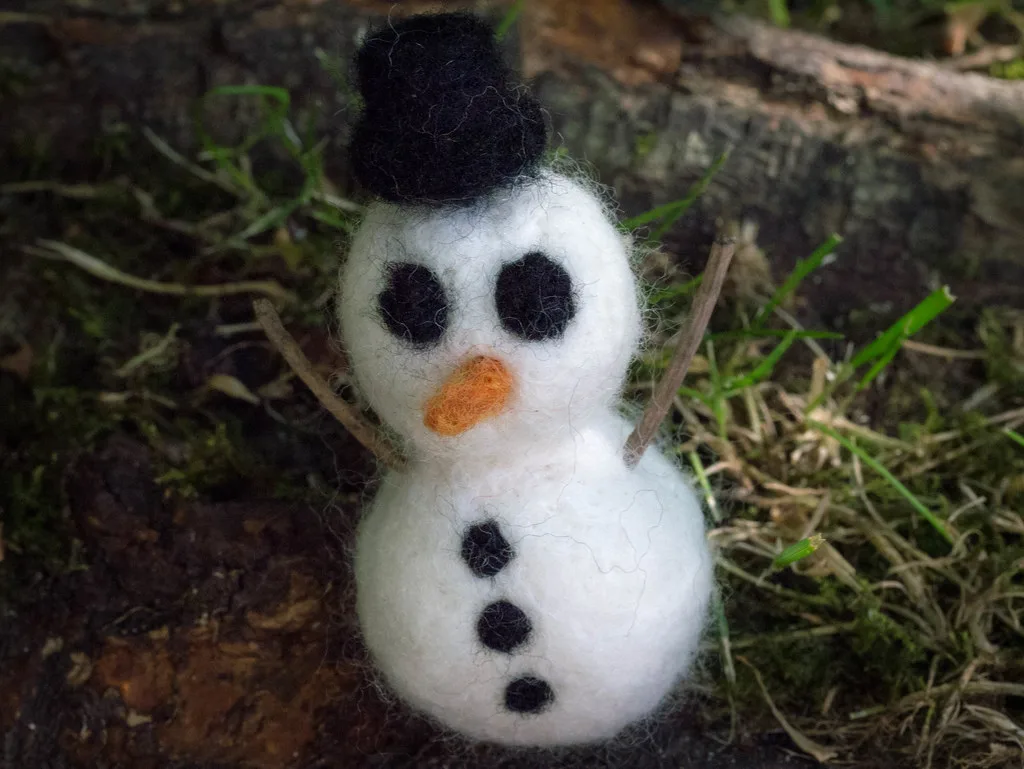
Face, hat and scarf
- Nose. Roll a small cone of orange wool, needle it firm with only the wide end left loose, then attach it by the loose end. Keep it short, about a third of the head's diameter. A long carrot reads as a beak.
- Eyes and mouth. Tiny rolled balls of black wool needled in, or a curve of separate dots for a coal mouth. For an ornament that only adults will handle, 3 to 4 mm black glass beads sewn in are crisper. Needle felting eyes compares the options. Set the eyes level with the top of the nose and a little wider apart than you expect.
- Buttons. Three black dots down the middle ball, or two on the middle and one on the base.
- Hat. A top hat is a short black cylinder with a flat disc brim. Needle felt both, or cut them from stiff black felt and glue them. A knitted hat is a tiny cone of colored wool with a white ball on top.
- Scarf. A strip of thin wool felt about ¼ in (6 mm) wide with fringed ends, wrapped once and tacked at the back. A strip of flat needle felted wool works too. Either one also hides the join between head and body.
- Arms. Real twigs pushed in at a slight upward angle, or thin rolls of brown wool needled firm.
The hanging ornament
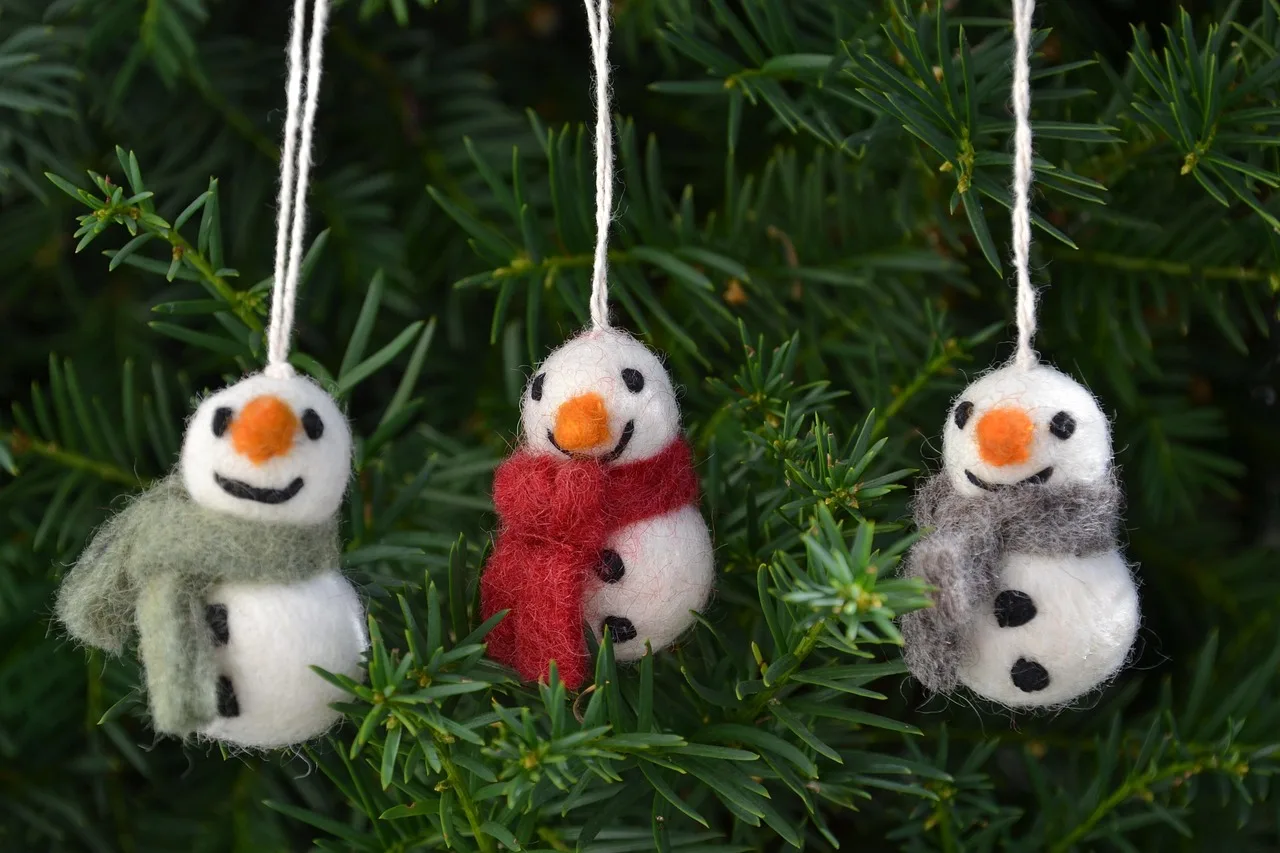
The hanging snowmen at the head of this page are the two-ball kind, which sits better on a branch than a tall three-ball figure. Make them at the ornament size in the table. To hang one, thread a long needle with strong thread or fine cord, pass it down through the top of the head and back up a few millimeters away, and knot the ends together into a loop. A loop that passes through the head cannot pull out the way a glued one does. A dozen of these in different scarf colors is a full set for a small tree.
A sewn sheet felt snowman
For children, or for a quick batch, a flat snowman ornament can be made from sheet felt with no needle felting at all.
Trace around a large and a small jar lid, overlapping the circles, to get the outline, and cut it twice from white felt. Stitch the face onto one piece while it is still flat, with dots of black thread for the coal and a felt triangle for the nose. Then sew the two pieces together face out with a running stitch a few millimeters in from the edge, pushing in a little stuffing as you go and catching a ribbon loop at the top of the head. A strip of red felt knotted around the neck finishes it.
Felt appliqué covers the stitches. For a toddler's ornament, stitch everything down and skip beads and buttons.
What else to make with them
A felted snowman works well tucked into the lower curve of a felted wreath, on a mantel with a gnome or a felted Santa, or at the foot of a felt Christmas tree. The penguin uses nearly the same body shape in black and white.
Frequently asked questions
How much wool do you need for a needle felted snowman?
About 17 g (just over half an ounce) for a 4 in (10 cm) three-ball snowman, of which only 3 to 4 g needs to be white if you build the cores from core wool. A two-ball ornament about 2¼ in tall takes about 6 g. Add a pinch each of orange, black and a scarf color.
What size should each ball of a snowman be?
Make each ball about three-quarters the diameter of the one below it. For a 4 in snowman, that is roughly 1¾ in, 1⅓ in and 1 in. Balls closer in size than that look like a caterpillar standing on end; a head much smaller than three-quarters looks like a pin.
How do you make a needle felted snowman stand up?
Needle the bottom of the base ball flat against the mat until it sits without rocking, and make sure the head and middle are centered over it. For a tall or heavy snowman, push a short length of bamboo skewer down through all three balls before joining them.
Why does my white snowman look gray?
Either the core wool is showing through a top layer that is too thin, or the white has picked up dirt from hands and the mat. Lay the white on in two or three thin layers, wash your hands before you start, and keep a clean cloth over the part of the mat you are not using.