Felting Needle Sizes: A Gauge Chart, and What Each One Is For
5 min read Beginner
A reference table of felting needle gauges from 32 to 46, what each is actually for, and why no honest chart gives you a millimetre figure.
Felting needle sizes are written as a gauge number, and the scale runs the wrong way round from every other measurement in craft: the bigger the number, the thinner the needle. A 40 is finer than a 36. That single inversion causes most of the confusion, and once it clicks, the rest of the chart is straightforward.
This page is the reference table. If you want the reasoning behind the barbs and blade shapes rather than the numbers, felting needles explained is the longer read.
The chart
| Gauge | Feel | What it is for | Mark it leaves |
|---|---|---|---|
| 32 | Very coarse | Rugs, carpet wool, heavy joins | Obvious holes |
| 36 | Coarse | Cores, bulk, the first half of any shape | Visible pitting |
| 38 | Medium — all-purpose | Shaping, most of the work, general use | Closes up as you go |
| 40 | Fine | Surface, firming, tidying stray fibre | Almost none |
| 42 | Very fine | Faces, fur direction, thin colour | None visible |
| 46 | Finest | Miniatures, single wisps of fibre | None; snaps easily |
If you take one thing from the table: coarse for inside, fine for outside. Every other decision follows from that.
36 gauge felting needles
The workhorse of the early stage. A 36 moves more fibre per stroke than anything else you will use by hand, which is exactly what you want when a handful of loose wool has to become a firm core and nothing about it looks like an object yet.
Its cost is the surface. The barbs are large enough to leave craters, and those craters do not disappear later — you cover them. So a 36 belongs under whatever anyone will look at. Pair it with cheap undyed fibre and the stage goes quickly: see core wool.
38 gauge felting needles
If the site could recommend only one gauge, this is it. A 38 builds shape at a reasonable speed and leaves marks that close up as you keep working, which means you can take a piece from loose wool to nearly finished without changing needles.
Most kits ship a 38 as their default for this reason, and most people find that two-thirds of their working time is spent on one. Beginners should start here rather than with a 36 — the slightly slower progress is repaid by not having to repair the surface. The rest of the starting kit is in felting needle kits.
38 gauge star needles
A star needle is four-sided rather than three, so it carries an extra row of barbs and moves proportionally more fibre. A 38 star behaves roughly like a fast 38: quicker through bulk, slightly less controlled, and blunter sooner because more edges are doing work.
Worth owning if you make larger pieces. Not worth owning as your only 38, because the extra bite is a nuisance on anything small.
40 gauge felting needles
The finishing gauge. A 40 firms a surface that is already dense, tucks stray fibre ends back in, and lets you add a thin layer of colour without dragging the layer underneath into it.
It is also the gauge to reach for when a piece has gone hard and a 38 has stopped biting. That is not a sign to push harder — it is a sign to go finer. Pushing harder is how needles break, which is covered in how to stop breaking felting needles.
42 gauge felting needles
Detail only. Eye sockets, the direction of fur, a whisker of colour on a cheek — work where the mark left by a 40 would still be too much. A 42 is noticeably more fragile, and it will snap if you angle it while it is buried.
You do not need one to start. You will want one the first time you try a face or an animal's coat: needle felting eyes and needle felting fur both live at this gauge.
Why there are no millimetre figures here
Because they would be made up. Felting needle gauge descends from an industrial wire scale, but manufacturers do not publish diameters for craft needles, and a "38" from one maker does not reliably match a "38" from another — the difference is small, real, and impossible to standardise from the outside.
Any chart quoting exact millimetres for every gauge is reporting one brand's numbers as if they were universal. Gauge is best used the way knitters use needle sizes in practice: as a relative scale you calibrate by feel, judging by the mark the needle leaves in your wool rather than by a specification.
Colour codes are not a standard either
Many sellers dip the crank in coloured paint so you can sort gauges at a glance, and it is a genuinely useful idea — especially in a kit, where a beginner cannot yet tell a 38 from a 40 by eye.
But the colours are chosen by each seller, not by an industry. Red does not mean 38 everywhere. Keep the packaging, or keep gauges in separate tubes, because once they are loose in a drawer the only way to tell them apart is to felt with them.
Which sizes to actually own
- Starting out: three 38s. That is genuinely enough for a first few projects.
- Once you are making shapes: add 36 for cores and 40 for surfaces — the standard working trio.
- Once you are making faces or animals: add a 42, and a reverse needle for raising fur.
- Rugs, bags or carpet wool: add a 32, and expect it to be the only gauge that copes.
Buy multiples of each rather than one of many. Needles are consumable — they blunt long before they break, and a blunt needle feels like a technique problem until you swap it.
Gauge is not the only number on the packet
Three things get confused with each other:
- Gauge — thickness. What this page is about.
- Shape — the cross-section: triangle, star, spiral, reverse, crown. It changes how much fibre moves per stroke as much as a gauge step does.
- Length — mostly comfort, and whether the needle fits a multi-needle tool. See needle felting pens.
A 38 triangle and a 38 star are not interchangeable, which is why two needles of the same stated size can feel quite different.
Matching gauge to wool
Coarse wool takes a coarse needle; fine wool does not. Merino is fine enough that a 36 tears rather than compacts it, so surface work in merino wants a 40 — see merino wool for felting. Coarser breeds and carding blends take a 36 happily and felt faster for it, which is covered in best wool for felting.
If a needle seems to be doing nothing at all, check the wool before the needle: superwash fibre has had its scales stripped and will not felt at any gauge. Why won't my wool felt goes through the rest of the causes, and needle felting for beginners covers the handling that makes any of these sizes work.
Frequently asked questions
What do felting needle sizes mean?
The number is a gauge, and it runs backwards: the higher it is, the finer the needle. A 36 is thick and fast, a 42 is fine and delicate. It describes thickness only — it says nothing about the blade shape or how many rows of barbs the needle carries.
What size felting needle should a beginner use?
A 38. It is the all-purpose gauge: fast enough to build a shape, fine enough that the holes close up. If you buy one needle, buy a 38; if you buy three, make them 36, 38 and 40.
What is a 36 gauge felting needle used for?
Bulk. Compacting loose wool into a firm core, joining large pieces, and the first stage of anything hand-sized. It works fastest of the common gauges and leaves the most visible holes, so it belongs under the surface rather than on it.
Do felting needle sizes come in millimetres?
Not usefully. Manufacturers do not publish consistent diameters, and the same stated gauge varies between makers, so a millimetre figure from one brand does not transfer to another. Treat gauge as a relative scale and judge by the mark the needle leaves.
Topics
Image credits
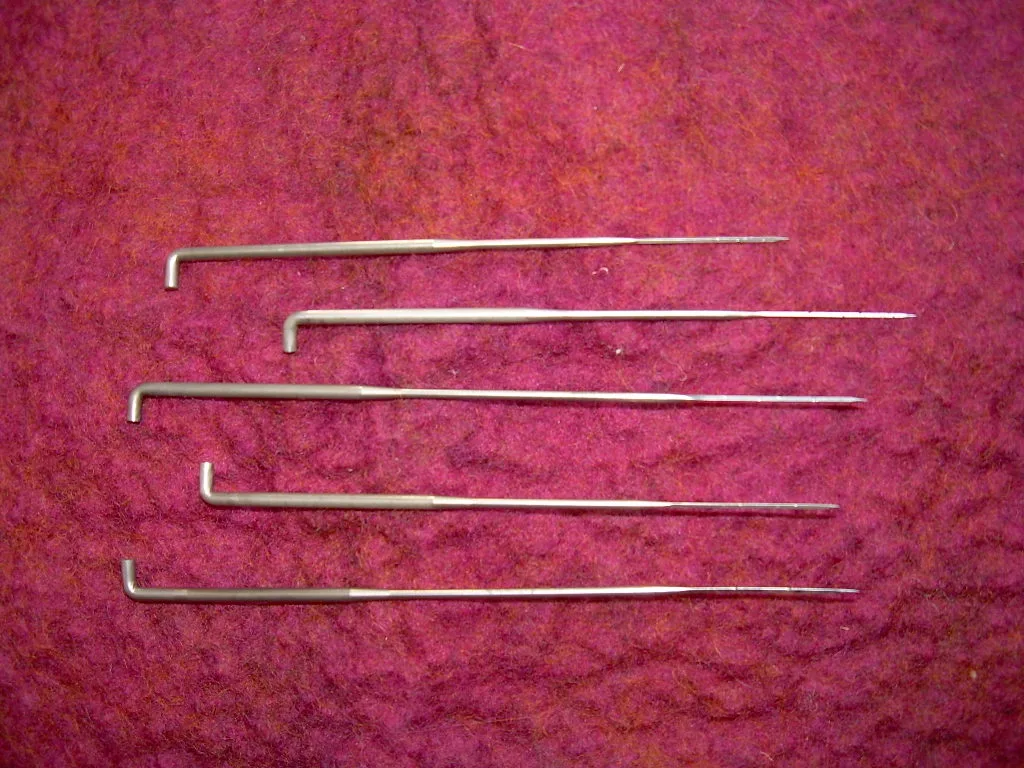
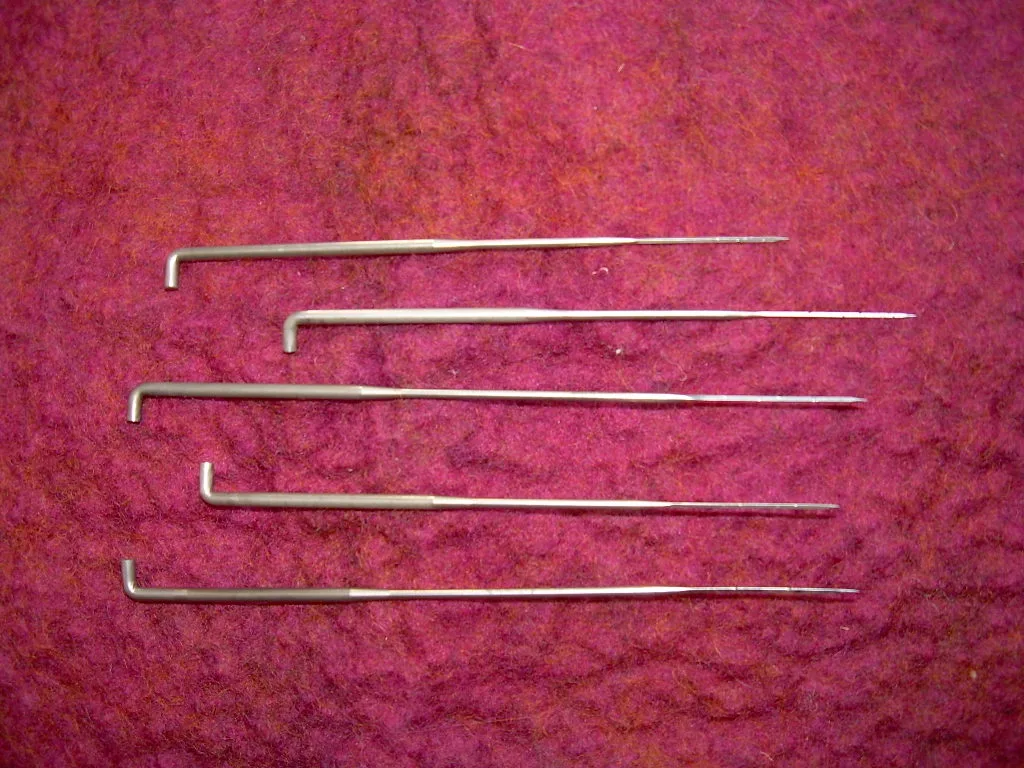
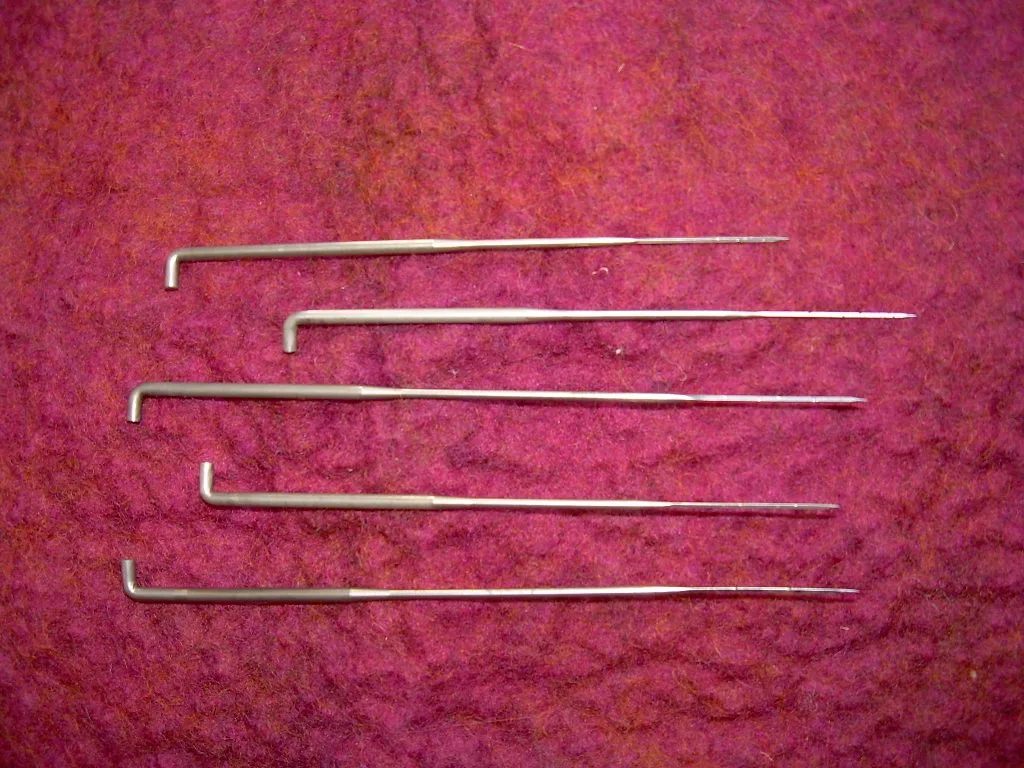
- Felting needles of several gauges laid side by side on felt — Danielle Keller (Danielle_dk) (PUBLIC DOMAIN)
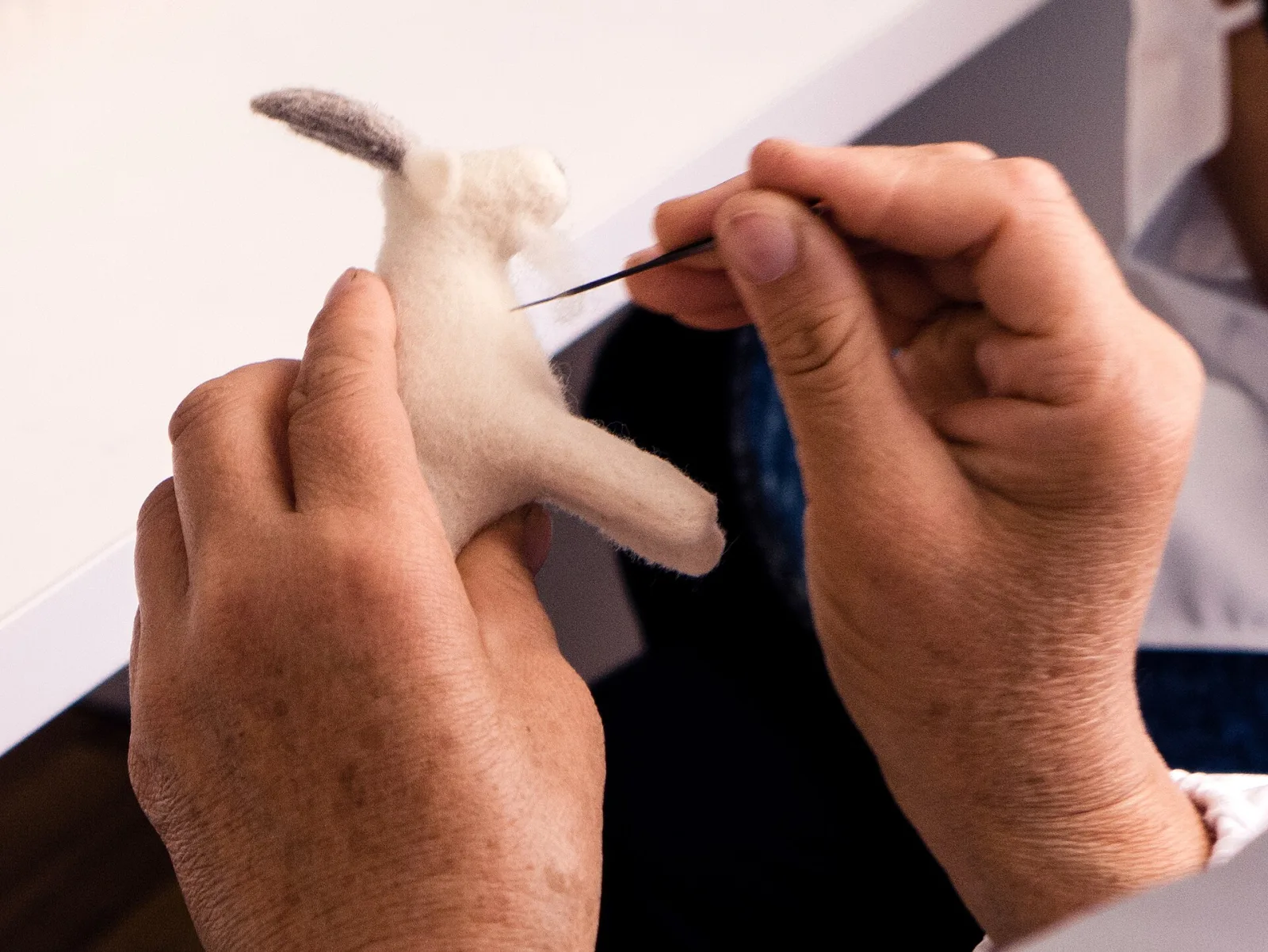
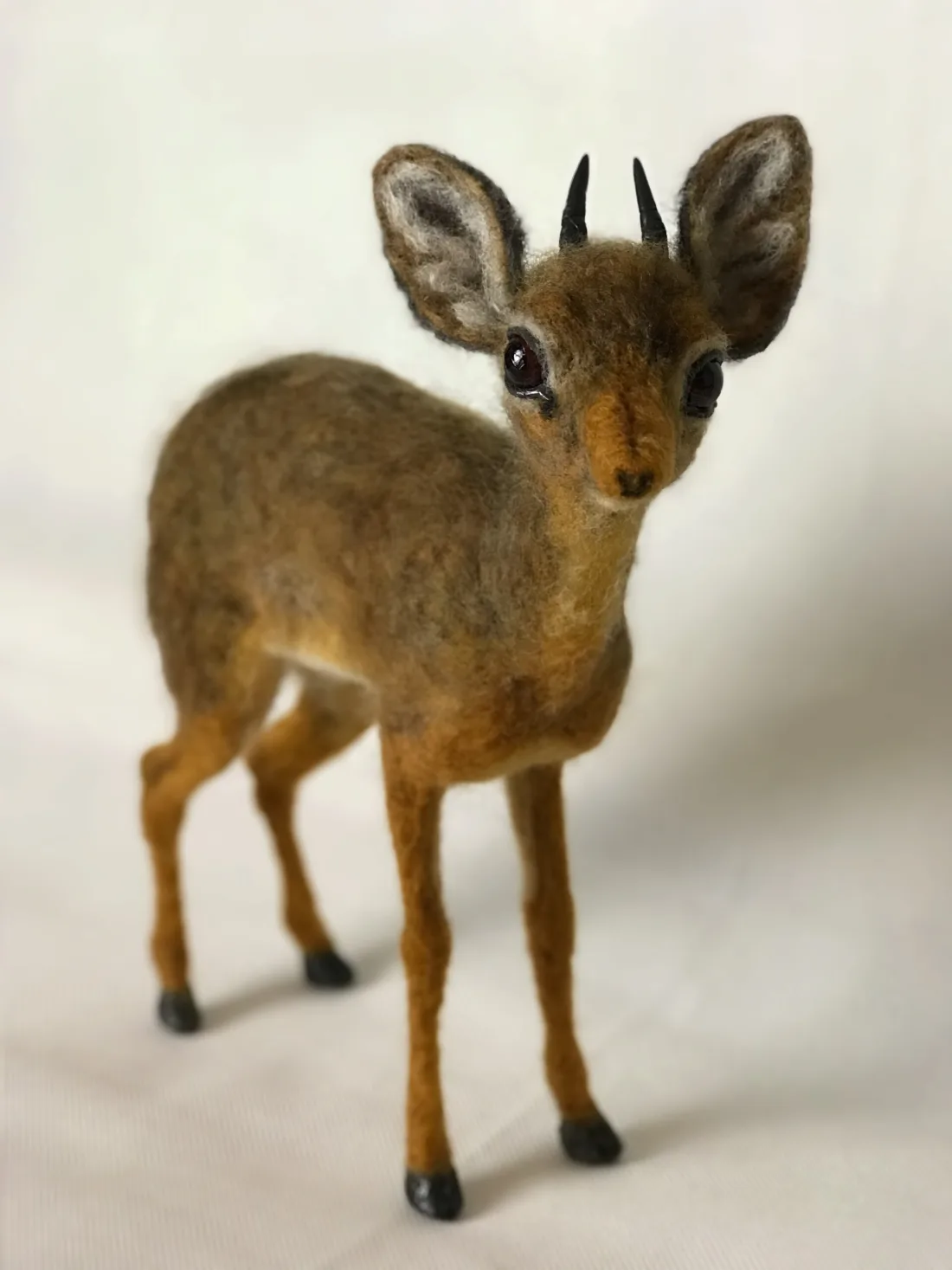
- A finely detailed needle felted antelope with a smooth surface — Smonks (BY SA 4.0)