Felt Cloche Hat: The 1920s Bell, How It Should Fit, and Choosing Wool Felt
8 min read
We may earn a commission from links on this page, at no extra cost to you. As an Amazon Associate I earn from qualifying purchases. Learn more.
Cloche is French for bell, and a felt cloche is a deep, close crown pulled down to the eyebrows, with no brim or a short one turned down. The 1920s original against today's wider-brimmed versions, how it should fit, wool against fur felt, wearing it with hair and glasses, and keeping the brim in shape.

A cloche is fitted more like a helmet than like a hat. The crown is deep and rounded, it comes down to the eyebrows at the front and low on the neck at the back, and the brim, if there is one, is short and turned down. The name is French for bell, which is exactly the shape a cloche makes when it sits on a table. It was the hat of the 1920s, and most were felt.
Shops now use the word for a much wider range of hats, many of them with a 2 in brim and a shallower crown. Knowing which you are looking at decides how it will fit and what it will do in wind and cold.
What makes a hat a cloche?
Three things: a deep, rounded crown with no crease, a close fit at the head, and a brim that is absent, very short, or turned down. The table puts the cloche next to the shapes it gets confused with.
| Classic cloche | Modern brimmed cloche | Bucket hat | Bowler | |
|---|---|---|---|---|
| Crown | Deep, rounded, uncreased | Rounded, often a little shallower | Flatter top, straighter sides | Hard, rounded dome |
| Brim | None, or under 1 in (2.5 cm), turned down | About 1½–2 in (4–5 cm), angled down | About 2–2½ in (5–6.5 cm), sloping down all round | About 1½–2 in (4–5 cm), curled up at the sides |
| Fit | Close, low on the brow | Close to medium | Loose, sits higher | Sits on the head, above the brow |
| Felt | Soft, lightly stiffened | Soft to medium | Soft, often crushable | Stiffened until rigid |
The brim widths for the modern cloche and the bucket hat are typical rather than fixed; listings vary, so measure from the base of the crown to the edge. A felt hat with a soft, wide, downturned brim is often sold under both names. If it fits close and low, it is a cloche; if it sits loosely on top of the head, it is closer to a felt bucket hat.
Where did the cloche come from?
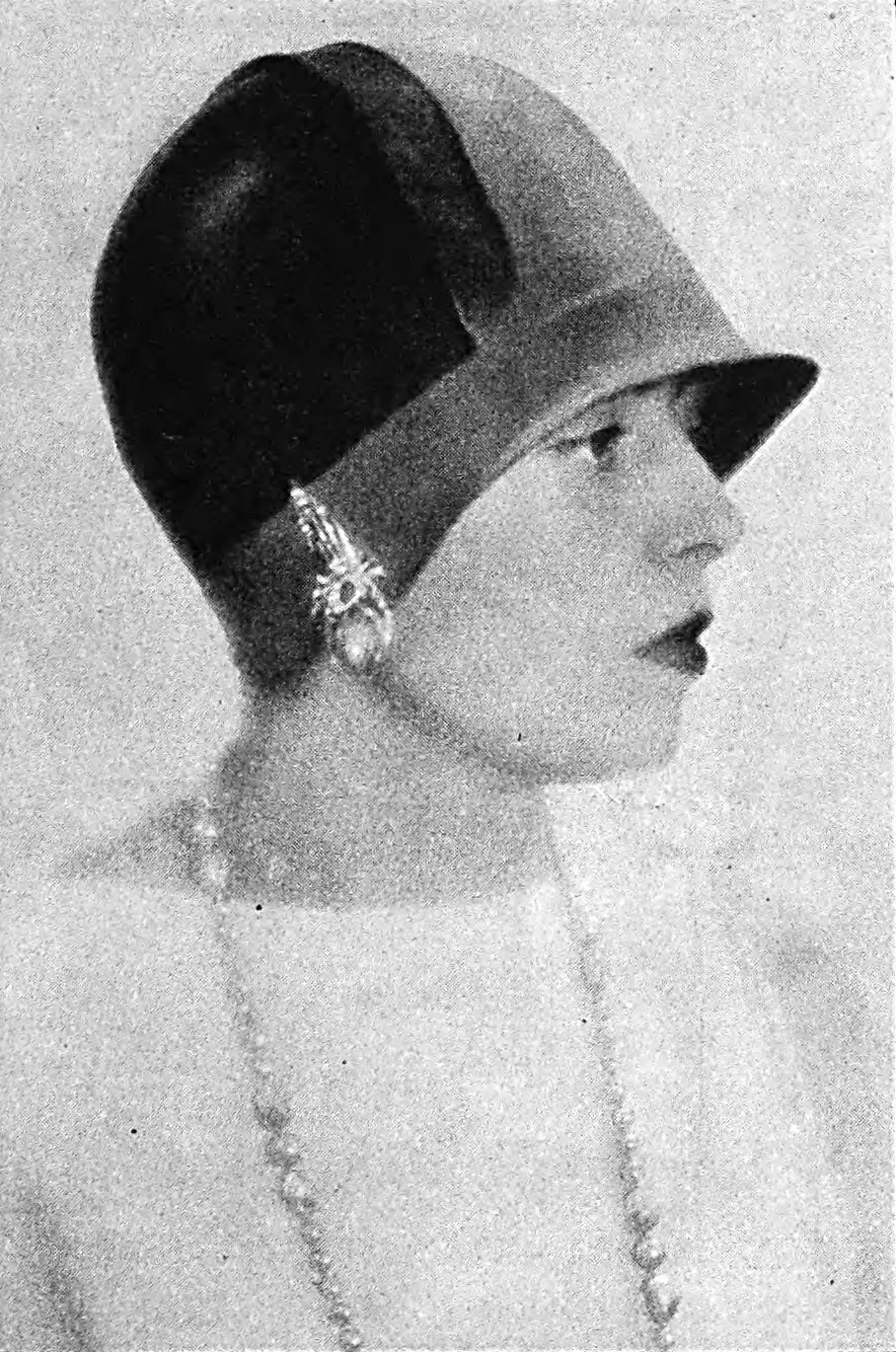
The Paris milliner Caroline Reboux is usually credited with creating the cloche, in the years before the First World War. It became the hat of the 1920s, when it matched the short, bobbed and shingled hair of the decade: a close crown pulled down to the eyebrows only works over hair that lies flat to the head. The deep crown framed the face, and the short or absent brim kept the profile narrow.
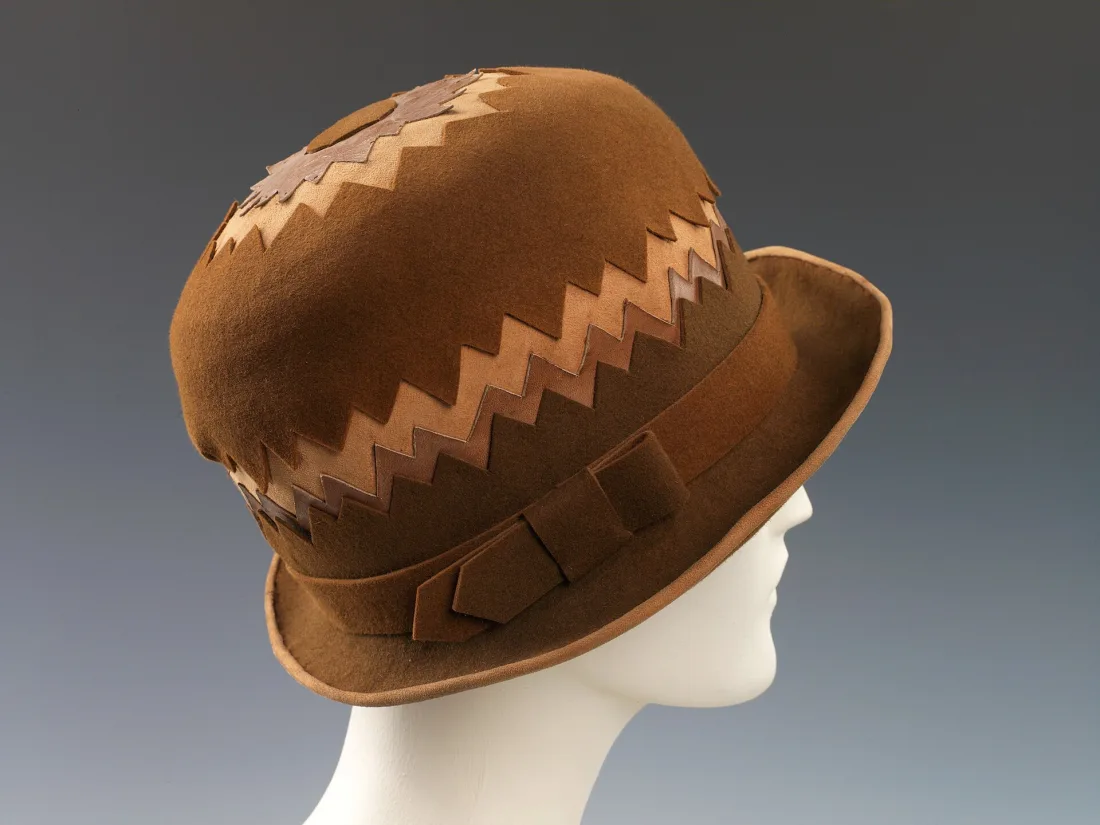
Felt was the main material, because a felt cone can be steamed and pulled over a block into a deep crown in one piece with no seams. Milliners trimmed the plain shape with grosgrain bands, bows at the side, brooches, embroidery and cut felt appliqué. Some brims were turned up sharply on one side, the asymmetric look that turns up in many late-1920s photographs.
The cloche faded around 1930, as hats moved up off the brow and brims grew again, and it has returned several times since. Today's versions are usually softer, often with a wider brim, and made to be worn with longer hair than the original ever was.
How should a cloche fit?
Closer than any other felt hat you own. A cloche should sit low on the forehead, just above the eyebrows, and low at the back of the head, and it should stay on in a wind without a hatpin. That is its practical advantage over a brimmed hat.
- Measure with your hair as you will wear it. A soft tape level across the forehead and just above the ears. Many women measure 21½ to 22½ in (55 to 57 cm); the full size table is in felt hats for women.
- Buy by the inch or centimeter figure, not S, M or L. Letter sizes vary between makers, and a cloche is unforgiving of a size out.
- Between sizes, take the larger and add a strip of foam sizing tape behind the band. A cloche that is too small rides up and perches; it cannot be stretched more than a little.
- One-size cloches usually have a drawstring or ribbon inside the band. It pulls the opening in for a smaller head, but it cannot make a shallow crown deeper.
- Check the crown depth. If the hat stops at your hairline rather than your eyebrows, it is a modern shallow version, or too small.
Wool felt or fur felt?
Wool felt, for most people. Nearly every cloche on sale is wool, and for a close, soft hat wool is a better match than it is for a wide stiff brim, because a cloche has almost no brim to droop. Wool takes strong colors well, which suits a shape that is often bought in burgundy, plum, mustard or teal rather than the browns and grays of men's hats.
Fur felt, usually rabbit, is lighter and smoother and sheds rain better. It is the choice for a cloche you will wear every day through a wet winter. Velour finishes, with a short brushed pile, look richer and show handling marks sooner. Some cheap hats sold as felt are polyester, which looks flat and slightly shiny and will not take steam; the felt hat burn test on one fiber from inside the band tells you which you have.
Knitted and crocheted hats are often sold as cloches too. They can be lovely, but they are a different object: they stretch to fit and cannot be blocked into the clean bell line a felt cloche keeps.
How to wear a cloche
Pull it down. A cloche perched on the back of the head looks like a bucket hat worn wrongly; the shape only works when the front comes down to the brow.
- Hair. Short hair and a bob are what it was designed for. Long hair is fine as long as it sits low: left down, tied back at the neck or pinned up at the nape. Volume on the crown or at the back of the head pushes the hat up off the brow.
- Glasses. A low cloche often sits on top of the frames. A narrow-brimmed or brimless cloche worn a fraction higher usually clears them; a wide downturned brim usually does not.
- Coats and collars. A classic cloche has little or no brim at the back to fight a high collar or a big scarf, which makes it one of the easiest hats to wear with winter coats.
- Wind and cold. It stays on and covers more of the head than a fedora. On a cloche with a wider brim, a hatpin through the felt and a section of hair holds it in a gale.
- Trim. A plain band and one bow or brooch at the side is the 1920s way. Felt flowers tuck under a band well and weigh nothing; see needle felted flowers to make your own.
Colors are a matter of the coats you own. The shades that sit easily with most of them are in felt hat colors.
Keeping a felt cloche in shape
The turned-down brim is the part that suffers. It flattens if the hat is stored lying on it, waves at the edge after rain, and flips up if it is pushed into a bag.
- Store it on its crown, or on a head form, never resting on the brim. Stuff the crown lightly with tissue if it goes into a box.
- Brush it after wearing with a soft hat brush, in one direction, to stop lint working into the felt.
- Reset the brim with steam. A few seconds of steam on a flattened or waved section, then curl it down with your fingers and hold it until it cools. A hat steamer or a handheld garment steamer is easier to aim than a kettle.
- Stiffen only the edge, if at all. A cloche is meant to be soft. If a wider brim keeps flopping after steaming, a thin coat of hat stiffener on the underside, near the brim edge, is enough; a stiff cloche loses the softness that makes it fit.
- After rain, blot it, push the crown and brim back into shape, and let it dry on its crown or a form at room temperature.
Stains, sweat marks and the sweatband are in how to clean a felt hat, and summer storage against moths is in protecting wool from moths.
Making a felt cloche
A cloche is one of the friendlier hats to make, because it needs no crisp brim. There are two routes:
- Blocking a felt cone. A wool felt cone has enough felt for a cloche crown and a short brim; a capeline gives room for a wider brim. Steam it, pull it down over a rounded crown block or a well-padded form, tie it off, and let it dry before trimming the brim. The cones and the blocking steps are in felt hat blanks.
- Wet felting from loose wool. Lay wool over a flat resist, felt it, take the resist out and full the hat to fit, then shape it over a bowl of the right size. The resist dimensions for a cloche, and the wool weights, are in wet felting a hat.
Either way, the finished cloche is shaped the same way a bought one is: with steam, your hands and a form to dry on. For other women's shapes, the fedora, the wide brim and the beret, see felt hats for women; for every hat name in one place, types of felt hats.
Frequently asked questions
What is a cloche hat?
A close-fitting, bell-shaped women's hat with a deep rounded crown that comes down to the eyebrows, and either no brim or a short one turned down. The name is French for bell. It was the defining hat of the 1920s and is usually made of felt.
How should a cloche hat fit?
Snugly all the way round, low on the forehead at the front, just above the eyebrows, and low at the back. It should stay on in wind without a hatpin. If it perches on top of the head, it is too small or your hair is too full underneath; if it drops over your eyes, it is too big.
Can you wear a cloche with long hair?
Yes, worn loose below the hat, in a low ponytail or in a low bun at the nape. A cloche fits close, so anything piled on the top or back of the head pushes it up. Measure your head with your hair the way you will wear it under the hat.
Is a wool felt cloche warm?
Warmer than most brimmed felt hats, because it comes down low at the back and sides and covers more of the head. Wool felt also blocks wind well. For deep cold a lined knit hat is warmer, but a cloche is one of the warmer felt shapes.
What is the difference between a cloche and a bucket hat?
A cloche is a fitted women's hat with a deep rounded crown and a short brim, or none, worn low on the brow. A bucket hat has a flatter top, straighter sides and a wider brim sloping down all round, and fits more loosely. Soft brimmed cloches and felt bucket hats can look alike.
Topics
Image credits
- A woman with long dark red hair holding the short downturned brim of a burgundy felt cloche-style hat with a black ribbon band and bow — Greece-China News (Pexels License)
- Black and white 1927 portrait of a young woman in profile wearing a close-fitting cloche pulled low over her forehead, with the brim turned up at one side, a jeweled clip and a long necklace — Unknown photographer (PUBLIC DOMAIN)
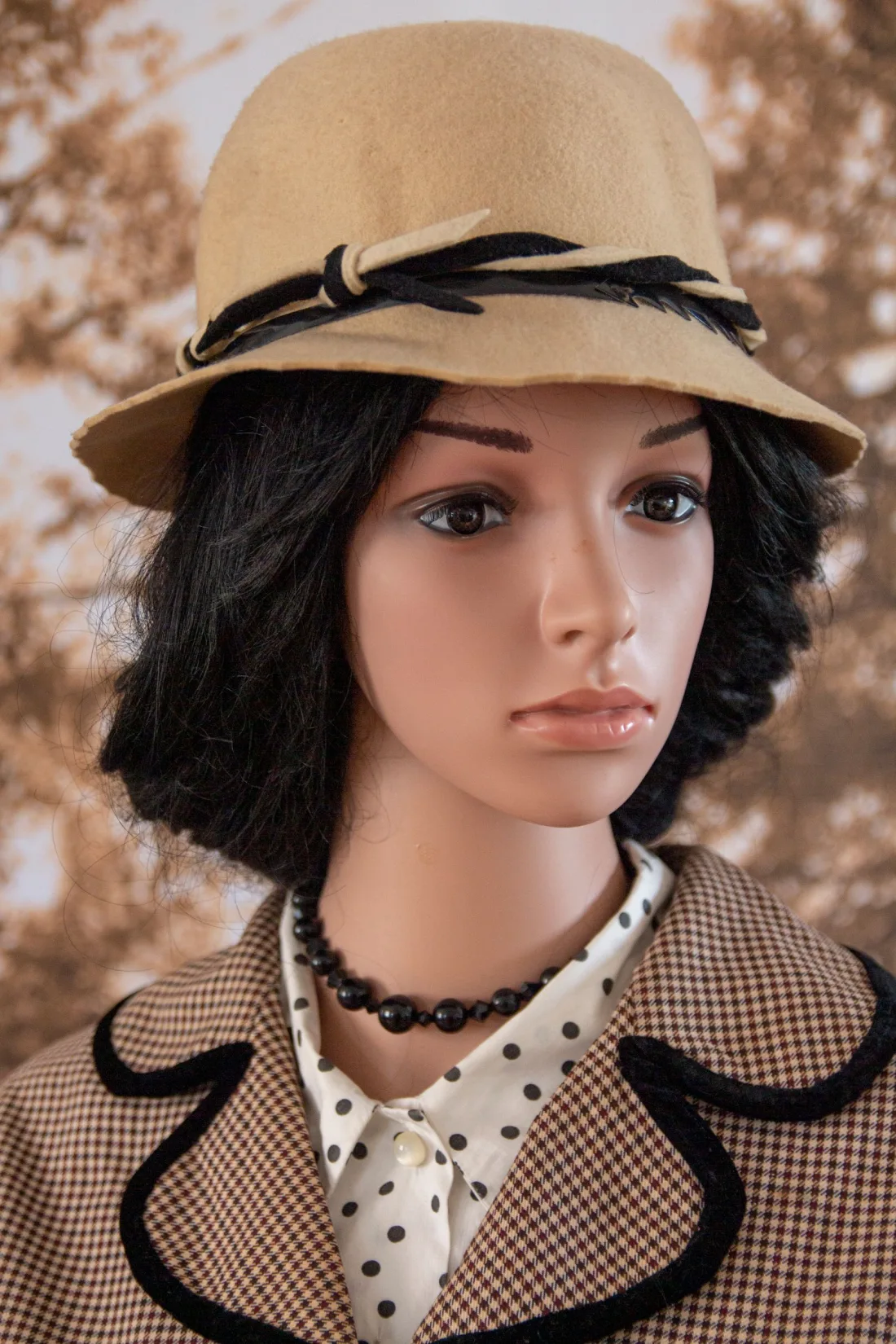
- A mannequin with a short black wig wearing a camel felt cloche-style hat with a narrow downturned brim and a knotted black band, with a houndstooth jacket and polka-dot blouse — Paul Seling (Pexels License)