Acid Dyes for Wool: The Chemistry, the Numbers and the One Rule
10 min read Intermediate
We may earn a commission from links on this page, at no extra cost to you. As an Amazon Associate I earn from qualifying purchases. Learn more.
Wool takes acid dye because it is protein and cotton is not. The acid, the temperature and the timing all exist to make that bond happen evenly — and to stop the pot felting your fibre while it does.
A wool fibre is a long chain of protein, and spaced along that chain are amino groups that take on a positive charge in warm, mildly acid water. An acid dye molecule carries a negative charge. Bring the two together at 85 °C and they bond to each other directly, ion to ion — the colour becomes part of the fibre rather than a film sitting on it.
Cotton is cellulose. There are no amino groups anywhere on it, so an acid dye has nothing to hold and rinses back out as fast as it went in, leaving a dirty grey cast. The same goes for linen, viscose, acrylic and polyester. Nylon is the one surprise: it has amine groups at the ends of its chains, which is why the nylon in a sock yarn comes out coloured alongside the wool, a shade or two off.
Everything below follows from that one reaction: the acid, the slow heat and the long hold exist to make it happen evenly.
Which dyes are acid dyes
- Levelling acid dyes — Jacquard Acid, Ashford, Kiton. The forgiving class: the dye keeps migrating while the bath is hot, so a patchy start evens itself out. Start here.
- Premetallised dyes — Lanaset, Sabraset. A metal atom built into the molecule gives the best wash and light fastness available for wool, but they strike hard and level poorly, so uneven loading shows.
- Food colouring and unsweetened drink powders — genuinely acid dyes, not an approximation of them. Weak, a short palette, entirely food-safe, and the right choice for a kitchen table or a child. The method is on dyeing wool with food colouring.
- All-purpose supermarket dyes such as Rit — half acid dye, half cotton dye. The cotton half does nothing on wool and rinses out, so you pay for twice the powder to get a paler, less washfast result. They work with a splash of vinegar at the same heat; a true acid dye simply does it better.
The acid, and how much
The acid does not colour anything. It lowers the pH so the fibre carries the charge the dye needs, and without it the dye simply sits in the water.
- White vinegar at roughly 60 ml per litre of bath. Cheap, in every cupboard, and it scents the kitchen like a chip shop.
- Citric acid at 5 to 10 g per 100 g of dry fibre. Odourless, measurable on scales, and a 500 g tub replaces a crate of vinegar bottles.
The two are measured against different things, which trips people up: the vinegar figure is per litre of water in the pot, the citric acid figure is per 100 g of dry fibre. Neither is a substitute for a pH strip, because how much water you used and how hard it is both move the result.
Aim for pH 4 to 4.5, checked with paper strips that cost a few pounds for a hundred. Below pH 3.5 the dye strikes so fast it lands unevenly; above 5 the bath never exhausts.
Depth of shade is a percentage, not a spoonful
Weigh the fibre dry and take the dye as a percentage of that weight. Two grams behaves completely differently on 100 g of wool than on 500 g, and how much water is in the pot barely affects the final shade at all.
- 0.25 to 0.5% — pastels and tints.
- 1% — a solid mid shade. This is the useful default.
- 2% — strong, saturated colour.
- 4% — about as deep as wool goes. Black often wants 6 to 8% and still lands as a very dark charcoal or brown.
Past roughly 4 to 5% the fibre is saturated. Extra dye stays in the water, refuses to exhaust, and some dries onto the surface where it rubs off later.
Weighing 0.5 g of powder accurately is hard, so make a stock solution: 1 g of dye in 100 ml of near-boiling water is a 1% solution, and 50 ml of that is 0.5 g. Measure with a syringe. It keeps a couple of weeks in a labelled jar in the dark.
Temperature and time
- Wet the fibre right through. Thirty minutes in cool water with a drop of wool wash. A dry lock sheds water for far longer than seems possible, and any part that stays dry stays pale.
- Dissolve the dye in a jug of hot water, away from the pot. Never shake powder over a bath with fibre in it — undissolved specks fix as permanent freckles.
- Fill the pot with enough water that the fibre floats freely, stir the dye solution through it, then lower the wool in with both hands supporting it and spread it out once, gently, while the bath is still cool.
- Add the acid now for a levelling dye. For an even colour on merino, hold it back for the first 15 minutes at temperature instead, because the dye lands wherever the acid is.
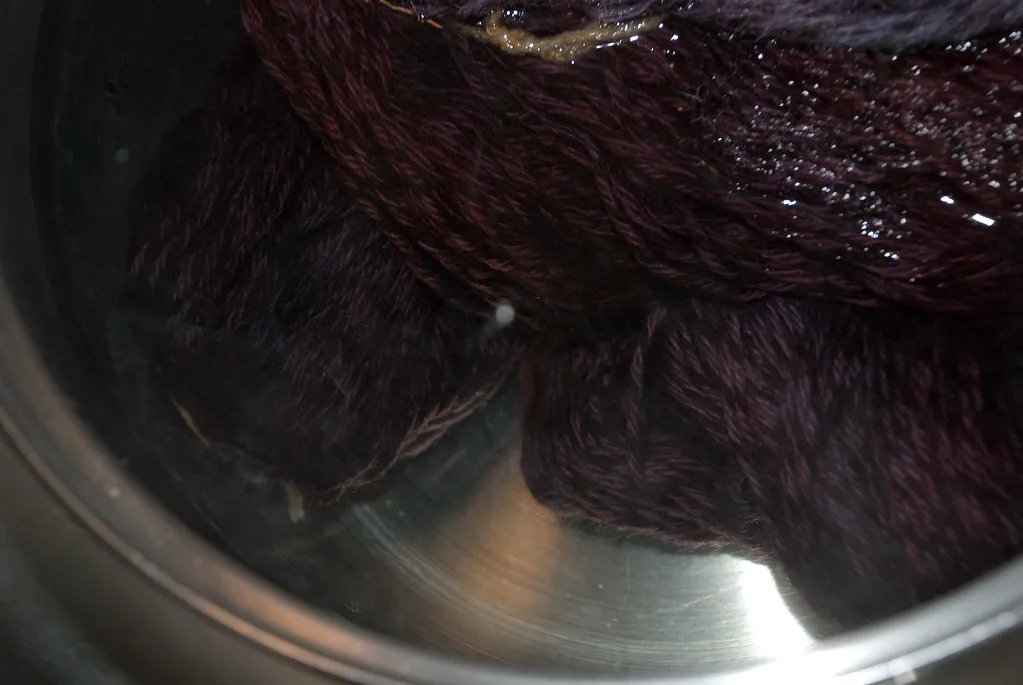
- Raise the heat over 30 minutes to 185 °F (85 °C), about three or four degrees Fahrenheit a minute. A probe thermometer removes the guesswork: at that temperature you get fine bubbles at the base and no rolling movement.
- Hold for 30 to 45 minutes. Never boil — it gives wool a harsh, squeaky handle and drives dye onto the outside of the mass before the middle has had any.
- Turn the heat off and walk away. Cooling in the pot takes hours; overnight is better than hurrying it.
The one rule: nothing moves while it is hot
Every wool fibre is covered in overlapping scales. Heat lifts them, and once lifted, any movement between neighbouring fibres lets them ratchet past one another and lock. That is not a risk of dyeing — it is the whole of wet felting, happening in your dye pot, and it cannot be undone.
Three things trigger it, and a dye pot offers all three:
- Stirring. The instinct to even out the colour with a spoon is exactly wrong. Evenness comes from the acid and the ramp, never from the spoon.
- A jump in temperature. Lifting fibre from a 185 °F bath into a cold sink contracts it hard and fast.
- Pressure while hot. Squeezing, wringing, or pressing a hot mass against the side of the pot.
So: lower it in, leave it alone, cool it in the pot, rinse at the temperature the wool has reached. Loose tops are the most vulnerable thing you can dye, since no twist holds the fibres in any relationship to each other, and half-felted top never drafts smoothly again — it pulls off in chunks instead of sliding. Skeined yarn is far more forgiving, because ply and twist hold each strand together whatever the bath does.
Superwash is the exception in both directions: the scales are stripped or resin-coated, so it takes dye more evenly and deeply than anything else and will not felt whatever you do to it. Check the band before you spend an afternoon on fibre you meant to felt — see why wool will not felt, and wool shrinkage when felting for what the scales are doing.
Exhausting the bath
A finished bath is clear water with vinegar in it, and that is what separates a colour which survives washing from one that bleeds into everything. Judging it through a potful of coloured liquid is unreliable, so lift a spoonful into a white cup and look at it against daylight: clear or faintly hazy is done, visibly tinted is not.
Still coloured after 45 minutes at 185 °F? In order of likelihood:
- Not enough acid. Add half as much again and hold another 15 minutes. This is the cause four times out of five.
- Too much dye for the fibre. Past saturation there is nowhere for it to go. Slide more wool in and dye a second, paler batch rather than tipping the pot away.
- The bath never got hot enough. Below about 160 °F (70 °C) the reaction is slow and incomplete, whatever the pH.
Roving, yarn and finished pieces
- Combed tops and loose fibre. The highest risk, and the best case for hand painting or steaming rather than immersion, since the fibre never moves. Method on dyeing wool roving; what to do next on blending wool colours and carding wool by hand.
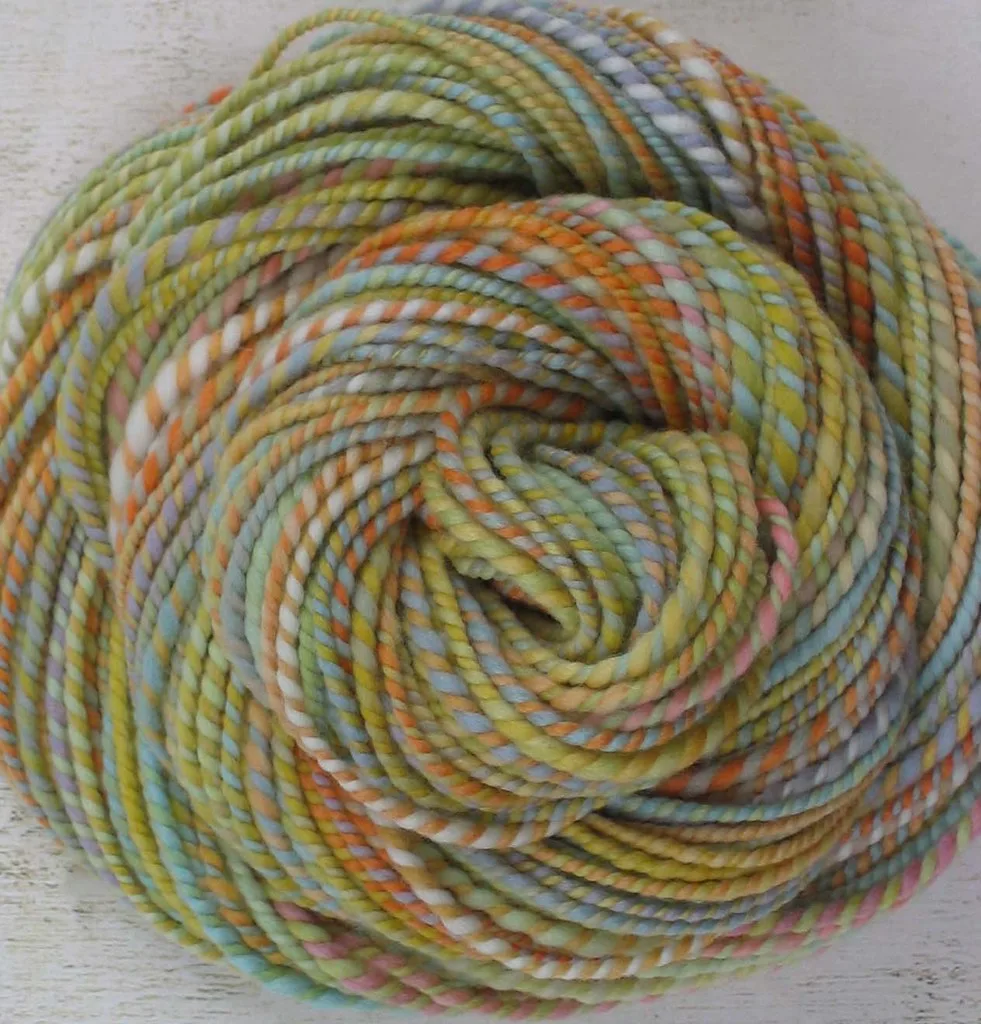
- Yarn. Tie the skein loosely in three or four places with smooth cotton thread, figure-of-eight so the strands cannot slide. Cotton takes no acid dye, so the ties stay white; tie them tight and you get pale bands, which is how a deliberate resist is made. A skein survives a spin-only cycle — spinning alone is not agitation.
- Knitted, crocheted and finished pieces. The limit is pot size: anything folded against itself dyes as a pale crease. See dyeing a wool sweater.
- Raw fleece. Scour it first. Dye will not travel through lanolin, and greasy tips come out patchy.
- Alpaca and mohair are protein too and take acid dye happily, though alpaca reads darker than the same dye on wool — see alpaca felting.
Black, and other deep shades
Black is the colour people most often get wrong, because it needs far more dye than intuition says: 4 to 6% of the fibre's dry weight against 1 to 2% for a mid shade. Too little gives charcoal or a greenish navy. Hold the full temperature for the whole 45 minutes, and expect the bath not to clear completely; a little leftover colour is normal at that depth. A pre-mixed jet black gives a truer result than blending your own from three primaries.
Silk, nylon, cashmere and alpaca
- Silk takes the same dyes and the same acid, but hold it lower, around 175 °F, because high heat dulls its lustre.
- Nylon dyes brilliantly with acid dyes, which is why sock yarn with 20 to 25% nylon still takes an even colour.
- Cashmere and alpaca are protein fibres and dye exactly like wool, but they felt and lose their hand faster, so be even gentler with handling and never shock them between hot and cold.
- Superwash wool takes acid dye faster and brighter than untreated wool, so it strikes unevenly if the heat rises too quickly. Raise it more slowly still.
For a garment rather than loose fibre, the extra problem is keeping it the size it was; see dyeing a wool sweater. For plant-based colour, see natural dyes for wool.
Safety, briefly and seriously
Buy one pot and never cook in it again. Stainless steel or enamel; aluminium and cast iron shift the colour of their own accord, which is useful in natural dyeing and a nuisance here.
The powder is the only genuinely hazardous stage. Dye particles are fine enough to breathe and hang in the air for minutes: wear a P2 or N95 mask while weighing, work in a still corner with no draught, and wipe the surface down afterwards. Once dissolved, the risk is largely gone. Gloves throughout, ventilation while the pot is hot, and if children are involved use food colouring instead. An exhausted bath goes down the drain; a dark one should be used again on more fibre.
Rinsing and drying
Rinse at the temperature the wool has cooled to, first with a drop of wool wash and then in plain water until it runs clean. Roll the fibre in a towel and press — never wring. Dry flat, out of direct sun, since ultraviolet fades even a well-bonded dye over a season in a south window. Hang skeins unweighted: a weight on a wet skein stretches the yarn for good.
A sensible first pot
Fifty grams of one colour at 1%, in a charity-shop stockpot, with a thermometer and a bag of citric acid. That pot teaches the ramp, the hold and the clear-water endpoint, and all three transfer unchanged to every colour and fibre afterwards. Three primaries and a black mix any shade you are likely to want.
Repeatability is the real reward. Write down the fibre weight, the percentage, the acid and the hold time, and you can make that colour again in a year — which is more than can be said for most of what goes on in a felting cupboard.
Frequently asked questions
What is an acid dye and what will it dye?
A dye that bonds ionically to protein fibres in warm, mildly acid water: wool, alpaca, mohair, silk and, because of its amine end groups, nylon. It does nothing lasting on cotton, linen, viscose, acrylic or polyester — those need a different dye class entirely.
Vinegar or citric acid, and how much?
Either works. White vinegar at about 60 ml per litre of water is the kitchen option; citric acid at 5 to 10 g per 100 g of dry fibre is more precise, does not smell and stores in a small tub. You are aiming for pH 4 to 4.5, which cheap paper strips will confirm.
How much acid dye do you need per 100 g of wool?
Dye is measured as a percentage of the dry fibre weight: about 0.5 g per 100 g for a pastel, 1 g for a mid shade, 2 g for a strong one. Above roughly 4 to 5 g per 100 g wool cannot absorb any more, and the surplus stays in the water.
How do you know when a dye bath is exhausted?
Lift a spoonful of the liquid into a white cup and look at it in daylight. Clear or faintly hazy means the dye is on the fibre; still tinted after 45 minutes at temperature usually means not enough acid, so add more and hold another 15 minutes.