Felt Tree Topper: A Stuffed Star, an Angel or a Needle Felted Star That Stays Upright
10 min read Intermediate
We may earn a commission from links on this page, at no extra cost to you. As an Amazon Associate I earn from qualifying purchases. Learn more.
How to size, build and mount a felt tree topper: a two-layer or five-panel stuffed star, a felt angel on a cone, or a needle felted star, with the sleeve that fits over the top shoot and the stiffening that stops it drooping.
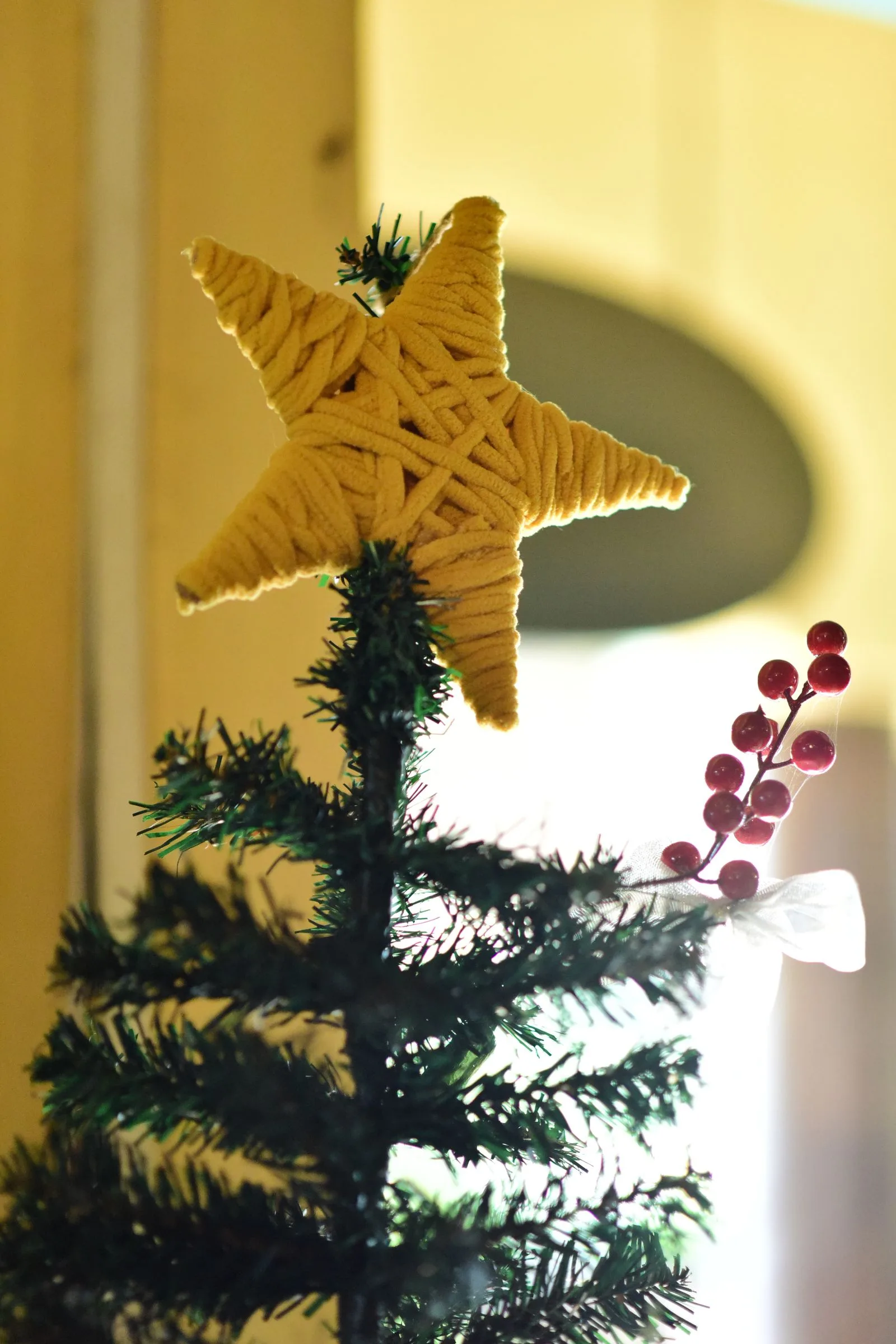
A felt tree topper has to weigh almost nothing and grip a shoot that is often thinner than a pencil, 7 ft off the floor. What keeps it there is a tube inside it, sized to the top of your tree, and enough stiffness in the points that they don't fold down before New Year.
Below are the sizes, the star geometry, three ways to build one (a stuffed two-layer star, a puffy five-panel star, and an angel on a cone), a needle felted alternative, and the mounting details that keep any of them straight.
How big should a felt tree topper be?
About one ninth of the tree height, measured from the top point of the star to the line between its two lower points, or from the angel's head to her hem. Then check the weight: the top shoot of an artificial tree is a bendy wire stem, and a real tree's leader is the softest growth on it.
| Tree height | Topper height | Keep it under | Sleeve (inside diameter × length) |
|---|---|---|---|
| 18–24 in (45–60 cm) tabletop | 2½–3 in (6–8 cm) | ½ oz (15 g) | ½ in × 2 in (13 mm × 5 cm) |
| 4 ft (1.2 m) | 5–6 in (13–15 cm) | 1 oz (28 g) | ¾ in × 2½ in (19 mm × 6 cm) |
| 6–7 ft (1.8–2.1 m) | 8–10 in (20–25 cm) | 3 oz (85 g) | 1 in × 3 in (25 mm × 7.5 cm) |
| 9 ft (2.7 m) | 11–13 in (28–33 cm) | 5 oz (140 g) | 1¼ in × 4 in (32 mm × 10 cm) |
The sleeve sizes are starting points. Measure your own tree before you cut anything: wrap a strip of paper around the top shoot 2 in (5 cm) below its tip, mark where it overlaps, and divide that length by 3.14 for the diameter. Add about ¼ in (6 mm) so the sleeve slides over the twigs and needles around the shoot.
A 9 in stuffed star in 2 mm wool felt weighs about 1 oz (28 g) with its sleeve. What pushes a topper over the limit is everything else: a wire frame in heavy gauge, a thick plastic tube, or a row of glass beads around the edge.
How do you draw an even five-point star?
Construct it on paper with a compass and a protractor. A heart gets two matching halves from one fold, but a five-point star drawn by eye always has one point that is off, and on a topper the eye catches it at once, because the star sits alone at the top of the tree.
- Draw the outer circle. Its radius is the distance from the star's center to a tip. For a 9 in (23 cm) topper, use a radius of 5 in (12.7 cm). The finished height is about 1.8 times the radius, not the full diameter, because the lower points sit above the bottom of the circle.
- Mark five tips 72° apart, starting straight up at the top.
- Draw the inner circle on the same center. Its radius sets how fat the points are: 0.38 of the outer radius gives the classic sharp star, made of five straight lines. For a stuffed star use 0.5, so each point is wide enough to push fiberfill into. On the 5 in radius that is a 2½ in (6.4 cm) inner radius.
- Mark five valleys on the inner circle, halfway between the tips, at 36°, 108° and so on.
- Join tip to valley to tip with a ruler all the way around, and cut the paper star out.
Check it by folding the paper through each tip in turn. Every fold should line up the two halves. The compass-only version, which works for small ornaments, is in the star section of felt Christmas ornaments.

Which felt and stiffener should you use?
Use 2 mm wool or wool-blend felt for the outside, in gold, cream, white or red. Thin 1 mm acrylic craft felt makes a limp star that stretches where the stuffing pushes on it. Wool felt fabric compares wool, blends and acrylic. Then pick a stiffener for the points:
| Stiffener | How it goes in | Best for |
|---|---|---|
| Stiff felt | Use it as the outer layer, or cut a second star ⅛ in (3 mm) smaller and slip it inside | Flat or lightly stuffed stars up to 8 in |
| Heavyweight fusible interfacing | Iron onto the back of each wool felt piece before sewing | Keeping soft wool felt crisp without adding thickness |
| Buckram | A star cut ¼ in (6 mm) smaller, sandwiched in the middle of the stuffing | Large stars, 10 in and over, and angel wings |
| Wire edge | 18 gauge wire bent to the star outline and caught inside the edge stitch | Points that must stay sharp; you can reshape it each year |
Two of these together is normally enough: fusible interfacing on the felt and a wire edge, or stiff felt and a buckram core. Iron interfacing onto wool felt with a press cloth on the wool setting; on acrylic felt use the lowest setting, because acrylic melts.
How do you make a stuffed two-layer felt star?
This is the quickest topper: two stars, a sleeve, and a light stuffing. It takes about two hours for a 9 in star.
- Cut two stars from your paper template, with no seam allowance, and stiffen them if you are using interfacing.
- Make the sleeve. Roll a piece of thin card around a marker or dowel that matches your measured diameter, glue the overlap and let it dry, or cut a length of plastic tube. Wrap it in a strip of felt so it doesn't rustle or show through.
- Place the sleeve. Lay it on the back star along the vertical center line, entering through the valley between the two lower points and running up to at least the middle of the star. Tack the felt wrap to the back star with a few stitches.
- Edge stitch the two stars together, starting at one lower point and going around over the top, with blanket stitch about ⅛ in (3 mm) deep and ⅛ in apart. Take one stitch straight through each tip so it stays sharp. Gold metallic thread suits a star; felt applique covers the edge stitches.
- Stuff the points first with small tufts pushed in on a chopstick, then the middle around the sleeve. Stop at about ¾ in (2 cm) thick in the center. A fat star is no stronger, only heavier.
- Close the bottom valley tight around the sleeve, and stitch through the felt wrap to lock the sleeve in place.
For a wire edge, bend the wire around the paper template before step 4, twist the two ends together at a lower valley, and lay it between the layers just inside the edge, so each blanket stitch passes over it.
How do you make a puffy five-panel star?
A puffy star rises to a ridge at the center instead of lying flat. Each face is made of five kite-shaped panels, one per point, whip stitched together along the lines from the center to each valley.
- The panel: draw a kite with its long point at the star tip, its short point at the center, and its two side corners at the valleys. On a flat star the angle at the center is 72°. Draw it at 60° instead, keeping the same tip and valley distances. Five 60° panels add up to 300°, not 360°, so when you join them the face lifts into a low pyramid.
- Cutting: ten panels from 2 mm felt, five per face, with no seam allowance. Number them in pencil on the back.
- Joining: whip stitch the panels edge to edge on the outside with matching thread. Felt doesn't fray, so the seams can show as ridges and nothing has to be turned through a tiny opening.
- Assembly: sew the two faces together around the outer edge, with the sleeve in the bottom valley, and stuff as for the two-layer star.
Allow about four hours. The result looks like a carved star from a distance, and the ridges catch light from the tree. A small amount of easing is normal where the outer edges meet; pin from the tips inward.
How do you make a felt angel tree topper?

Build her on a hollow cone, so the cone itself slides over the shoot. A 7 in (18 cm) angel with a 4 in (10 cm) hem suits a 5–6 ft tree.
- Draw the cone. The slant length is the square root of height² plus hem radius². For a 6 in (15 cm) body and a 2 in hem radius, that is about 6⅓ in (16 cm). Draw a circle of that radius and cut out a wedge of 114°, which is 360 × 2 ÷ 6⅓. Snip ½ in off the point so the shoot can pass through toward the head.
- Cut it twice, once from card and once from felt with ¼ in (6 mm) added along one straight edge for an overlap. Glue the card into a cone, then wrap the felt around it and slip stitch the overlap at the back.
- Dress the cone with a second felt layer for the gown, a wavy hem, or a band of trim.
- Add the head, a 1½ in (4 cm) felt ball or a stuffed felt circle gathered into a ball, sewn over the top of the cone. Leave the inside of the cone clear.
- Add the wings last, cut from stiff felt or from wool felt with buckram between two layers, about 3 in (7.5 cm) tip to tip each side, and stitch them to the back of the cone at shoulder height.
Don't hang the arms or the hair out past the hem; a topper is seen from below, and anything that sticks out reads as a shadow. A needle felted angel can be built the same way over a removable paper cone, as in needle felted angel. A tall pointed hat works on the same cone principle, which is how a felted gnome becomes a topper.
Can you make a needle felted tree topper?
Yes, but stay at 6–8 in (15–20 cm) and save it for a tree of 6 ft or more. Solid needle felted wool is far heavier than a stuffed star: at about 0.3 g/cm³, a 6 in star that is 1 in thick in the middle and thinner at the points weighs about 1–1½ oz (30–45 g), already over the limit for a 4 ft tree, and an 8 in star comes close to 3 oz. Build it with core wool inside and a gold or white top layer.
- Wire the points. Bend 20 gauge wire into the star outline, with the ends twisted at a valley, and felt the wool over it. The bending and wrapping are covered in wire armature for needle felting.
- Never felt into the sleeve. A needle that hits card or plastic snaps. Instead, coil 18 gauge wire around a marker or dowel that matches your measured sleeve diameter into a spiral 3 in long, flatten one end and stitch it to the back of the finished star, or stitch on a felt-covered card tube.
- Keep the needles away from children. They are sharp and barbed; is needle felting dangerous covers safe working.
How do you keep a tree topper from leaning?
Most leaning toppers have one of three faults:
- The sleeve is too short. If the shoot ends below the star's middle, the weight sits on top of a lever. Lengthen the sleeve until the shoot reaches the center.
- The sleeve is on the back. A tube stitched to the back face tips the star forward. Run it between the layers, on the center line.
- The shoot is too weak. Tie a pencil-thick dowel or chopstick alongside the top 8 in (20 cm) of the shoot with green floral wire in three places, and fit the topper over both. On a real tree, cut the leader back to a firm section first.
Turn the topper so it faces the room, then check it from where people sit, not from the stepladder.
What goes with a felt topper?
Repeat its color lower down. Gold felt stars on the branches pick up a gold topper, and white felt snowflake ornaments match a white or silver one. A children's felt Christmas tree on the wall takes a flat 3 in star with hook tape on the back instead of a sleeve. For the rest of the room, felt Christmas decorations has garlands, stockings and table pieces in the same colors.
Frequently asked questions
How big should a felt tree topper be?
Roughly one ninth of the tree height. A 6–7 ft (1.8–2.1 m) tree takes an 8–10 in (20–25 cm) star or angel, a 4 ft (1.2 m) tree a 5–6 in (13–15 cm) one, and a tabletop tree 2½–3 in (6–8 cm). Measure the star from the top point to the line between the two lower points.
How do you attach a felt topper to the tree?
Build a tube into it that slips over the top shoot. Roll card or cut a plastic tube with an inside diameter about 1/4 in (6 mm) wider than the shoot, at least 3 in (7.5 cm) long on a full-size tree, and stitch it between the layers so the shoot reaches the middle of the star.
Why does my tree topper lean or droop?
Either the sleeve is too short, so the weight sits above the end of the shoot, or the sleeve is fixed to the back of the star and levers it forward. Run the sleeve up the center line between the two layers to at least the middle of the star, and tie a thin shoot to a dowel splint with floral wire.
How heavy can a tree topper be?
Keep a felt topper under about 3 oz (85 g) on a 6–7 ft tree and under 1 oz (28 g) on a 4 ft one. A stuffed 9 in felt star usually weighs about 1 oz, so felt is well inside the limit; added wire, beads and a heavy tube are what push it over.
Can you needle felt a tree topper?
Yes, a star of about 6 in (15 cm) works well, but solid needle felting gets heavy fast: a 6 in star 1 in thick at the middle weighs about 1–1½ oz (30–45 g), too much for a 4 ft tree. Keep it under 8 in, felt it over thin wire in the points, and stitch a wire coil or tube to it rather than felting into the tube.
Topics
Image credits
- A star tree topper wrapped in golden yarn on top of a small Christmas tree — Sóc Năng Động (Pexels License)
- A star made of black wire, backlit by warm Christmas lights — Iunia Vinersar (Pexels License)
- A small handmade angel ornament with a red ribbon dress hanging on a Christmas tree — Christina & Peter (Pexels License)