Felt Poinsettia, Holly and Mistletoe: Patterns for Christmas Plants That Never Wilt
8 min read Beginner
We may earn a commission from links on this page, at no extra cost to you. As an Amazon Associate I earn from qualifying purchases. Learn more.
A three-layer felt poinsettia pattern with bract sizes, a beaded center and a wire stem for picks and wreaths, plus a spiny holly leaf template, a holly garland layout and pale felt mistletoe with white berries.
The red "petals" on a poinsettia are not petals at all. They are bracts, colored leaves that surround the real flowers, which are the small yellow-green buds clustered in the middle. That matters for a felt pattern: bracts are leaf-shaped, pointed and veined, and they come in graduated layers, so a felt poinsettia is really a ring of red leaves around a beaded center.
The pattern below has three layers of bracts with their sizes. After it come the two plants that usually share a wreath with a poinsettia: holly, with a spiny leaf template and a garland layout, and mistletoe. All three are sewn or glued from sheet felt and take no special tools.
How big are the pieces in a felt poinsettia pattern?
Three layers of bracts, largest at the back, with the points of each layer set between the points of the one behind it. These sizes give a flower 5½ in (14 cm) across, the right size for a wreath or the top of a gift.
| Layer | Bract length | Widest point | Bracts | Color |
|---|---|---|---|---|
| Back | 2¾ in (7 cm) | 1 in (2.5 cm) | 6 | Red, cream or pink |
| Middle | 2¼ in (5.5 cm) | ⅞ in (2.2 cm) | 6 | Same color, or one shade lighter |
| Front | 1½ in (4 cm) | ⅝ in (1.6 cm) | 5 | Same color |
| Backing circle | 1¼ in (3.2 cm) circle | 1 | Green | |
| Leaves, optional | 3 in (7.5 cm) | 1¼ in (3.2 cm) | 2–3 | Dark green |
Draw each bract as a long pointed oval, widest about a third of the way up from the base, with a sharp tip and a blunt, narrow base. Real bracts often have one or two shallow lobes along each side; adding a single lobe to a few of the back-layer bracts makes the flower look less like a star. A 9 × 12 in (23 × 30 cm) sheet gives the bracts for two to three flowers when you nest the shapes tip to base.
For a napkin ring, hair clip or tree ornament, scale the whole pattern to 60 percent, which gives a flower about 3¼ in (8 cm) across. Below that the front bracts are too small to pinch.
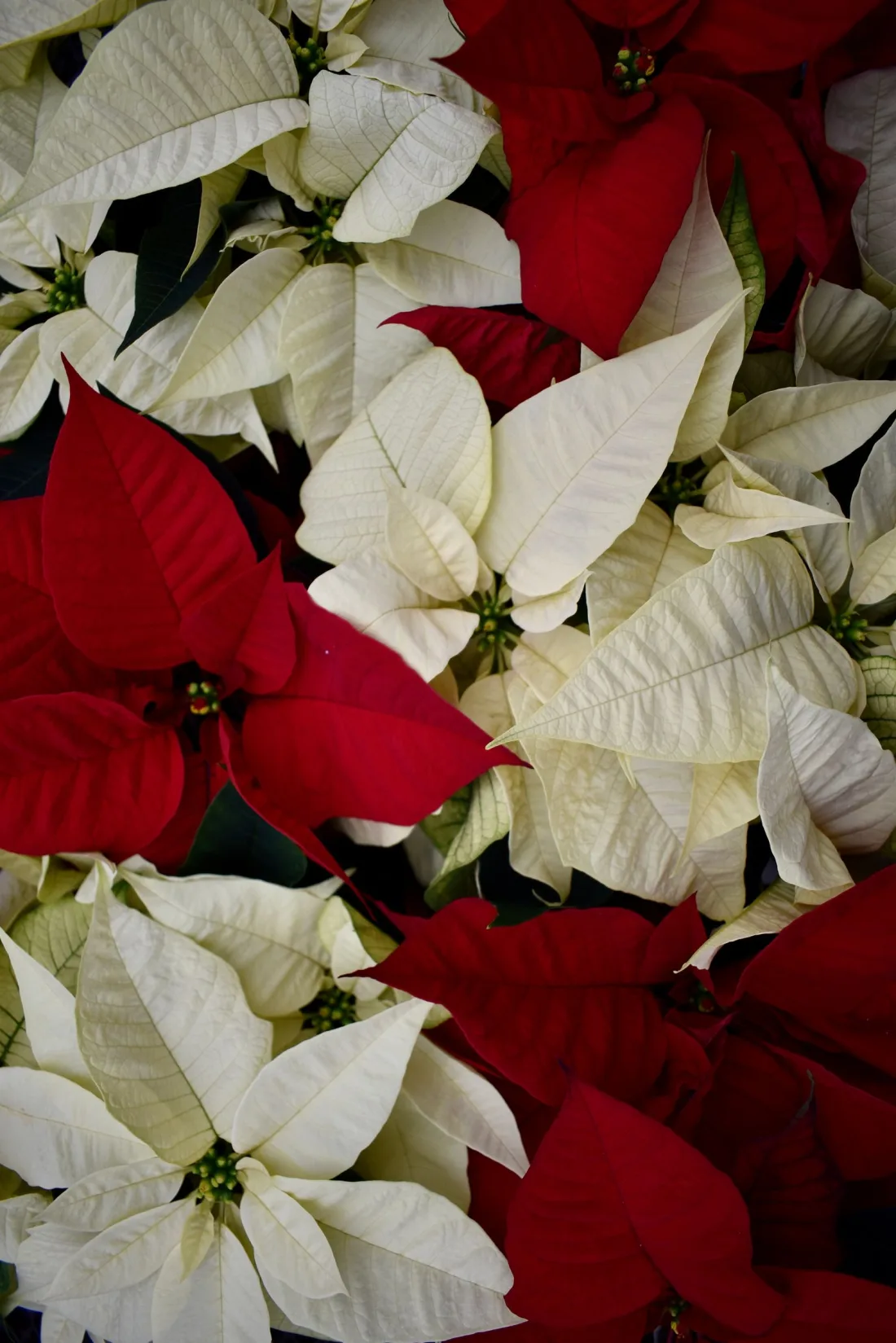
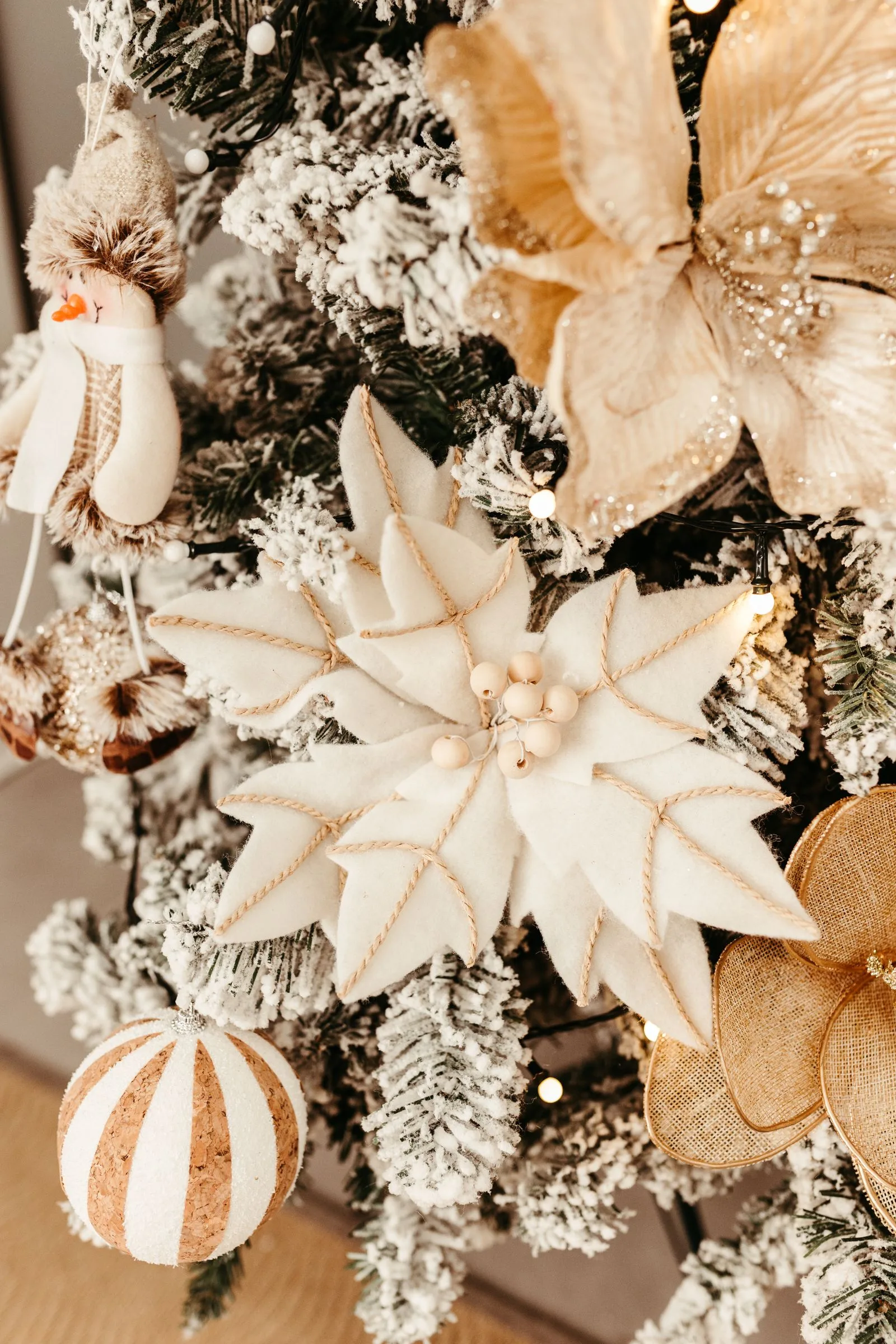
Red is traditional, but white and cream poinsettias are common, and pink and marbled ones are sold too. Cream poinsettias on a tree, like the fabric ones in the photo at the top of this page, look quieter than red and suit a neutral scheme, and cream felt gives the same effect.
How do you make a felt poinsettia?
Allow about 40 minutes for one flower once the bracts are cut. Wool or wool blend felt 1 to 1.5 mm thick holds the points best; wool felt fabric explains why acrylic felt goes limp.
- Cut the bracts. Make a card template for each size, trace onto the felt and cut with small sharp scissors. Cut the tips last, in one stroke from each side, so they come to a clean point.
- Mark the veins. Backstitch a center vein down each back and middle bract in a slightly darker thread, stopping ¼ in (6 mm) short of the tip. A sewing machine does this in a few seconds per bract with a straight stitch.
- Pinch each base. Fold the base of a bract in half lengthwise and put one stitch through the fold ⅛ in (3 mm) from the end. This turns the flat shape into a shallow cup, so the flower has depth.
- Build the back layer. Sew or glue the six large bracts to the green backing circle, bases meeting at the center, spaced evenly like the hands of a clock.
- Add the middle and front layers on top, each turned so its points sit between the points of the layer behind.
- Stitch the center. Sew five to seven yellow seed beads, size 8 or the larger size 6, in a tight cluster over the bases, with a green bead or two among them. French knots in yellow and green floss, or three or four tiny yellow felt balls, work instead. Sewing beads on felt shows how to anchor each one so it cannot pull loose.
If the bracts droop, either because the felt is thin or the flower is larger than these sizes, brush the back of each bract with fabric stiffener, lay it over a curved surface such as a rolling pin, and let it dry before assembling. The same layered method, with different shapes, is behind most of the flowers on felt flowers, and needle felted flowers covers solid wool versions.
What can you make with felt poinsettias?
Finish the back to suit the use:
- Wreath flower. Leave the back plain and hot glue or wire it to the wreath. Three flowers grouped off-center at the bottom of a felted wreath look better than five spread evenly around it.
- Tree pick. Push a 6 in (15 cm) length of 18 gauge green floral wire through the backing circle, bend a small hook at the end inside, and glue a second green circle over it. Wind the free end around a branch.
- Gift topper. Glue a 6 in length of ribbon across the back and tie it around the package, or stick the flower on with a glue dot so it can be reused.
- Napkin ring. Sew a 60 percent flower onto a strip of green felt 1 × 6 in (2.5 × 15 cm) closed with a snap. A matching set goes well with poinsettia-stitched felt coasters.
- Hair clip. Glue a small flower to a felt-covered alligator clip, with the backing circle hiding the metal.
- Ornament. Sew two flowers back to back with a loop between them, so it looks right from both sides as it turns on the branch.
How do you make felt holly leaves?
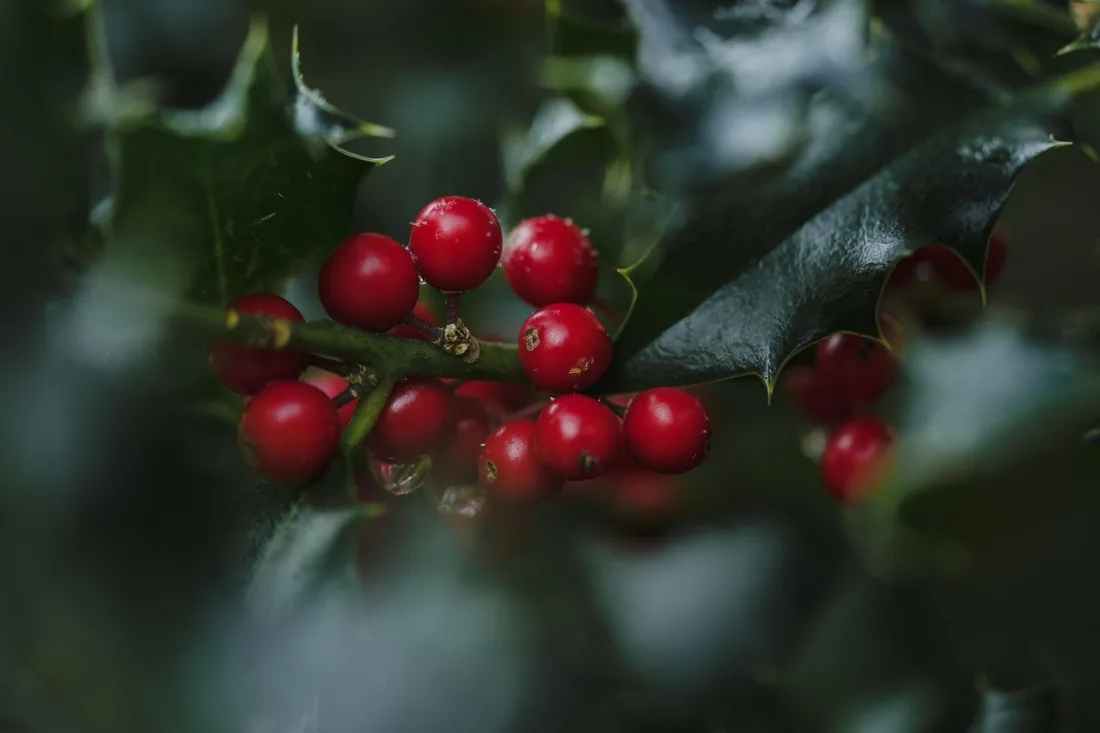
Cut a plain pointed oval 2½ in (6.5 cm) long and 1¼ in (3.2 cm) wide, then cut shallow curves into the edge between four spine points on each side, plus the tip. The curves are what make it holly: each one should be about ⅛ to 3/16 in (3–5 mm) deep, so the spines stick out without becoming thin enough to curl. Fold the template in half lengthwise to cut it, so both sides match.
- Felt: a dark, slightly blue-green, which looks more like holly than a bright grass green. A paler green backstitched vein down the middle finishes it.
- Yield: about 24 leaves from a 9 × 12 in sheet, with the leaves nested so the spines interlock.
- Berries: red, ¼ to ⅜ in (6–10 mm) across, which is the size of real holly berries. Use wet felted balls, which weigh a fraction of a gram each, red beads, or small red pom-poms. Group them in threes at the base of a pair of leaves.
For a holly sprig ornament, sew two leaves into a V with three berries at the point and a loop behind. A sprig glued to the top of a felted heart makes a quick gift tag.
How do you lay out a felt holly garland?
String the clusters on jute twine or narrow ribbon, a cluster of two leaves and three berries every 6 in (15 cm), with the leaves stitched through their bases so they lie flat against the wall. Add a poinsettia every 2 ft (60 cm) if you want a focal point.
| Garland length | Clusters | Leaves | Berries | Poinsettias, optional |
|---|---|---|---|---|
| 3 ft (90 cm) | 6 | 12 | 18 | 1 |
| 6 ft (1.8 m) | 12 | 24 | 36 | 3 |
| 9 ft (2.7 m) | 18 | 36 | 54 | 4 |
Leave about 8 in (20 cm) of bare twine at each end for tying. If you would rather felt the leaves from loose wool than cut sheet felt, the felted holly method on felt garland makes a sheet of homemade felt to cut from.
How do you make felt mistletoe?
Mistletoe is the opposite of holly: soft, rounded leaves in pale yellow-green, growing in pairs, with white berries. Cut each leaf as a narrow paddle 1½ in (4 cm) long and ½ in (1.3 cm) wide, round at the tip and narrowing to the base, with no veins or spines. Sew the leaves in opposite pairs along a short stem of green floral wire wrapped in green floss, and stitch two or three white berries where each pair meets. Pearl beads, ¼ in (6 mm), give the slightly glossy look of real berries; white felt balls are softer and safer for a house with children.
Tie a bunch of three or four sprigs with red ribbon to hang in a doorway, or cover a 3 in (7.5 cm) foam ball with mistletoe leaves glued on in overlapping rows to make a kissing ball.
Why make Christmas plants in felt?
Partly because they last for years, and partly because of pets. Poinsettia sap is mildly irritating to cats and dogs, usually causing drooling or an upset stomach, and holly and mistletoe are more of a concern, especially the berries. A felt version takes the plant off the list of things to watch. Bead and felt ball berries are still choking hazards for children under 3 and can be swallowed by pets, so for a toddler's room embroider the berries as satin stitch dots instead.
For more projects in the same colors, felted Christmas ornaments has holly sprigs alongside stars and animals, and felt Christmas decorations gathers every Christmas project on the site in one place.
Frequently asked questions
How big should a felt poinsettia be?
About 5½ in (14 cm) across for a wreath or gift topper, using bracts 2¾ in, 2¼ in and 1½ in (7, 5.5 and 4 cm) long. For a napkin ring or hair clip, scale the pattern to 60 percent, which gives a flower about 3¼ in (8 cm) across.
What felt is best for poinsettias?
Wool or wool blend felt about 1 to 1.5 mm thick. It holds the pointed bract tips and takes a pinch at the base without creasing. Thin acrylic felt flops; if that is all you have, brush the bracts with fabric stiffener and let them dry over a curved surface.
How do you make the center of a felt poinsettia?
Stitch a cluster of five to seven small yellow beads, French knots in yellow and green floss, or tiny yellow felt balls into the middle. These stand in for the real flowers, which on a living poinsettia are the small yellow-green buds in the center, not the red bracts.
How many holly leaves do you need for a garland?
With a cluster of two leaves and three berries every 6 in (15 cm), a 6 ft (1.8 m) garland takes 24 leaves and 36 berries. One 9 × 12 in sheet of green felt gives about 24 leaves at 2½ in (6.5 cm) long.
Are real poinsettias poisonous to pets?
Poinsettia sap is mildly irritating to cats and dogs and usually causes drooling or an upset stomach rather than serious poisoning. Holly and mistletoe are more of a concern, especially the berries. Felt versions avoid the question, but keep bead and felt ball berries away from pets and small children too.