Crochet Felted Slippers: Sizing for a Fabric That Shrinks Less
10 min read Intermediate
We may earn a commission from links on this page, at no extra cost to you. As an Amazon Associate I earn from qualifying purchases. Learn more.
Crochet loses 20 to 30% in the wash where knitting loses 30 to 40%. Every measurement, hook size and cycle length on a crochet slipper follows from that one difference.
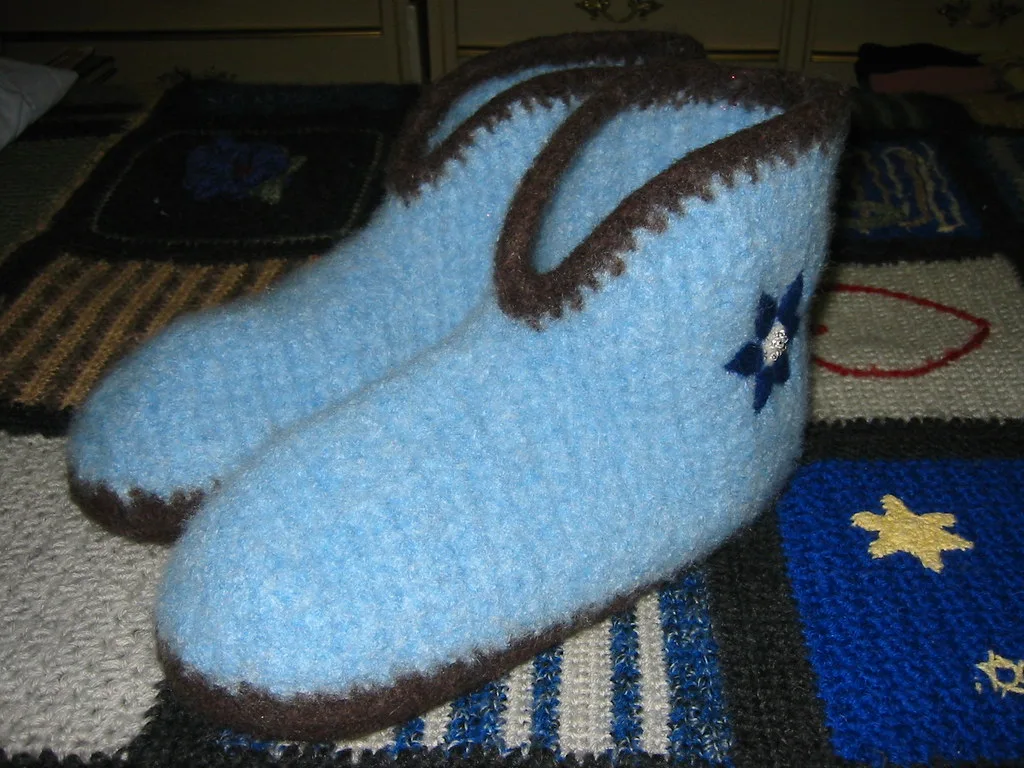
Put a knitted swatch and a crocheted swatch of the same wool through the same 60 °C cycle and the knitted one comes back 30 to 40% smaller, while the crocheted one loses 20 to 30%. The crochet also still shows its stitches, where the knitting has closed into an anonymous sheet of felt.
That gap decides everything else. A crochet slipper worked to the enlargement figures in a knitting pattern comes out roughly a size and a half too big, and thicker than a knitter would expect from the same yarn.
Why crochet felts less
Felting is fibres migrating and tangling into the spaces between them. Crochet gives them less room and holds them tighter:
- The fabric starts denser. At the same yarn weight, crochet is thicker and has less open space in it than knitting. There is less air for fibres to migrate into, so less distance the fabric can travel before it is solid.
- Each stitch locks more yarn. A crochet stitch pulls the working yarn through more loops per centimetre of fabric than a knit stitch does, so a greater share of its length is pinned down by its neighbours. Tightly held fibre resists being dragged out — and being dragged out is exactly what felting requires.
- Stitch patterns differ more. Stocking stitch is nearly the only sensible knitted choice for felting and behaves the same way every time. Crochet offers a dozen usable stitches and they do not shrink alike, which is why a published percentage is worth so little here.
So crochet keeps its stitch definition much longer — a lightly felted crochet slipper still looks crocheted, and it is worth deciding whether you want that before you start. It needs a longer or hotter run than the equivalent knitted piece. And the swatch is not a precaution, it is the measurement the project is built on. The fabric behaviour behind all this is in felting crochet, and what the fibre itself is doing in wool shrinkage when felting.
Yarn
Non-superwash wool, and nothing else. Superwash has had its scales stripped or coated so that it will not felt, and no amount of heat or agitation changes that — it is the single most common reason a project fails. If there is no ball band, felt a test length first.
Then a smooth plied wool: aran or chunky, plainly twisted, no halo. Stitch definition is the one thing crochet keeps through a wash, so the yarn has to be one whose stitches are worth keeping — an even ply comes out of the drum as crisp, legible fabric, where a bouclé or a thick-and-thin comes out as lumps. There is a mechanical reason as well as an aesthetic one: the stitch packs fibre tightly, an uneven yarn packs it unevenly, and you get patches that felt hard beside sections that stay slack, with no wash long enough to level them. Which breeds felt hardest is a knitter's question more than a crocheter's, and it is answered on knitted felted slippers. Felting supplies covers what to look for.
Hook size and fabric
Go up substantially — two to three sizes above the band recommendation: typically 6.5 to 8 mm for aran, 9 or 10 mm for chunky. The fabric should look wrong. Loose, floppy, slack enough that the stitches sag under their own weight when you hold the piece up.
That is not the contradiction it sounds like. Crochet is the denser of the two fabrics at any given hook size, so going three sizes up does not make a mesh of it — it leaves you with something still closer than the equivalent knitting, only with room in it for the fibres to travel. Which is the whole reason to do it, and why it matters more here than it does to a knitter. Worked at the tension you would use for a bag, a slipper has nowhere to shrink into: it comes off the machine stiff, small and board-like, and never softens.
Stitch choice
All stitch names here are US. Single crochet is what UK patterns call double crochet — the short, tight stitch made with one yarn over. It is the workhorse for felting, and on an oversized hook it gives an even fabric with no structural holes, which is what you want under a foot.
Half double crochet is acceptable, faster and marginally softer. Taller stitches — double, treble, anything openwork — leave gaps between the posts, and felting shrinks those gaps without reliably closing them. A half-closed hole on the instep is a draught; on the sole it is where the slipper wears through first. Avoid post stitches, bobbles and shells too: they become vague bumps, and they shrink at a different rate from the plain fabric around them.
In the round or flat and seamed
A continuous spiral from the toe gives a seamless slipper and the smoothest result. Use a stitch marker: the spiral is hard to read at this tension.
Flat pieces are easier to shape and to try against a paper template, and the seam is less of a compromise than it sounds. Whip stitch them with the same yarn before felting and the wash fuses the two edges into each other — on a good seam you cannot find it afterwards by eye or by touch. Sew into finished felt and the seam shows for ever. Never seam in a contrasting yarn, even temporarily; it felts in permanently.
The swatch
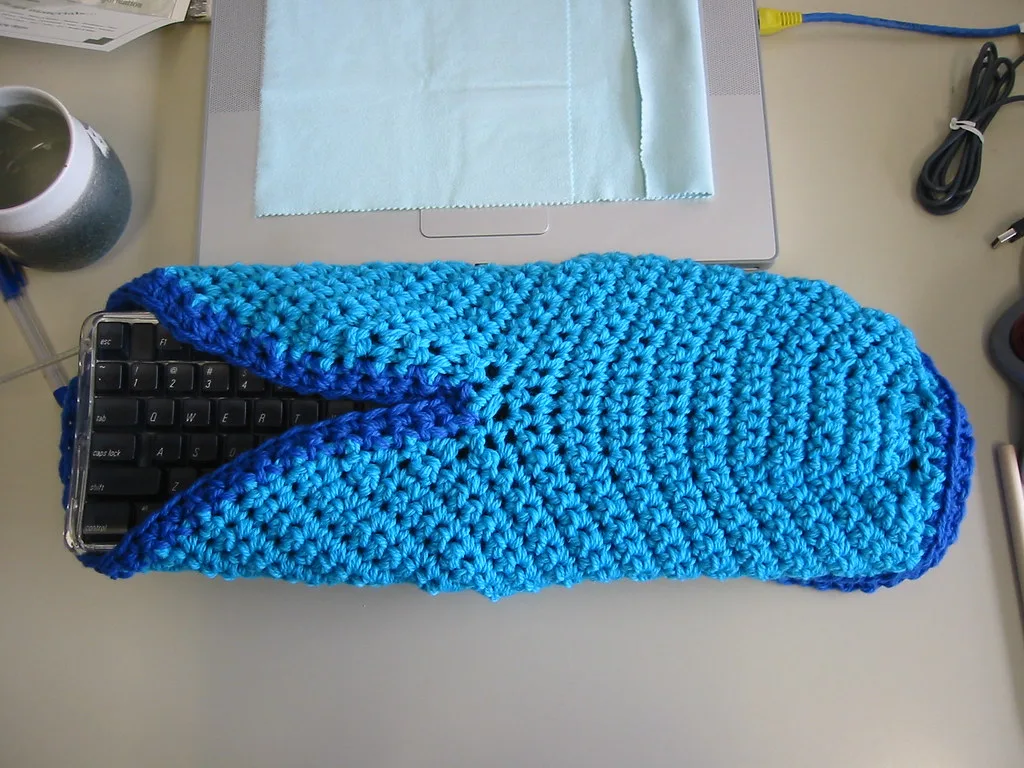
Crochet 20 × 20 cm in the stitch and hook you intend to use. Mark 15 cm across and 15 cm down with contrast thread, and felt it exactly as you plan to felt the slippers — same temperature, cycle, detergent and jeans in the drum. Measure between the marks in both directions and write both numbers down: crochet often shrinks more in height than width, and a slipper sized off one average figure comes out short and wide.
The swatch has a second job: it tells you how long the cycle needs to be, which for crochet is genuinely unknown before you try. If 45 minutes at 60 °C has closed the fabric only halfway, you know to plan two runs.
Sizing
The foot is not the target. Allow about 1 cm of ease over the foot length for the finished slipper, then divide that by (1 − shrinkage) to get the length to crochet to. At 25%, the middle of the crochet range:
- Child, 18 cm foot: finished 19 cm, crochet to 25 cm
- Adult, 24 cm foot: finished 25 cm, crochet to 33 cm
- Adult, 28 cm foot: finished 29 cm, crochet to 39 cm
Replace all three the moment your swatch gives you a real figure: at the 20% end the adult 24 cm entry drops to 31 cm, at the 30% end it rises to 36 cm, and nothing but your own wool and your own machine decides which. Add 2 cm to the cuff on top of whatever looks right; cuffs lose more than anything else, and a short one will not stay on the heel. Always err large — too big goes back in the drum, too small has no remedy at all.
The felting run
The machine routine is not a crochet routine, it is the standard one, and it is written out step by step on knitted felted slippers: laundry bag, jeans in the drum, a teaspoon of detergent, hot and long, no spin the first time round. Three things about it change for a hook.
It takes longer and it wants more heat. Where a knitted pair is frequently finished in a single cycle, plan on one and a half to two, and keep a third at a higher temperature in reserve for a fabric that went in tighter than intended. Budget the time before you start rather than discovering it at ten o'clock at night.
Check it more often. Crochet closes up slowly while the air is still in the stitches and then quite abruptly once it has gone, so the interval between "barely moved" and "gone too far" is shorter than the interval a knitter learns to expect. Measure against your target length at every opportunity the door gives you.
Do not read across from knitting timings. Every duration quoted in felting in knitting is shorter than what this fabric needs, and treating them as a schedule is the usual reason a crocheter concludes the yarn was superwash when it was not.
Shaping and drying
Mould them on your own feet over a plastic bag and then dry them packed out with paper, by the method on knitted felted slippers. Only the drying differs: thick crochet felt carries far more water than knitted felt of the same size, so it needs every hour of the two days, and it punishes impatience specifically. Put it near a radiator and the outside will feel finished while the sole is still wet through, which is how a pair ends up smelling of damp sheep a week later.
Soles
Felt on its own is slick underfoot and thins where you push off, and crochet buys you only a stay of execution: the fabric starts thicker, so an unsoled pair survives a little longer than a knitted one, which is not the same as surviving. Everything else about it — the materials, the cutting, the stitching, and how to patch the underside once it has gone thin — is on slipper soles.
Free patterns and how to judge one
Free crochet felted slipper patterns are abundant — Ravelry holds most of them, and many designers post one on a blog. We do not host one. The general tests that any felting pattern has to pass, whatever it is worked with, are set out on knitted felted slippers. Two more apply only to a hook:
- Does it give a stitch count and a hook size? Not a yarn weight, not "a large hook" — the actual millimetres and the actual number of stitches to the row. Crochet gauge varies further between one pair of hands and another than knitting gauge does, and a pattern quoting only a weight has hidden the number the whole project is built on.
- Does it declare US or UK stitch names? A surprising number never say, and the gap is not cosmetic: follow a UK double crochet where the designer meant a US one and you get a fabric half again as tall, half as dense, and full of the gaps a sole cannot afford.
Anything failing those is still useful as a shape: take the construction and use your own swatch numbers. Sources for both crafts are gathered in free felting patterns for beginners.
Crochet or knitted?
Choose crochet if you crochet faster than you knit, if you want a thick hard-wearing slipper, or if you like the stitch texture surviving into the finished piece. It is also easier to shape as you go: hold a piece against a foot at any point and undo a few stitches, with no needle full of live loops to manage.
Choose knitting for a first attempt, for a smooth surface with no stitch pattern showing, and if you would rather follow a pattern's numbers than establish your own. Knitted patterns are more numerous and better tested: Bev Galeskas's Felt Clogs, published by Fiber Trends, is the reference point everybody works from, and there is nothing of that standing on the crochet side.
If neither appeals, a slipper can be built with no stitching at all, by wrapping fibre round a foot-shaped template; resist felting covers that, and every route is compared on felted slippers.
Whatever pattern you settle on, the crochet discipline comes down to three habits: a hook far bigger than the band says, a swatch felted the way the slippers will be felted, and the nerve to run a second cycle when the first one has done less than you hoped. Get those right and you finish with something no knitted felt can give you — a slipper dense as board that still, close up, reads unmistakably as crochet, every stitch legible under the surface.
Frequently asked questions
How much do crochet slippers shrink when felted?
Around 20 to 30%, against 30 to 40% for knitted stocking stitch in the same wool. Crochet also varies more between stitch patterns than knitting does, so the figure from your own swatch matters more here than it does for a knitter.
Which crochet stitch felts best for slippers?
Single crochet, which is UK double crochet. It gives the most even fabric and the fewest holes. Taller stitches leave gaps that felting shrinks but does not always close, and a half-closed hole in a sole is a draught.
Why did my crochet slippers not felt as much as the pattern said?
Either the yarn is superwash, in which case it never will, or the fabric was crocheted too tightly and the cycle was too short. Dense crochet needs a longer or hotter run than knitting to reach the same point. Run it again and measure between runs.
Are there free crochet felted slipper patterns?
Plenty, mostly on Ravelry and on individual designers' blogs. Use one that states both the pre-felting and post-felting measurements and names the exact yarn, and treat everything else as a shape to copy rather than a set of numbers to trust.