Needle Felting Classes: Finding One, and Whether You Need One
3 min read Beginner
Needle felting is the easiest fibre craft to teach yourself and one of the most rewarding to be taught, for one specific reason: someone can look at your work and tell you it is not dense enough.
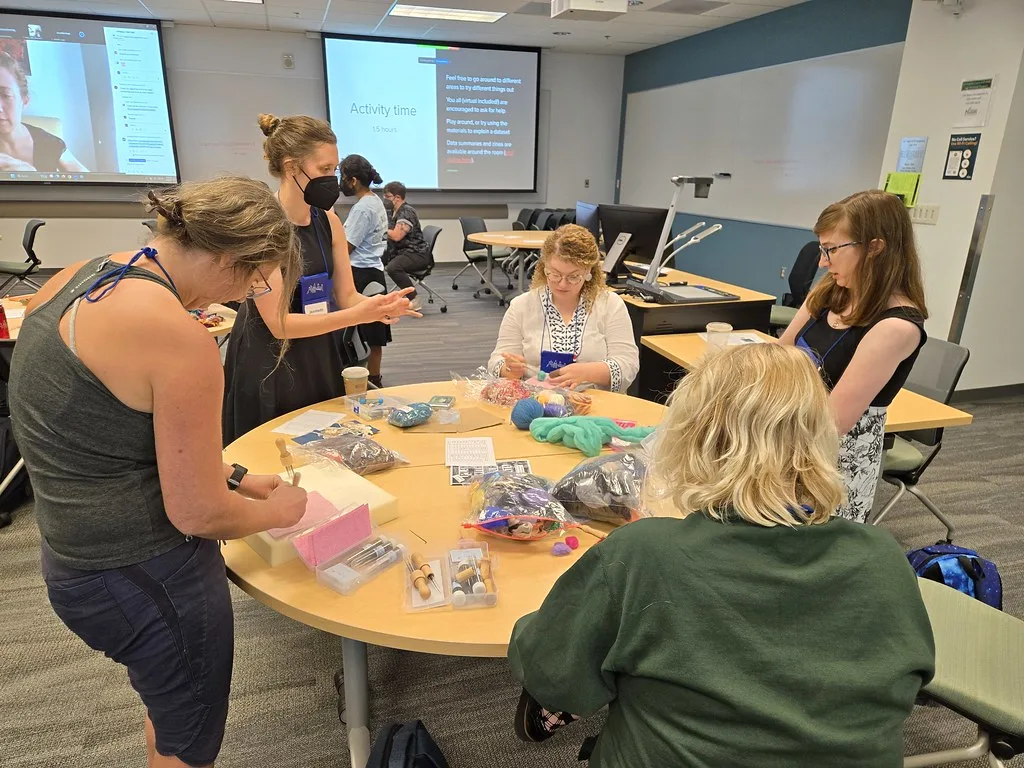
You can learn needle felting from a page. What you cannot easily do from a page is judge your own work: beginners consistently under-felt, stop while the piece is still soft, and cannot tell why it looks like a wool blob rather than a mouse. Ten seconds of someone squeezing your work and saying "keep going" fixes that permanently.
Where classes actually happen
- Craft and yarn shops. The most common venue. Two to three hours, six to ten people, a kit included. Announced on the shop's mailing list and rarely anywhere else.
- Guilds of weavers, spinners and dyers. Regional, monthly, cheap, and full of people who have been doing this for decades. Visitors welcome.
- Adult and community education. Six to ten week evening courses, usually badged as textiles rather than felting. Enrol in July for September.
- Farm shops, garden centres and rural craft centres. Seasonal workshops, heaviest in autumn and before Christmas.
- Fibre festivals and wool shows. Short taster workshops, and the tutors who teach them usually run longer courses of their own.
- Individual makers. Many felt artists teach small groups from a home studio. Usually the best tuition per pound; found through their own sites and social accounts rather than listing sites.
Search terms that work better than "classes near me": the name of your county plus "guild of weavers spinners dyers", or your nearest large town plus "craft workshop wool".
What a beginner class covers
- Safety and grip — how to hold the needle, why you never look away, and finger guards.
- Core wool and surface wool — building a dense core cheaply and covering it with the colour you want.
- Making a firm shape — usually a ball or an egg, worked until it holds under real pressure.
- Joining — attaching a head to a body so it does not pull off.
- Detail — eyes, ears, a nose, and how to set them symmetrically.
- One finished animal to take home, plus the leftover kit.
A good class spends the first hour on density and the rest on shape. A weak class hands out a kit and lets everyone follow a photo.
Questions to ask before booking
- How many people per tutor? Eight is the sensible maximum.
- Are needles and a mat included, and do you keep them?
- What gauge needles are provided? A class supplying only one gauge is teaching one stage of the process.
- Will you finish the piece in the session?
- Is it suitable for left-handers, if you are one? It always is — but a tutor who has thought about it is a tutor who watches individuals.
Classes for children
Felting needles are barbed and sharp, and they hurt considerably more than a sewing needle. Realistic guidance:
- Eight and up, one adult per two children, and a hard rule about where the other hand is.
- Leather or silicone finger guards on the thumb and forefinger.
- Short shapes, not sculptures — a ball, a heart, a flat shape on a background.
- For younger children, wet felting is the safe alternative and just as satisfying.
More on the risks and how to manage them in is needle felting dangerous.
Learning without a class
If there is nothing within reach, the self-taught path works — as long as you deliberately fix the density problem a tutor would have caught:
- Start with needle felting for beginners for tools and technique.
- Make a ball first, and keep working it until it feels like a rubber ball, not a pompom. That is the calibration exercise.
- Read the nine common mistakes before your second project, not after your tenth.
- Then work through needle felted animals for beginners.
For the wet side of the craft, the equivalent guide is wet felting classes.
Frequently asked questions
Where can I find needle felting classes?
Craft shops and yarn shops, regional guilds of weavers, spinners and dyers, adult education programmes, garden centres and farm shops with craft rooms, and fibre festivals. Workshop places are often announced only on a shop's social media or mailing list.
How much is a needle felting class?
A two to three hour workshop, usually including a kit to take home, is the cheapest way in. A full day with a well-known tutor costs roughly two to three times that. Guild and community sessions undercut both, often by half again, and are the best value if there is one near you.
Is needle felting worth taking a class for?
For the first session, yes — mainly because a tutor will tell you your wool is not dense enough, which is the mistake almost every self-taught beginner makes and the hardest one to see in your own work.
What age can children start needle felting?
Around eight with close supervision, since the needles are genuinely sharp and barbed. Younger children can wet felt safely instead, or use a felting tool with a guard.