Wet Felting Classes and Courses: Where to Find One, and What to Expect
4 min read Beginner
Guilds, craft schools, fibre festivals and studio makers run most of the teaching, and almost none of it shows up in a search for "classes near me". Here is where to actually look.
Felting is taught almost entirely through small local networks. Searching for classes turns up national listing sites with nothing in your county, while the guild two towns away runs a workshop every month and never appears. The trick is knowing which four channels to check.
1. Guilds of weavers, spinners and dyers
Regional guilds are the backbone of fibre teaching in the UK, and equivalents exist across Europe, North America and Australia. They:
- Meet monthly, usually on a weekday, in a village or community hall
- Run beginner workshops several times a year, often at close to cost
- Welcome visitors for a small fee before you join anything
- Have members who teach privately and take small groups
Find your nearest through the national association's guild list rather than through a general search. Many guilds have a single-page website that ranks nowhere.
2. Adult and community education
Local authority adult education and further education colleges run evening and daytime craft courses, usually over six to ten weeks. Terms start in September and January, and enrolment opens six to eight weeks earlier. Look under "textiles" or "craft" rather than "felting" — felting is often a module inside a broader textiles course.
These are the cheapest structured route and the best for people who want repeated sessions rather than one intensive day.
3. Craft schools and studios
- Residential craft schools run weekend and week-long courses with visiting tutors. Expensive, well-equipped, and the fastest way to get good.
- Independent studios — individual felt makers teaching from their own workshop, usually four to eight people. The best value for individual attention.
- Yarn and wool shops frequently host workshops in the back room, particularly in autumn.
- Museums and heritage sites with textile collections run occasional day schools.
4. Fibre festivals and shows
Wool festivals run short workshops — 90 minutes to half a day — alongside the trade stands. They are the cheapest way to try wet felting before committing to a course, and you can buy your materials in the same building. Book the workshops as soon as the programme is published; they sell out well before the event.
What a beginners' day covers
- Fibre and layout — pulling staples from tops and laying them in crossed layers, which is the skill everything else depends on.
- Soap and water — temperature, concentration and how much to use.
- Wetting out and rubbing — through netting or bubble wrap, until the fibres migrate and hold.
- Rolling — usually on a bamboo mat or pool noodle, changing direction to shrink evenly.
- Fulling — the vigorous stage that turns a fragile web into fabric.
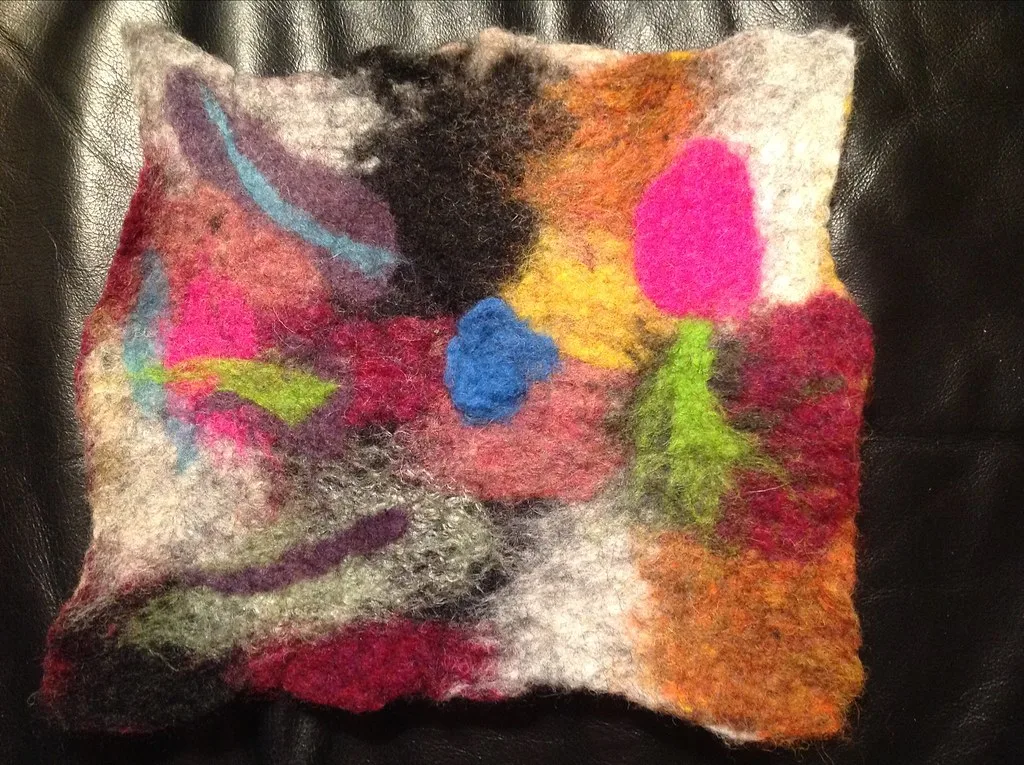
- One finished object — a flat sample and a small piece, or a single larger project.
You can read all of that first in wet felting for beginners, which is worth doing — arriving knowing what fulling means makes a one-day course go considerably further.
Courses for adults, and courses for beginners
Two labels worth distinguishing when you book:
- "For beginners" — no experience assumed, materials included, one guided project. Start here.
- "For adults" — usually just signalling that it is not a children's workshop, and says nothing about level. Check the description for prerequisites.
- Themed courses — nuno felting, seamless vessels, felted hats. These generally do assume you can already make a flat piece of felt.
What to ask before booking
- Are materials included, and how much wool do you get?
- How many people to one tutor? Six to eight is comfortable; twelve is a demonstration.
- What will you take home, finished?
- Is there hot water on tap in the room? Wet felting without it is a long day.
- Is the work standing at a table? It usually is, for several hours.
If there is nothing near you
Wet felting is one of the easier crafts to learn without a teacher, because nothing is sharp and mistakes are recoverable. A first session at a kitchen table needs wool, washing-up liquid, warm water, a bamboo mat or towel, and bubble wrap. Start with felted soap, which takes an evening and teaches the whole process in miniature, then move to a scarf or a bag over a resist.
For dry felting instead, the equivalent guide is needle felting classes.
Frequently asked questions
Where can I find wet felting classes near me?
The four reliable sources are your regional guild of weavers, spinners and dyers; adult and community education programmes; independent craft schools and studios; and fibre festivals, which run short workshops across a weekend. Most of these do not advertise beyond their own mailing lists.
What does a beginner wet felting course cover?
A one-day beginners' course typically covers fibre layout in crossed layers, soap and water temperature, rubbing and rolling, fulling, and one finished piece — usually a flat sample, a small bag over a resist or a pair of slippers.
How much do wet felting classes cost?
A one-day workshop including materials is the standard unit and the usual first booking. A residential weekend at a craft school costs several times that, since it covers tuition, board and a much longer contact time. Guild sessions and community evening classes are considerably cheaper than either, often by a factor of four or five.
Do you need any experience to join a wet felting class?
No. Wet felting has almost no prerequisites — no needles, no sharp tools, no pattern reading. Courses labelled "for beginners" assume you have never touched wool.