How to Make Felt Food for Beginners
3 min read Beginner
We may earn a commission from links on this page, at no extra cost to you. As an Amazon Associate I earn from qualifying purchases. Learn more.
Play food from felt is the rare craft where crude shapes work better than accurate ones — and where the sewn and needle felted methods each win at different foods.
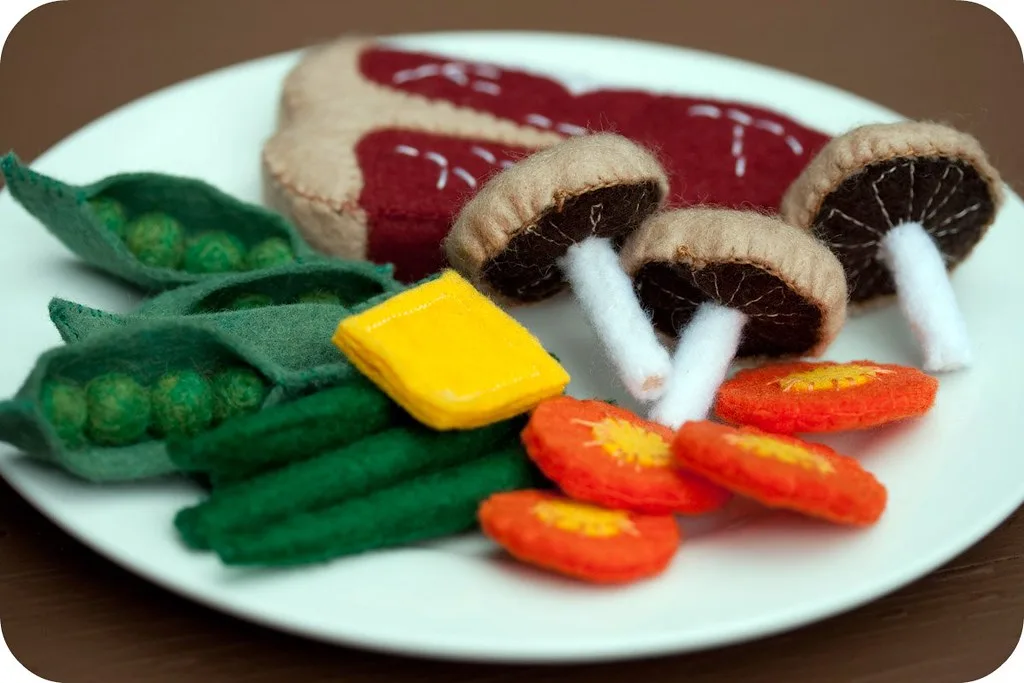
Felt food gets played with more than almost any other handmade toy, and it is one of the few crafts where a slightly clumsy result is better than an accurate one. Children want a recognisable tomato, not a photographic one.
There are two methods, and choosing the right one for each food is most of the skill.
Which method for which food
- Sew it when the food is flat, sliced or has a distinct edge: bread, toast, cheese slices, pizza, biscuits, fried eggs, bacon, lettuce leaves, cake slices.
- Needle felt it when the food is round and solid: apples, oranges, tomatoes, potatoes, eggs, mushrooms, meatballs, grapes, carrots.
Sewn spheres end up as lumpy pincushions with visible seams. Needle felted flat shapes end up thick and shapeless. The failure mode of each is obvious once you have seen it.
Sewn felt food
What you need
- Wool felt or wool blend felt, 1–2 mm, in food colours
- Embroidery thread in matching and contrasting colours
- Toy filling
- Sharp small scissors, and paper for templates
Wool felt is worth the difference here. Acrylic craft felt looks fine on day one and pills into fuzz within a month of daily handling — the comparison is in wool felt fabric.
Method
- Draw a simple template on paper. Simplify hard: a strawberry is a rounded triangle, not a strawberry.
- Cut two pieces. No seam allowance is needed — felt does not fray.
- Add details to the front piece before assembling: stitched seeds, an appliqué crust, a contrasting rind.
- Blanket stitch around the edge, leaving a gap.
- Stuff lightly — flat food should stay flat.
- Close the gap and finish the thread ends inside.
Foods that work first time
A fried egg (a white blob and a yellow circle), a slice of bread (a rounded square with a stitched crust), cheese (a yellow triangle with punched holes), a pizza slice with appliqué toppings, a biscuit with stitched chocolate chips.
Needle felted food
Method
- Wind a core from cheap wool into roughly the right shape and needle it firm. Method in how to needle felt a ball.
- Shape it. Flatten the top and bottom of an apple, taper a carrot, dimple a tomato by stabbing repeatedly into one spot.
- Add the colour as a thin outer veil and needle it down with a 40 gauge needle at a shallow angle.
- Add features: a green needled stalk, a leaf of felt fabric, a dark dimple at the base of an apple.
- Firm it hard. Play food gets squeezed, dropped and stood on. Soft pieces go shapeless within a fortnight.
Foods that work first time
Apples, oranges, tomatoes, potatoes, eggs, mushrooms — see felted mushrooms for the cap-and-stem join, which is exactly the technique a carrot top needs too.
Sizing
Make everything slightly larger than life. Small hands manage a 6 cm apple better than a 4 cm one, oversized food reads as toy rather than object, and anything under about 5 cm is a choking risk for the age group most likely to be playing with it.
Safety
- No glue, no beads, no buttons. Everything stitched or felted.
- Tug-test every stalk, leaf and appliqué before it goes into a toy box.
- Nothing under 5 cm for children under three.
- Count the felting needles back into the tin when you finish — see is needle felting dangerous.
Building a set
A useful set is about a dozen pieces covering several categories: two or three fruits, two vegetables, something bread-based, something to slice, and one thing that comes apart — a burger that stacks, or a pizza cut into wedges. Sets that are all fruit get boring fast.
Make it in batches by stage rather than one item at a time: cut all the templates, then all the pieces, then all the stitching. It roughly halves the time.
Storage and care
A drawstring bag or a wooden crate. Hand wash cool with no agitation and reshape damp — machine washing wool felt food shrinks and hardens it, which is the same process used deliberately elsewhere.
Frequently asked questions
What felt is best for felt food?
Wool felt or a wool blend, 1 to 2 mm thick. Acrylic craft felt pills within weeks of real play and looks shiny and cheap next to wool, which matters for something handled daily.
Should felt food be sewn or needle felted?
Sew anything flat or sliced — bread, cheese, pizza, biscuits, fried eggs. Needle felt anything round and solid — fruit, vegetables, eggs, meatballs. Trying it the other way round is what makes felt food look wrong.
Is felt food safe for toddlers?
Yes, if nothing is glued and there are no small parts. Everything should be stitched or felted in so firmly it cannot be pulled off, and pieces should be too big to swallow — about 5 cm minimum.
Can felt food be washed?
Hand wash cool with no agitation, and reshape while damp. Never machine wash wool felt food — it will shrink and harden. Spot cleaning is what most of it needs anyway.