Falling Leaves Knitting Pattern: A Free Scarf and a Triangular Shawl
4 min read Intermediate
Two complete patterns from one eleven-stitch leaf repeat — a straight scarf you can start tonight, and a top-down triangular shawl with a leaf border.
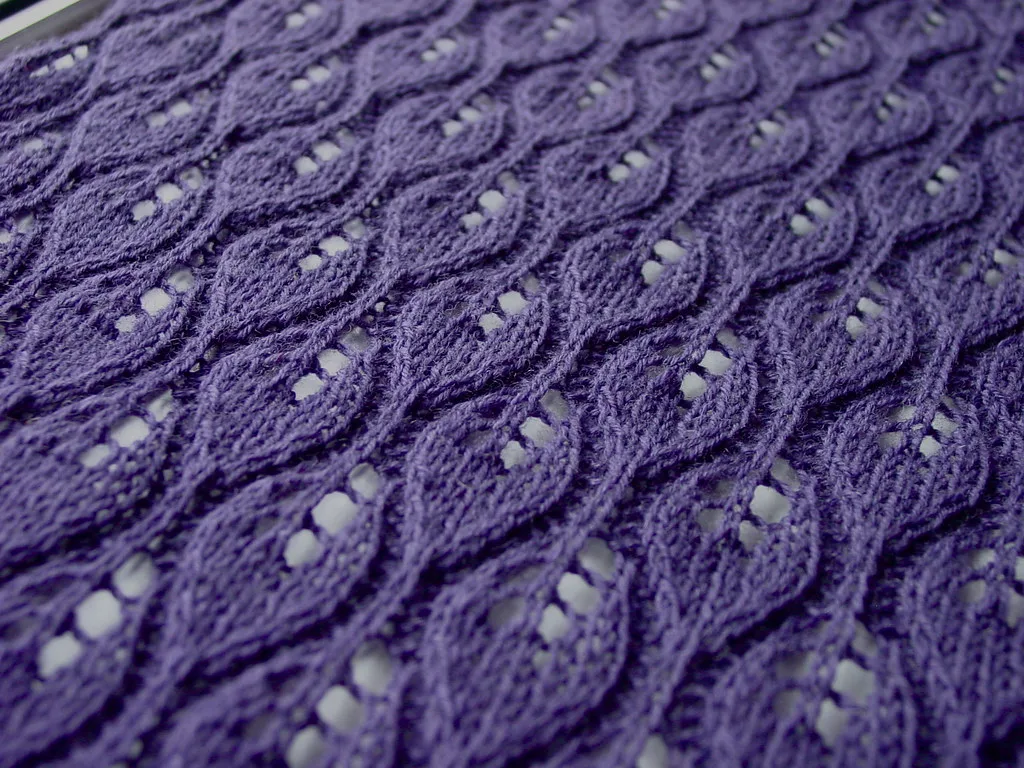
Both patterns below are built from the same repeat: eleven stitches, two decreases at the outer edges and two yarn overs either side of a centre stitch. It is written out in full each time, so you never need a chart.
The leaf repeat
- RS row: *k2tog, k3, yo, k1, yo, k3, ssk* — 11 stitches, repeat as many times as the pattern calls for
- WS row: purl
Two stitches are removed and two added in every repeat, so the count is constant. If you finish a right-side row with a different number of stitches than you started, you have missed a yarn over — the usual culprit.
Pattern 1: the falling leaves scarf
Yarn: 200 g DK wool. Needles: 4.5 mm straight. Size: about 22 × 170 cm blocked.
- Cast on 48 stitches.
- Rows 1–6: knit every row (garter border).
- Row 7 (RS): k2, *k2tog, k3, yo, k1, yo, k3, ssk* four times, k2.
- Row 8 (WS): k2, purl to last 2 sts, k2.
- Repeat rows 7 and 8 for 8 rows, then work 4 rows of stocking stitch keeping the garter edges — this is what separates one leaf from the next and makes them read as falling rather than climbing.
- Continue alternating 8 lace rows and 4 plain rows until 6 cm short of the finished length.
- Knit 6 rows and cast off loosely, one needle size up.
For continuous vines instead of separate leaves, simply leave out step 5 and repeat rows 7 and 8 the whole way — that version is written up in full in the autumn leaves knitting pattern.
Pattern 2: the falling leaves shawl
A top-down triangle: it starts at the back of the neck with five stitches and grows outwards, so you can stop whenever the yarn runs out or the shawl is big enough.
Yarn: 400–800 m fingering weight. Needles: 4 mm circular, 80 cm, worked flat.
Setting up
- Cast on 5 stitches. Knit 2 rows.
- Row 1 (RS): k2, yo, k1, yo, k2 — 7 sts. The centre stitch is the spine; mark it.
- Row 2 (WS): k2, purl to last 2 sts, k2.
The body
Repeat these two rows:
- RS: k2, yo, knit to the marked centre stitch, yo, k1 (centre), yo, knit to last 2 sts, yo, k2 — 4 stitches added
- WS: k2, purl to last 2 sts, k2
Each right-side row adds two stitches to each wing. Continue until each wing holds 44 stitches — 93 stitches in total, which is 22 increase rows. For a larger shawl, carry on to 66 stitches per wing (137 total) instead; any multiple of 22 per wing works.
The leaf border
Stop the increases. Working over the 93 stitches:
- RS: k2, *k2tog, k3, yo, k1, yo, k3, ssk* four times, k1 (centre), *k2tog, k3, yo, k1, yo, k3, ssk* four times, k2
- WS: k2, purl to last 2 sts, k2
Work those two rows twelve times — 24 rows of leaves. Then knit 6 rows and cast off very loosely. A tight cast-off on a shawl edge is the single most common way to ruin one; if in doubt, cast off with a needle two sizes larger.
Blocking, which is not optional
- Soak the finished piece 15–20 minutes in cool water with wool wash.
- Press the water out in a towel. Do not wring.
- Pin the shawl out under real tension: the long top edge straight, the point pulled down, and the lower edges stretched until the eyelets open into leaves.
- Leave to dry completely — overnight, and longer in a cold room.
A blocked lace shawl is often a third larger than it was off the needles. Plan the size around the blocked measurement, not the knitted one.
Yarn choices
- Non-superwash wool blocks best and holds the shape longest.
- Wool-silk blends add drape and shine, at the cost of some memory.
- Avoid short-repeat variegated yarn — it hides the leaves entirely. A slow gradient in rust, gold and brown does what a variegated yarn promises and fails to deliver.
- Avoid acrylic for anything you intend to block.
Fixing the usual mistakes
- Stitch count wrong at the end of a RS row — a dropped yarn over. Count each repeat as you go rather than the whole row.
- Leaves drifting sideways — a decrease worked as k2tog where it should be ssk, or vice versa. The lean is what holds the column straight.
- Edges curling — the garter border was skipped or is too narrow. Two stitches is the minimum; three is safer in fingering weight.
- Holes in the wrong places — a yarn over made before a purl on the wrong-side row. All wrong-side rows here are plain.
If you would rather make leaves as separate pieces to sew on, string or scatter, the standalone version is in how to knit a leaf. And if a knitted piece is destined to be felted afterwards, read felting in knitting first — lace and fulling do not mix, and the maths of how far it shrinks is in wool shrinkage when felting.
Frequently asked questions
Is the falling leaves pattern hard?
The scarf is beginner lace: one repeated right-side row, purled wrong-side rows, and the stitch count never changes. The shawl adds shaping increases on every right-side row, which is the only extra skill involved.
How much yarn does a falling leaves shawl take?
About 400 m of fingering weight for a shoulder-width triangle, or 800 m for a large wrap. The scarf takes roughly 200 g of DK.
Can I knit the shawl on straight needles?
Only the scarf. The shawl reaches over 90 stitches at its widest and must be worked on a circular needle — still knitted flat, back and forth, but the cable carries the weight that a straight needle cannot.
Why do my leaves look like a wonky rib?
Lace does not show until it is blocked. Soak the finished piece, pin it out stretched firmly across the width, and let it dry completely. The eyelets open and the leaves appear.