How to Knit a Leaf: One Pattern, Ten Minutes, No Sewing
4 min read Beginner
A knitted leaf is a triangle worked twice — increase to the widest point, decrease back to a tip. Twenty-one rows, three stitches to start, and it works in any yarn you have.
Every knitted leaf pattern is the same idea: a shape that widens to a point and then narrows to a point, with a central vein down the middle. This one is worked flat on two straight needles and needs no shaping you have not already met in a scarf.
What you need
- Any DK or worsted weight wool — 5 g makes a leaf about 8 cm long
- Straight needles one size below the ball band: 3.5 mm for DK, 4 mm for worsted
- A darning needle for the tail
Abbreviations
- k — knit; p — purl
- yo — yarn over (wrap the yarn over the needle to make a new stitch)
- k2tog — knit two together (a right-leaning decrease)
- ssk — slip, slip, knit (a left-leaning decrease)
- sl1, k2tog, psso — slip one, knit two together, pass the slipped stitch over (removes two stitches at once)
The pattern
Cast on 3 stitches. All wrong-side rows are purled.
- Row 1 (RS): k1, yo, k1, yo, k1 — 5 sts
- Row 2 and every WS row: purl
- Row 3: k2, yo, k1, yo, k2 — 7 sts
- Row 5: k3, yo, k1, yo, k3 — 9 sts
- Row 7: k4, yo, k1, yo, k4 — 11 sts
- Row 9: k5, yo, k1, yo, k5 — 13 sts
- Row 11: ssk, k9, k2tog — 11 sts
- Row 13: ssk, k7, k2tog — 9 sts
- Row 15: ssk, k5, k2tog — 7 sts
- Row 17: ssk, k3, k2tog — 5 sts
- Row 19: ssk, k1, k2tog — 3 sts
- Row 21: sl1, k2tog, psso — 1 st
Break the yarn, leaving 20 cm, and pull it through the last stitch. That tail becomes the stem.
Reading what the rows do
The two yarn overs either side of the centre stitch open a line of eyelets straight up the middle — that is the vein. Because they sit against the same central stitch every time, the vein stays in the middle as the leaf widens. On the way down, ssk at the start and k2tog at the end lean the decreases outward so the edges taper cleanly instead of bunching.
The stem
Three options, easiest first:
- Twisted tail. Twist the 20 cm tail tightly until it kinks, fold it in half and let it ply back on itself. Knot the end.
- Crochet chain. Chain 8–10 from the tip stitch with a small hook.
- Knitted i-cord. Leave the last stitch on a double-pointed needle, pick up 2 more, and work a 3-stitch i-cord for 3 cm.
Blocking, and why it matters
Straight off the needles the leaf curls, because stocking stitch always does. Blocking fixes it permanently in wool:
- Soak in cool water with a drop of wool wash for ten minutes.
- Squeeze — do not wring — and roll in a towel.
- Pin flat on a towel or blocking mat, stretching the width slightly and pulling the tip to a point.
- Leave until bone dry, which takes overnight.
Acrylic will not hold a block. If you are using it, work the first and last stitch of every row as a knit stitch to make garter-stitch edges, which curl far less.
Variations
- Bigger leaf. Keep going in the pattern of rows 1–9 — k6, yo, k1, yo, k6 for 15 stitches, and so on — then mirror the decreases.
- Narrow willow leaf. Stop increasing at 9 stitches and work four plain rows before starting the decreases.
- Oak leaf. Work the decrease half in three steps, dropping two stitches then working two plain rows, twice, to make lobes.
- Autumn colours. Change yarn on row 11 for a two-tone leaf, or use a short-repeat variegated yarn.
- Felted leaves. Knit in 100% non-superwash wool at a loose tension, then full them in hot water — they come out thick, solid and cuttable. The method is in felting in knitting.
What to do with them
- A garland of twelve on a length of twine
- Sewn to a hat band or the corner of a scarf
- As a brooch with a pin back stitched on
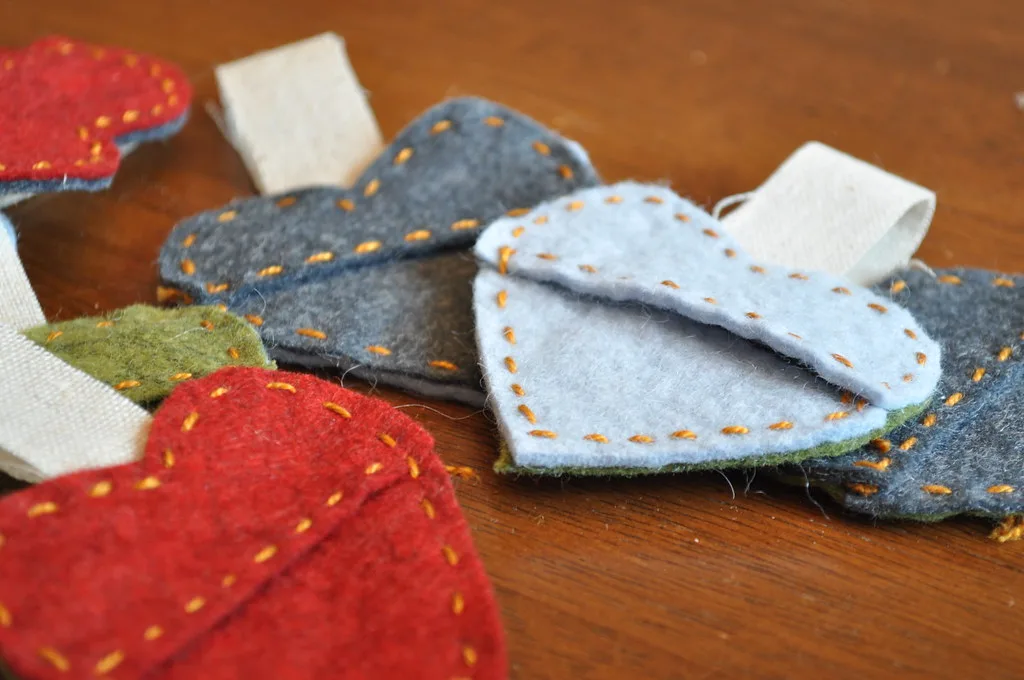
- Napkin rings, with a leaf sewn to a felt strip
- Table scatter for autumn, in three sizes and five colours
For leaves worked into the fabric of a scarf rather than made separately, see the autumn leaves knitting pattern and falling leaves. If you want leaves in wool without needles at all, needle felted flowers and foliage covers the felted equivalent.
Frequently asked questions
How do you knit a simple leaf shape?
Cast on three stitches and increase with a yarn over either side of a central stitch on every right-side row until you have thirteen. Then decrease one stitch at each edge on every right-side row until three remain, and finish with a central double decrease.
What yarn should I use for knitted leaves?
DK or worsted weight wool on needles a size smaller than the ball band suggests. The tighter fabric holds the leaf shape without curling. Pure wool blocks and holds its shape far better than acrylic.
How do you stop a knitted leaf curling?
Stocking stitch always curls. Either work the two edge stitches in garter stitch, or block the finished leaf: soak it, pin it flat to shape, and let it dry completely. Wool holds the blocked shape; acrylic does not.
How long does a knitted leaf take?
About ten minutes in DK weight once you have made one. A garland of a dozen is an evening.