Autumn Leaves Knitting Pattern: Free, Simple, Straight Needles
4 min read Beginner
One eleven-stitch repeat, one right-side row to remember, and every wrong-side row purled. It makes columns of leaves — or, with four plain rows between, leaves scattered across the fabric.
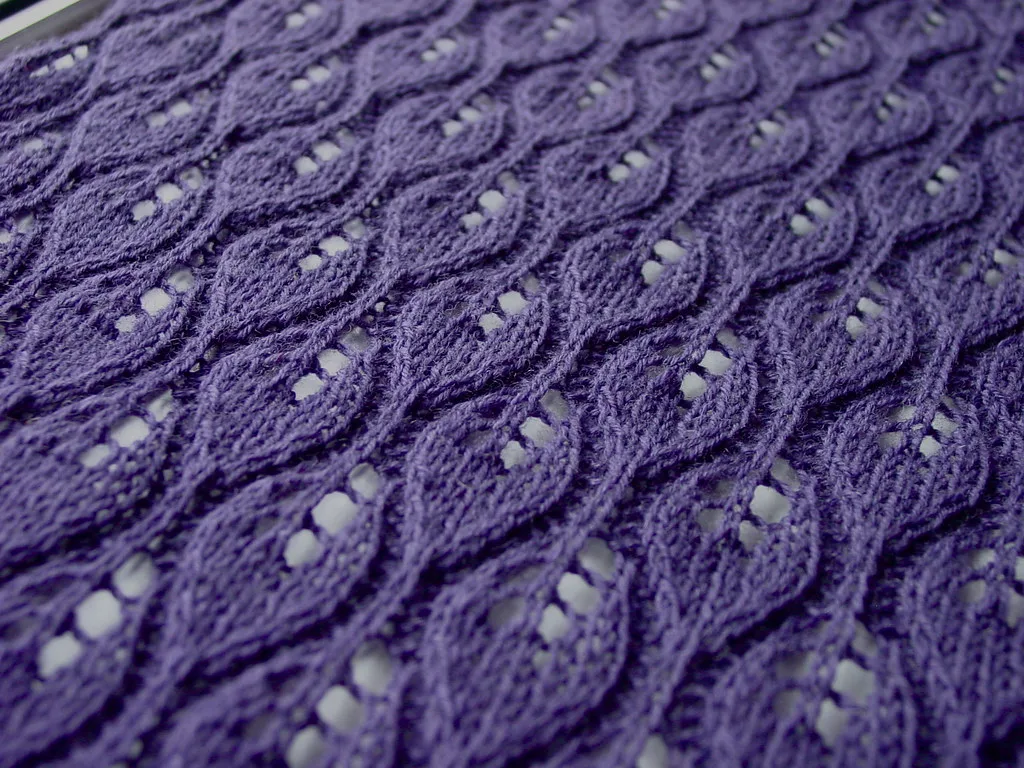
Most autumn leaf patterns are charted lace with a different instruction on every right-side row. This one is a single row repeated, which means you can knit it while talking to someone.
The stitch pattern
Multiple of 11 stitches.
- Row 1 (RS): *k2tog, k3, yo, k1, yo, k3, ssk* — repeat to end
- Row 2 (WS): purl
Repeat those two rows. That is the entire pattern.
The two decreases sit at the outside edges of each repeat and the two yarn overs sit either side of a central stitch. The fabric leans inward at the edges and opens in the middle, so each repeat grows into a pointed leaf shape with a vein of eyelets up the centre. Stitch count never changes: two stitches removed, two added, every row.
Abbreviations
- k2tog — knit two together; leans right
- ssk — slip, slip, knit; leans left
- yo — yarn over
If ssk is unfamiliar, k2tog through the back loop works in its place and looks nearly identical.
A scarf, from cast-on to cast-off
You need: 200 g DK wool, 4 mm straight needles. Finished size about 20 × 160 cm.
- Cast on 48 stitches (4 repeats of 11, plus 4 edge stitches).
- Work 6 rows in garter stitch (knit every row) so the end does not curl.
- Row 1 (RS): k2, *k2tog, k3, yo, k1, yo, k3, ssk* four times, k2.
- Row 2 (WS): k2, purl to last 2 stitches, k2.
- Repeat rows 1 and 2 until the scarf is 5 cm short of the length you want.
- Work 6 rows garter stitch and cast off loosely.
Cast off in pattern or one needle size up. A tight cast-off pulls the top edge in and spoils the drape of everything below it.
The scattered leaves variation
Continuous columns read as a vine. To get separate leaves falling across the fabric instead:
- Work rows 1–2 four times (8 rows of lace).
- Work 4 rows of plain stocking stitch — knit on RS, purl on WS, keeping the garter edges.
- Repeat.
For leaves that are offset rather than stacked, shift the repeat by 5 stitches after each plain section: work k2, k5, then start the repeat, and adjust the end of the row to match. Offsetting is what makes a scatter look natural rather than tiled.
Yarn and needles
- Wool, not acrylic. Lace only looks like lace after blocking, and acrylic will not hold a block.
- Smooth, plain colours. Variegated yarn hides the leaf shapes completely. If you want autumn colour, use a slow-changing gradient rather than a short-repeat multicolour.
- Needles a size larger than the ball band suggests. Lace wants an open fabric.
- Fingering weight on 3.5 mm for a fine shawl-like scarf; DK on 4.5 mm for something quicker.
Blocking
Unblocked, this pattern looks like a slightly wonky rib. Blocked, the leaves open. It is not optional.
- Soak 15 minutes in cool water with wool wash.
- Roll in a towel and press out the water — never wring.
- Pin out flat, stretching firmly across the width until the eyelets open, and pull the edges straight.
- Dry completely before unpinning, which takes overnight.
Other things to make with it
- Cushion front — 3 repeats wide, worked to a square, backed with felt or fabric.
- Table runner — 2 repeats wide, blocked hard.
- Hat brim — 8 rows of the lace before switching to rib and stocking stitch.
- Wrist warmers — 2 repeats worked flat and seamed, with a thumb gap left open.
Where to go next
For separate leaves you can sew on, string into a garland or use as appliqué, the standalone pattern is in how to knit a leaf — twenty-one rows each, ten minutes apiece.
For larger pieces built on the same repeat, including a triangular shawl worked from the top down, see the falling leaves knitting pattern. If you are knitting leaves at the turn of the year, the reason they are that colour in the first place is in why leaves fall. And if you want the finished fabric thick and cuttable rather than lacy, knitting it loosely in pure wool and fulling it is covered in felting in knitting — though note that felting closes the eyelets, so the leaves become texture rather than lace.
Frequently asked questions
Is there a simple autumn leaves pattern for straight needles?
Yes. The repeat below is 11 stitches wide with a single right-side row to memorise — k2tog, k3, yo, k1, yo, k3, ssk — and every wrong-side row purled. It works flat on two straight needles with no charts.
How many stitches do I cast on?
Any multiple of 11, plus 4 for garter edges. A scarf is usually 3 or 4 repeats: 37 or 48 stitches in DK weight on 4 mm needles.
Does the stitch count change during the pattern?
No. Each repeat has two decreases and two increases in the same row, so the count is the same on every row. That makes it much easier to keep track of than most lace.
Can I make individual leaves instead of columns?
Yes. Work eight rows of the lace, then four rows of plain stocking stitch, and repeat. The plain rows break the columns so each group reads as a separate leaf.