Felt Wall Panels and Tiles: What They Do for Echo, and What They Cannot
8 min read
We may earn a commission from links on this page, at no extra cost to you. As an Amazon Associate I earn from qualifying purchases. Learn more.
Most felt wall panels and felt wall tiles are 9 mm polyester (PET) felt. They take the hard edge off an echoing room, mostly in the speech range, but they do not soundproof. How acoustic felt panels work, how much wall to cover, how to mount them without wrecking the paint, and when wool felt is worth it.
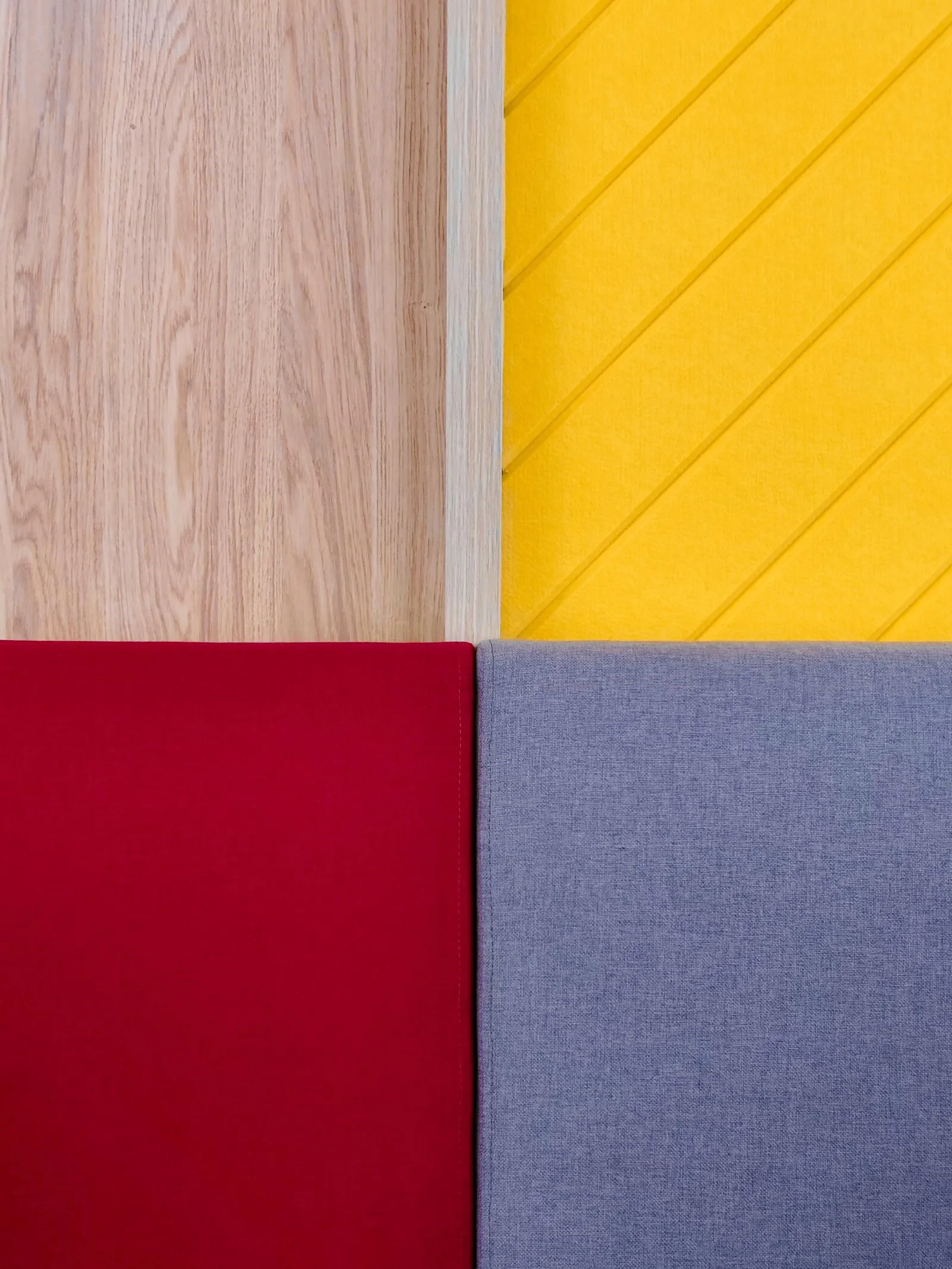
Clap once in an empty room with bare walls and a hard floor and you hear the problem felt wall panels are sold to fix: a quick, bright ring that hangs in the air, or a fluttering buzz between two parallel walls. Felt panels absorb some of that reflected sound instead of bouncing it back, and in a home office, a stairwell or a room full of hard modern finishes, enough of them make speech clearer and the room quieter to be in.
Nearly all of the felt wall panels and felt wall tiles on sale are polyester felt about 9 mm (⅜ in) thick, cut into squares, hexagons, long boards or pressed patterns. That material, its thickness and how much of the wall it covers decide almost everything about how well it works.
What felt panels do, and what they do not
Two different problems get called "noise", and felt panels only solve one of them.
- Echo and reverberation inside a room. Sound bouncing off hard surfaces, making voices boomy, video calls hollow and a room feel loud. Porous materials like felt absorb some of that energy. This is what panels are for.
- Sound passing through walls. A neighbor's television, a barking dog next door. Stopping it takes mass, airtight construction and decoupled layers: extra drywall, sealed gaps, resilient mounting. A light, porous sheet of felt changes it very little.
Listings sometimes blur this by calling acoustic panels "soundproof panels". If your problem is the second one, felt panels will be a disappointment however many you buy.
How well they absorb
Absorption depends on frequency. A thin porous layer works best on short, high-frequency sound waves and progressively less on longer, lower ones. A 9 mm felt panel glued flat to drywall does most of its work in the upper mids and highs: the hiss of consonants, clattering dishes, the bright ring of a clap. It does very little for the low hum of traffic or bass from a speaker.
The usual number on a listing is the NRC, or noise reduction coefficient: an average of absorption at four frequencies from 250 to 2,000 Hz, on a scale from 0 (reflects everything) to 1 (absorbs everything). Thin felt panels mounted flat are commonly quoted somewhere around 0.2 to 0.4. Thick mineral wool or fiberglass panels of about 2 in can reach around 0.8 to 1. Two things to check:
- How the panel was mounted in the test. A panel tested with an air gap behind it scores higher than the same panel flat on the wall. A high NRC for a thin panel usually means a gap.
- Whether the figure is for the panel at all. Some listings quote a figure for the raw felt material in its thickest form, not the tile you are buying.
Getting more from thin panels
- Leave an air gap. Mounting a 9 mm panel on battens or spacers an inch or two off the wall improves absorption in the lower mids noticeably. Many large panels are designed to be hung this way.
- Go thicker. Felt panels of 12 mm and up, or felt wrapped over a thicker absorbent core, reach lower.
- Cover more area. Absorption adds up roughly with the area treated. Doubling the panel area does more than buying fancier panels.

How much wall to cover, and where
A cluster of six hexagons on one wall is decoration. It may take the edge off a small room, but in an ordinary living room it is too little surface to hear. As a rough guide, people start to notice a real change once a fair share of the bare wall area, often quoted as somewhere between a fifth and a third, is covered with absorbent material, counting rugs, curtains and soft furniture as part of the total.
Placement matters more than total area when the area is small.
- Parallel bare walls. Two hard, facing walls produce flutter echo, the buzzing ring after a clap. Treating one of them, at ear height, removes most of it.
- Behind and in front of a desk. For video calls, the wall you face and the wall behind you send your voice back into the microphone. Panels there make the biggest difference to how you sound.
- Side-wall reflection points. For listening to music, the spot on each side wall where a mirror would show you the speaker.
- Ear height first. Panels near the ceiling look tidy but do less than the same panels between about 3 and 6 ft from the floor.
A soft floor does a lot of the same job. A rug with a felt pad under it absorbs reflections from the largest hard surface in most rooms, and felt rug pads add to it.
The kinds you will find
Square and rectangular tiles
Usually around 12 in (30 cm) square, 9 mm thick, in sets meant to be laid edge to edge as a grid or a checkerboard of colors. Easy to align and to extend later. Many are cut with beveled edges so the joints read as a pattern rather than gaps.
Hexagons
The most popular decorative shape: hexagonal felt tiles about a foot across, arranged in clusters or honeycomb runs. They look good in small numbers, which is also why they so often go up in small numbers that do not do much acoustically.
Large boards and sheets
Panels of 2 × 4 ft and bigger, and sheets up to around 4 × 8 ft, used in offices and studios. Fewer joints, faster to hang, and the most absorption per hour of work. They can be cut to fit and usually take a pin.
Pressed and grooved panels
Polyester felt can be heat-pressed into grooves, waves and raised geometric patterns. These are decorative first; the texture adds a little surface area but does not change the material.
Wood slat panels
Strips of wood or veneer mounted on a backing of black polyester felt, sold as acoustic slat panels. The felt behind the gaps does the absorbing; the wood scatters some reflections and is mostly there for looks. They are heavier and are usually screwed to the wall.
Polyester or wool felt
Polyester (PET) felt dominates for practical reasons: it is the cheaper material by a wide margin, colorfast, does not shed, does not attract moths, and cuts cleanly. It is often made partly from recycled bottles, and that is usually in the listing.
Wool felt panels exist and are a different class of product, sold mainly through architects and designers. Wool is denser, so a wool panel of the same thickness is heavier and absorbs slightly differently. It is naturally slower to ignite than most synthetics and tends to char rather than melt. It also costs far more, can fade in strong sun, and needs the same moth precautions as any wool in the house; see protecting wool from moths. For most homes, a well-placed PET panel does the job at a fraction of the cost.
The same wool-or-PET question comes up with a felt desk mat and with felt storage baskets, and the trade-offs are much the same.
Fire rating
Anything covering a large area of wall should have a stated fire performance. In the US, acoustic panels are commonly rated under ASTM E84, and many PET panels are sold as Class A, the best class under that test. If a listing gives no rating, treat that as a reason to buy elsewhere, especially for a bedroom, a stairwell or a child's room. In commercial spaces, local code decides what is allowed.
Hanging them
The adhesive pads included with many sets are the most common cause of regret. They hold well, and when the panels come down they often take paint, and sometimes the paper face of the drywall, with them. Better options, from removable mounting strips to battens, depend on the size of the panel and how long it will stay up.
- Removable mounting strips. The renter's choice. Use enough of them; a 9 mm square tile is light but a large board is not.
- Pins or small nails. A pin pushed through the felt into drywall vanishes into the surface and leaves a hole that a dab of filler hides. Good for tiles that might move later.
- Spray or construction adhesive. Permanent. Fine for a wall you will never want back bare.
- Battens, rails or cleats. For large panels and for an air gap behind them.
Plan the layout on paper or with painter's tape first, and use a laser level or a long spirit level for the first row. A grid that is a quarter-inch out of true at one end is obvious across a whole wall.
Cutting
Polyester felt of 9 mm cuts with a sharp utility knife and a straightedge, in three or four firm passes rather than one hard push. Change the blade often; a dull blade drags and leaves a ragged, fuzzy edge. Cut on a board or a cutting mat, not on the floor.
Living with them
- Dust. Vacuum with a soft brush attachment every few months. Felt holds dust rather than showing it, until you look closely.
- Marks. Spot clean with a damp cloth and a little mild detergent. Do not soak a panel on the wall.
- A pinboard bonus. Felt panels take push pins, so a panel behind a desk doubles as a noticeboard.
- Sun. Some dyed panels fade on a wall in direct sun. Rotate tiles if one area gets the light.
Decorative felt panels
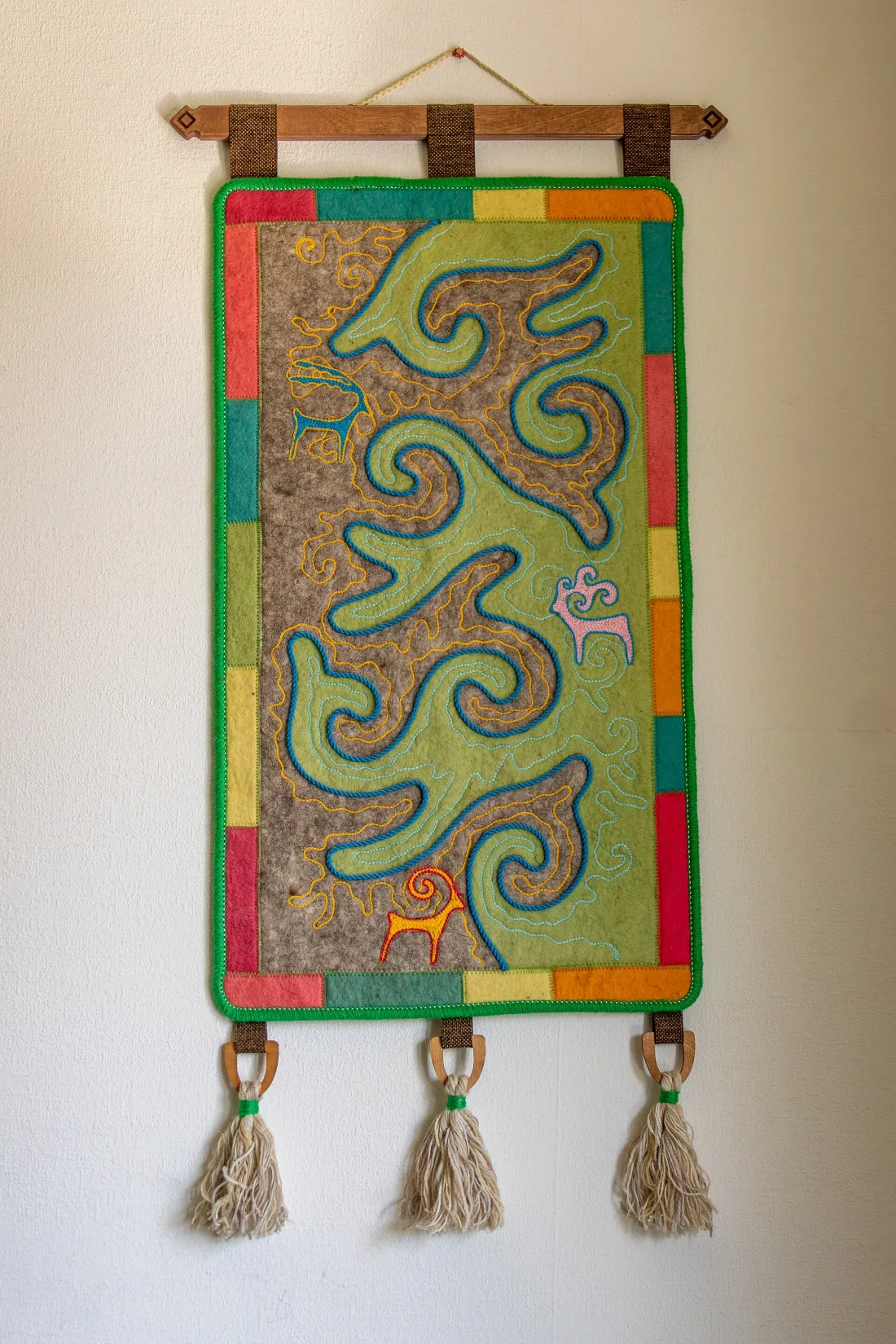
Long before acoustic tiles, felt went on walls as decoration. In Central Asia, felt panels and hangings with appliquéd and inlaid designs have been made for homes for a very long time, and the felt rugs and wall pieces of Kyrgyz and Kazakh makers are still sold widely. A handmade wool felt hanging is decoration first; it absorbs some sound like any soft surface, but one piece will not change a room's acoustics.
If you would rather make something than buy tiles, a wet felted wall panel is a good large project; wet felting art covers laying in a design, and felt ball rugs show another texture that works hung on a wall as well as on a floor.
Frequently asked questions
Do felt wall panels actually work?
For echo, yes, if you cover enough wall. They soak up reflected sound in the upper-mid and high range, which is where speech clarity, clatter and the ringing of an empty room live. A handful of tiles on one wall does little; panels covering a good part of the bare walls make a room noticeably calmer. They do not block sound passing to the next room.
Are felt panels soundproof?
No. Soundproofing means stopping sound from getting through a wall, and that takes mass, airtight construction and decoupled layers. A 9 mm felt panel weighs very little and is porous, so it absorbs sound inside the room but barely changes what the neighbors hear.
What are felt acoustic panels made of?
Most are polyester felt, often called PET felt, frequently made partly from recycled plastic bottles. It is cheap, colorfast, easy to cut and does not shed. Wool felt panels exist; they are denser and naturally slower to catch fire, but cost considerably more and are sold mostly to architects and designers.
How thick should acoustic felt panels be?
The common 9 mm (about ⅜ in) panels deal with high frequencies and the upper part of speech. For more effect in the lower mids, use thicker panels or mount thin ones with an air gap of an inch or two behind them. No felt panel of normal thickness does much for bass.
How do you hang felt wall panels without damaging the wall?
Use removable mounting strips or small pins rather than the permanent adhesive pads that often come in the box. Pins disappear into the felt and leave tiny holes. Strong double-sided tape can pull off paint and the paper face of drywall when the panel comes down.
Topics
Image credits
- Four wall surfaces meeting in a grid: light oak, a yellow panel with diagonal grooves pressed into it, a deep red panel and a blue-gray panel — Praylin Jerish (Pexels License)
- A podcast studio table with microphones on arms, headphones and a mixer, in front of a white wall dotted with black square acoustic foam tiles — Hc Digital (Pexels License)
- A handmade felt wall hanging from Kyrgyzstan with green, blue and gray swirling shapes, small animal figures and a multicolored border, hung from a wooden bar with three tassels — ElenaLitera (BY SA 4.0)