Carding Machine Parts: Every Component Named, in Order
4 min read
Fibre enters at the hopper and leaves as a web at the doffer. Between them sit the licker-in, the cylinder, the workers and strippers and the fancy — each doing one job to the fibre as it passes.
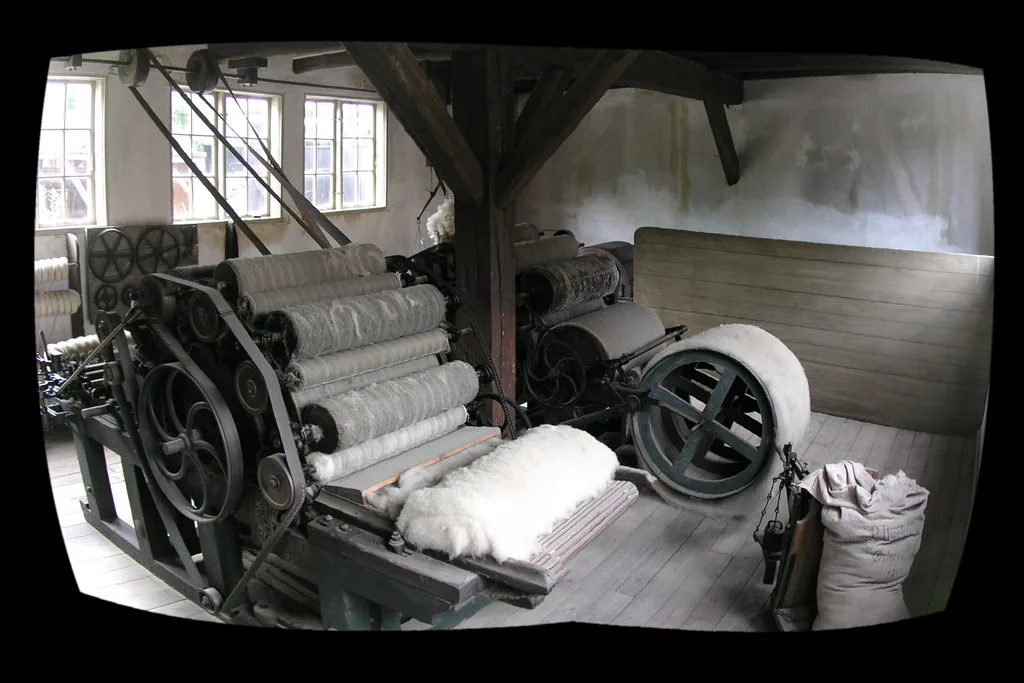
A carding machine has one job: to separate a mass of tangled fibre into individual fibres, remove what is not fibre, and deliver the result as an even web. Every component below exists to do one part of that, in sequence.
The feed end
- Hopper feeder / bale opener — takes compressed fibre and opens it into tufts, delivering at a controlled weight per minute.
- Chute feed — on modern lines, replaces the hopper by delivering fibre pneumatically as an even mat straight to the feed roller.
- Feed lattice / apron — the slatted conveyor carrying fibre into the machine.
- Weigh pan or autoleveller — measures the incoming mass and adjusts feed speed so the delivered web stays even.
- Feed roller — a fluted roller that grips the mat and advances it slowly.
- Feed plate (nose bar) — the curved plate the feed roller presses against, holding the fibre while the licker-in pulls at it.
The opening section
- Licker-in (taker-in) — a fast roller clothed in saw-tooth wire that plucks tufts from the feed roller and opens them. Runs many times faster than the feed roller; that speed ratio is the opening action.
- Mote knives — blades set beneath the licker-in that intercept heavy trash, seed and vegetable matter thrown off by centrifugal force.
- Undercasing — the perforated screen under the licker-in and cylinder that collects droppings.
- Carding plates / stationary flats — fixed wire segments before and after the flats that add carding action without extra rollers.
The main carding section
- Main cylinder (swift) — the large central drum, typically 1–1.5 m across, clothed in fine wire. Everything else works against it.
- Flats — on a cotton card, a chain of narrow clothed bars travelling slowly over the top of the cylinder. The point-against-point action between flats and cylinder is the true carding, and it is where neps and short fibre are removed as flat strips.
- Flat stripping comb and brush — cleans the flats as they come round.
- Workers — on a woollen card, rollers set into the cylinder that lift fibre off it, hold it, and return it. Each worker/stripper pair is one carding point.
- Strippers — small rollers that take fibre from the worker and hand it back to the cylinder, redistributed.
- Fancy roller — clothed with long flexible wire that penetrates deeper than the cylinder wire and raises fibre to the surface so the doffer can take it. Woollen cards only.
- Angle stripper / burr beater — clears the fancy and removes remaining vegetable matter in wool processing.
The delivery end
- Doffer — a slow, large roller that strips the carded fibre off the cylinder as a thin web. Its slower surface speed is what condenses the fibre into a coherent sheet.
- Doffer comb — an oscillating comb that lifts the web cleanly off the doffer. Replaced on modern machines by a stripping roller pair.
- Web condenser / trumpet — gathers the wide web into a rope.
- Calender rollers — compress that rope into a sliver.
- Coiler — lays the sliver into a can in overlapping coils so it can be drawn off later without tangling.
- Condenser (woollen system) — instead of a single sliver, divides the web into many narrow strips and rubs each between oscillating leather aprons into a round slubbing, ready for the mule or ring frame.
- Cross-lapper — on a nonwoven line, folds the web into a multi-layer batt for needling. This is where felt production begins; see industrial felt machines.
Card clothing
Every working surface is covered in card clothing, and the specification of that wire matters more than any other single variable:
- Metallic wire — saw-tooth wire wound in a spiral. Standard for cylinder, licker-in and doffer.
- Flexible clothing — bent wire staples set in a fabric foundation. Traditional on flats and on woollen workers.
- Tooth angle, height, point density and rib width — chosen for the fibre. Wool takes coarser, taller wire than cotton.
- Grinding — clothing dulls and must be reground periodically. A dull card produces neps, and no setting adjustment compensates.
Settings that control quality
- Setting — the gap between cylinder and flats or workers, measured in thousandths of an inch. Closer settings card harder and risk fibre damage.
- Speed ratios — licker-in to feed roller controls opening; cylinder to doffer controls web weight.
- Production rate — pushing throughput degrades web evenness before anything else shows.
The hand-scale equivalent
A drum carder is the same machine with the parts removed: a licker-in, a main drum, and your hands doing the job of the doffer. Hand carders are two flats and nothing else. Everything an industrial card does with fifteen components, they do in several passes — which is why hand carding is slow and why the result is a batt rather than a sliver.
The hand process, and what it means for felting, is in carding wool by hand. What the carded output is called and how to buy it — tops, sliver, roving, batts — is in wool roving for felting and wool batting for felting.
Frequently asked questions
What are the main parts of a carding machine?
In order: hopper feeder, feed roller and feed plate, licker-in, main cylinder, flats or workers and strippers, fancy roller, doffer, doffer comb or stripping roller, and then either a condenser or calender rollers and a coiler into a can.
What does the licker-in do?
The licker-in, also called the taker-in, is the first fast roller. It pulls tufts from the feed roller, opens them into smaller tufts, and throws out heavy trash over the mote knives before passing the fibre to the main cylinder.
What is the difference between a woollen and a cotton card?
A cotton revolving flat card uses a moving chain of flats over the cylinder and delivers a sliver into a can. A woollen card uses workers and strippers instead of flats, often in two or three sections, and delivers either a batt or condensed slubbings for spinning.
What is card clothing?
The wire surface covering every working roller — fine angled steel teeth set in a foundation, either as metallic wire wound in a spiral or as flexible clothing set in fabric. The angle, height and density of those teeth is what actually does the carding.