Wool Slippers with Arch Support: What Actually Supports a Foot
3 min read
Most slippers advertised as supportive have a soft foam insole, which is the opposite of support. Three constructions genuinely hold an arch, and one of them you can fit yourself.
Softness and support are opposites. A foam that compresses flat under your body weight is not holding anything up; it just feels pleasant for the first ten seconds. Real support means a shaped surface that stays shaped.
The three constructions that actually work
- Cork-latex footbed. Firm, contoured, with a raised medial arch, a toe bar and a deep heel cup. It moulds to your foot over one to two weeks and then holds that shape for years. Birkenstock's construction, and used by several German and Austrian slipper makers.
- Moulded EVA or PU footbed. A shaped foam unit — not a flat sheet — with a defined arch. Lighter and softer than cork, less durable, and it flattens after a year or two of daily wear. This is what most "supportive" wool slippers use.
- Removable insole plus your own orthotic. The most reliable option if you already have prescribed orthotics: the slipper only has to provide depth, a firm base and a heel that holds.
What does not support anything
- Memory foam. Comfortable, and it compresses to nothing under an arch within seconds.
- A thick wool felt insole. Warm and cushioning; it flattens.
- Sheepskin lining. Insulation, not structure.
- Backless mules. Without a heel counter the foot slides forward and the toes grip to hold the slipper on, which is what aggravates plantar fasciitis in the first place.
How to judge one before buying
- Press the arch area with your thumb. If it flattens easily, it will flatten under a foot.
- Squeeze the heel cup. A supportive slipper has a stiffened counter that does not collapse between finger and thumb.
- Twist the slipper. It should resist. A slipper you can wring like a cloth has no midfoot structure.
- Look for a stated footbed material — cork, latex, moulded EVA. "Cushioned insole" describes foam.
- Check whether the insole lifts out. That alone doubles the useful life of the purchase.
The break-in problem
A cork footbed feels wrong for the first week. It is firm, the arch presses into a foot that is not used to being held, and people return them believing the size is wrong. The sequence that works:
- Wear for an hour a day for the first three or four days.
- Build to half a day by the end of week one.
- By week two the cork has taken an impression of your foot and the pressure spreads.
If the arch still hurts sharply after two weeks, the footbed is the wrong profile for your foot, not merely unbroken-in.
Wool, and what it is doing here
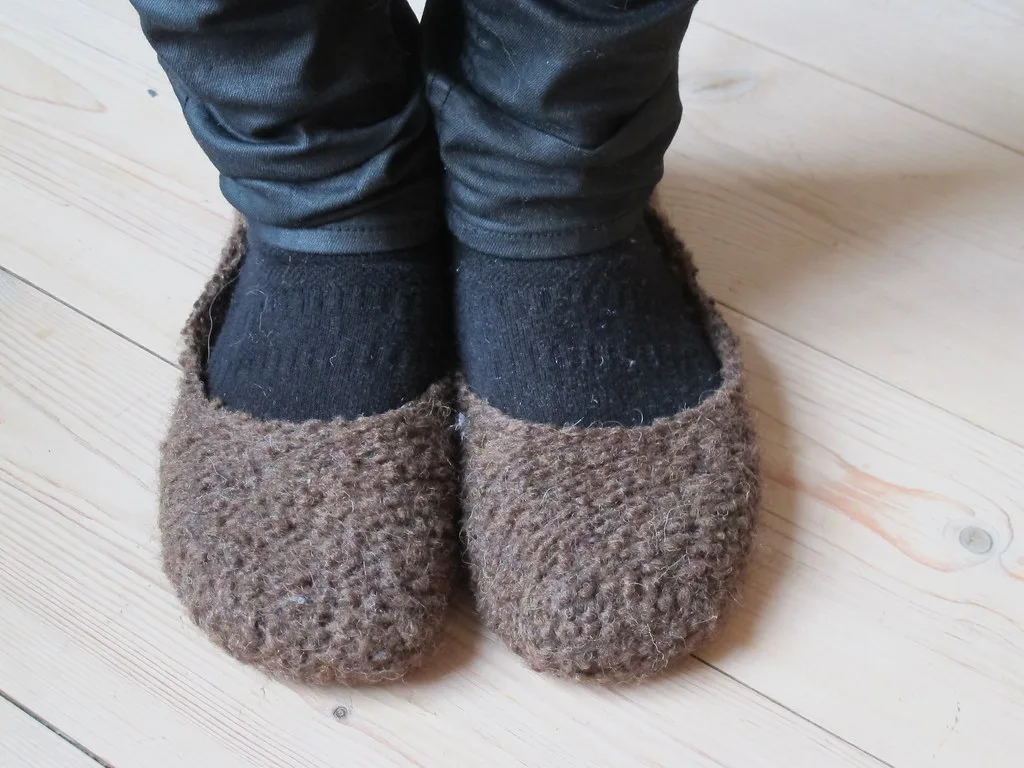
The wool upper is doing thermal and moisture work, not structural: it holds warmth without trapping sweat, which matters in a slipper worn all day. Boiled wool and wet-felted uppers both hold their shape around a structured footbed better than knitted fleece, which sags away from it.
What the wool grade means for durability is covered in best felt slippers, and the Nordic makes that use coarse hard-wearing fleece in Scandinavian wool slippers.
Fitting support into slippers you already own
If you have a pair you like that has no structure:
- Buy a firm three-quarter-length orthotic insole rather than a full-length foam one — it fits without lifting your heel out of the slipper.
- Remove any existing insole first; stacking two makes the slipper too tight, which cramps the toes and undoes the benefit.
- Trim to the outline of the original insole, not to your foot.
Felting your own gives you the depth to do this from the start — make them roomier than you would otherwise, and drop an orthotic in. The pattern and shrinkage allowance are in felted slippers.
Support is only half of it: a slipper with a good footbed and a bare felt underside still slides on a hard floor and wears through at the ball of the foot. The options, from latex dots to stitched-on leather, are in slipper soles.
None of this substitutes for a podiatrist if you have persistent heel or arch pain. A slipper can stop making a problem worse; it is not the treatment.
Frequently asked questions
Do wool slippers give arch support?
The wool does not — it is the footbed underneath it. A cork-latex or moulded EVA footbed with a raised medial arch supports the foot; a flat sheet of memory foam under wool does not, however soft it feels.
Are Allbirds wool slippers supportive?
They use a moulded foam footbed with a mild contour and a wool upper. That is more support than a flat slipper and considerably less than a cork footbed. For plantar fasciitis specifically, most people need something firmer.
What slipper is best for plantar fasciitis?
One with a firm contoured footbed, a slight heel raise and a rigid heel cup — the cork-latex construction, or a slipper with a removable insole so you can fit your own orthotic. Soft, flat and backless is the combination to avoid.
Can you put orthotics in wool slippers?
Only if the existing insole lifts out, and only if the slipper has depth to spare. Look for "removable footbed" in the description and buy half a size up to make room.