Cobweb Felting: How to Make a Cobweb Felted Scarf
4 min read Intermediate
We may earn a commission from links on this page, at no extra cost to you. As an Amazon Associate I earn from qualifying purchases. Learn more.
Cobweb felt is wool laid so thinly it has holes in it on purpose — lace-light, full of gaps, and the most forgiving advanced technique in wet felting.
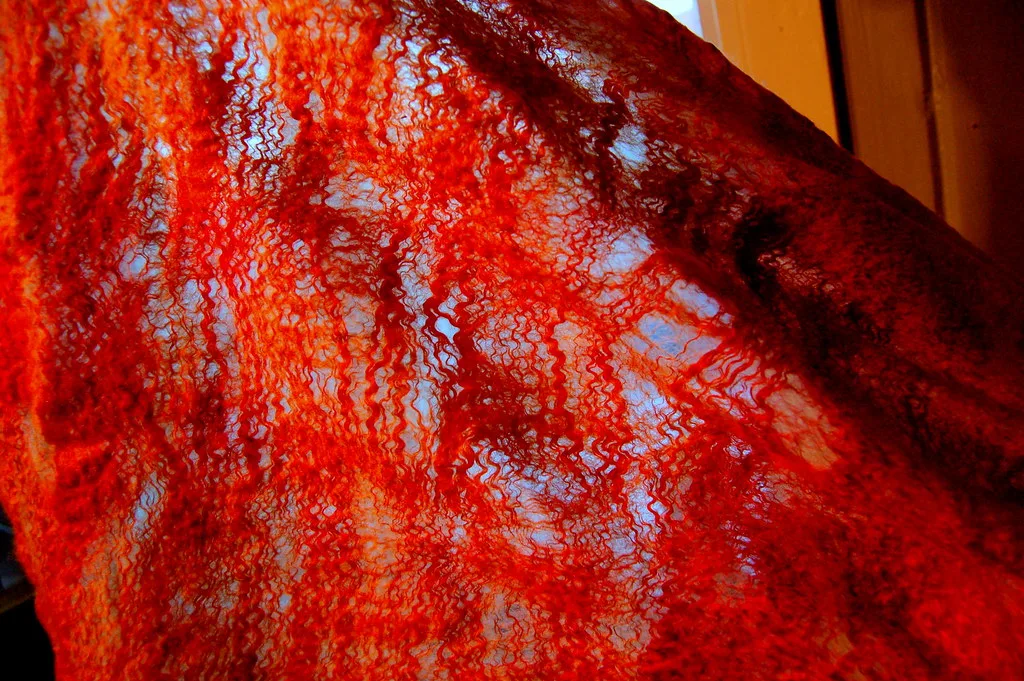
Cobweb felt is what happens when you lay wool out so thinly that it cannot form a continuous sheet. Instead of filling in, the fibres draw together into a web of connected threads with holes between them. It looks fragile and is surprisingly strong, and it weighs almost nothing.
Why it works
Wool shrinks as it felts. At normal thickness the sheet simply gets smaller and denser. At cobweb thickness there is not enough fibre to close the gaps, so as the wool contracts it gathers into strands and the holes open up rather than closing.
The technique is therefore an exercise in restraint. The mistake is always laying too much wool.
What you need
- Fine merino tops, 19 to 21 micron. 25 to 40 g for a full-length scarf
- Bubble wrap, longer than the finished piece
- Net curtain or fine tulle, large enough to cover the whole layout
- Warm soapy water, ideally in a squeezy bottle or a sprinkler
- A bamboo mat or a towel for rolling
- Optional: silk fibres, small pieces of silk fabric, or locks for texture
Coarse wool does not work here. It needs bulk to hold together and there is no bulk. Merino is effectively compulsory — see merino wool for felting.
Laying out
- Mark the size. Lay out about 35% larger than you want the finished scarf, so roughly 240 cm for a 180 cm scarf.
- Pull very thin wisps. Hold the tops loosely and draw fibre off in fine, almost transparent slivers. If you cannot see the bubble wrap through a wisp, it is too thick.
- Lay them in one direction with gaps of a centimetre or two between them.
- Second layer at right angles, equally thin, again with gaps.
- Look at it against the light. You should see holes everywhere and connections everywhere — a web, not a sheet with thin spots. Add wisps only where the wool is genuinely isolated.
Two crossed layers is the whole structure. Any third layer will close the holes.
Adding texture
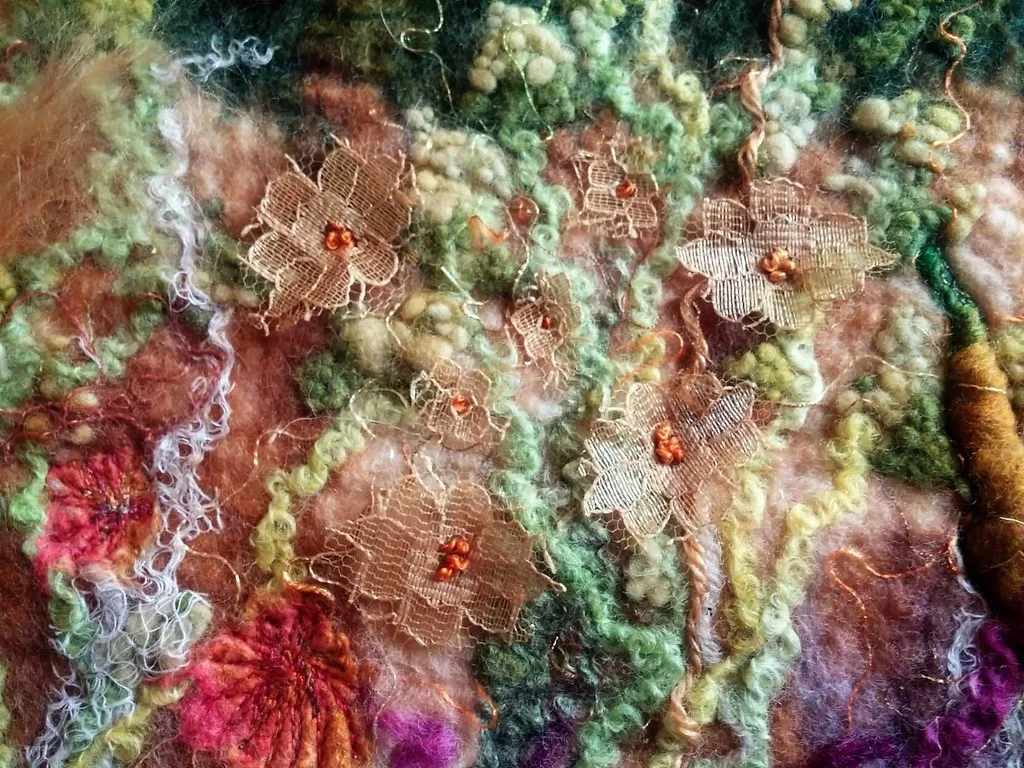
Cobweb felt is a natural background for silk. Lay silk fibres, small squares of chiffon or a few wool locks over the web before wetting and they felt in as accents. Because the base is so open, they read strongly.
This is also where cobweb work meets nuno felting — a cobweb layer over a whole length of silk gives a scarf with structure and openness at once.
Wetting and felting
- Cover with net before wetting. Not after. Unsupported wisps float away the moment water arrives.
- Wet gently through the net with warm soapy water. Sprinkle rather than pour.
- Press the air out with flat hands, working from the middle outwards.
- Rub through the net with very light pressure for ten to fifteen minutes. Much longer than a normal scarf, because there is so little fibre to grip.
- Peel the net back carefully, checking nothing lifts with it. If wool comes away, lay it back and rub longer.
Rolling
Roll in a bamboo mat, 50 rolls at a time, unroll, turn 90 degrees, repeat. Four or five rounds. Handle it as a flat package throughout — the danger is not the rolling but the unrolling and repositioning.
Stop when the strands hold firmly and the piece survives being lifted from one corner. Cobweb felt does not need the full fulling a solid scarf gets; it will keep tightening and the holes will keep opening.
Finishing
Rinse in cool water with a splash of vinegar to remove the soap, supporting the whole piece with both hands. Squeeze — never wring. Lay flat, stretch gently into shape while damp, and let it dry.
Steam pressing at the end flattens the strands and makes the web look deliberate rather than accidental.
What can go wrong
- No holes. Too much wool. Nothing to be done but call it a light scarf and lay thinner next time.
- Large tears. Wool laid too unevenly, leaving areas with no connection at all. Look against the light before wetting.
- It fell apart in the rinse. Under-felted. Cobweb needs more rubbing time than a solid piece, not less.
Other things to make with it
Wraps, shawls, lampshade covers over a wire frame, panels for framing, and open collars. Anywhere the light coming through the holes is part of the point. For a solid version of the same garment, see how to wet felt a scarf.
Frequently asked questions
What is cobweb felting?
Wet felting with the wool laid so thinly that gaps are left deliberately, producing an open, lacy fabric. The holes are the design rather than a mistake, and the finished cloth is extremely light.
How much wool do you need for a cobweb felted scarf?
Around 25 to 40 g for a scarf 180 cm long. A conventional wet felted scarf of the same size uses two to three times as much.
Which wool is best for cobweb felting?
Fine merino, 19 to 21 micron. Fine fibre spreads into thinner veils and grips itself well enough to hold together at low density. Coarse wool will not hold at cobweb thinness.
How do you stop cobweb felt from tearing?
Handle it flat and supported at every stage, never lift it wet without a net under it, and rub gently through covering for far longer than feels necessary before rolling. Almost every tear happens while moving the piece.